 Add to Chrome
 Add to Firefox
 Add to Edge
Learning When to Trust via Selective Context Preference Optimization
Aug 06, 2026
Language models increasingly condition their answers on external signals, and a single misleading one can turn a correct answer wrong. The obvious remedy, training models to resist such signals, hides a failure mode: a model that ignores all context looks robust yet is useless when the context is worth trusting. We recast the problem as selective trust and introduce MIST, a human-annotated benchmark that renders each reasoning item under four matched conditions (clean, misleading, correct-context, and irrelevant-context), together with SC2W, a paired metric counting how often a misleading signal flips a clean-correct answer to wrong. Across a comprehensive benchmark study, we observe that such a susceptibility is universal. We then propose SCOPE, which mines clean-correct/misleading-wrong failures and optimizes a standard Direct Preference Optimization (DPO) objective over matched preference pairs balanced equally across all four conditions, rather than over misleading items alone. Our approach substantially reduces SC2W on popular open-sourced models while preserving accuracy when the added context is clean, correct, or irrelevant. With this work, we argue that models should be judged on selective trust, not on resistance alone.

DualAnchor: Preserving Language Priors and Improving Lexical Fidelity in Gloss-Free Sign Language Translation
Jul 30, 2026Recent advances in large language models (LLMs) have led sign language translation (SLT), the task of converting sign-language videos into spoken-language text, to increasingly adopt LLMs as textual backbones. However, despite their strong language modeling capabilities, existing LLM-based SLT methods often undermine rather than exploit this language prior, producing disfluent translations, a failure we term language-prior degradation. Meanwhile, existing methods typically align videos and text at the sentence level, which does not ensure accurate lexical details and creates a lexical fidelity gap. To address both issues, we propose DualAnchor, a gloss-free LLM-based SLT training framework that couples two complementary anchors for linguistically fluent and visually faithful generation. Token-level Prior Anchoring (TPA) preserves the LLM's language prior by regularizing the multimodal decoder at each decoding step toward the next-token distribution of a frozen LLM conditioned on the same autoregressive prefix. Optimal Transport Alignment (OTA) improves lexical fidelity by formulating visual-textual matching as entropy-regularized partial optimal transport, with Sinkhorn optimization inducing a soft alignment between visual tokens and textual content tokens under a cosine cost. DualAnchor achieves strong overall performance on both PHOENIX-2014T and CSL-Daily. Targeted analyses attribute these gains to the complementary effects of the two anchors: TPA improves fluency, whereas OTA reduces fine-grained lexical errors.
Think, Plan, Paint: Layout-Aware Reasoning for Controllable Image Generation in Unified Models
Jul 17, 2026Unified Multimodal Large Language Models (MLLMs) offer a promising paradigm for unifying visual understanding and generation, yet they still struggle to follow complex spatial instructions and logical constraints in controllable image generation. To address this gap, we present ATLAS, a unified framework that equips MLLMs with a human-like "Think, Plan, and Paint" paradigm. We adopt layout as the shared representation that connects the three stages, enabling the model to reason about spatial requirements, plan explicit object arrangements, and render the final image. We further improve plan-to-image fidelity with reinforcement-learning-based layout alignment. We instantiate ATLAS at 7B and 80B scales, achieving state-of-the-art performance among MLLMs on image generation benchmarks and an average 65.31% improvement over existing layout-based unified MLLMs. On spatially related tasks, ATLAS obtains an average 23.06% gain over the base models. Through the same layout interface, ATLAS also supports instruction-guided editing and multimodal grounding. We further introduce ATLAS-Reasoning, a benchmark for evaluating generation under complex spatial instructions.
One Framework for All: Cross-Modal Membership Inference for Generative Models
Jul 05, 2026Large generative models across text-to-text, text-to-image, and image-to-text modalities have been shown to pose significant privacy risks. One fundamental threat is membership inference attacks (MIA), which aim to determine whether a given data point was used in a model's training set. Although prior work has investigated MIAs against these three classes of generative models, existing approaches treat them in isolation and are not cross-applicable, thereby limiting their real-world utility. To address this limitation, we present the first comprehensive study of a unified membership inference framework that applies across text-to-text, text-to-image, and image-to-text modalities. Our approach is grounded in a key modality-agnostic observation: the output distribution of a generative model can approximate its training data distribution. Leveraging this property, we model the distributions of model-generated outputs and auxiliary non-member samples in a shared embedding space, and perform membership inference via likelihood ratio testing. We conduct extensive experiments in a strict black-box setting under both partial-knowledge and zero-knowledge threat models, and evaluate membership inference against both fine-tuning and pre-training data. Experimental results demonstrate our approach's superior performance in comparison to existing state-of-the-art methods, which are typically optimized for a single model class.
FL-Sailer: Efficient and Privacy-Preserving Federated Learning for Scalable Single-Cell Epigenetic Data Analysis via Adaptive Sampling
May 06, 2026Single-cell ATAC-seq (scATAC-seq) enables high-resolution mapping of chromatin accessibility, yet privacy regulations and data size constraints hinder multi-institutional sharing. Federated learning (FL) offers a privacy-preserving alternative, but faces three fundamental barriers in scATAC-seq analysis: ultra-high dimensionality, extreme sparsity, and severe cross-institutional heterogeneity. We propose FL-Sailer, the first FL framework designed for scATAC-seq data. FL-Sailer integrates two key innovations: (i) adaptive leverage score sampling, which selects biologically interpretable features while reducing dimensionality by 80%, and (ii) an invariant VAE architecture, which disentangles biological signals from technical confounders via mutual information minimization. We provide a convergence guarantee, showing that FL-Sailer converges to an approximate solution of the original high-dimensional problem with bounded error. Extensive experiments on synthetic and real epigenomic datasets demonstrate that FL-Sailer not only enables previously infeasible multi-institutional collaborations but also surpasses centralized methods by leveraging adaptive sampling as an implicit regularizer to suppress technical noise. Our work establishes that federated learning, when tailored to domain-specific challenges, can become a superior paradigm for collaborative epigenomic research.
WASD: Locating Critical Neurons as Sufficient Conditions for Explaining and Controlling LLM Behavior
Mar 19, 2026Precise behavioral control of large language models (LLMs) is critical for complex applications. However, existing methods often incur high training costs, lack natural language controllability, or compromise semantic coherence. To bridge this gap, we propose WASD (unWeaving Actionable Sufficient Directives), a novel framework that explains model behavior by identifying sufficient neural conditions for token generation. Our method represents candidate conditions as neuron-activation predicates and iteratively searches for a minimal set that guarantees the current output under input perturbations. Experiments on SST-2 and CounterFact with the Gemma-2-2B model demonstrate that our approach produces explanations that are more stable, accurate, and concise than conventional attribution graphs. Moreover, through a case study on controlling cross-lingual output generation, we validated the practical effectiveness of WASD in controlling model behavior.
SC-Arena: A Natural Language Benchmark for Single-Cell Reasoning with Knowledge-Augmented Evaluation
Feb 26, 2026Large language models (LLMs) are increasingly applied in scientific research, offering new capabilities for knowledge discovery and reasoning. In single-cell biology, however, evaluation practices for both general and specialized LLMs remain inadequate: existing benchmarks are fragmented across tasks, adopt formats such as multiple-choice classification that diverge from real-world usage, and rely on metrics lacking interpretability and biological grounding. We present SC-ARENA, a natural language evaluation framework tailored to single-cell foundation models. SC-ARENA formalizes a virtual cell abstraction that unifies evaluation targets by representing both intrinsic attributes and gene-level interactions. Within this paradigm, we define five natural language tasks (cell type annotation, captioning, generation, perturbation prediction, and scientific QA) that probe core reasoning capabilities in cellular biology. To overcome the limitations of brittle string-matching metrics, we introduce knowledge-augmented evaluation, which incorporates external ontologies, marker databases, and scientific literature to support biologically faithful and interpretable judgments. Experiments and analysis across both general-purpose and domain-specialized LLMs demonstrate that (i) under the Virtual Cell unified evaluation paradigm, current models achieve uneven performance on biologically complex tasks, particularly those demanding mechanistic or causal understanding; and (ii) our knowledge-augmented evaluation framework ensures biological correctness, provides interpretable, evidence-grounded rationales, and achieves high discriminative capacity, overcoming the brittleness and opacity of conventional metrics. SC-Arena thus provides a unified and interpretable framework for assessing LLMs in single-cell biology, pointing toward the development of biology-aligned, generalizable foundation models.
Focus-LIME: Surgical Interpretation of Long-Context Large Language Models via Proxy-Based Neighborhood Selection
Feb 04, 2026As Large Language Models (LLMs) scale to handle massive context windows, achieving surgical feature-level interpretation is essential for high-stakes tasks like legal auditing and code debugging. However, existing local model-agnostic explanation methods face a critical dilemma in these scenarios: feature-based methods suffer from attribution dilution due to high feature dimensionality, thus failing to provide faithful explanations. In this paper, we propose Focus-LIME, a coarse-to-fine framework designed to restore the tractability of surgical interpretation. Focus-LIME utilizes a proxy model to curate the perturbation neighborhood, allowing the target model to perform fine-grained attribution exclusively within the optimized context. Empirical evaluations on long-context benchmarks demonstrate that our method makes surgical explanations practicable and provides faithful explanations to users.
Towards Budget-Friendly Model-Agnostic Explanation Generation for Large Language Models
May 18, 2025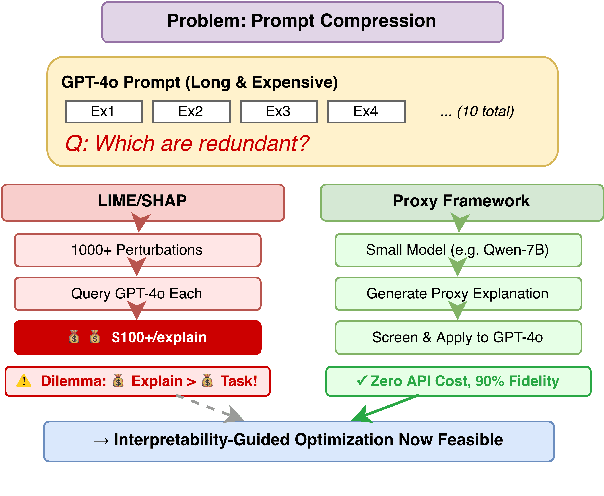
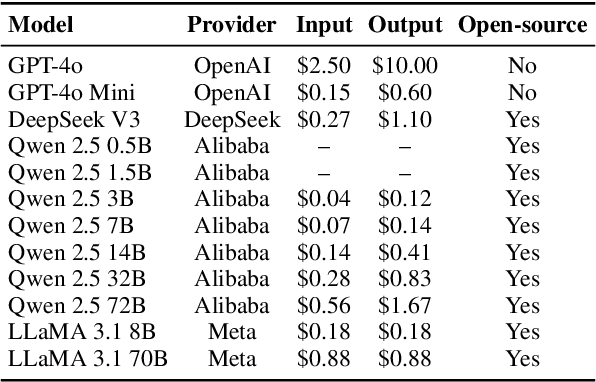
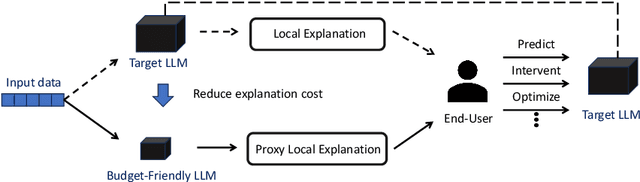
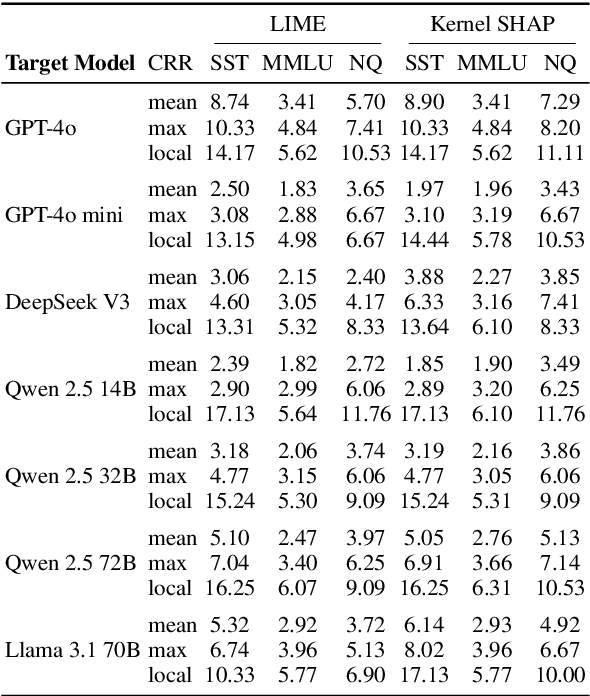
With Large language models (LLMs) becoming increasingly prevalent in various applications, the need for interpreting their predictions has become a critical challenge. As LLMs vary in architecture and some are closed-sourced, model-agnostic techniques show great promise without requiring access to the model's internal parameters. However, existing model-agnostic techniques need to invoke LLMs many times to gain sufficient samples for generating faithful explanations, which leads to high economic costs. In this paper, we show that it is practical to generate faithful explanations for large-scale LLMs by sampling from some budget-friendly models through a series of empirical studies. Moreover, we show that such proxy explanations also perform well on downstream tasks. Our analysis provides a new paradigm of model-agnostic explanation methods for LLMs, by including information from budget-friendly models.
Single-Cell Omics Arena: A Benchmark Study for Large Language Models on Cell Type Annotation Using Single-Cell Data
Dec 03, 2024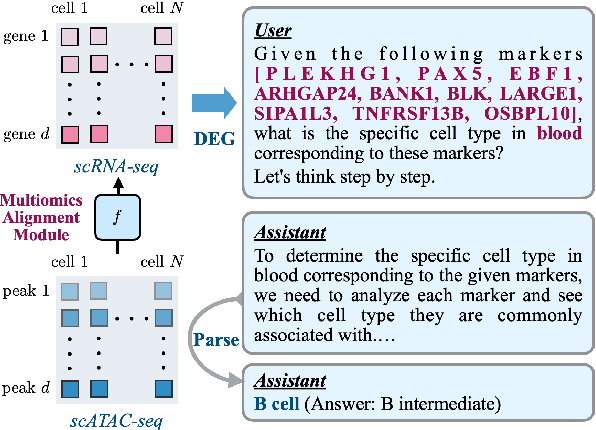
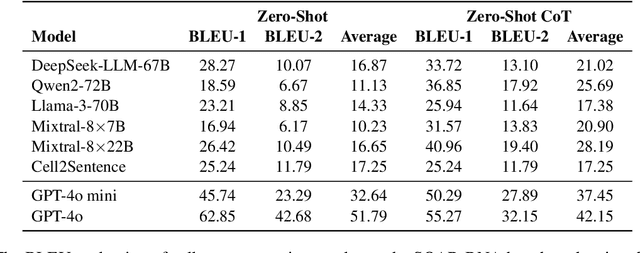

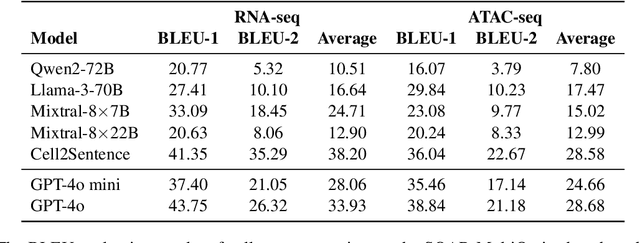
Over the past decade, the revolution in single-cell sequencing has enabled the simultaneous molecular profiling of various modalities across thousands of individual cells, allowing scientists to investigate the diverse functions of complex tissues and uncover underlying disease mechanisms. Among all the analytical steps, assigning individual cells to specific types is fundamental for understanding cellular heterogeneity. However, this process is usually labor-intensive and requires extensive expert knowledge. Recent advances in large language models (LLMs) have demonstrated their ability to efficiently process and synthesize vast corpora of text to automatically extract essential biological knowledge, such as marker genes, potentially promoting more efficient and automated cell type annotations. To thoroughly evaluate the capability of modern instruction-tuned LLMs in automating the cell type identification process, we introduce SOAR, a comprehensive benchmarking study of LLMs for cell type annotation tasks in single-cell genomics. Specifically, we assess the performance of 8 instruction-tuned LLMs across 11 datasets, spanning multiple cell types and species. Our study explores the potential of LLMs to accurately classify and annotate cell types in single-cell RNA sequencing (scRNA-seq) data, while extending their application to multiomics data through cross-modality translation. Additionally, we evaluate the effectiveness of chain-of-thought (CoT) prompting techniques in generating detailed biological insights during the annotation process. The results demonstrate that LLMs can provide robust interpretations of single-cell data without requiring additional fine-tuning, advancing the automation of cell type annotation in genomics research.