 Add to Chrome
 Add to Firefox
 Add to Edge
When Is Shallow Enough? Adaptive Split Federated Learning with Client-Specific Sufficiency Estimation
Aug 16, 2026
\textit{Split Federated Learning} (SFL) enables distributed model training by splitting networks between the server and clients. However, under client heterogeneity, the conventional static split strategy may be suboptimal because clients can differ in data distributions, adaptation dynamics, and representation learning progress, making a single split point insufficient to accommodate client-specific training states. In this paper, we propose \textsc{FedSGA}, a \textbf{S}ufficiency-\textbf{G}uided \textbf{A}daptive split \textbf{Fed}erated learning framework that addresses this question through client-specific shallow sufficiency estimation. First, we introduce a client-specific adaptation channel based on private prompt tokens, which tracks local adaptation dynamics separately from the shared backbone and provides a lightweight signal for detecting whether client adaptation remains active. To further avoid repeated online probing over multiple candidate depths, we design a shallow sufficiency estimator that combines cross-client semantic alignment, temporal interface stability, and prompt-state variation to estimate whether the shallowest split is already sufficient. Finally, we introduce a split-compatible interface harmonization module that projects activations from different split depths into a shared semantic space, improving the comparability of heterogeneous client interfaces before server-side prediction. Extensive experiments on multiple heterogeneous benchmarks demonstrate the effectiveness of \textsc{FedSGA} in improving model performance compared with state-of-the-art methods while reducing unnecessary client-side computation.

One Graph, Multiple Gains: Single High-Quality Item-Item Graph for Multimodal Recommendation
Jul 27, 2026Multimodal recommendation leverages item multimodal features alongside collaborative signals to capture user preferences. While item-item graphs have become a key building block in advanced models, existing methods typically construct them with noisy similarity edges and limit their role to a single function of item-item representation propagation, leaving substantial potential untapped. In this paper, we propose IIMRec, a framework that constructs a single high-quality item-item graph during preprocessing and systematically reuses it across three stages of the recommendation pipeline: representation enhancement, interaction graph enhancement, and optimization enhancement. The graph is built by fusing semantic and co-occurrence signals, then refined via Neighborhood Consistency Edge Reweighting (NCER), which applies the triadic closure principle to amplify structurally reliable edges and suppress spurious ones. Once constructed, the graph is leveraged in three complementary ways: (1) Item-item propagation with a Residual II Gate (RIG) that adaptively controls per-item absorption of semantic neighborhood signals for representation enhancement; (2) A content-guided UI graph expansion that introduces virtual user-item edges through high-confidence semantic neighbors for interaction graph enhancement; (3) II-Neighbor BPR Augmentation (INA) that treats top neighbors of positive items as discounted soft positives for optimization enhancement. We provide theoretical analysis showing that NCER reduces the spectral noise-to-signal ratio, RIG converges to a non-degenerate gating regime, and INA yields a tighter generalization bound. Extensive experiments on four datasets demonstrate that IIMRec consistently outperforms state-of-the-art baselines while running faster and consuming less GPU memory, with particularly strong gains under cold-start and sparse-interaction conditions.
KeyFrame-Compass: Towards Comprehensive Evaluation of Keyframe-Conditioned Video Generation
Jul 15, 2026Video generation increasingly relies on keyframe-based workflows, where creators specify a sequence of reference images to guide generation. Although recent models support multi-keyframe conditioning, it remains unclear whether they can faithfully reproduce the prescribed keyframes while maintaining overall video quality. We present KeyFrame-Compass, the first comprehensive benchmark for evaluating keyframe-conditioned video generation. The benchmark contains 386 carefully curated samples spanning three application domains, two video structures, two prompt granularities, two conditioning formats, and four keyframe densities, enabling controlled analysis under diverse generation settings. We further introduce an automated evaluation framework that jointly measures keyframe execution and overall video quality. Specifically, we decompose keyframe execution into six complementary metrics covering presence, fidelity, temporal ordering, localization, persistence, and uniqueness, while assessing overall video quality through evidence-grounded MLLM judgments augmented with specialized perception models. Experiments on nine representative video generation systems reveal several fundamental limitations. Current models exhibit a clear trade-off between faithful keyframe execution and natural video synthesis. Their performance further degrades as keyframe constraints become denser and most open-source models also fail to interpret storyboard-grid inputs as temporally ordered keyframe sequences.
Ling and Ring 2.6 Technical Report: Efficient and Instant Agentic Intelligence at Trillion-Parameter Scale
Jun 13, 2026Efficient and scalable agentic intelligence requires models that can deliver both low-latency responses and strong reasoning capabilities while remaining practical to train, serve, and deploy. In this report, we present Ling-2.6 and Ring-2.6, a family of models designed to address this challenge at scale. Ling-2.6 is optimized for instant response generation and high capability per output token, whereas Ring-2.6 is tailored for deeper reasoning and more advanced agentic workflows. Instead of training from scratch, we upgrade the Ling-2.0 base model through architectural migration pre-training and large-scale post-training. This upgrade is guided by a unified co-design of model architecture, optimization objectives, serving systems, and agent training environments, enabling improvements in both model capability and deployment efficiency. At the architectural level, we introduce a hybrid linear attention design that integrates Lightning Attention with MLA, improving the efficiency of long-context training and decoding. To further enhance token efficiency, we optimize capability per output token through Evolutionary Chain-of-Thought, Linguistic Unit Policy Optimization, bidirectional preference alignment, and shortest-correct-response distillation. For agentic capabilities, we propose KPop, a reinforcement learning framework designed to support stable training of Ring-2.6-1T on large-scale environment-grounded data. KPop improves training efficiency through asynchronous scheduling across coding, search, tool use, and workflow execution, enabling scalable learning from complex agent-environment interactions. Together, Ling-2.6 and Ring-2.6 provide a practical pathway toward efficient, scalable, and open agentic systems. We open-source all checkpoints in the 2.6 family to support further research and development in practical agentic intelligence.
FedSM: Robust Semantics-Guided Feature Mixup for Bias Reduction in Federated Learning with Long-Tail Data
Oct 31, 2025Federated Learning (FL) enables collaborative model training across decentralized clients without sharing private data. However, FL suffers from biased global models due to non-IID and long-tail data distributions. We propose \textbf{FedSM}, a novel client-centric framework that mitigates this bias through semantics-guided feature mixup and lightweight classifier retraining. FedSM uses a pretrained image-text-aligned model to compute category-level semantic relevance, guiding the category selection of local features to mix-up with global prototypes to generate class-consistent pseudo-features. These features correct classifier bias, especially when data are heavily skewed. To address the concern of potential domain shift between the pretrained model and the data, we propose probabilistic category selection, enhancing feature diversity to effectively mitigate biases. All computations are performed locally, requiring minimal server overhead. Extensive experiments on long-tail datasets with various imbalanced levels demonstrate that FedSM consistently outperforms state-of-the-art methods in accuracy, with high robustness to domain shift and computational efficiency.
Learning Speaker-Invariant Visual Features for Lipreading
Jun 09, 2025Lipreading is a challenging cross-modal task that aims to convert visual lip movements into spoken text. Existing lipreading methods often extract visual features that include speaker-specific lip attributes (e.g., shape, color, texture), which introduce spurious correlations between vision and text. These correlations lead to suboptimal lipreading accuracy and restrict model generalization. To address this challenge, we introduce SIFLip, a speaker-invariant visual feature learning framework that disentangles speaker-specific attributes using two complementary disentanglement modules (Implicit Disentanglement and Explicit Disentanglement) to improve generalization. Specifically, since different speakers exhibit semantic consistency between lip movements and phonetic text when pronouncing the same words, our implicit disentanglement module leverages stable text embeddings as supervisory signals to learn common visual representations across speakers, implicitly decoupling speaker-specific features. Additionally, we design a speaker recognition sub-task within the main lipreading pipeline to filter speaker-specific features, then further explicitly disentangle these personalized visual features from the backbone network via gradient reversal. Experimental results demonstrate that SIFLip significantly enhances generalization performance across multiple public datasets. Experimental results demonstrate that SIFLip significantly improves generalization performance across multiple public datasets, outperforming state-of-the-art methods.
Blend the Separated: Mixture of Synergistic Experts for Data-Scarcity Drug-Target Interaction Prediction
Mar 20, 2025Drug-target interaction prediction (DTI) is essential in various applications including drug discovery and clinical application. There are two perspectives of input data widely used in DTI prediction: Intrinsic data represents how drugs or targets are constructed, and extrinsic data represents how drugs or targets are related to other biological entities. However, any of the two perspectives of input data can be scarce for some drugs or targets, especially for those unpopular or newly discovered. Furthermore, ground-truth labels for specific interaction types can also be scarce. Therefore, we propose the first method to tackle DTI prediction under input data and/or label scarcity. To make our model functional when only one perspective of input data is available, we design two separate experts to process intrinsic and extrinsic data respectively and fuse them adaptively according to different samples. Furthermore, to make the two perspectives complement each other and remedy label scarcity, two experts synergize with each other in a mutually supervised way to exploit the enormous unlabeled data. Extensive experiments on 3 real-world datasets under different extents of input data scarcity and/or label scarcity demonstrate our model outperforms states of the art significantly and steadily, with a maximum improvement of 53.53%. We also test our model without any data scarcity and it still outperforms current methods.
HeTGB: A Comprehensive Benchmark for Heterophilic Text-Attributed Graphs
Mar 05, 2025Graph neural networks (GNNs) have demonstrated success in modeling relational data primarily under the assumption of homophily. However, many real-world graphs exhibit heterophily, where linked nodes belong to different categories or possess diverse attributes. Additionally, nodes in many domains are associated with textual descriptions, forming heterophilic text-attributed graphs (TAGs). Despite their significance, the study of heterophilic TAGs remains underexplored due to the lack of comprehensive benchmarks. To address this gap, we introduce the Heterophilic Text-attributed Graph Benchmark (HeTGB), a novel benchmark comprising five real-world heterophilic graph datasets from diverse domains, with nodes enriched by extensive textual descriptions. HeTGB enables systematic evaluation of GNNs, pre-trained language models (PLMs) and co-training methods on the node classification task. Through extensive benchmarking experiments, we showcase the utility of text attributes in heterophilic graphs, analyze the challenges posed by heterophilic TAGs and the limitations of existing models, and provide insights into the interplay between graph structures and textual attributes. We have publicly released HeTGB with baseline implementations to facilitate further research in this field.
Unifying Structured Data as Graph for Data-to-Text Pre-Training
Jan 02, 2024Data-to-text (D2T) generation aims to transform structured data into natural language text. Data-to-text pre-training has proved to be powerful in enhancing D2T generation and yields impressive performances. However, previous pre-training methods either oversimplified structured data into a sequence without considering input structures or designed training objectives tailored for a specific data structure (e.g., table or knowledge graph). In this paper, we unify different types of structured data (i.e., table, key-value data, knowledge graph) into the graph format and cast different data-to-text generation tasks as graph-to-text generation. To effectively exploit the structural information of the input graph, we propose a structure-enhanced pre-training method for D2T generation by designing a structure-enhanced Transformer. Concretely, we devise a position matrix for the Transformer, encoding relative positional information of connected nodes in the input graph. In addition, we propose a new attention matrix to incorporate graph structures into the original Transformer by taking the available explicit connectivity structure into account. Extensive experiments on six benchmark datasets show the effectiveness of our model. Our source codes are available at https://github.com/AlibabaResearch/DAMO-ConvAI/tree/main/unid2t.
Tenrec: A Large-scale Multipurpose Benchmark Dataset for Recommender Systems
Oct 20, 2022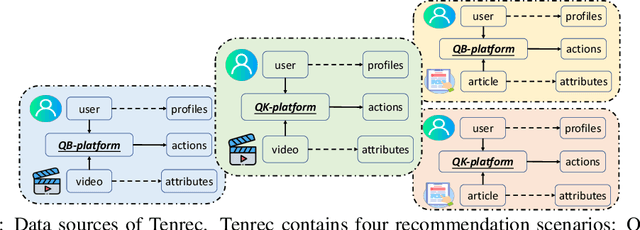
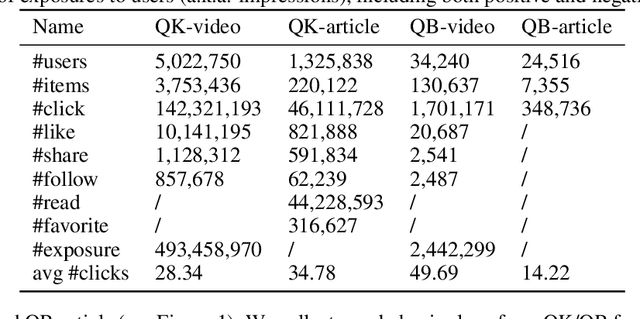
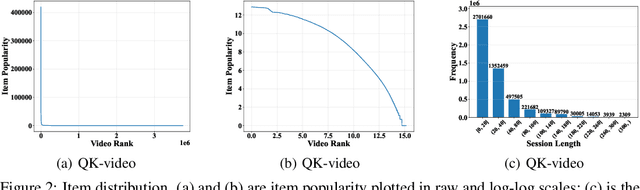
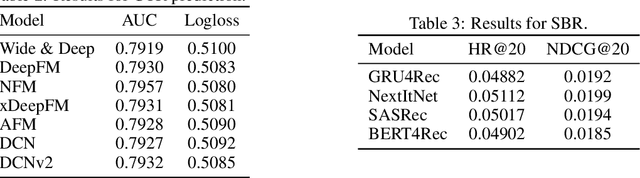
Existing benchmark datasets for recommender systems (RS) either are created at a small scale or involve very limited forms of user feedback. RS models evaluated on such datasets often lack practical values for large-scale real-world applications. In this paper, we describe Tenrec, a novel and publicly available data collection for RS that records various user feedback from four different recommendation scenarios. To be specific, Tenrec has the following five characteristics: (1) it is large-scale, containing around 5 million users and 140 million interactions; (2) it has not only positive user feedback, but also true negative feedback (vs. one-class recommendation); (3) it contains overlapped users and items across four different scenarios; (4) it contains various types of user positive feedback, in forms of clicks, likes, shares, and follows, etc; (5) it contains additional features beyond the user IDs and item IDs. We verify Tenrec on ten diverse recommendation tasks by running several classical baseline models per task. Tenrec has the potential to become a useful benchmark dataset for a majority of popular recommendation tasks.