 Add to Chrome
 Add to Firefox
 Add to Edge
Neural Tree Collaborative Filtering: Rethinking Graph Collaborative Filtering as Tree Collaborative Filtering with Curvature-Aware Propagation Depth
Aug 10, 2026
Graph Collaborative Filtering (GCF) has become the dominant paradigm in modern recommender systems by modeling user-item interactions as a bipartite graph and propagating embeddings through a fixed number of message-passing layers. However, applying a uniform propagation depth to every node ignores a fundamental property of real interaction graphs: nodes differ substantially in their local connectivity, so peripheral nodes quickly suffer from over-smoothing while hub-like nodes remain under-explored beyond their immediate neighborhood. In this paper, we revisit GCF from a tree-structured perspective and propose Neural Tree Collaborative Filtering (NTCF), a framework that re-interprets each node's local neighborhood as a rooted tree and assigns a node-specific propagation depth based on a closed-form local-degree-imbalance score that serves as a discrete Ricci-curvature proxy. We provide a theoretical analysis showing that (i) NTCF strictly generalizes NGCF, degenerating to NGCF when all curvature-induced depth adjustments vanish (a lower bound on its representation power), and (ii) the curvature-aware schedule retains strictly more discriminative information at deep layers on positively-curved (peripheral) nodes than uniform-depth propagation. NTCF can achieve higher performance than most widely used GCF backbone models and can be integrated into existing advanced self-supervised models as a backbone, replacing their original backbone to achieve enhanced performance. Extensive experiments on three public datasets demonstrate the superiority of NTCF.

One Graph, Multiple Gains: Single High-Quality Item-Item Graph for Multimodal Recommendation
Jul 27, 2026Multimodal recommendation leverages item multimodal features alongside collaborative signals to capture user preferences. While item-item graphs have become a key building block in advanced models, existing methods typically construct them with noisy similarity edges and limit their role to a single function of item-item representation propagation, leaving substantial potential untapped. In this paper, we propose IIMRec, a framework that constructs a single high-quality item-item graph during preprocessing and systematically reuses it across three stages of the recommendation pipeline: representation enhancement, interaction graph enhancement, and optimization enhancement. The graph is built by fusing semantic and co-occurrence signals, then refined via Neighborhood Consistency Edge Reweighting (NCER), which applies the triadic closure principle to amplify structurally reliable edges and suppress spurious ones. Once constructed, the graph is leveraged in three complementary ways: (1) Item-item propagation with a Residual II Gate (RIG) that adaptively controls per-item absorption of semantic neighborhood signals for representation enhancement; (2) A content-guided UI graph expansion that introduces virtual user-item edges through high-confidence semantic neighbors for interaction graph enhancement; (3) II-Neighbor BPR Augmentation (INA) that treats top neighbors of positive items as discounted soft positives for optimization enhancement. We provide theoretical analysis showing that NCER reduces the spectral noise-to-signal ratio, RIG converges to a non-degenerate gating regime, and INA yields a tighter generalization bound. Extensive experiments on four datasets demonstrate that IIMRec consistently outperforms state-of-the-art baselines while running faster and consuming less GPU memory, with particularly strong gains under cold-start and sparse-interaction conditions.
Multi-modal Dynamic Proxy Learning for Personalized Multiple Clustering
Nov 10, 2025Multiple clustering aims to discover diverse latent structures from different perspectives, yet existing methods generate exhaustive clusterings without discerning user interest, necessitating laborious manual screening. Current multi-modal solutions suffer from static semantic rigidity: predefined candidate words fail to adapt to dataset-specific concepts, and fixed fusion strategies ignore evolving feature interactions. To overcome these limitations, we propose Multi-DProxy, a novel multi-modal dynamic proxy learning framework that leverages cross-modal alignment through learnable textual proxies. Multi-DProxy introduces 1) gated cross-modal fusion that synthesizes discriminative joint representations by adaptively modeling feature interactions. 2) dual-constraint proxy optimization where user interest constraints enforce semantic consistency with domain concepts while concept constraints employ hard example mining to enhance cluster discrimination. 3) dynamic candidate management that refines textual proxies through iterative clustering feedback. Therefore, Multi-DProxy not only effectively captures a user's interest through proxies but also enables the identification of relevant clusterings with greater precision. Extensive experiments demonstrate state-of-the-art performance with significant improvements over existing methods across a broad set of multi-clustering benchmarks.
Squeeze and Excitation: A Weighted Graph Contrastive Learning for Collaborative Filtering
Apr 06, 2025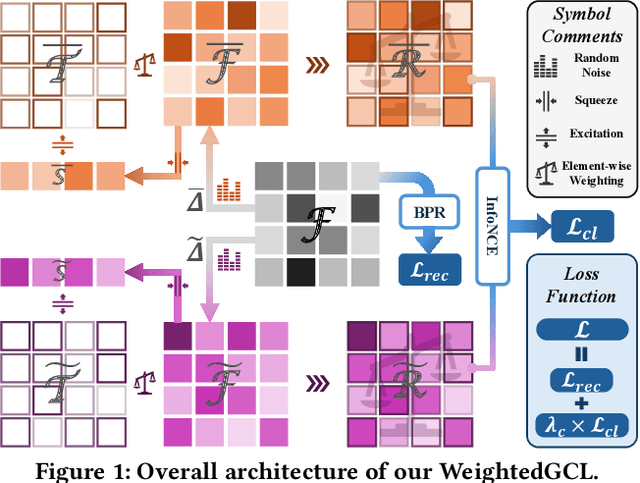
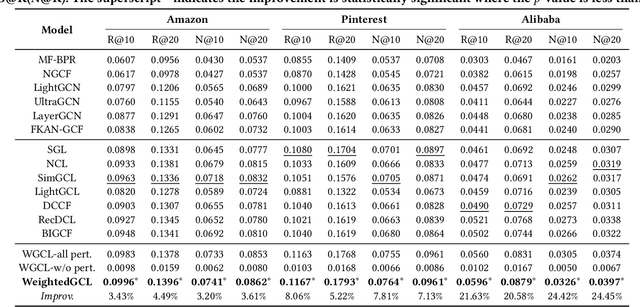
Contrastive Learning (CL) has recently emerged as a powerful technique in recommendation systems, particularly for its capability to harness self-supervised signals from perturbed views to mitigate the persistent challenge of data sparsity. The process of constructing perturbed views of the user-item bipartite graph and performing contrastive learning between perturbed views in a graph convolutional network (GCN) is called graph contrastive learning (GCL), which aims to enhance the robustness of representation learning. Although existing GCL-based models are effective, the weight assignment method for perturbed views has not been fully explored. A critical problem in existing GCL-based models is the irrational allocation of feature attention. This problem limits the model's ability to effectively leverage crucial features, resulting in suboptimal performance. To address this, we propose a Weighted Graph Contrastive Learning framework (WeightedGCL). Specifically, WeightedGCL applies a robust perturbation strategy, which perturbs only the view of the final GCN layer. In addition, WeightedGCL incorporates a squeeze and excitation network (SENet) to dynamically weight the features of the perturbed views. Our WeightedGCL strengthens the model's focus on crucial features and reduces the impact of less relevant information. Extensive experiments on widely used datasets demonstrate that our WeightedGCL achieves significant accuracy improvements compared to competitive baselines.