 Add to Chrome
 Add to Firefox
 Add to Edge
Rethinking Shrinkage Bias in LLM FP4 Pretraining: Geometric Origin, Systemic Impact, and UFP4 Recipe
Jun 18, 2026
FP4 training promises substantial reductions in memory and computation cost for LLM pretraining, yet current FP4 hardware paths and recipes, including NVIDIA Blackwell/Rubin-class systems and AMD MI350-series GPUs, remain centered on E2M1 data elements. In this study, we identify a fundamental limitation of that choice: non-uniform formats such as E2M1 inherently suffer from Shrinkage Bias, a systematic negative rounding error caused by the geometric asymmetry of their representable bins. We show that this bias accumulates multiplicatively across layers and is amplified by the Random Hadamard Transform (RHT), providing a unified explanation for the training instability observed in existing E2M1-based FP4 recipes. In contrast, uniform grids (E1M2/INT4) bypass this grid-geometry error and better convert the improved bucket utilization from RHT into higher quantization quality. Based on this finding, we propose UFP4, a uniform 4-bit training recipe that applies RHT to all three training GEMMs while restricting stochastic rounding to dY alone. On Dense 1.5B, MoE 7.9B, and MoE 124B long-run pretraining, UFP4 consistently achieves lower BF16-relative loss degradation than strong E2M1-based baselines, supported by scaling-law analysis and ablation studies. Our results suggest that future accelerators should support E1M2/INT4-style uniform 4-bit grids as first-class training primitives alongside E2M1.

Ling and Ring 2.6 Technical Report: Efficient and Instant Agentic Intelligence at Trillion-Parameter Scale
Jun 13, 2026Efficient and scalable agentic intelligence requires models that can deliver both low-latency responses and strong reasoning capabilities while remaining practical to train, serve, and deploy. In this report, we present Ling-2.6 and Ring-2.6, a family of models designed to address this challenge at scale. Ling-2.6 is optimized for instant response generation and high capability per output token, whereas Ring-2.6 is tailored for deeper reasoning and more advanced agentic workflows. Instead of training from scratch, we upgrade the Ling-2.0 base model through architectural migration pre-training and large-scale post-training. This upgrade is guided by a unified co-design of model architecture, optimization objectives, serving systems, and agent training environments, enabling improvements in both model capability and deployment efficiency. At the architectural level, we introduce a hybrid linear attention design that integrates Lightning Attention with MLA, improving the efficiency of long-context training and decoding. To further enhance token efficiency, we optimize capability per output token through Evolutionary Chain-of-Thought, Linguistic Unit Policy Optimization, bidirectional preference alignment, and shortest-correct-response distillation. For agentic capabilities, we propose KPop, a reinforcement learning framework designed to support stable training of Ring-2.6-1T on large-scale environment-grounded data. KPop improves training efficiency through asynchronous scheduling across coding, search, tool use, and workflow execution, enabling scalable learning from complex agent-environment interactions. Together, Ling-2.6 and Ring-2.6 provide a practical pathway toward efficient, scalable, and open agentic systems. We open-source all checkpoints in the 2.6 family to support further research and development in practical agentic intelligence.
SuperValid: Capability-Aligned OOD Validation for Generalizable Downstream Scaling
May 27, 2026Scaling laws guide large language model training by relating compute to cross-entropy loss, and recent work further extends them to predict downstream benchmark performance. However, prior approaches face generalization limitations from two aspects: focusing on benchmark-level performance introduces scenario-specific artifacts, while relying on IID validation loss fails to track capability improvements when training distributions vary. In this work, we argue that downstream scaling should be studied at the capability level, which captures shared skill factors across related tasks while abstracting away benchmark-specific noise. We propose SuperValid, a framework that synthesizes OOD (out-of-distribution), capability-aligned validation data by distilling core concepts from benchmarks within a capability domain and expanding them into diverse, knowledge-rich texts. Extensive experiments spanning 17 benchmarks grouped into 6 capability domains show that SuperValid loss exhibits strong and stable correlation with downstream performance across models of different architectures, scales, and training data distributions. As a training-free metric computable during training without benchmark evaluation, SuperValid enables effective model selection, early stopping, and scaling decisions.
Optimal Expert-Attention Allocation in Mixture-of-Experts: A Scalable Law for Dynamic Model Design
Mar 11, 2026This paper presents a novel extension of neural scaling laws to Mixture-of-Experts (MoE) models, focusing on the optimal allocation of compute between expert and attention sub-layers. As MoE architectures have emerged as an efficient method for scaling model capacity without proportionally increasing computation, determining the optimal expert-attention compute ratio becomes critical. We define the ratio $r$ as the fraction of total FLOPs per token dedicated to the expert layers versus the attention layers, and explore how this ratio interacts with the overall compute budget and model sparsity. Through extensive experiments with GPT-style MoE Transformers, we empirically find that the optimal ratio $r^*$ follows a power-law relationship with total compute and varies with sparsity. Our analysis leads to an explicit formula for $r^*$, enabling precise control over the expert-attention compute allocation. We generalize the Chinchilla scaling law by incorporating this architectural parameter, providing a new framework for tuning MoE models beyond size and data. Our findings offer practical guidelines for designing efficient MoE models, optimizing performance while respecting fixed compute budgets.
MergeMix: Optimizing Mid-Training Data Mixtures via Learnable Model Merging
Jan 25, 2026Optimizing data mixtures is essential for unlocking the full potential of large language models (LLMs), yet identifying the optimal composition remains computationally prohibitive due to reliance on heuristic trials or expensive proxy training. To address this, we introduce \textbf{MergeMix}, a novel approach that efficiently determines optimal data mixing ratios by repurposing model merging weights as a high-fidelity, low-cost performance proxy. By training domain-specific experts on minimal tokens and optimizing their merging weights against downstream benchmarks, MergeMix effectively optimizes the performance of data mixtures without incurring the cost of full-scale training. Extensive experiments on models with 8B and 16B parameters validate that MergeMix achieves performance comparable to or surpassing exhaustive manual tuning while drastically reducing search costs. Furthermore, MergeMix exhibits high rank consistency (Spearman $ρ> 0.9$) and strong cross-scale transferability, offering a scalable, automated solution for data mixture optimization.
Arrows of Math Reasoning Data Synthesis for Large Language Models: Diversity, Complexity and Correctness
Aug 26, 2025Enhancing the mathematical reasoning of large language models (LLMs) demands high-quality training data, yet conventional methods face critical challenges in scalability, cost, and data reliability. To address these limitations, we propose a novel program-assisted synthesis framework that systematically generates a high-quality mathematical corpus with guaranteed diversity, complexity, and correctness. This framework integrates mathematical knowledge systems and domain-specific tools to create executable programs. These programs are then translated into natural language problem-solution pairs and vetted by a bilateral validation mechanism that verifies solution correctness against program outputs and ensures program-problem consistency. We have generated 12.3 million such problem-solving triples. Experiments demonstrate that models fine-tuned on our data significantly improve their inference capabilities, achieving state-of-the-art performance on several benchmark datasets and showcasing the effectiveness of our synthesis approach.
Towards Greater Leverage: Scaling Laws for Efficient Mixture-of-Experts Language Models
Jul 24, 2025Mixture-of-Experts (MoE) has become a dominant architecture for scaling Large Language Models (LLMs) efficiently by decoupling total parameters from computational cost. However, this decoupling creates a critical challenge: predicting the model capacity of a given MoE configurations (e.g., expert activation ratio and granularity) remains an unresolved problem. To address this gap, we introduce Efficiency Leverage (EL), a metric quantifying the computational advantage of an MoE model over a dense equivalent. We conduct a large-scale empirical study, training over 300 models up to 28B parameters, to systematically investigate the relationship between MoE architectural configurations and EL. Our findings reveal that EL is primarily driven by the expert activation ratio and the total compute budget, both following predictable power laws, while expert granularity acts as a non-linear modulator with a clear optimal range. We integrate these discoveries into a unified scaling law that accurately predicts the EL of an MoE architecture based on its configuration. To validate our derived scaling laws, we designed and trained Ling-mini-beta, a pilot model for Ling-2.0 series with only 0.85B active parameters, alongside a 6.1B dense model for comparison. When trained on an identical 1T high-quality token dataset, Ling-mini-beta matched the performance of the 6.1B dense model while consuming over 7x fewer computational resources, thereby confirming the accuracy of our scaling laws. This work provides a principled and empirically-grounded foundation for the scaling of efficient MoE models.
WSM: Decay-Free Learning Rate Schedule via Checkpoint Merging for LLM Pre-training
Jul 23, 2025Recent advances in learning rate (LR) scheduling have demonstrated the effectiveness of decay-free approaches that eliminate the traditional decay phase while maintaining competitive performance. Model merging techniques have emerged as particularly promising solutions in this domain. We present Warmup-Stable and Merge (WSM), a general framework that establishes a formal connection between learning rate decay and model merging. WSM provides a unified theoretical foundation for emulating various decay strategies-including cosine decay, linear decay and inverse square root decay-as principled model averaging schemes, while remaining fully compatible with diverse optimization methods. Through extensive experiments, we identify merge duration-the training window for checkpoint aggregation-as the most critical factor influencing model performance, surpassing the importance of both checkpoint interval and merge quantity. Our framework consistently outperforms the widely-adopted Warmup-Stable-Decay (WSD) approach across multiple benchmarks, achieving significant improvements of +3.5% on MATH, +2.9% on HumanEval, and +5.5% on MMLU-Pro. The performance advantages extend to supervised fine-tuning scenarios, highlighting WSM's potential for long-term model refinement.
Every FLOP Counts: Scaling a 300B Mixture-of-Experts LING LLM without Premium GPUs
Mar 07, 2025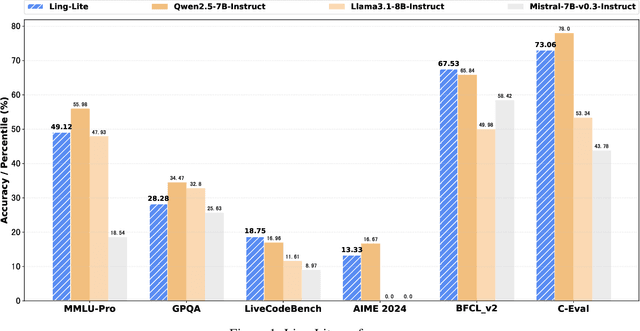
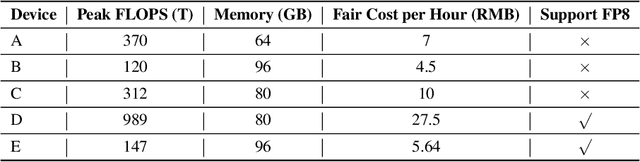
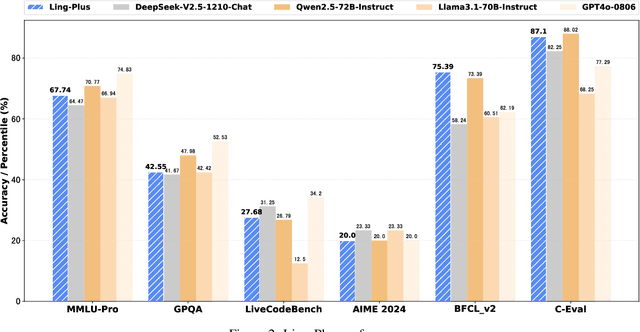
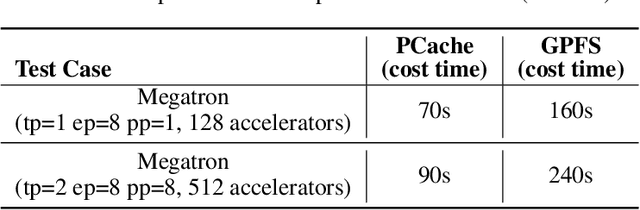
In this technical report, we tackle the challenges of training large-scale Mixture of Experts (MoE) models, focusing on overcoming cost inefficiency and resource limitations prevalent in such systems. To address these issues, we present two differently sized MoE large language models (LLMs), namely Ling-Lite and Ling-Plus (referred to as "Bailing" in Chinese, spelled B\v{a}il\'ing in Pinyin). Ling-Lite contains 16.8 billion parameters with 2.75 billion activated parameters, while Ling-Plus boasts 290 billion parameters with 28.8 billion activated parameters. Both models exhibit comparable performance to leading industry benchmarks. This report offers actionable insights to improve the efficiency and accessibility of AI development in resource-constrained settings, promoting more scalable and sustainable technologies. Specifically, to reduce training costs for large-scale MoE models, we propose innovative methods for (1) optimization of model architecture and training processes, (2) refinement of training anomaly handling, and (3) enhancement of model evaluation efficiency. Additionally, leveraging high-quality data generated from knowledge graphs, our models demonstrate superior capabilities in tool use compared to other models. Ultimately, our experimental findings demonstrate that a 300B MoE LLM can be effectively trained on lower-performance devices while achieving comparable performance to models of a similar scale, including dense and MoE models. Compared to high-performance devices, utilizing a lower-specification hardware system during the pre-training phase demonstrates significant cost savings, reducing computing costs by approximately 20%. The models can be accessed at https://huggingface.co/inclusionAI.
Can Small Language Models be Good Reasoners for Sequential Recommendation?
Mar 07, 2024
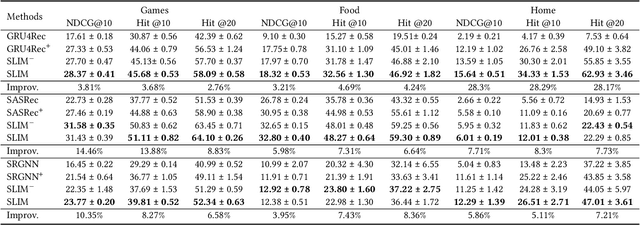


Large language models (LLMs) open up new horizons for sequential recommendations, owing to their remarkable language comprehension and generation capabilities. However, there are still numerous challenges that should be addressed to successfully implement sequential recommendations empowered by LLMs. Firstly, user behavior patterns are often complex, and relying solely on one-step reasoning from LLMs may lead to incorrect or task-irrelevant responses. Secondly, the prohibitively resource requirements of LLM (e.g., ChatGPT-175B) are overwhelmingly high and impractical for real sequential recommender systems. In this paper, we propose a novel Step-by-step knowLedge dIstillation fraMework for recommendation (SLIM), paving a promising path for sequential recommenders to enjoy the exceptional reasoning capabilities of LLMs in a "slim" (i.e., resource-efficient) manner. We introduce CoT prompting based on user behavior sequences for the larger teacher model. The rationales generated by the teacher model are then utilized as labels to distill the downstream smaller student model (e.g., LLaMA2-7B). In this way, the student model acquires the step-by-step reasoning capabilities in recommendation tasks. We encode the generated rationales from the student model into a dense vector, which empowers recommendation in both ID-based and ID-agnostic scenarios. Extensive experiments demonstrate the effectiveness of SLIM over state-of-the-art baselines, and further analysis showcasing its ability to generate meaningful recommendation reasoning at affordable costs.