 Add to Chrome
 Add to Firefox
 Add to Edge
Neural Tree Collaborative Filtering: Rethinking Graph Collaborative Filtering as Tree Collaborative Filtering with Curvature-Aware Propagation Depth
Aug 10, 2026
Graph Collaborative Filtering (GCF) has become the dominant paradigm in modern recommender systems by modeling user-item interactions as a bipartite graph and propagating embeddings through a fixed number of message-passing layers. However, applying a uniform propagation depth to every node ignores a fundamental property of real interaction graphs: nodes differ substantially in their local connectivity, so peripheral nodes quickly suffer from over-smoothing while hub-like nodes remain under-explored beyond their immediate neighborhood. In this paper, we revisit GCF from a tree-structured perspective and propose Neural Tree Collaborative Filtering (NTCF), a framework that re-interprets each node's local neighborhood as a rooted tree and assigns a node-specific propagation depth based on a closed-form local-degree-imbalance score that serves as a discrete Ricci-curvature proxy. We provide a theoretical analysis showing that (i) NTCF strictly generalizes NGCF, degenerating to NGCF when all curvature-induced depth adjustments vanish (a lower bound on its representation power), and (ii) the curvature-aware schedule retains strictly more discriminative information at deep layers on positively-curved (peripheral) nodes than uniform-depth propagation. NTCF can achieve higher performance than most widely used GCF backbone models and can be integrated into existing advanced self-supervised models as a backbone, replacing their original backbone to achieve enhanced performance. Extensive experiments on three public datasets demonstrate the superiority of NTCF.

F2STNet: Fair and Federated Spectral-Temporal Modeling for Graph Forecasting
Aug 10, 2026Spatiotemporal prediction on graph-structured data is central to traffic forecasting and environmental monitoring, yet decentralized and heterogeneous data complicate both sequence modeling and collaborative training. We propose F$^2$STNet, a federated forecasting framework that combines truncated graph-Fourier features, a lightweight diagonal state-space temporal encoder, graph convolution, and Fairness-aware Federated Aggregation (FFA). The spectral branch exposes graph-frequency structure, while the state-space layer models long temporal dependencies with linear complexity in the sequence length. FFA adjusts the FedAvg prior using client validation losses and an increasing fairness schedule. Experiments on PeMS04, HZMetro, and KnowAir show favorable forecasting accuracy relative to the evaluated baselines; federated experiments on PeMS04 additionally improve worst-client and client-dispersion metrics.
One Graph, Multiple Gains: Single High-Quality Item-Item Graph for Multimodal Recommendation
Jul 27, 2026Multimodal recommendation leverages item multimodal features alongside collaborative signals to capture user preferences. While item-item graphs have become a key building block in advanced models, existing methods typically construct them with noisy similarity edges and limit their role to a single function of item-item representation propagation, leaving substantial potential untapped. In this paper, we propose IIMRec, a framework that constructs a single high-quality item-item graph during preprocessing and systematically reuses it across three stages of the recommendation pipeline: representation enhancement, interaction graph enhancement, and optimization enhancement. The graph is built by fusing semantic and co-occurrence signals, then refined via Neighborhood Consistency Edge Reweighting (NCER), which applies the triadic closure principle to amplify structurally reliable edges and suppress spurious ones. Once constructed, the graph is leveraged in three complementary ways: (1) Item-item propagation with a Residual II Gate (RIG) that adaptively controls per-item absorption of semantic neighborhood signals for representation enhancement; (2) A content-guided UI graph expansion that introduces virtual user-item edges through high-confidence semantic neighbors for interaction graph enhancement; (3) II-Neighbor BPR Augmentation (INA) that treats top neighbors of positive items as discounted soft positives for optimization enhancement. We provide theoretical analysis showing that NCER reduces the spectral noise-to-signal ratio, RIG converges to a non-degenerate gating regime, and INA yields a tighter generalization bound. Extensive experiments on four datasets demonstrate that IIMRec consistently outperforms state-of-the-art baselines while running faster and consuming less GPU memory, with particularly strong gains under cold-start and sparse-interaction conditions.
Beyond the Target: From Imitation to Collaboration in Speculative Decoding
May 24, 2026Speculative decoding (SPD) accelerates large language model (LLM) inference by letting a smaller draft model propose multiple future tokens that are verified in parallel by a larger target model. The dominant SPD paradigm treats the target model as the sole reliable teacher, accepting a draft token only when it exactly matches the target prediction. This design implicitly assumes that the target is always the better choice at every position. In practice, this assumption does not hold. Although the draft is the weaker model overall, it is not uniformly inferior at the token level. In a meaningful fraction of cases where draft and target disagree, the draft's choice is the one that leads to the correct final answer. Inspired by this, we introduce \textbf{Collaborative Speculative Decoding (CoSpec)}, a generalization of SPD that no longer treats the target model as the sole token-level authority. CoSpec trains an arbitration policy via reinforcement learning to decide whether to accept tokens from the draft or target model, selectively accepting draft tokens at mismatches when doing so is likely to yield a correct final answer. Experimental results show that CoSpec maintains substantial speedups while surpassing target-only performance. By shifting the emphasis from imitation to collaboration, CoSpec suggests a new perspective on speculative decoding.
Well Begun is Half Done: Training-Free and Model-Agnostic Semantically Guaranteed User Representation Initialization for Multimodal Recommendation
Apr 16, 2026Recent advancements in multimodal recommendations, which leverage diverse modality information to mitigate data sparsity and improve recommendation accuracy, have gained significant attention. However, existing multimodal recommendations overlook the critical role of user representation initialization. Unlike items, which are naturally associated with rich modality information, users lack such inherent information. Consequently, item representations initialized based on meaningful modality information and user representations initialized randomly exhibit a significant semantic gap. To this end, we propose a Semantically Guaranteed User Representation Initialization (SG-URInit). SG-URInit constructs the initial representation for each user by integrating both the modality features of the items they have interacted with and the global features of their corresponding clusters. SG-URInit enables the initialization of semantically enriched user representations that effectively capture both local (item-level) and global (cluster-level) semantics. Our SG-URInit is training-free and model-agnostic, meaning it can be seamlessly integrated into existing multimodal recommendation models without incurring any additional computational overhead during training. Extensive experiments on multiple real-world datasets demonstrate that incorporating SG-URInit into advanced multimodal recommendation models significantly enhances recommendation performance. Furthermore, the results show that SG-URInit can further alleviate the item cold-start problem and also accelerate model convergence, making it an efficient and practical solution for multimodal recommendations.
DBGL: Decay-aware Bipartite Graph Learning for Irregular Medical Time Series Classification
Apr 12, 2026Irregular Medical Time Series play a critical role in the clinical domain to better understand the patient's condition. However, inherent irregularity arising from heterogeneous sampling rates, asynchronous observations, and variable gaps poses key challenges for reliable modeling. Existing methods often distort temporal sampling irregularity and missingness patterns while failing to capture variable decay irregularity, resulting in suboptimal representations. To address these limitations, we introduce DBGL, Decay-Aware Bipartite Graph Learning for Irregular Medical Time Series. DBGL first introduces a patient-variable bipartite graph that simultaneously captures irregular sampling patterns without artificial alignment and adaptively models variable relationships for temporal sampling irregularity modeling, enhancing representation learning. To model variable decay irregularity, DBGL designs a novel node-specific temporal decay encoding mechanism that captures each variable's decay rates based on sampling interval, yielding a more accurate and faithful representation of irregular temporal dynamics. We evaluate the performance of DBGL on four publicly available datasets, and the results show that DBGL outperforms all baselines.
CAMMSR: Category-Guided Attentive Mixture of Experts for Multimodal Sequential Recommendation
Mar 04, 2026The explosion of multimedia data in information-rich environments has intensified the challenges of personalized content discovery, positioning recommendation systems as an essential form of passive data management. Multimodal sequential recommendation, which leverages diverse item information such as text and images, has shown great promise in enriching item representations and deepening the understanding of user interests. However, most existing models rely on heuristic fusion strategies that fail to capture the dynamic and context-sensitive nature of user-modal interactions. In real-world scenarios, user preferences for modalities vary not only across individuals but also within the same user across different items or categories. Moreover, the synergistic effects between modalities-where combined signals trigger user interest in ways isolated modalities cannot-remain largely underexplored. To this end, we propose CAMMSR, a Category-guided Attentive Mixture of Experts model for Multimodal Sequential Recommendation. At its core, CAMMSR introduces a category-guided attentive mixture of experts (CAMoE) module, which learns specialized item representations from multiple perspectives and explicitly models inter-modal synergies. This component dynamically allocates modality weights guided by an auxiliary category prediction task, enabling adaptive fusion of multimodal signals. Additionally, we design a modality swap contrastive learning task to enhance cross-modal representation alignment through sequence-level augmentation. Extensive experiments on four public datasets demonstrate that CAMMSR consistently outperforms state-of-the-art baselines, validating its effectiveness in achieving adaptive, synergistic, and user-centric multimodal sequential recommendation.
Reinforced Curriculum Pre-Alignment for Domain-Adaptive VLMs
Feb 11, 2026Vision-Language Models (VLMs) demonstrate remarkable general-purpose capabilities but often fall short in specialized domains such as medical imaging or geometric problem-solving. Supervised Fine-Tuning (SFT) can enhance performance within a target domain, but it typically causes catastrophic forgetting, limiting its generalization. The central challenge, therefore, is to adapt VLMs to new domains while preserving their general-purpose capabilities. Continual pretraining is effective for expanding knowledge in Large Language Models (LLMs), but it is less feasible for VLMs due to prohibitive computational costs and the unavailability of pretraining data for most open-source models. This necessitates efficient post-training adaptation methods. Reinforcement learning (RL)-based approaches such as Group Relative Policy Optimization (GRPO) have shown promise in preserving general abilities, yet they often fail in domain adaptation scenarios where the model initially lacks sufficient domain knowledge, leading to optimization collapse. To bridge this gap, we propose Reinforced Curriculum Pre-Alignment (RCPA), a novel post-training paradigm that introduces a curriculum-aware progressive modulation mechanism. In the early phase, RCPA applies partial output constraints to safely expose the model to new domain concepts. As the model's domain familiarity increases, training gradually transitions to full generation optimization, refining responses and aligning them with domain-specific preferences. This staged adaptation balances domain knowledge acquisition with the preservation of general multimodal capabilities. Extensive experiments across specialized domains and general benchmarks validate the effectiveness of RCPA, establishing a practical pathway toward building high-performing and domain-adaptive VLMs.
Learning and Editing Universal Graph Prompt Tuning via Reinforcement Learning
Dec 09, 2025Early graph prompt tuning approaches relied on task-specific designs for Graph Neural Networks (GNNs), limiting their adaptability across diverse pre-training strategies. In contrast, another promising line of research has investigated universal graph prompt tuning, which operates directly in the input graph's feature space and builds a theoretical foundation that universal graph prompt tuning can theoretically achieve an equivalent effect of any prompting function, eliminating dependence on specific pre-training strategies. Recent works propose selective node-based graph prompt tuning to pursue more ideal prompts. However, we argue that selective node-based graph prompt tuning inevitably compromises the theoretical foundation of universal graph prompt tuning. In this paper, we strengthen the theoretical foundation of universal graph prompt tuning by introducing stricter constraints, demonstrating that adding prompts to all nodes is a necessary condition for achieving the universality of graph prompts. To this end, we propose a novel model and paradigm, Learning and Editing Universal GrAph Prompt Tuning (LEAP), which preserves the theoretical foundation of universal graph prompt tuning while pursuing more ideal prompts. Specifically, we first build the basic universal graph prompts to preserve the theoretical foundation and then employ actor-critic reinforcement learning to select nodes and edit prompts. Extensive experiments on graph- and node-level tasks across various pre-training strategies in both full-shot and few-shot scenarios show that LEAP consistently outperforms fine-tuning and other prompt-based approaches.
VI-MMRec: Similarity-Aware Training Cost-free Virtual User-Item Interactions for Multimodal Recommendation
Dec 09, 2025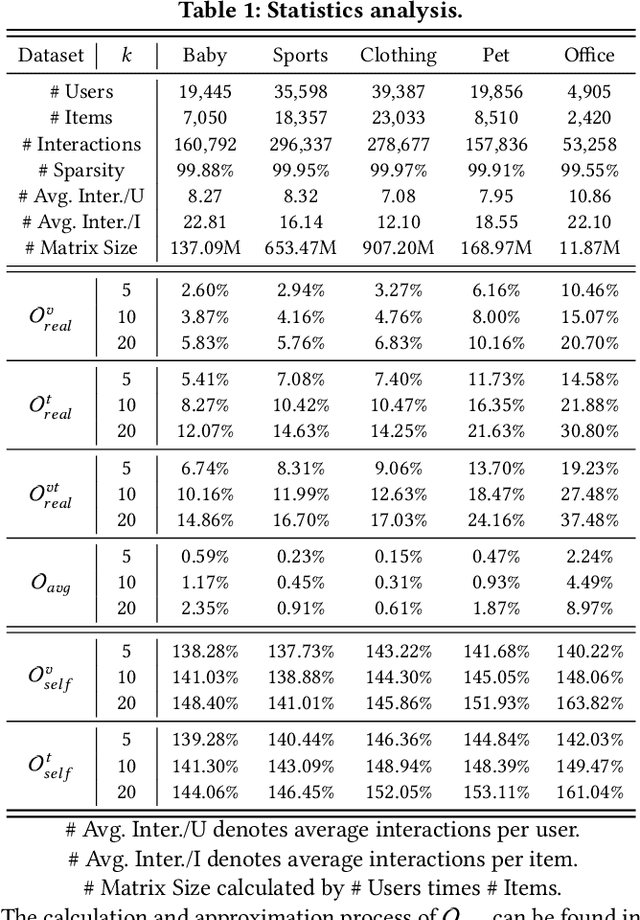
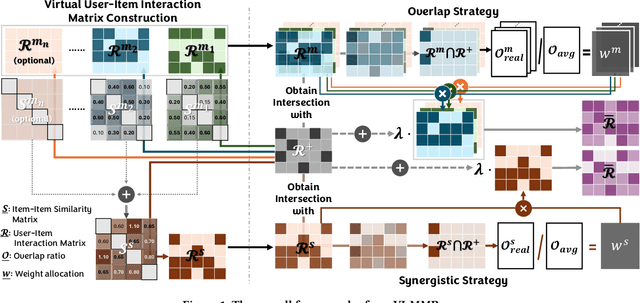
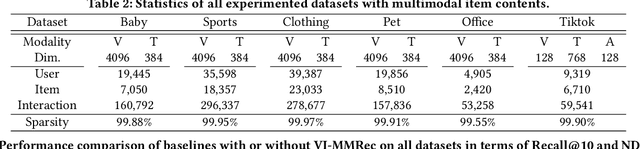
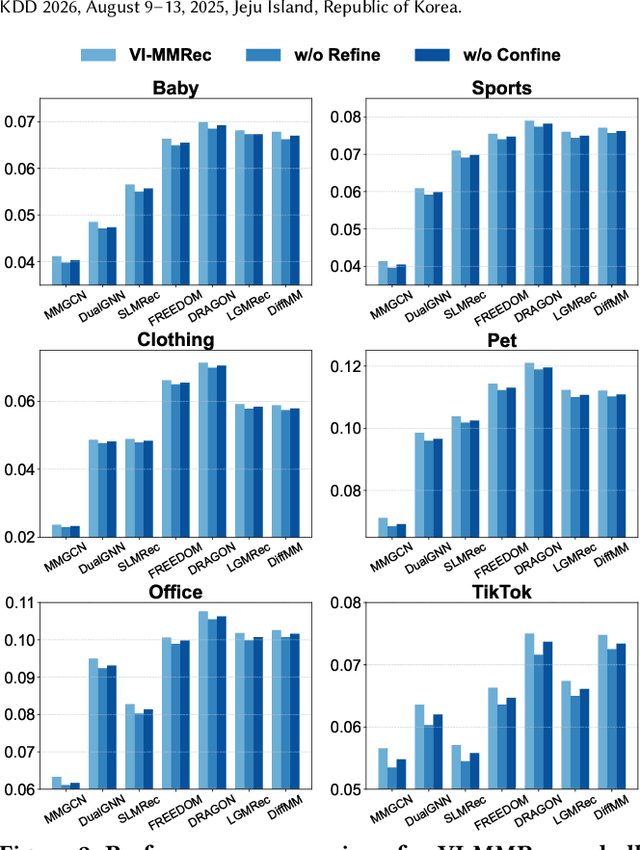
Although existing multimodal recommendation models have shown promising performance, their effectiveness continues to be limited by the pervasive data sparsity problem. This problem arises because users typically interact with only a small subset of available items, leading existing models to arbitrarily treat unobserved items as negative samples. To this end, we propose VI-MMRec, a model-agnostic and training cost-free framework that enriches sparse user-item interactions via similarity-aware virtual user-item interactions. These virtual interactions are constructed based on modality-specific feature similarities of user-interacted items. Specifically, VI-MMRec introduces two different strategies: (1) Overlay, which independently aggregates modality-specific similarities to preserve modality-specific user preferences, and (2) Synergistic, which holistically fuses cross-modal similarities to capture complementary user preferences. To ensure high-quality augmentation, we design a statistically informed weight allocation mechanism that adaptively assigns weights to virtual user-item interactions based on dataset-specific modality relevance. As a plug-and-play framework, VI-MMRec seamlessly integrates with existing models to enhance their performance without modifying their core architecture. Its flexibility allows it to be easily incorporated into various existing models, maximizing performance with minimal implementation effort. Moreover, VI-MMRec introduces no additional overhead during training, making it significantly advantageous for practical deployment. Comprehensive experiments conducted on six real-world datasets using seven state-of-the-art multimodal recommendation models validate the effectiveness of our VI-MMRec.