 Add to Chrome
 Add to Firefox
 Add to Edge
OmniPack: Unified Token Compression for Efficient Omni-modal Large Language Models
Aug 04, 2026
Omni-modal large language models (Omni-LLMs) have achieved remarkable performance on audio-visual understanding tasks, but processing long and highly redundant visual and audio token sequences incurs substantial computational overhead, demanding aggressive token compression for efficient deployment. Existing methods often degrade at low token budgets: pre-LLM compression may discard structurally important and globally distributed evidence, whereas inner-LLM compression often underexploits query-conditioned audio-visual collaboration. To address these limitations, we propose OmniPack, a training-free framework that coordinates structural compression before the LLM with task-relevant semantic refinement within the LLM. Before the LLM, OmniPack removes structural redundancy through modality-specific importance, global coverage, and similarity-aware merging. After sufficient multimodal interaction, it further consolidates diverse, task-relevant representations through textual guidance and audio-visual collaboration. Extensive experiments on five benchmarks with three Omni-LLM backbones demonstrate that OmniPack consistently achieves the best performance-efficiency trade-off across diverse retention ratios, outperforming all existing methods. Notably, on Qwen2.5-Omni-7B, OmniPack preserves 98.0% of the original performance while reducing FLOPs to 16.7%, and still retains 92.9% of the original performance with only 6.8% of the original FLOPs.

KeyFrame-Compass: Towards Comprehensive Evaluation of Keyframe-Conditioned Video Generation
Jul 15, 2026Video generation increasingly relies on keyframe-based workflows, where creators specify a sequence of reference images to guide generation. Although recent models support multi-keyframe conditioning, it remains unclear whether they can faithfully reproduce the prescribed keyframes while maintaining overall video quality. We present KeyFrame-Compass, the first comprehensive benchmark for evaluating keyframe-conditioned video generation. The benchmark contains 386 carefully curated samples spanning three application domains, two video structures, two prompt granularities, two conditioning formats, and four keyframe densities, enabling controlled analysis under diverse generation settings. We further introduce an automated evaluation framework that jointly measures keyframe execution and overall video quality. Specifically, we decompose keyframe execution into six complementary metrics covering presence, fidelity, temporal ordering, localization, persistence, and uniqueness, while assessing overall video quality through evidence-grounded MLLM judgments augmented with specialized perception models. Experiments on nine representative video generation systems reveal several fundamental limitations. Current models exhibit a clear trade-off between faithful keyframe execution and natural video synthesis. Their performance further degrades as keyframe constraints become denser and most open-source models also fail to interpret storyboard-grid inputs as temporally ordered keyframe sequences.
AVadCLIP: Audio-Visual Collaboration for Robust Video Anomaly Detection
Apr 06, 2025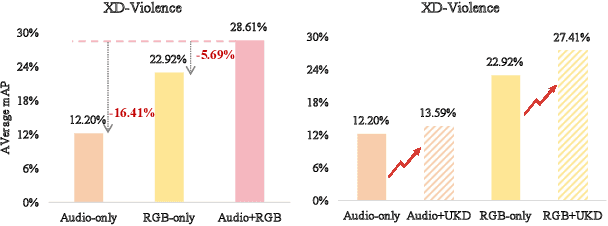
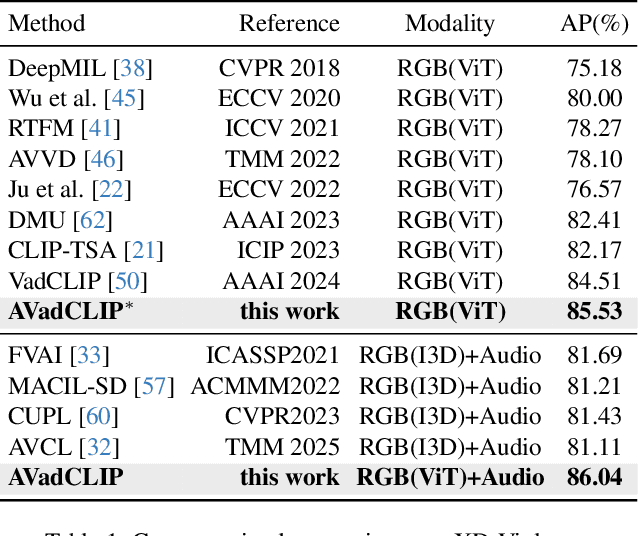
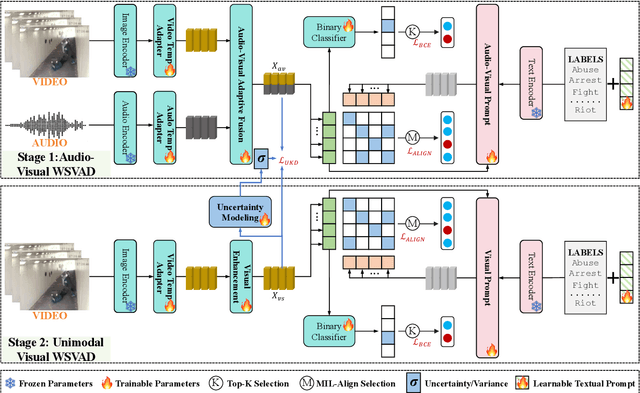

With the increasing adoption of video anomaly detection in intelligent surveillance domains, conventional visual-based detection approaches often struggle with information insufficiency and high false-positive rates in complex environments. To address these limitations, we present a novel weakly supervised framework that leverages audio-visual collaboration for robust video anomaly detection. Capitalizing on the exceptional cross-modal representation learning capabilities of Contrastive Language-Image Pretraining (CLIP) across visual, audio, and textual domains, our framework introduces two major innovations: an efficient audio-visual fusion that enables adaptive cross-modal integration through lightweight parametric adaptation while maintaining the frozen CLIP backbone, and a novel audio-visual prompt that dynamically enhances text embeddings with key multimodal information based on the semantic correlation between audio-visual features and textual labels, significantly improving CLIP's generalization for the video anomaly detection task. Moreover, to enhance robustness against modality deficiency during inference, we further develop an uncertainty-driven feature distillation module that synthesizes audio-visual representations from visual-only inputs. This module employs uncertainty modeling based on the diversity of audio-visual features to dynamically emphasize challenging features during the distillation process. Our framework demonstrates superior performance across multiple benchmarks, with audio integration significantly boosting anomaly detection accuracy in various scenarios. Notably, with unimodal data enhanced by uncertainty-driven distillation, our approach consistently outperforms current unimodal VAD methods.