 Add to Chrome
 Add to Firefox
 Add to Edge
One Graph, Multiple Gains: Single High-Quality Item-Item Graph for Multimodal Recommendation
Jul 27, 2026
Multimodal recommendation leverages item multimodal features alongside collaborative signals to capture user preferences. While item-item graphs have become a key building block in advanced models, existing methods typically construct them with noisy similarity edges and limit their role to a single function of item-item representation propagation, leaving substantial potential untapped. In this paper, we propose IIMRec, a framework that constructs a single high-quality item-item graph during preprocessing and systematically reuses it across three stages of the recommendation pipeline: representation enhancement, interaction graph enhancement, and optimization enhancement. The graph is built by fusing semantic and co-occurrence signals, then refined via Neighborhood Consistency Edge Reweighting (NCER), which applies the triadic closure principle to amplify structurally reliable edges and suppress spurious ones. Once constructed, the graph is leveraged in three complementary ways: (1) Item-item propagation with a Residual II Gate (RIG) that adaptively controls per-item absorption of semantic neighborhood signals for representation enhancement; (2) A content-guided UI graph expansion that introduces virtual user-item edges through high-confidence semantic neighbors for interaction graph enhancement; (3) II-Neighbor BPR Augmentation (INA) that treats top neighbors of positive items as discounted soft positives for optimization enhancement. We provide theoretical analysis showing that NCER reduces the spectral noise-to-signal ratio, RIG converges to a non-degenerate gating regime, and INA yields a tighter generalization bound. Extensive experiments on four datasets demonstrate that IIMRec consistently outperforms state-of-the-art baselines while running faster and consuming less GPU memory, with particularly strong gains under cold-start and sparse-interaction conditions.

DBGL: Decay-aware Bipartite Graph Learning for Irregular Medical Time Series Classification
Apr 12, 2026Irregular Medical Time Series play a critical role in the clinical domain to better understand the patient's condition. However, inherent irregularity arising from heterogeneous sampling rates, asynchronous observations, and variable gaps poses key challenges for reliable modeling. Existing methods often distort temporal sampling irregularity and missingness patterns while failing to capture variable decay irregularity, resulting in suboptimal representations. To address these limitations, we introduce DBGL, Decay-Aware Bipartite Graph Learning for Irregular Medical Time Series. DBGL first introduces a patient-variable bipartite graph that simultaneously captures irregular sampling patterns without artificial alignment and adaptively models variable relationships for temporal sampling irregularity modeling, enhancing representation learning. To model variable decay irregularity, DBGL designs a novel node-specific temporal decay encoding mechanism that captures each variable's decay rates based on sampling interval, yielding a more accurate and faithful representation of irregular temporal dynamics. We evaluate the performance of DBGL on four publicly available datasets, and the results show that DBGL outperforms all baselines.
Meta-Learning for Speeding Up Large Model Inference in Decentralized Environments
Oct 28, 2024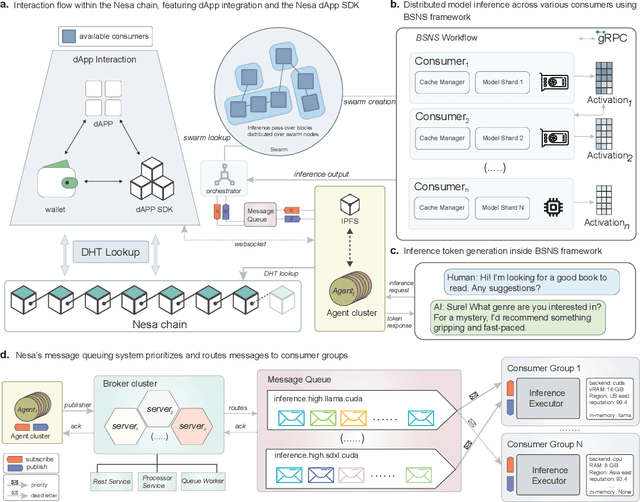
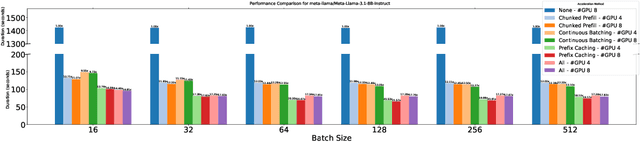
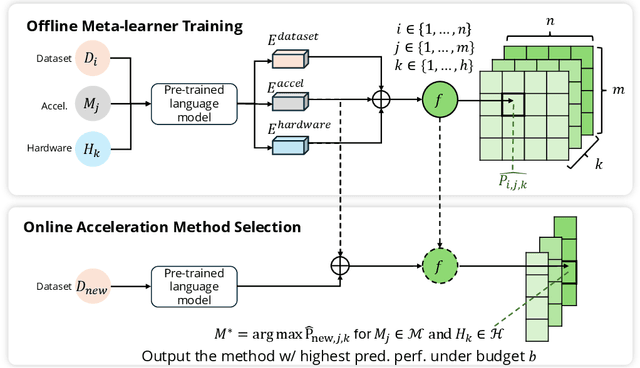
The deployment of large-scale models, such as large language models (LLMs) and sophisticated image generation systems, incurs substantial costs due to their computational demands. To mitigate these costs and address challenges related to scalability and data security, there is a growing shift towards decentralized systems for deploying such models. In these decentralized environments, efficient inference acceleration becomes crucial to manage computational resources effectively and enhance system responsiveness. In this work, we address the challenge of selecting optimal acceleration methods in decentralized systems by introducing a meta-learning-based framework. This framework automates the selection process by learning from historical performance data of various acceleration techniques across different tasks. Unlike traditional methods that rely on random selection or expert intuition, our approach systematically identifies the best acceleration strategies based on the specific characteristics of each task. We demonstrate that our meta-learning framework not only streamlines the decision-making process but also consistently outperforms conventional methods in terms of efficiency and performance. Our results highlight the potential of meta-learning to revolutionize inference acceleration in decentralized AI systems, offering a path towards more democratic and economically feasible artificial intelligence solutions.