 Add to Chrome
 Add to Firefox
 Add to Edge
FocusMem: Factorizing Content, Readout, and Trust in Latent GUI Memory
Aug 05, 2026
GUI agents must remember both useful experience from earlier tasks and unfinished progress in the current interaction. Latent memory offers a compact solution by compressing multimodal trajectories into a few continuous tokens. Existing methods, however, usually map each trajectory to one fixed memory block and train it mainly through next-action supervision. This creates three practical problems: important details may be lost during compression, the same memory block must serve different decision stages, and irrelevant retrieved trajectories may still mislead the agent. We introduce FocusMem, which separates these responsibilities within a compact latent-memory interface. A role-aware content basis encourages episodic memory to retain reusable experience and working memory to retain task progress. A state-conditioned readout generates a decision-specific view of the same stored evidence, while a lightweight trust gate can suppress memory blocks that appear irrelevant to the current step. All components are trained while the GUI policy remains frozen. Across five GUI-agent benchmarks, FocusMem consistently outperforms a fully matched action-only fixed-memory baseline and prior latent memory adaptations. Further analysis shows that semantic and functional supervision preserve complementary information, state-conditioned readout is more robust as surrounding trajectory context grows, and the trust gate reduces the harm caused by injected irrelevant episodic evidence. These results show that effective latent memory depends not only on compressing past interaction, but also on what is retained, what is exposed, and what is allowed.

OmniPack: Unified Token Compression for Efficient Omni-modal Large Language Models
Aug 04, 2026Omni-modal large language models (Omni-LLMs) have achieved remarkable performance on audio-visual understanding tasks, but processing long and highly redundant visual and audio token sequences incurs substantial computational overhead, demanding aggressive token compression for efficient deployment. Existing methods often degrade at low token budgets: pre-LLM compression may discard structurally important and globally distributed evidence, whereas inner-LLM compression often underexploits query-conditioned audio-visual collaboration. To address these limitations, we propose OmniPack, a training-free framework that coordinates structural compression before the LLM with task-relevant semantic refinement within the LLM. Before the LLM, OmniPack removes structural redundancy through modality-specific importance, global coverage, and similarity-aware merging. After sufficient multimodal interaction, it further consolidates diverse, task-relevant representations through textual guidance and audio-visual collaboration. Extensive experiments on five benchmarks with three Omni-LLM backbones demonstrate that OmniPack consistently achieves the best performance-efficiency trade-off across diverse retention ratios, outperforming all existing methods. Notably, on Qwen2.5-Omni-7B, OmniPack preserves 98.0% of the original performance while reducing FLOPs to 16.7%, and still retains 92.9% of the original performance with only 6.8% of the original FLOPs.
Beacon: Knowing When and How to Perform Agentic Visual Reasoning
Jul 30, 2026The fundamental goal of agentic visual reasoning is to improve the success rate of multimodal large language models (MLLMs) on complex tasks, rather than merely equipping them with a sophisticated yet inefficient reasoning paradigm. In this work, we rethink agentic visual reasoning through two key dimensions of tool use: Mode Adaptiveness (MA) and Tool Effect (TE). Mode Adaptiveness characterizes whether an MLLM can recognize when tools are truly necessary and invoke them accordingly, thereby avoiding unnecessary computational overhead while improving performance on challenging problems that require tool assistance. Tool Effect characterizes the actual impact of tool use: tools should extend the model's capabilities on problems unsolvable through text-only reasoning, while avoiding additional errors on problems that the model can already solve without tools. We conduct a comprehensive analysis to quantify these two properties and empirically reveal that existing agentic visual reasoning models exhibit limited Mode Adaptiveness, while the gains produced by tool use on hard examples are largely offset by the harm introduced on easy examples that the models can already solve. Motivated by these observations, we propose Beacon, a novel agentic visual reasoning model that achieves stronger overall performance, improved Mode Adaptiveness, and genuine tool-induced performance gains. At the core of Beacon are the Necessity-Aware Adaptive Reward and the Hint-Guided Capability Expansion mechanism in the reinforcement learning stage, which respectively encourage adaptive tool invocation based on task necessity and strengthen the model's tool-use capability on the most challenging problems. Extensive experiments across diverse benchmarks demonstrate the strong overall performance of Beacon and its substantial improvements in both Mode Adaptiveness and Tool Effect.
RefCaptioner: Multi-Reference Image-Grounded Video Captioning
Jul 30, 2026Existing video captioning models generate natural descriptions of video content but cannot explicitly ground local visual elements to multiple reference images. We introduce multi-reference image-grounded video captioning, a new task requiring factual video descriptions with phrase-level reference grounding, and propose RefCaptioner, a two-stage post-training framework for this task. RefCaptioner combines mixed-data SFT with Hierarchical Coverage-Discounted GRPO to jointly improve reference selection, phrase-level binding, distractor rejection, and cross-reference consistency while preserving general video-captioning ability. To support training, we construct a corpus containing $20,000$ videos and 171,354 reference images. We further introduce MRVBench, a benchmark for evaluating caption factuality and multi-reference grounding on both real-world and AI-generated videos. Experiments show that RefCaptioner achieves the best overall performance among the open-source models while remaining competitive on standard video captioning benchmarks. Human evaluation further confirms that its captions are preferred by annotators and enable more source-faithful video reconstruction with both open-source and proprietary video generators.
KeyFrame-Compass: Towards Comprehensive Evaluation of Keyframe-Conditioned Video Generation
Jul 15, 2026Video generation increasingly relies on keyframe-based workflows, where creators specify a sequence of reference images to guide generation. Although recent models support multi-keyframe conditioning, it remains unclear whether they can faithfully reproduce the prescribed keyframes while maintaining overall video quality. We present KeyFrame-Compass, the first comprehensive benchmark for evaluating keyframe-conditioned video generation. The benchmark contains 386 carefully curated samples spanning three application domains, two video structures, two prompt granularities, two conditioning formats, and four keyframe densities, enabling controlled analysis under diverse generation settings. We further introduce an automated evaluation framework that jointly measures keyframe execution and overall video quality. Specifically, we decompose keyframe execution into six complementary metrics covering presence, fidelity, temporal ordering, localization, persistence, and uniqueness, while assessing overall video quality through evidence-grounded MLLM judgments augmented with specialized perception models. Experiments on nine representative video generation systems reveal several fundamental limitations. Current models exhibit a clear trade-off between faithful keyframe execution and natural video synthesis. Their performance further degrades as keyframe constraints become denser and most open-source models also fail to interpret storyboard-grid inputs as temporally ordered keyframe sequences.
LongAV-Compass: Towards Unified Evaluation of Minute-Scale Audio-Visual Generation Across T2AV, I2AV, and V2AV
May 25, 2026Audio-visual generation is rapidly advancing from short clips to minute-long content, while existing evaluation protocols remain largely confined to short-form settings. Existing benchmarks primarily focus on 5--10 second text-conditioned generation and rarely support unified evaluation across text, image, and video conditioning modalities. Moreover, they provide limited insight into how identity consistency, narrative coherence, and audio-visual alignment degrade over extended temporal horizons. To bridge this gap, we introduce LongAV-Compass, a systematic benchmark for minute-long audio-visual generation. LongAV-Compass contains 284 curated test cases spanning text-to-audio-video (T2AV), image-to-audio-video (I2AV), and video-to-audio-video (V2AV), organized by application scenario and generation complexity. The benchmark combines taxonomy-guided benchmark construction with a unified evaluation framework that integrates MLLM-assisted assessment with complementary perceptual and multimodal metrics, including DINO-v2, ArcFace, CLIP, and ImageBind. The framework evaluates more than 20 fine-grained dimensions covering within-segment quality, cross-segment consistency, global narrative coherence, semantic alignment, and audio-visual synchronization. Through experiments on 11 representative models together with human-alignment validation, LongAV-Compass provides a diagnostic testbed for analyzing the limitations of current systems in sustaining coherent, semantically aligned, and temporally consistent minute-scale audio-visual generation across diverse input modalities.
Artifact-Bench: Evaluating MLLMs on Detecting and Assessing the Artifacts of AI-Generated Videos
May 18, 2026Recent video generative models have greatly improved the realism of AI-generated videos, yet their outputs still exhibit artifacts such as temporal inconsistencies, structural distortions, and semantic incoherence. While Multimodal Large Language Models (MLLMs) show strong visual understanding capabilities, their ability to perceive and reason about such artifacts remains unclear. Existing benchmarks often lack systematic evaluation of artifact-aware perception and fine-grained diagnostic reasoning, especially across diverse AI-generated video domains beyond photorealistic content. To address this gap, we introduce Artifact-Bench, a comprehensive benchmark for evaluating MLLMs on AI-generated video artifact detection and analysis. We first establish a three-level hierarchical taxonomy of realism artifacts, covering photorealistic, animated, and CG-style videos. Based on this taxonomy, Artifact-Bench defines three complementary tasks: real vs. AI-generated video classification, pairwise realism comparison, and fine-grained artifact identification. Experiments on 19 leading MLLMs reveal substantial limitations in artifact perception and reasoning, with many models approaching random or even below-random performance in challenging settings. We further observe significant misalignment between MLLM judgments and human perceptual preferences, highlighting their limited reliability as general evaluators for AI-generated video realism.
Hybrid Attribution Priors for Explainable and Robust Model Training
Dec 09, 2025Small language models (SLMs) are widely used in tasks that require low latency and lightweight deployment, particularly classification. As interpretability and robustness gain increasing importance, explanation-guided learning has emerged as an effective framework by introducing attribution-based supervision during training; however, deriving general and reliable attribution priors remains a significant challenge. Through an analysis of representative attribution methods in classification settings, we find that although these methods can reliably highlight class-relevant tokens, they often focus on common keywords shared by semantically similar classes. Because such classes are already difficult to distinguish under standard training, these attributions provide insufficient discriminative cues, limiting their ability to improve model differentiation. To overcome this limitation, we propose Class-Aware Attribution Prior (CAP), a novel attribution prior extraction framework that guides language models toward capturing fine-grained class distinctions and producing more salient, discriminative attribution priors. Building on this idea, we further introduce CAP Hybrid, which combines priors from CAP with those from existing attribution techniques to form a more comprehensive and balanced supervisory signal. By aligning a model's self-attribution with these enriched priors, our approach encourages the learning of diverse, decision-relevant features. Extensive experiments in full-data, few-shot, and adversarial scenarios demonstrate that our method consistently enhances both interpretability and robustness.
MME-VideoOCR: Evaluating OCR-Based Capabilities of Multimodal LLMs in Video Scenarios
May 27, 2025Multimodal Large Language Models (MLLMs) have achieved considerable accuracy in Optical Character Recognition (OCR) from static images. However, their efficacy in video OCR is significantly diminished due to factors such as motion blur, temporal variations, and visual effects inherent in video content. To provide clearer guidance for training practical MLLMs, we introduce the MME-VideoOCR benchmark, which encompasses a comprehensive range of video OCR application scenarios. MME-VideoOCR features 10 task categories comprising 25 individual tasks and spans 44 diverse scenarios. These tasks extend beyond text recognition to incorporate deeper comprehension and reasoning of textual content within videos. The benchmark consists of 1,464 videos with varying resolutions, aspect ratios, and durations, along with 2,000 meticulously curated, manually annotated question-answer pairs. We evaluate 18 state-of-the-art MLLMs on MME-VideoOCR, revealing that even the best-performing model (Gemini-2.5 Pro) achieves an accuracy of only 73.7%. Fine-grained analysis indicates that while existing MLLMs demonstrate strong performance on tasks where relevant texts are contained within a single or few frames, they exhibit limited capability in effectively handling tasks that demand holistic video comprehension. These limitations are especially evident in scenarios that require spatio-temporal reasoning, cross-frame information integration, or resistance to language prior bias. Our findings also highlight the importance of high-resolution visual input and sufficient temporal coverage for reliable OCR in dynamic video scenarios.
EAP-GP: Mitigating Saturation Effect in Gradient-based Automated Circuit Identification
Feb 07, 2025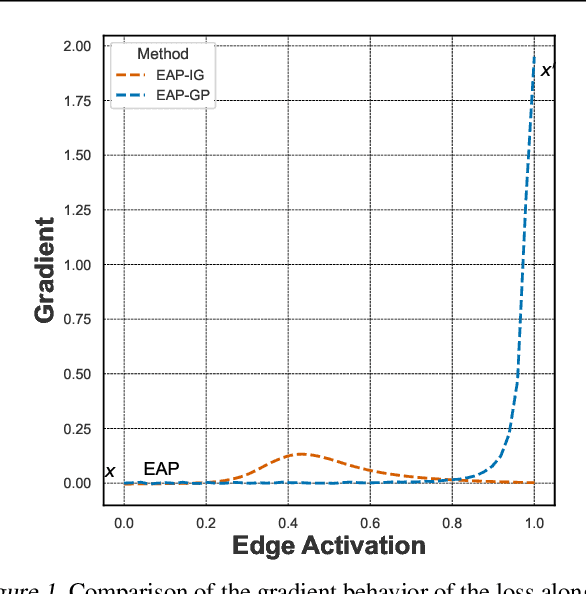
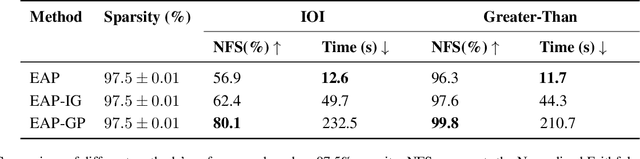
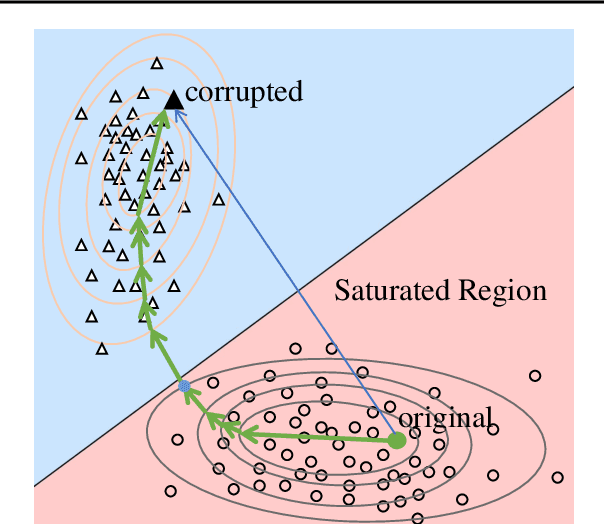
Understanding the internal mechanisms of transformer-based language models remains challenging. Mechanistic interpretability based on circuit discovery aims to reverse engineer neural networks by analyzing their internal processes at the level of computational subgraphs. In this paper, we revisit existing gradient-based circuit identification methods and find that their performance is either affected by the zero-gradient problem or saturation effects, where edge attribution scores become insensitive to input changes, resulting in noisy and unreliable attribution evaluations for circuit components. To address the saturation effect, we propose Edge Attribution Patching with GradPath (EAP-GP), EAP-GP introduces an integration path, starting from the input and adaptively following the direction of the difference between the gradients of corrupted and clean inputs to avoid the saturated region. This approach enhances attribution reliability and improves the faithfulness of circuit identification. We evaluate EAP-GP on 6 datasets using GPT-2 Small, GPT-2 Medium, and GPT-2 XL. Experimental results demonstrate that EAP-GP outperforms existing methods in circuit faithfulness, achieving improvements up to 17.7%. Comparisons with manually annotated ground-truth circuits demonstrate that EAP-GP achieves precision and recall comparable to or better than previous approaches, highlighting its effectiveness in identifying accurate circuits.