 Add to Chrome
 Add to Firefox
 Add to Edge
AMOR: A Recipe for Building Adaptable Modular Knowledge Agents Through Process Feedback
Feb 02, 2024
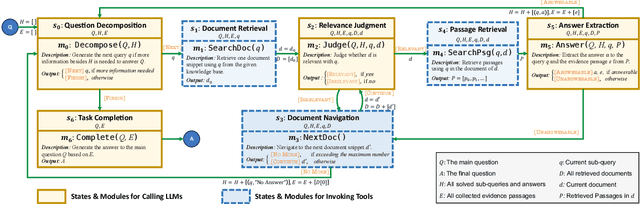
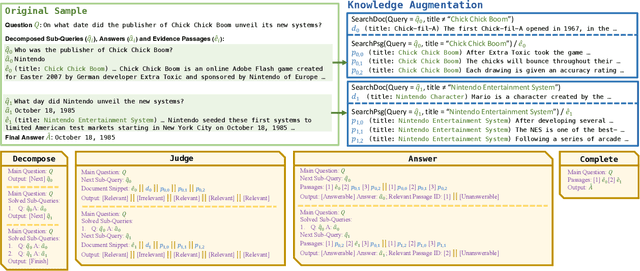
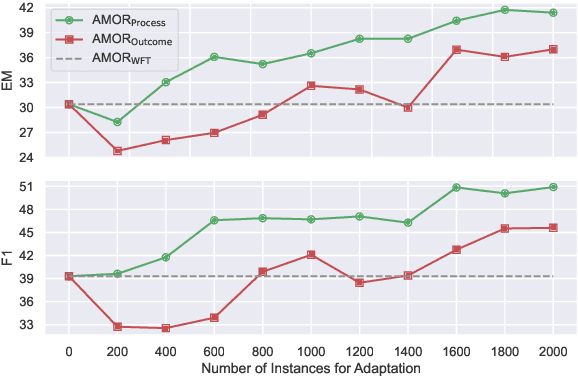
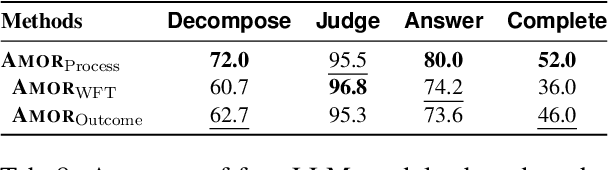
The notable success of large language models (LLMs) has sparked an upsurge in building language agents to complete various complex tasks. We present AMOR, an agent framework based on open-source LLMs, which reasons with external knowledge bases and adapts to specific domains through human supervision to the reasoning process. AMOR builds reasoning logic over a finite state machine (FSM) that solves problems through autonomous executions and transitions over disentangled modules. This allows humans to provide direct feedback to the individual modules, and thus naturally forms process supervision. Based on this reasoning and feedback framework, we develop AMOR through two-stage fine-tuning: warm-up and adaptation. The former fine-tunes the LLM with examples automatically constructed from various public datasets and enables AMOR to generalize across different knowledge environments, while the latter tailors AMOR to specific domains using process feedback. Extensive experiments across multiple domains demonstrate the advantage of AMOR to strong baselines, thanks to its FSM-based reasoning and process feedback mechanism.

ChatQA: Building GPT-4 Level Conversational QA Models
Jan 23, 2024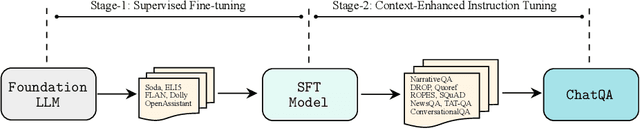
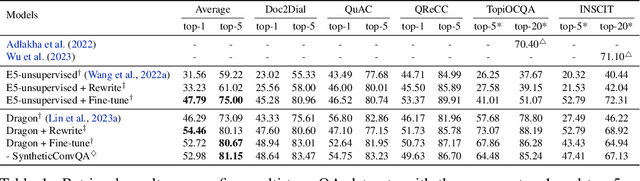
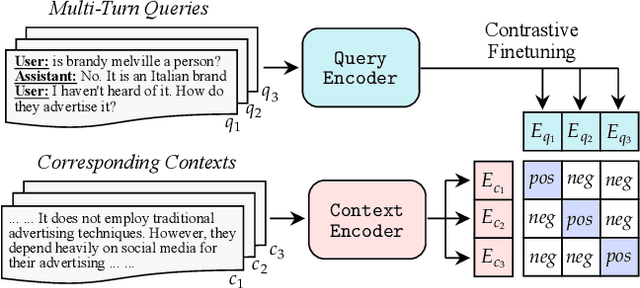
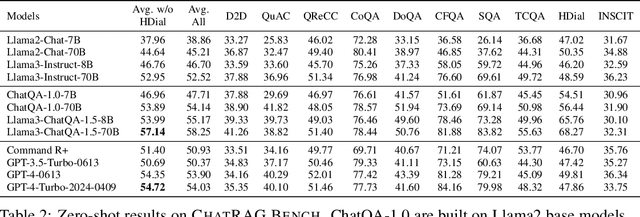
In this work, we introduce ChatQA, a family of conversational question answering (QA) models that obtain GPT-4 level accuracies. Specifically, we propose a two-stage instruction tuning method that can significantly improve the zero-shot conversational QA results from large language models (LLMs). To handle retrieval-augmented generation in conversational QA, we fine-tune a dense retriever on a multi-turn QA dataset, which provides comparable results to using the state-of-the-art query rewriting model while largely reducing deployment cost. Notably, our ChatQA-70B can outperform GPT-4 in terms of average score on 10 conversational QA datasets (54.14 vs. 53.90), without relying on any synthetic data from OpenAI GPT models.
AutoRT: Embodied Foundation Models for Large Scale Orchestration of Robotic Agents
Jan 23, 2024Foundation models that incorporate language, vision, and more recently actions have revolutionized the ability to harness internet scale data to reason about useful tasks. However, one of the key challenges of training embodied foundation models is the lack of data grounded in the physical world. In this paper, we propose AutoRT, a system that leverages existing foundation models to scale up the deployment of operational robots in completely unseen scenarios with minimal human supervision. AutoRT leverages vision-language models (VLMs) for scene understanding and grounding, and further uses large language models (LLMs) for proposing diverse and novel instructions to be performed by a fleet of robots. Guiding data collection by tapping into the knowledge of foundation models enables AutoRT to effectively reason about autonomy tradeoffs and safety while significantly scaling up data collection for robot learning. We demonstrate AutoRT proposing instructions to over 20 robots across multiple buildings and collecting 77k real robot episodes via both teleoperation and autonomous robot policies. We experimentally show that such "in-the-wild" data collected by AutoRT is significantly more diverse, and that AutoRT's use of LLMs allows for instruction following data collection robots that can align to human preferences.
p-Laplacian Adaptation for Generative Pre-trained Vision-Language Models
Dec 17, 2023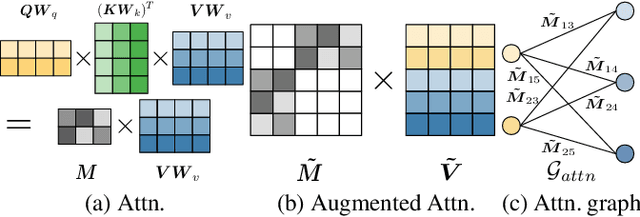
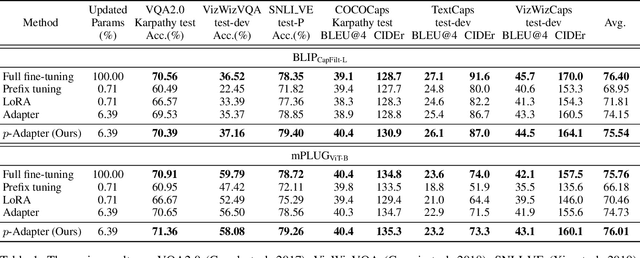
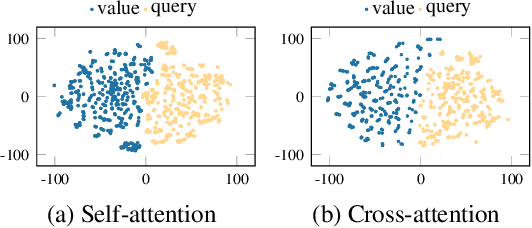
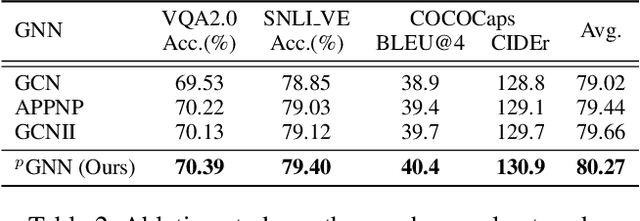
Vision-Language models (VLMs) pre-trained on large corpora have demonstrated notable success across a range of downstream tasks. In light of the rapidly increasing size of pre-trained VLMs, parameter-efficient transfer learning (PETL) has garnered attention as a viable alternative to full fine-tuning. One such approach is the adapter, which introduces a few trainable parameters into the pre-trained models while preserving the original parameters during adaptation. In this paper, we present a novel modeling framework that recasts adapter tuning after attention as a graph message passing process on attention graphs, where the projected query and value features and attention matrix constitute the node features and the graph adjacency matrix, respectively. Within this framework, tuning adapters in VLMs necessitates handling heterophilic graphs, owing to the disparity between the projected query and value space. To address this challenge, we propose a new adapter architecture, $p$-adapter, which employs $p$-Laplacian message passing in Graph Neural Networks (GNNs). Specifically, the attention weights are re-normalized based on the features, and the features are then aggregated using the calibrated attention matrix, enabling the dynamic exploitation of information with varying frequencies in the heterophilic attention graphs. We conduct extensive experiments on different pre-trained VLMs and multi-modal tasks, including visual question answering, visual entailment, and image captioning. The experimental results validate our method's significant superiority over other PETL methods.
Large Model Based Referring Camouflaged Object Detection
Nov 28, 2023
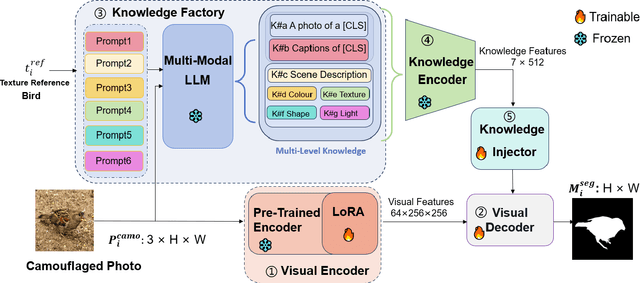

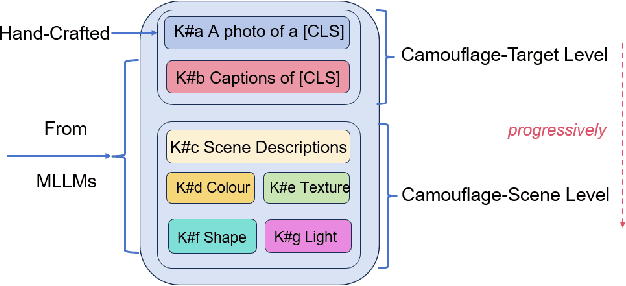
Referring camouflaged object detection (Ref-COD) is a recently-proposed problem aiming to segment out specified camouflaged objects matched with a textual or visual reference. This task involves two major challenges: the COD domain-specific perception and multimodal reference-image alignment. Our motivation is to make full use of the semantic intelligence and intrinsic knowledge of recent Multimodal Large Language Models (MLLMs) to decompose this complex task in a human-like way. As language is highly condensed and inductive, linguistic expression is the main media of human knowledge learning, and the transmission of knowledge information follows a multi-level progression from simplicity to complexity. In this paper, we propose a large-model-based Multi-Level Knowledge-Guided multimodal method for Ref-COD termed MLKG, where multi-level knowledge descriptions from MLLM are organized to guide the large vision model of segmentation to perceive the camouflage-targets and camouflage-scene progressively and meanwhile deeply align the textual references with camouflaged photos. To our knowledge, our contributions mainly include: (1) This is the first time that the MLLM knowledge is studied for Ref-COD and COD. (2) We, for the first time, propose decomposing Ref-COD into two main perspectives of perceiving the target and scene by integrating MLLM knowledge, and contribute a multi-level knowledge-guided method. (3) Our method achieves the state-of-the-art on the Ref-COD benchmark outperforming numerous strong competitors. Moreover, thanks to the injected rich knowledge, it demonstrates zero-shot generalization ability on uni-modal COD datasets. We will release our code soon.
RT-Trajectory: Robotic Task Generalization via Hindsight Trajectory Sketches
Nov 06, 2023


Generalization remains one of the most important desiderata for robust robot learning systems. While recently proposed approaches show promise in generalization to novel objects, semantic concepts, or visual distribution shifts, generalization to new tasks remains challenging. For example, a language-conditioned policy trained on pick-and-place tasks will not be able to generalize to a folding task, even if the arm trajectory of folding is similar to pick-and-place. Our key insight is that this kind of generalization becomes feasible if we represent the task through rough trajectory sketches. We propose a policy conditioning method using such rough trajectory sketches, which we call RT-Trajectory, that is practical, easy to specify, and allows the policy to effectively perform new tasks that would otherwise be challenging to perform. We find that trajectory sketches strike a balance between being detailed enough to express low-level motion-centric guidance while being coarse enough to allow the learned policy to interpret the trajectory sketch in the context of situational visual observations. In addition, we show how trajectory sketches can provide a useful interface to communicate with robotic policies: they can be specified through simple human inputs like drawings or videos, or through automated methods such as modern image-generating or waypoint-generating methods. We evaluate RT-Trajectory at scale on a variety of real-world robotic tasks, and find that RT-Trajectory is able to perform a wider range of tasks compared to language-conditioned and goal-conditioned policies, when provided the same training data.
RoboVQA: Multimodal Long-Horizon Reasoning for Robotics
Nov 01, 2023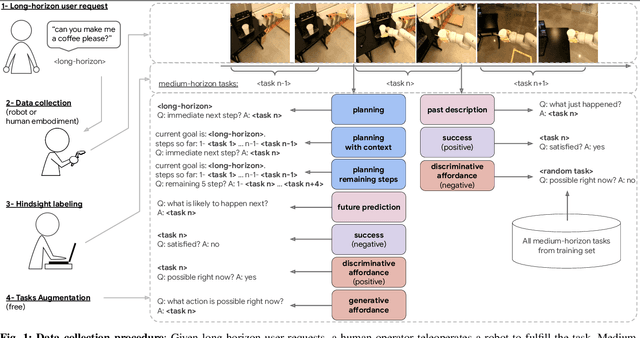
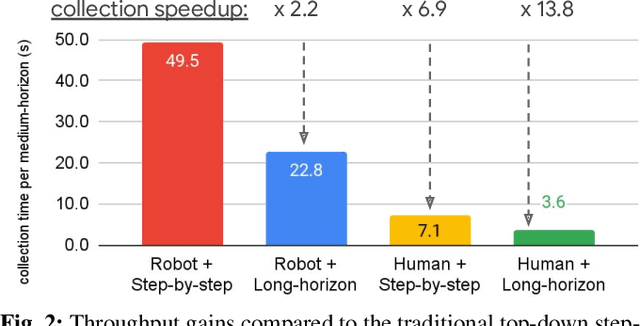
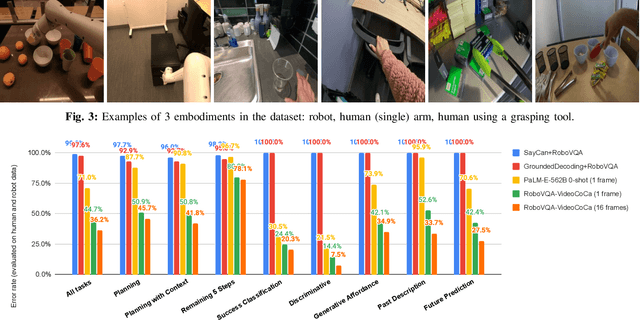
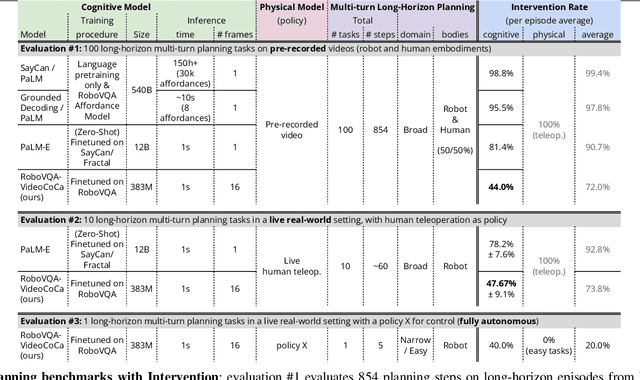
We present a scalable, bottom-up and intrinsically diverse data collection scheme that can be used for high-level reasoning with long and medium horizons and that has 2.2x higher throughput compared to traditional narrow top-down step-by-step collection. We collect realistic data by performing any user requests within the entirety of 3 office buildings and using multiple robot and human embodiments. With this data, we show that models trained on all embodiments perform better than ones trained on the robot data only, even when evaluated solely on robot episodes. We find that for a fixed collection budget it is beneficial to take advantage of cheaper human collection along with robot collection. We release a large and highly diverse (29,520 unique instructions) dataset dubbed RoboVQA containing 829,502 (video, text) pairs for robotics-focused visual question answering. We also demonstrate how evaluating real robot experiments with an intervention mechanism enables performing tasks to completion, making it deployable with human oversight even if imperfect while also providing a single performance metric. We demonstrate a single video-conditioned model named RoboVQA-VideoCoCa trained on our dataset that is capable of performing a variety of grounded high-level reasoning tasks in broad realistic settings with a cognitive intervention rate 46% lower than the zero-shot state of the art visual language model (VLM) baseline and is able to guide real robots through long-horizon tasks. The performance gap with zero-shot state-of-the-art models indicates that a lot of grounded data remains to be collected for real-world deployment, emphasizing the critical need for scalable data collection approaches. Finally, we show that video VLMs significantly outperform single-image VLMs with an average error rate reduction of 19% across all VQA tasks. Data and videos available at https://robovqa.github.io
Open X-Embodiment: Robotic Learning Datasets and RT-X Models
Oct 17, 2023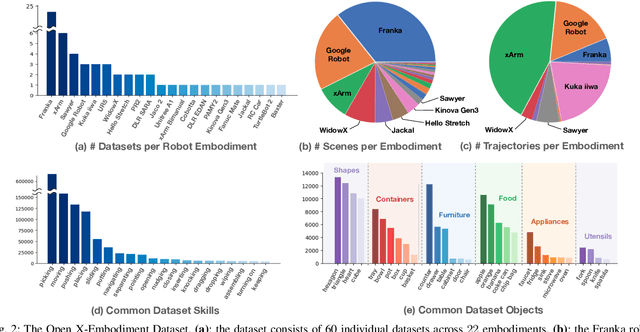
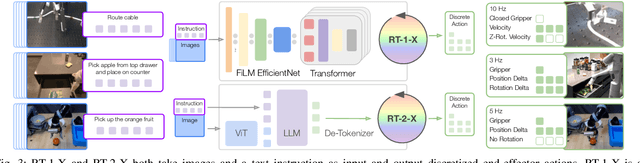


Large, high-capacity models trained on diverse datasets have shown remarkable successes on efficiently tackling downstream applications. In domains from NLP to Computer Vision, this has led to a consolidation of pretrained models, with general pretrained backbones serving as a starting point for many applications. Can such a consolidation happen in robotics? Conventionally, robotic learning methods train a separate model for every application, every robot, and even every environment. Can we instead train generalist X-robot policy that can be adapted efficiently to new robots, tasks, and environments? In this paper, we provide datasets in standardized data formats and models to make it possible to explore this possibility in the context of robotic manipulation, alongside experimental results that provide an example of effective X-robot policies. We assemble a dataset from 22 different robots collected through a collaboration between 21 institutions, demonstrating 527 skills (160266 tasks). We show that a high-capacity model trained on this data, which we call RT-X, exhibits positive transfer and improves the capabilities of multiple robots by leveraging experience from other platforms. More details can be found on the project website $\href{https://robotics-transformer-x.github.io}{\text{robotics-transformer-x.github.io}}$.
InstructRetro: Instruction Tuning post Retrieval-Augmented Pretraining
Oct 11, 2023Pretraining auto-regressive large language models (LLMs) with retrieval demonstrates better perplexity and factual accuracy by leveraging external databases. However, the size of existing pretrained retrieval-augmented LLM is still limited (e.g., Retro has 7.5B parameters), which limits the effectiveness of instruction tuning and zero-shot generalization. In this work, we introduce Retro 48B, the largest LLM pretrained with retrieval before instruction tuning. Specifically, we continue to pretrain the 43B GPT model on additional 100 billion tokens using the Retro augmentation method by retrieving from 1.2 trillion tokens. The obtained foundation model, Retro 48B, largely outperforms the original 43B GPT in terms of perplexity. After instruction tuning on Retro, InstructRetro demonstrates significant improvement over the instruction tuned GPT on zero-shot question answering (QA) tasks. Specifically, the average improvement of InstructRetro is 7% over its GPT counterpart across 8 short-form QA tasks, and 10% over GPT across 4 challenging long-form QA tasks. Surprisingly, we find that one can ablate the encoder from InstructRetro architecture and directly use its decoder backbone, while achieving comparable results. We hypothesize that pretraining with retrieval makes its decoder good at incorporating context for QA. Our results highlights the promising direction to obtain a better GPT decoder for QA through continued pretraining with retrieval before instruction tuning.
Generative quantum machine learning via denoising diffusion probabilistic models
Oct 09, 2023Deep generative models are key-enabling technology to computer vision, text generation and large language models. Denoising diffusion probabilistic models (DDPMs) have recently gained much attention due to their ability to generate diverse and high-quality samples in many computer vision tasks, as well as to incorporate flexible model architectures and relatively simple training scheme. Quantum generative models, empowered by entanglement and superposition, have brought new insight to learning classical and quantum data. Inspired by the classical counterpart, we propose the quantum denoising diffusion probabilistic models (QuDDPM) to enable efficiently trainable generative learning of quantum data. QuDDPM adopts sufficient layers of circuits to guarantee expressivity, while introduces multiple intermediate training tasks as interpolation between the target distribution and noise to avoid barren plateau and guarantee efficient training. We demonstrate QuDDPM's capability in learning correlated quantum noise model and learning topological structure of nontrivial distribution of quantum data.