 Add to Chrome
 Add to Firefox
 Add to Edge
CounselReflect: A Toolkit for Auditing Mental-Health Dialogues
Mar 31, 2026
Mental-health support is increasingly mediated by conversational systems (e.g., LLM-based tools), but users often lack structured ways to audit the quality and potential risks of the support they receive. We introduce CounselReflect, an end-to-end toolkit for auditing mental-health support dialogues. Rather than producing a single opaque quality score, CounselReflect provides structured, multi-dimensional reports with session-level summaries, turn-level scores, and evidence-linked excerpts to support transparent inspection. The system integrates two families of evaluation signals: (i) 12 model-based metrics produced by task-specific predictors, and (ii) rubric-based metrics that extend coverage via a literature-derived library (69 metrics) and user-defined custom metrics, operationalized with configurable LLM judges. CounselReflect is available as a web application, browser extension, and command-line interface (CLI), enabling use in real-time settings as well as at scale. Human evaluation includes a user study with 20 participants and an expert review with 6 mental-health professionals, suggesting that CounselReflect supports understandable, usable, and trustworthy auditing. A demo video and full source code are also provided.

Deep Learning in Concealed Dense Prediction
Apr 15, 2025Deep learning is developing rapidly and handling common computer vision tasks well. It is time to pay attention to more complex vision tasks, as model size, knowledge, and reasoning capabilities continue to improve. In this paper, we introduce and review a family of complex tasks, termed Concealed Dense Prediction (CDP), which has great value in agriculture, industry, etc. CDP's intrinsic trait is that the targets are concealed in their surroundings, thus fully perceiving them requires fine-grained representations, prior knowledge, auxiliary reasoning, etc. The contributions of this review are three-fold: (i) We introduce the scope, characteristics, and challenges specific to CDP tasks and emphasize their essential differences from generic vision tasks. (ii) We develop a taxonomy based on concealment counteracting to summarize deep learning efforts in CDP through experiments on three tasks. We compare 25 state-of-the-art methods across 12 widely used concealed datasets. (iii) We discuss the potential applications of CDP in the large model era and summarize 6 potential research directions. We offer perspectives for the future development of CDP by constructing a large-scale multimodal instruction fine-tuning dataset, CvpINST, and a concealed visual perception agent, CvpAgent.
Large Model Based Referring Camouflaged Object Detection
Nov 28, 2023
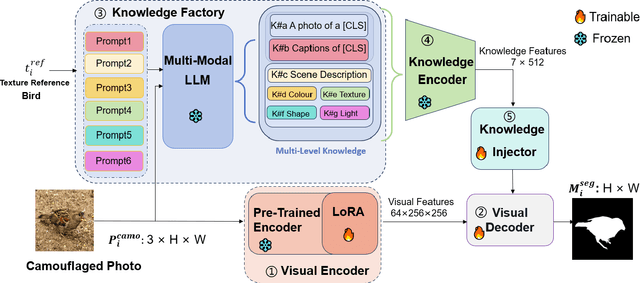

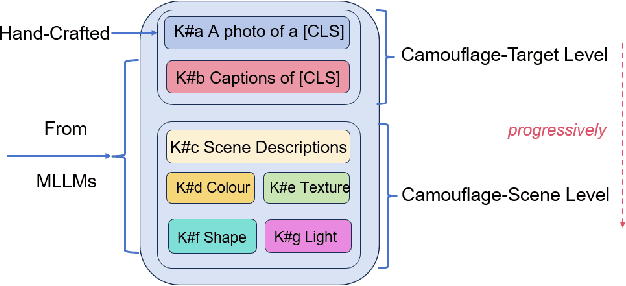
Referring camouflaged object detection (Ref-COD) is a recently-proposed problem aiming to segment out specified camouflaged objects matched with a textual or visual reference. This task involves two major challenges: the COD domain-specific perception and multimodal reference-image alignment. Our motivation is to make full use of the semantic intelligence and intrinsic knowledge of recent Multimodal Large Language Models (MLLMs) to decompose this complex task in a human-like way. As language is highly condensed and inductive, linguistic expression is the main media of human knowledge learning, and the transmission of knowledge information follows a multi-level progression from simplicity to complexity. In this paper, we propose a large-model-based Multi-Level Knowledge-Guided multimodal method for Ref-COD termed MLKG, where multi-level knowledge descriptions from MLLM are organized to guide the large vision model of segmentation to perceive the camouflage-targets and camouflage-scene progressively and meanwhile deeply align the textual references with camouflaged photos. To our knowledge, our contributions mainly include: (1) This is the first time that the MLLM knowledge is studied for Ref-COD and COD. (2) We, for the first time, propose decomposing Ref-COD into two main perspectives of perceiving the target and scene by integrating MLLM knowledge, and contribute a multi-level knowledge-guided method. (3) Our method achieves the state-of-the-art on the Ref-COD benchmark outperforming numerous strong competitors. Moreover, thanks to the injected rich knowledge, it demonstrates zero-shot generalization ability on uni-modal COD datasets. We will release our code soon.
When Super-Resolution Meets Camouflaged Object Detection: A Comparison Study
Aug 08, 2023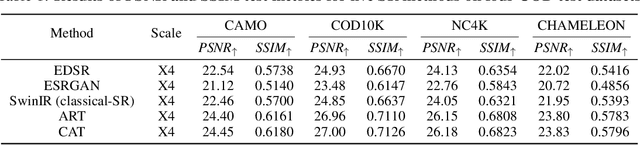
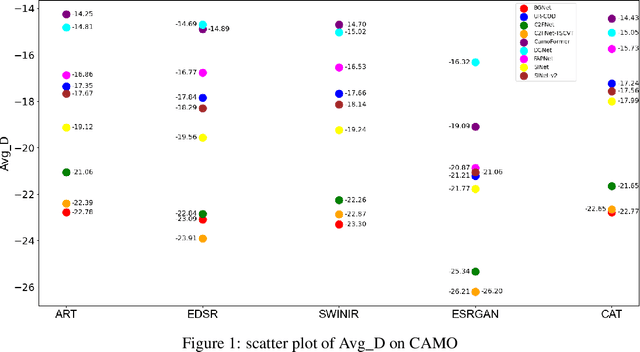
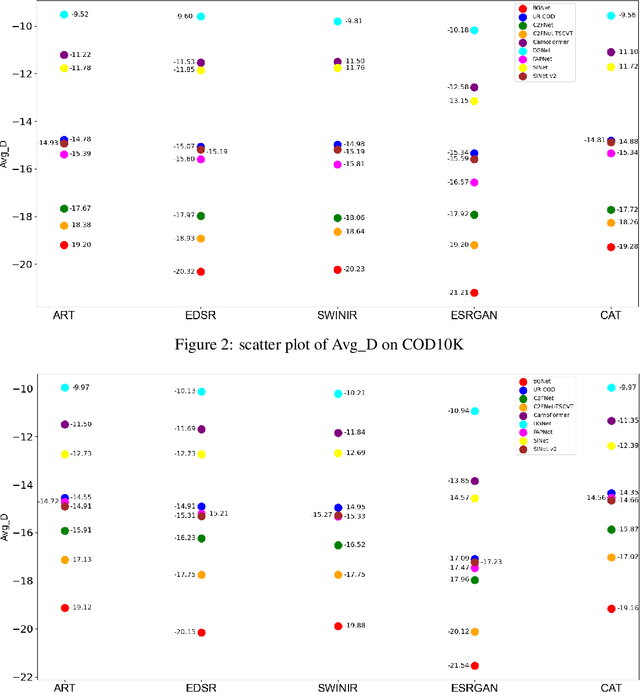
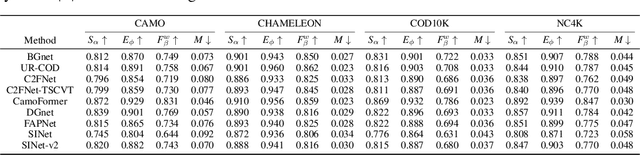
Super Resolution (SR) and Camouflaged Object Detection (COD) are two hot topics in computer vision with various joint applications. For instance, low-resolution surveillance images can be successively processed by super-resolution techniques and camouflaged object detection. However, in previous work, these two areas are always studied in isolation. In this paper, we, for the first time, conduct an integrated comparative evaluation for both. Specifically, we benchmark different super-resolution methods on commonly used COD datasets, and meanwhile, we evaluate the robustness of different COD models by using COD data processed by SR methods. Our goal is to bridge these two domains, discover novel experimental phenomena, summarize new experim.