 Add to Chrome
 Add to Firefox
 Add to Edge
Ling and Ring 2.6 Technical Report: Efficient and Instant Agentic Intelligence at Trillion-Parameter Scale
Jun 13, 2026
Efficient and scalable agentic intelligence requires models that can deliver both low-latency responses and strong reasoning capabilities while remaining practical to train, serve, and deploy. In this report, we present Ling-2.6 and Ring-2.6, a family of models designed to address this challenge at scale. Ling-2.6 is optimized for instant response generation and high capability per output token, whereas Ring-2.6 is tailored for deeper reasoning and more advanced agentic workflows. Instead of training from scratch, we upgrade the Ling-2.0 base model through architectural migration pre-training and large-scale post-training. This upgrade is guided by a unified co-design of model architecture, optimization objectives, serving systems, and agent training environments, enabling improvements in both model capability and deployment efficiency. At the architectural level, we introduce a hybrid linear attention design that integrates Lightning Attention with MLA, improving the efficiency of long-context training and decoding. To further enhance token efficiency, we optimize capability per output token through Evolutionary Chain-of-Thought, Linguistic Unit Policy Optimization, bidirectional preference alignment, and shortest-correct-response distillation. For agentic capabilities, we propose KPop, a reinforcement learning framework designed to support stable training of Ring-2.6-1T on large-scale environment-grounded data. KPop improves training efficiency through asynchronous scheduling across coding, search, tool use, and workflow execution, enabling scalable learning from complex agent-environment interactions. Together, Ling-2.6 and Ring-2.6 provide a practical pathway toward efficient, scalable, and open agentic systems. We open-source all checkpoints in the 2.6 family to support further research and development in practical agentic intelligence.

SearchSwarm: Towards Delegation Intelligence in Agentic LLMs for Long-Horizon Deep Research
Jun 08, 2026Large language models are increasingly expected to handle complex, long-horizon real-world tasks whose context demands can grow without bound, yet model context windows remain inherently finite. Recent work explores a paradigm where a main agent decomposes tasks and dispatches subtasks to subagents, which execute and return only summarized results, conserving the main agent's context budget. However, performing this well requires delegation intelligence: the ability to decompose complex tasks, determine when and what to delegate, and integrate returned results into the ongoing workflow. Training data for this capability is scarce in naturally occurring text, and to our knowledge, how to synthesize such data and train models to acquire this capability remains largely unexplored in the open-source community. To bridge this gap, we present a preliminary exploration targeting deep research, a representative long-horizon agent task. Specifically, we design a harness that guides the model toward high-quality task decomposition and delegation, while constraining subagents to return results properly to support the main agent's workflow. The harness-guided trajectories naturally encode correct delegation decisions, which we use as supervised fine-tuning data to internalize delegation intelligence into model weights. Our resulting model, SearchSwarm-30B-A3B, achieves 68.1 on BrowseComp and 73.3 on BrowseComp-ZH, the best results among all models of comparable scale. We will release our harness, model weights, and training data to facilitate future research.
InftyThink+: Effective and Efficient Infinite-Horizon Reasoning via Reinforcement Learning
Feb 09, 2026Large reasoning models achieve strong performance by scaling inference-time chain-of-thought, but this paradigm suffers from quadratic cost, context length limits, and degraded reasoning due to lost-in-the-middle effects. Iterative reasoning mitigates these issues by periodically summarizing intermediate thoughts, yet existing methods rely on supervised learning or fixed heuristics and fail to optimize when to summarize, what to preserve, and how to resume reasoning. We propose InftyThink+, an end-to-end reinforcement learning framework that optimizes the entire iterative reasoning trajectory, building on model-controlled iteration boundaries and explicit summarization. InftyThink+ adopts a two-stage training scheme with supervised cold-start followed by trajectory-level reinforcement learning, enabling the model to learn strategic summarization and continuation decisions. Experiments on DeepSeek-R1-Distill-Qwen-1.5B show that InftyThink+ improves accuracy by 21% on AIME24 and outperforms conventional long chain-of-thought reinforcement learning by a clear margin, while also generalizing better to out-of-distribution benchmarks. Moreover, InftyThink+ significantly reduces inference latency and accelerates reinforcement learning training, demonstrating improved reasoning efficiency alongside stronger performance.
Rethinking Sample Polarity in Reinforcement Learning with Verifiable Rewards
Dec 25, 2025Large reasoning models (LRMs) are typically trained using reinforcement learning with verifiable reward (RLVR) to enhance their reasoning abilities. In this paradigm, policies are updated using both positive and negative self-generated rollouts, which correspond to distinct sample polarities. In this paper, we provide a systematic investigation into how these sample polarities affect RLVR training dynamics and behaviors. We find that positive samples sharpen existing correct reasoning patterns, while negative samples encourage exploration of new reasoning paths. We further explore how adjusting the advantage values of positive and negative samples at both the sample level and the token level affects RLVR training. Based on these insights, we propose an Adaptive and Asymmetric token-level Advantage shaping method for Policy Optimization, namely A3PO, that more precisely allocates advantage signals to key tokens across different polarities. Experiments across five reasoning benchmarks demonstrate the effectiveness of our approach.
Every Step Evolves: Scaling Reinforcement Learning for Trillion-Scale Thinking Model
Oct 21, 2025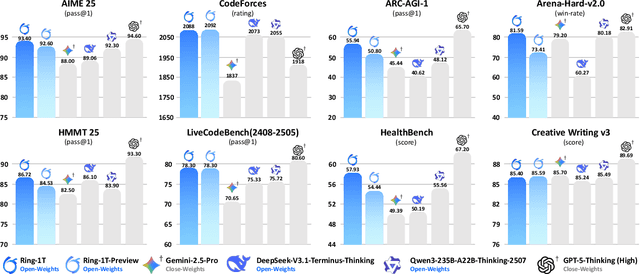
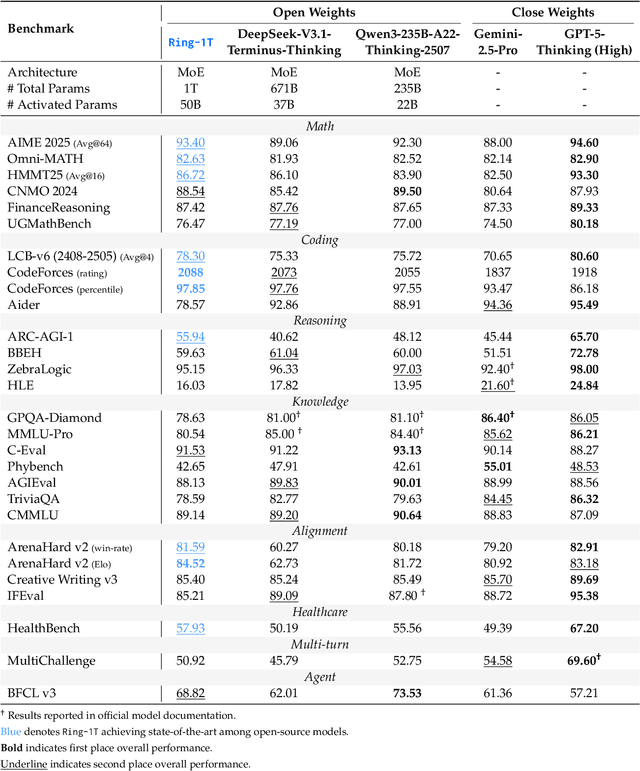
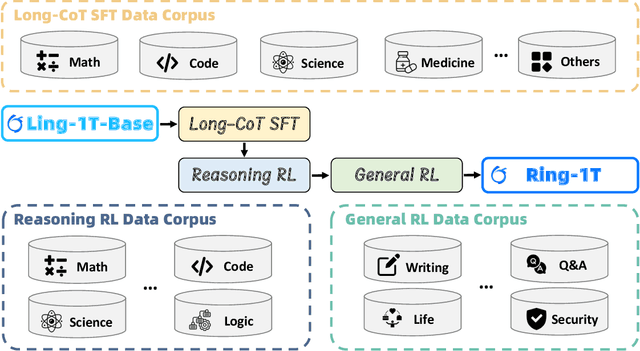
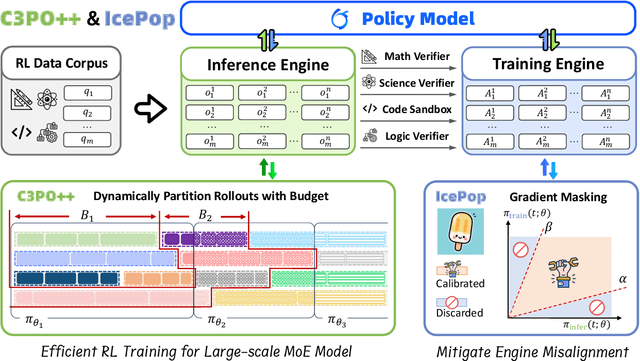
We present Ring-1T, the first open-source, state-of-the-art thinking model with a trillion-scale parameter. It features 1 trillion total parameters and activates approximately 50 billion per token. Training such models at a trillion-parameter scale introduces unprecedented challenges, including train-inference misalignment, inefficiencies in rollout processing, and bottlenecks in the RL system. To address these, we pioneer three interconnected innovations: (1) IcePop stabilizes RL training via token-level discrepancy masking and clipping, resolving instability from training-inference mismatches; (2) C3PO++ improves resource utilization for long rollouts under a token budget by dynamically partitioning them, thereby obtaining high time efficiency; and (3) ASystem, a high-performance RL framework designed to overcome the systemic bottlenecks that impede trillion-parameter model training. Ring-1T delivers breakthrough results across critical benchmarks: 93.4 on AIME-2025, 86.72 on HMMT-2025, 2088 on CodeForces, and 55.94 on ARC-AGI-v1. Notably, it attains a silver medal-level result on the IMO-2025, underscoring its exceptional reasoning capabilities. By releasing the complete 1T parameter MoE model to the community, we provide the research community with direct access to cutting-edge reasoning capabilities. This contribution marks a significant milestone in democratizing large-scale reasoning intelligence and establishes a new baseline for open-source model performance.
Enhancing Cross-task Transfer of Large Language Models via Activation Steering
Jul 17, 2025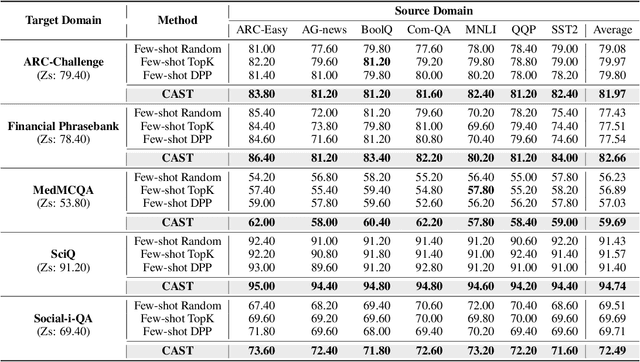
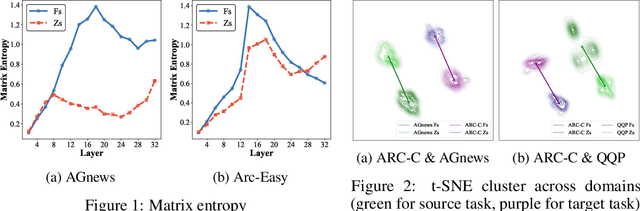
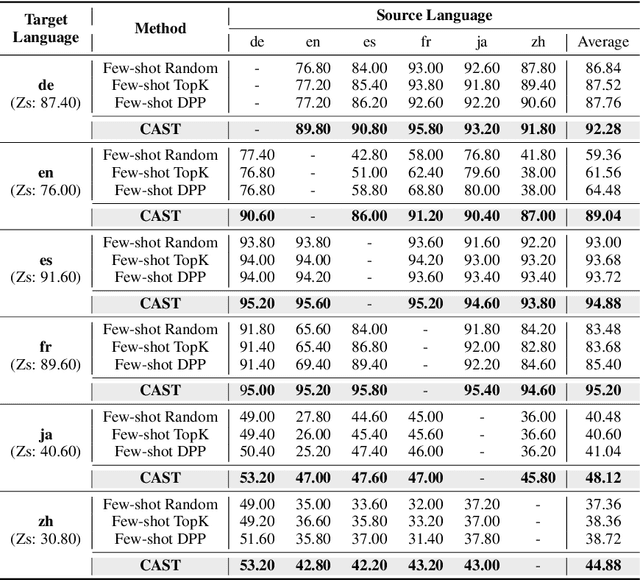
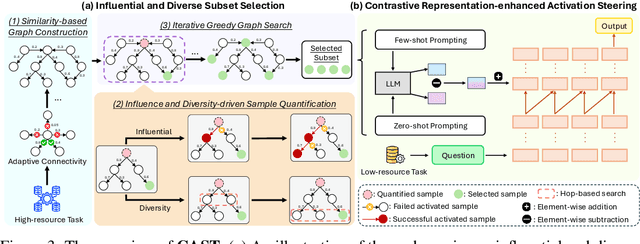
Large language models (LLMs) have shown impressive abilities in leveraging pretrained knowledge through prompting, but they often struggle with unseen tasks, particularly in data-scarce scenarios. While cross-task in-context learning offers a direct solution for transferring knowledge across tasks, it still faces critical challenges in terms of robustness, scalability, and efficiency. In this paper, we investigate whether cross-task transfer can be achieved via latent space steering without parameter updates or input expansion. Through an analysis of activation patterns in the latent space of LLMs, we observe that the enhanced activations induced by in-context examples have consistent patterns across different tasks. Inspired by these findings, we propose CAST, a novel Cross-task Activation Steering Transfer framework that enables effective transfer by manipulating the model's internal activation states. Our approach first selects influential and diverse samples from high-resource tasks, then utilizes their contrastive representation-enhanced activations to adapt LLMs to low-resource tasks. Extensive experiments across both cross-domain and cross-lingual transfer settings show that our method outperforms competitive baselines and demonstrates superior scalability and lower computational costs.
Ring-lite: Scalable Reasoning via C3PO-Stabilized Reinforcement Learning for LLMs
Jun 18, 2025We present Ring-lite, a Mixture-of-Experts (MoE)-based large language model optimized via reinforcement learning (RL) to achieve efficient and robust reasoning capabilities. Built upon the publicly available Ling-lite model, a 16.8 billion parameter model with 2.75 billion activated parameters, our approach matches the performance of state-of-the-art (SOTA) small-scale reasoning models on challenging benchmarks (e.g., AIME, LiveCodeBench, GPQA-Diamond) while activating only one-third of the parameters required by comparable models. To accomplish this, we introduce a joint training pipeline integrating distillation with RL, revealing undocumented challenges in MoE RL training. First, we identify optimization instability during RL training, and we propose Constrained Contextual Computation Policy Optimization(C3PO), a novel approach that enhances training stability and improves computational throughput via algorithm-system co-design methodology. Second, we empirically demonstrate that selecting distillation checkpoints based on entropy loss for RL training, rather than validation metrics, yields superior performance-efficiency trade-offs in subsequent RL training. Finally, we develop a two-stage training paradigm to harmonize multi-domain data integration, addressing domain conflicts that arise in training with mixed dataset. We will release the model, dataset, and code.
Every FLOP Counts: Scaling a 300B Mixture-of-Experts LING LLM without Premium GPUs
Mar 07, 2025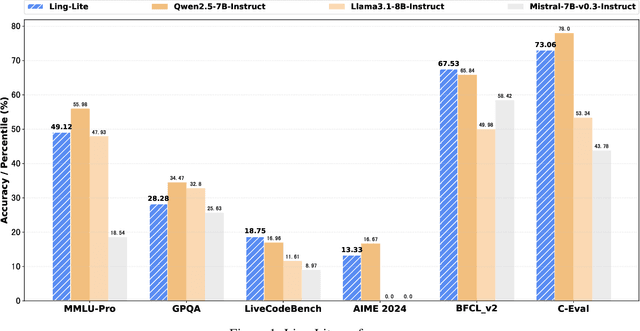
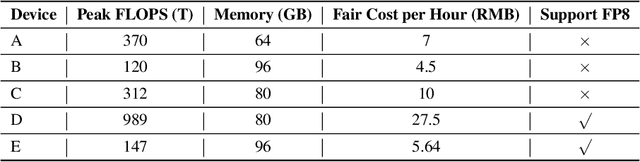
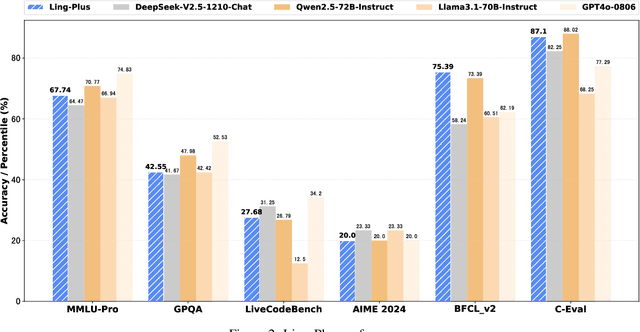
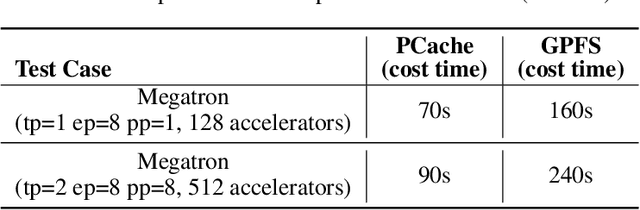
In this technical report, we tackle the challenges of training large-scale Mixture of Experts (MoE) models, focusing on overcoming cost inefficiency and resource limitations prevalent in such systems. To address these issues, we present two differently sized MoE large language models (LLMs), namely Ling-Lite and Ling-Plus (referred to as "Bailing" in Chinese, spelled B\v{a}il\'ing in Pinyin). Ling-Lite contains 16.8 billion parameters with 2.75 billion activated parameters, while Ling-Plus boasts 290 billion parameters with 28.8 billion activated parameters. Both models exhibit comparable performance to leading industry benchmarks. This report offers actionable insights to improve the efficiency and accessibility of AI development in resource-constrained settings, promoting more scalable and sustainable technologies. Specifically, to reduce training costs for large-scale MoE models, we propose innovative methods for (1) optimization of model architecture and training processes, (2) refinement of training anomaly handling, and (3) enhancement of model evaluation efficiency. Additionally, leveraging high-quality data generated from knowledge graphs, our models demonstrate superior capabilities in tool use compared to other models. Ultimately, our experimental findings demonstrate that a 300B MoE LLM can be effectively trained on lower-performance devices while achieving comparable performance to models of a similar scale, including dense and MoE models. Compared to high-performance devices, utilizing a lower-specification hardware system during the pre-training phase demonstrates significant cost savings, reducing computing costs by approximately 20%. The models can be accessed at https://huggingface.co/inclusionAI.
CARE: A Clue-guided Assistant for CSRs to Read User Manuals
Aug 07, 2024
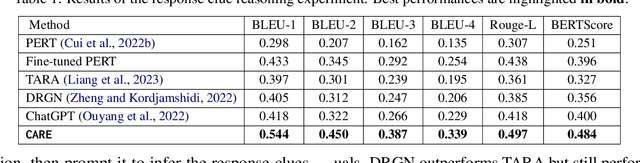


It is time-saving to build a reading assistant for customer service representations (CSRs) when reading user manuals, especially information-rich ones. Current solutions don't fit the online custom service scenarios well due to the lack of attention to user questions and possible responses. Hence, we propose to develop a time-saving and careful reading assistant for CSRs, named CARE. It can help the CSRs quickly find proper responses from the user manuals via explicit clue chains. Specifically, each of the clue chains is formed by inferring over the user manuals, starting from the question clue aligned with the user question and ending at a possible response. To overcome the shortage of supervised data, we adopt the self-supervised strategy for model learning. The offline experiment shows that CARE is efficient in automatically inferring accurate responses from the user manual. The online experiment further demonstrates the superiority of CARE to reduce CSRs' reading burden and keep high service quality, in particular with >35% decrease in time spent and keeping a >0.75 ICC score.
Hummer: Towards Limited Competitive Preference Dataset
May 21, 2024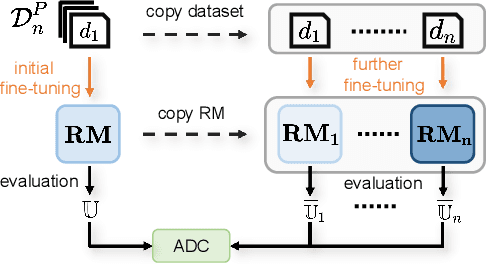

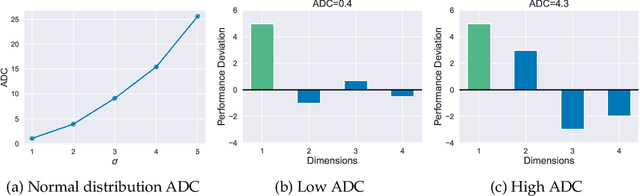
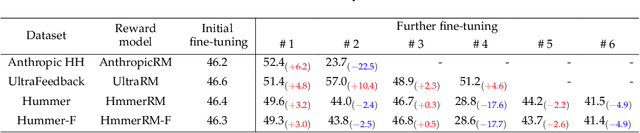
Preference datasets are essential for incorporating human preferences into pre-trained language models, playing a key role in the success of Reinforcement Learning from Human Feedback. However, these datasets often demonstrate conflicting alignment objectives, leading to increased vulnerability to jailbreak attacks and challenges in adapting downstream tasks to prioritize specific alignment objectives without negatively impacting others. In this work, we introduce a novel statistical metric, Alignment Dimension Conflict, to quantify the degree of conflict within preference datasets. We then present \texttt{Hummer} and its fine-grained variant, \texttt{Hummer-F}, as innovative pairwise preference datasets with reduced-conflict alignment objectives. \texttt{Hummer} is built based on UltraFeedback and is enhanced by AI feedback from GPT-4, marking as the first preference dataset aimed at reducing the competition between alignment objectives. Furthermore, we develop reward models, HummerRM and HummerRM-F, which employ a hybrid sampling approach to balance diverse alignment objectives effectively. This sampling method positions HummerRM as an ideal model for domain-specific further fine-tuning and reducing vulnerabilities to attacks.