 Add to Chrome
 Add to Firefox
 Add to Edge
BPP: Long-Context Robot Imitation Learning by Focusing on Key History Frames
Feb 16, 2026
Many robot tasks require attending to the history of past observations. For example, finding an item in a room requires remembering which places have already been searched. However, the best-performing robot policies typically condition only on the current observation, limiting their applicability to such tasks. Naively conditioning on past observations often fails due to spurious correlations: policies latch onto incidental features of training histories that do not generalize to out-of-distribution trajectories upon deployment. We analyze why policies latch onto these spurious correlations and find that this problem stems from limited coverage over the space of possible histories during training, which grows exponentially with horizon. Existing regularization techniques provide inconsistent benefits across tasks, as they do not fundamentally address this coverage problem. Motivated by these findings, we propose Big Picture Policies (BPP), an approach that conditions on a minimal set of meaningful keyframes detected by a vision-language model. By projecting diverse rollouts onto a compact set of task-relevant events, BPP substantially reduces distribution shift between training and deployment, without sacrificing expressivity. We evaluate BPP on four challenging real-world manipulation tasks and three simulation tasks, all requiring history conditioning. BPP achieves 70% higher success rates than the best comparison on real-world evaluations.

Evaluating Gemini Robotics Policies in a Veo World Simulator
Dec 11, 2025Generative world models hold significant potential for simulating interactions with visuomotor policies in varied environments. Frontier video models can enable generation of realistic observations and environment interactions in a scalable and general manner. However, the use of video models in robotics has been limited primarily to in-distribution evaluations, i.e., scenarios that are similar to ones used to train the policy or fine-tune the base video model. In this report, we demonstrate that video models can be used for the entire spectrum of policy evaluation use cases in robotics: from assessing nominal performance to out-of-distribution (OOD) generalization, and probing physical and semantic safety. We introduce a generative evaluation system built upon a frontier video foundation model (Veo). The system is optimized to support robot action conditioning and multi-view consistency, while integrating generative image-editing and multi-view completion to synthesize realistic variations of real-world scenes along multiple axes of generalization. We demonstrate that the system preserves the base capabilities of the video model to enable accurate simulation of scenes that have been edited to include novel interaction objects, novel visual backgrounds, and novel distractor objects. This fidelity enables accurately predicting the relative performance of different policies in both nominal and OOD conditions, determining the relative impact of different axes of generalization on policy performance, and performing red teaming of policies to expose behaviors that violate physical or semantic safety constraints. We validate these capabilities through 1600+ real-world evaluations of eight Gemini Robotics policy checkpoints and five tasks for a bimanual manipulator.
Gemini Robotics: Bringing AI into the Physical World
Mar 25, 2025Recent advancements in large multimodal models have led to the emergence of remarkable generalist capabilities in digital domains, yet their translation to physical agents such as robots remains a significant challenge. This report introduces a new family of AI models purposefully designed for robotics and built upon the foundation of Gemini 2.0. We present Gemini Robotics, an advanced Vision-Language-Action (VLA) generalist model capable of directly controlling robots. Gemini Robotics executes smooth and reactive movements to tackle a wide range of complex manipulation tasks while also being robust to variations in object types and positions, handling unseen environments as well as following diverse, open vocabulary instructions. We show that with additional fine-tuning, Gemini Robotics can be specialized to new capabilities including solving long-horizon, highly dexterous tasks, learning new short-horizon tasks from as few as 100 demonstrations and adapting to completely novel robot embodiments. This is made possible because Gemini Robotics builds on top of the Gemini Robotics-ER model, the second model we introduce in this work. Gemini Robotics-ER (Embodied Reasoning) extends Gemini's multimodal reasoning capabilities into the physical world, with enhanced spatial and temporal understanding. This enables capabilities relevant to robotics including object detection, pointing, trajectory and grasp prediction, as well as multi-view correspondence and 3D bounding box predictions. We show how this novel combination can support a variety of robotics applications. We also discuss and address important safety considerations related to this new class of robotics foundation models. The Gemini Robotics family marks a substantial step towards developing general-purpose robots that realizes AI's potential in the physical world.
A Short Note on Evaluating RepNet for Temporal Repetition Counting in Videos
Nov 13, 2024


We discuss some consistent issues on how RepNet has been evaluated in various papers. As a way to mitigate these issues, we report RepNet performance results on different datasets, and release evaluation code and the RepNet checkpoint to obtain these results. Code URL: https://github.com/google-research/google-research/blob/master/repnet/
Gen2Act: Human Video Generation in Novel Scenarios enables Generalizable Robot Manipulation
Sep 24, 2024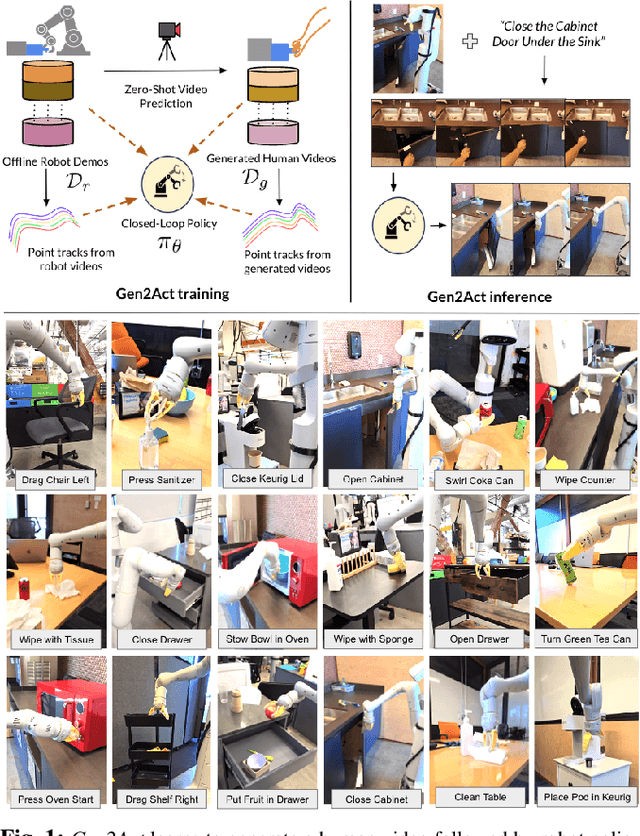

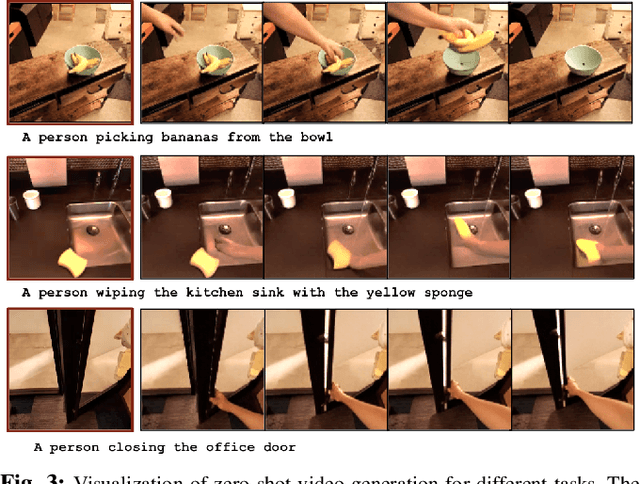
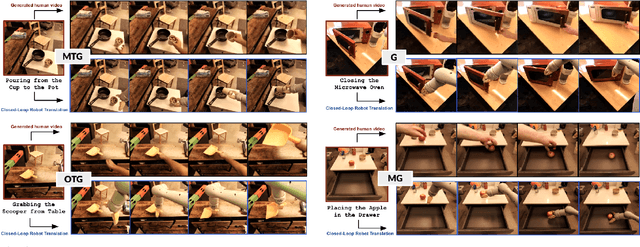
How can robot manipulation policies generalize to novel tasks involving unseen object types and new motions? In this paper, we provide a solution in terms of predicting motion information from web data through human video generation and conditioning a robot policy on the generated video. Instead of attempting to scale robot data collection which is expensive, we show how we can leverage video generation models trained on easily available web data, for enabling generalization. Our approach Gen2Act casts language-conditioned manipulation as zero-shot human video generation followed by execution with a single policy conditioned on the generated video. To train the policy, we use an order of magnitude less robot interaction data compared to what the video prediction model was trained on. Gen2Act doesn't require fine-tuning the video model at all and we directly use a pre-trained model for generating human videos. Our results on diverse real-world scenarios show how Gen2Act enables manipulating unseen object types and performing novel motions for tasks not present in the robot data. Videos are at https://homangab.github.io/gen2act/
OVR: A Dataset for Open Vocabulary Temporal Repetition Counting in Videos
Jul 24, 2024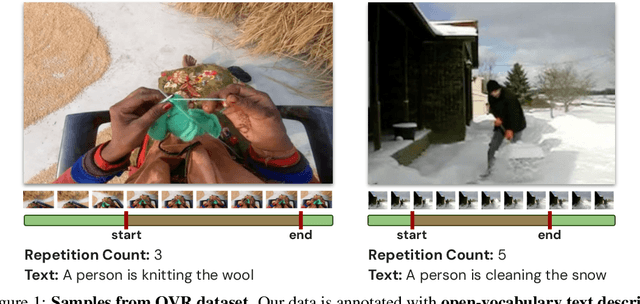
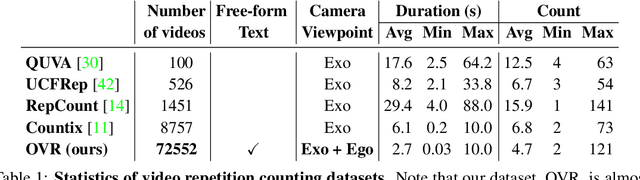
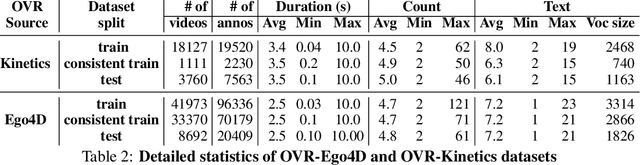
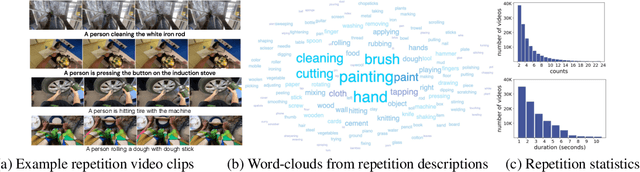
We introduce a dataset of annotations of temporal repetitions in videos. The dataset, OVR (pronounced as over), contains annotations for over 72K videos, with each annotation specifying the number of repetitions, the start and end time of the repetitions, and also a free-form description of what is repeating. The annotations are provided for videos sourced from Kinetics and Ego4D, and consequently cover both Exo and Ego viewing conditions, with a huge variety of actions and activities. Moreover, OVR is almost an order of magnitude larger than previous datasets for video repetition. We also propose a baseline transformer-based counting model, OVRCounter, that can localise and count repetitions in videos that are up to 320 frames long. The model is trained and evaluated on the OVR dataset, and its performance assessed with and without using text to specify the target class to count. The performance is also compared to a prior repetition counting model. The dataset is available for download at: https://sites.google.com/view/openvocabreps/
Vid2Robot: End-to-end Video-conditioned Policy Learning with Cross-Attention Transformers
Mar 19, 2024


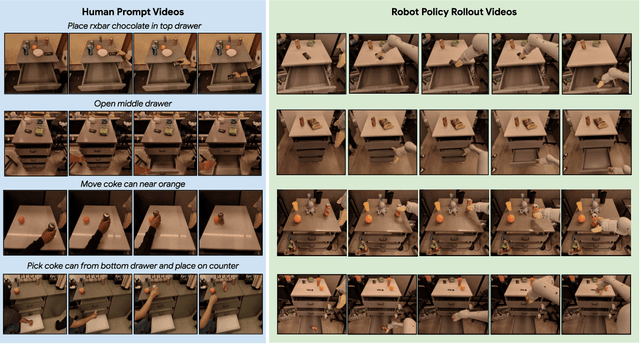
While large-scale robotic systems typically rely on textual instructions for tasks, this work explores a different approach: can robots infer the task directly from observing humans? This shift necessitates the robot's ability to decode human intent and translate it into executable actions within its physical constraints and environment. We introduce Vid2Robot, a novel end-to-end video-based learning framework for robots. Given a video demonstration of a manipulation task and current visual observations, Vid2Robot directly produces robot actions. This is achieved through a unified representation model trained on a large dataset of human video and robot trajectory. The model leverages cross-attention mechanisms to fuse prompt video features to the robot's current state and generate appropriate actions that mimic the observed task. To further improve policy performance, we propose auxiliary contrastive losses that enhance the alignment between human and robot video representations. We evaluate Vid2Robot on real-world robots, demonstrating a 20% improvement in performance compared to other video-conditioned policies when using human demonstration videos. Additionally, our model exhibits emergent capabilities, such as successfully transferring observed motions from one object to another, and long-horizon composition, thus showcasing its potential for real-world applications. Project website: vid2robot.github.io
FlexCap: Generating Rich, Localized, and Flexible Captions in Images
Mar 18, 2024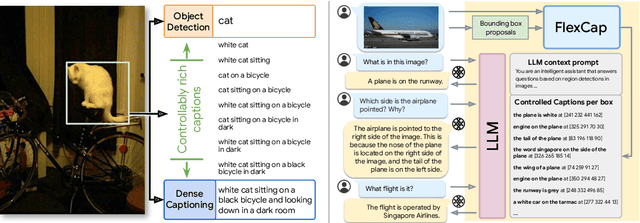
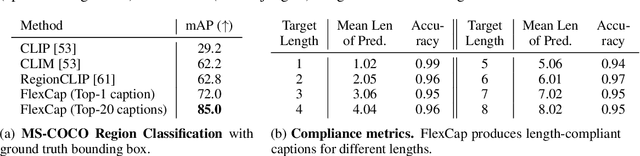
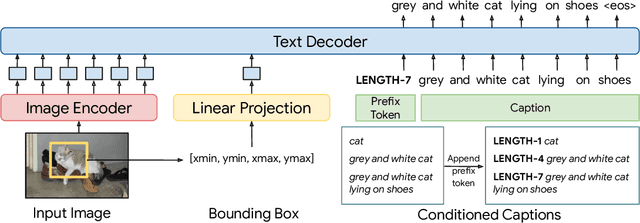

We introduce a versatile $\textit{flexible-captioning}$ vision-language model (VLM) capable of generating region-specific descriptions of varying lengths. The model, FlexCap, is trained to produce length-conditioned captions for input bounding boxes, and this allows control over the information density of its output, with descriptions ranging from concise object labels to detailed captions. To achieve this we create large-scale training datasets of image region descriptions of varying length, starting from captioned images. This flexible-captioning capability has several valuable applications. First, FlexCap demonstrates superior performance in dense captioning tasks on the Visual Genome dataset. Second, a visual question answering (VQA) system can be built by employing FlexCap to generate localized descriptions as inputs to a large language model. The resulting system achieves state-of-the-art zero-shot performance on a number of VQA datasets. We also demonstrate a $\textit{localize-then-describe}$ approach with FlexCap can be better at open-ended object detection than a $\textit{describe-then-localize}$ approach with other VLMs. We highlight a novel characteristic of FlexCap, which is its ability to extract diverse visual information through prefix conditioning. Finally, we qualitatively demonstrate FlexCap's broad applicability in tasks such as image labeling, object attribute recognition, and visual dialog. Project webpage: https://flex-cap.github.io .
RT-H: Action Hierarchies Using Language
Mar 04, 2024
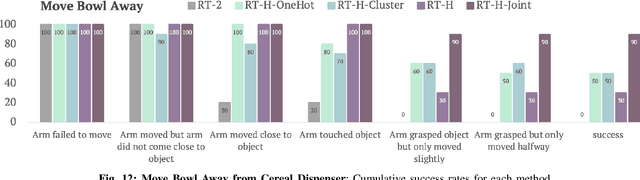
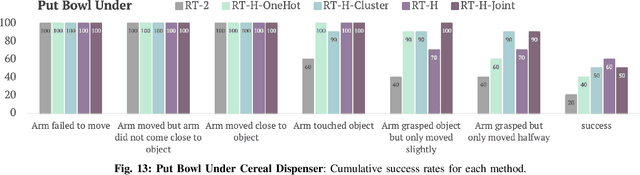

Language provides a way to break down complex concepts into digestible pieces. Recent works in robot imitation learning use language-conditioned policies that predict actions given visual observations and the high-level task specified in language. These methods leverage the structure of natural language to share data between semantically similar tasks (e.g., "pick coke can" and "pick an apple") in multi-task datasets. However, as tasks become more semantically diverse (e.g., "pick coke can" and "pour cup"), sharing data between tasks becomes harder, so learning to map high-level tasks to actions requires much more demonstration data. To bridge tasks and actions, our insight is to teach the robot the language of actions, describing low-level motions with more fine-grained phrases like "move arm forward". Predicting these language motions as an intermediate step between tasks and actions forces the policy to learn the shared structure of low-level motions across seemingly disparate tasks. Furthermore, a policy that is conditioned on language motions can easily be corrected during execution through human-specified language motions. This enables a new paradigm for flexible policies that can learn from human intervention in language. Our method RT-H builds an action hierarchy using language motions: it first learns to predict language motions, and conditioned on this and the high-level task, it predicts actions, using visual context at all stages. We show that RT-H leverages this language-action hierarchy to learn policies that are more robust and flexible by effectively tapping into multi-task datasets. We show that these policies not only allow for responding to language interventions, but can also learn from such interventions and outperform methods that learn from teleoperated interventions. Our website and videos are found at https://rt-hierarchy.github.io.
AutoRT: Embodied Foundation Models for Large Scale Orchestration of Robotic Agents
Jan 23, 2024Foundation models that incorporate language, vision, and more recently actions have revolutionized the ability to harness internet scale data to reason about useful tasks. However, one of the key challenges of training embodied foundation models is the lack of data grounded in the physical world. In this paper, we propose AutoRT, a system that leverages existing foundation models to scale up the deployment of operational robots in completely unseen scenarios with minimal human supervision. AutoRT leverages vision-language models (VLMs) for scene understanding and grounding, and further uses large language models (LLMs) for proposing diverse and novel instructions to be performed by a fleet of robots. Guiding data collection by tapping into the knowledge of foundation models enables AutoRT to effectively reason about autonomy tradeoffs and safety while significantly scaling up data collection for robot learning. We demonstrate AutoRT proposing instructions to over 20 robots across multiple buildings and collecting 77k real robot episodes via both teleoperation and autonomous robot policies. We experimentally show that such "in-the-wild" data collected by AutoRT is significantly more diverse, and that AutoRT's use of LLMs allows for instruction following data collection robots that can align to human preferences.