 Add to Chrome
 Add to Firefox
 Add to Edge
RedunCut: Measurement-Driven Sampling and Accuracy Performance Modeling for Low-Cost Live Video Analytics
Dec 30, 2025
Live video analytics (LVA) runs continuously across massive camera fleets, but inference cost with modern vision models remains high. To address this, dynamic model size selection (DMSS) is an attractive approach: it is content-aware but treats models as black boxes, and could potentially reduce cost by up to 10x without model retraining or modification. Without ground truth labels at runtime, we observe that DMSS methods use two stages per segment: (i) sampling a few models to calculate prediction statistics (e.g., confidences), then (ii) selection of the model size from those statistics. Prior systems fail to generalize to diverse workloads, particularly to mobile videos and lower accuracy targets. We identify that the failure modes stem from inefficient sampling whose cost exceeds its benefit, and inaccurate per-segment accuracy prediction. In this work, we present RedunCut, a new DMSS system that addresses both: It uses a measurement-driven planner that estimates the cost-benefit tradeoff of sampling, and a lightweight, data-driven performance model to improve accuracy prediction. Across road-vehicle, drone, and surveillance videos and multiple model families and tasks, RedunCut reduces compute cost by 14-62% at fixed accuracy and remains robust to limited historical data and to drift.

Let the Barbarians In: How AI Can Accelerate Systems Performance Research
Dec 22, 2025Artificial Intelligence (AI) is beginning to transform the research process by automating the discovery of new solutions. This shift depends on the availability of reliable verifiers, which AI-driven approaches require to validate candidate solutions. Research focused on improving systems performance is especially well-suited to this paradigm because system performance problems naturally admit such verifiers: candidates can be implemented in real systems or simulators and evaluated against predefined workloads. We term this iterative cycle of generation, evaluation, and refinement AI-Driven Research for Systems (ADRS). Using several open-source ADRS instances (i.e., OpenEvolve, GEPA, and ShinkaEvolve), we demonstrate across ten case studies (e.g., multi-region cloud scheduling, mixture-of-experts load balancing, LLM-based SQL, transaction scheduling) that ADRS-generated solutions can match or even outperform human state-of-the-art designs. Based on these findings, we outline best practices (e.g., level of prompt specification, amount of feedback, robust evaluation) for effectively using ADRS, and we discuss future research directions and their implications. Although we do not yet have a universal recipe for applying ADRS across all of systems research, we hope our preliminary findings, together with the challenges we identify, offer meaningful guidance for future work as researcher effort shifts increasingly toward problem formulation and strategic oversight. Note: This paper is an extension of our prior work [14]. It adds extensive evaluation across multiple ADRS frameworks and provides deeper analysis and insights into best practices.
UCCL-EP: Portable Expert-Parallel Communication
Dec 22, 2025Mixture-of-Experts (MoE) workloads rely on expert parallelism (EP) to achieve high GPU efficiency. State-of-the-art EP communication systems such as DeepEP demonstrate strong performance but exhibit poor portability across heterogeneous GPU and NIC platforms. The poor portability is rooted in architecture: GPU-initiated token-level RDMA communication requires tight vertical integration between GPUs and NICs, e.g., GPU writes to NIC driver/MMIO interfaces. We present UCCL-EP, a portable EP communication system that delivers DeepEP-level performance across heterogeneous GPU and NIC hardware. UCCL-EP replaces GPU-initiated RDMA with a high-throughput GPU-CPU control channel: compact token-routing commands are transferred to multithreaded CPU proxies, which then issue GPUDirect RDMA operations on behalf of GPUs. UCCL-EP further emulates various ordering semantics required by specialized EP communication modes using RDMA immediate data, enabling correctness on NICs that lack such ordering, e.g., AWS EFA. We implement UCCL-EP on NVIDIA and AMD GPUs with EFA and Broadcom NICs. On EFA, it outperforms the best existing EP solution by up to $2.1\times$ for dispatch and combine throughput. On NVIDIA-only platform, UCCL-EP achieves comparable performance to the original DeepEP. UCCL-EP also improves token throughput on SGLang by up to 40% on the NVIDIA+EFA platform, and improves DeepSeek-V3 training throughput over the AMD Primus/Megatron-LM framework by up to 45% on a 16-node AMD+Broadcom platform.
TurboDiffusion: Accelerating Video Diffusion Models by 100-200 Times
Dec 18, 2025We introduce TurboDiffusion, a video generation acceleration framework that can speed up end-to-end diffusion generation by 100-200x while maintaining video quality. TurboDiffusion mainly relies on several components for acceleration: (1) Attention acceleration: TurboDiffusion uses low-bit SageAttention and trainable Sparse-Linear Attention (SLA) to speed up attention computation. (2) Step distillation: TurboDiffusion adopts rCM for efficient step distillation. (3) W8A8 quantization: TurboDiffusion quantizes model parameters and activations to 8 bits to accelerate linear layers and compress the model. In addition, TurboDiffusion incorporates several other engineering optimizations. We conduct experiments on the Wan2.2-I2V-14B-720P, Wan2.1-T2V-1.3B-480P, Wan2.1-T2V-14B-720P, and Wan2.1-T2V-14B-480P models. Experimental results show that TurboDiffusion achieves 100-200x speedup for video generation even on a single RTX 5090 GPU, while maintaining comparable video quality. The GitHub repository, which includes model checkpoints and easy-to-use code, is available at https://github.com/thu-ml/TurboDiffusion.
FrontierCS: Evolving Challenges for Evolving Intelligence
Dec 17, 2025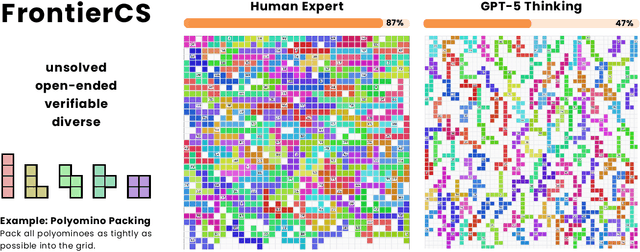

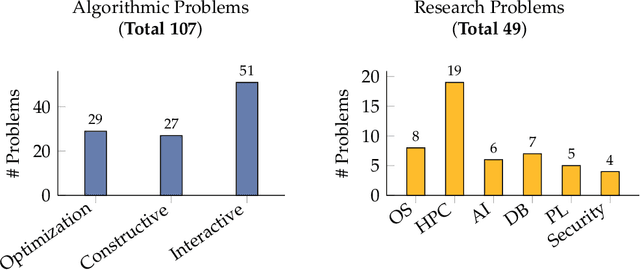

We introduce FrontierCS, a benchmark of 156 open-ended problems across diverse areas of computer science, designed and reviewed by experts, including CS PhDs and top-tier competitive programming participants and problem setters. Unlike existing benchmarks that focus on tasks with known optimal solutions, FrontierCS targets problems where the optimal solution is unknown, but the quality of a solution can be objectively evaluated. Models solve these tasks by implementing executable programs rather than outputting a direct answer. FrontierCS includes algorithmic problems, which are often NP-hard variants of competitive programming problems with objective partial scoring, and research problems with the same property. For each problem we provide an expert reference solution and an automatic evaluator. Combining open-ended design, measurable progress, and expert curation, FrontierCS provides a benchmark at the frontier of computer-science difficulty. Empirically, we find that frontier reasoning models still lag far behind human experts on both the algorithmic and research tracks, that increasing reasoning budgets alone does not close this gap, and that models often over-optimize for generating merely workable code instead of discovering high-quality algorithms and system designs.
SonicMoE: Accelerating MoE with IO and Tile-aware Optimizations
Dec 16, 2025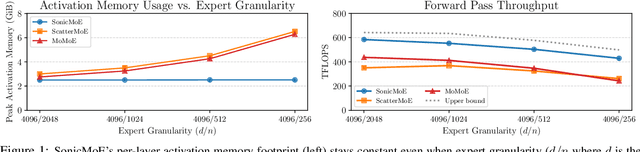
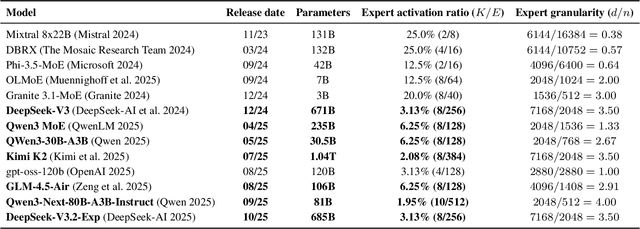
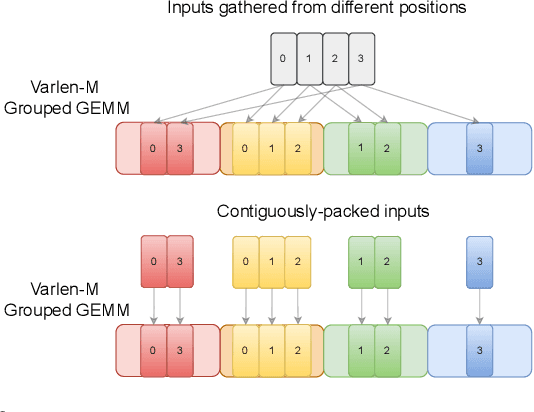
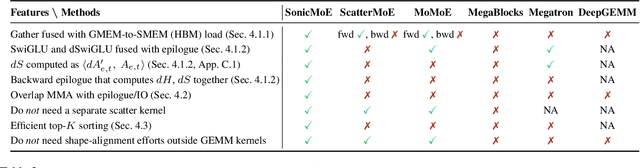
Mixture of Experts (MoE) models have emerged as the de facto architecture for scaling up language models without significantly increasing the computational cost. Recent MoE models demonstrate a clear trend towards high expert granularity (smaller expert intermediate dimension) and higher sparsity (constant number of activated experts with higher number of total experts), which improve model quality per FLOP. However, fine-grained MoEs suffer from increased activation memory footprint and reduced hardware efficiency due to higher IO costs, while sparser MoEs suffer from wasted computations due to padding in Grouped GEMM kernels. In response, we propose a memory-efficient algorithm to compute the forward and backward passes of MoEs with minimal activation caching for the backward pass. We also design GPU kernels that overlap memory IO with computation benefiting all MoE architectures. Finally, we propose a novel "token rounding" method that minimizes the wasted compute due to padding in Grouped GEMM kernels. As a result, our method SonicMoE reduces activation memory by 45% and achieves a 1.86x compute throughput improvement on Hopper GPUs compared to ScatterMoE's BF16 MoE kernel for a fine-grained 7B MoE. Concretely, SonicMoE on 64 H100s achieves a training throughput of 213 billion tokens per day comparable to ScatterMoE's 225 billion tokens per day on 96 H100s for a 7B MoE model training with FSDP-2 using the lm-engine codebase. Under high MoE sparsity settings, our tile-aware token rounding algorithm yields an additional 1.16x speedup on kernel execution time compared to vanilla top-$K$ routing while maintaining similar downstream performance. We open-source all our kernels to enable faster MoE model training.
RLBoost: Harvesting Preemptible Resources for Cost-Efficient Reinforcement Learning on LLMs
Oct 22, 2025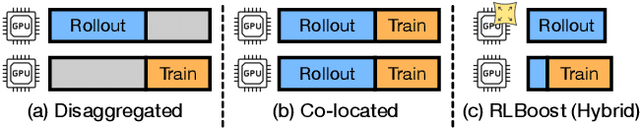
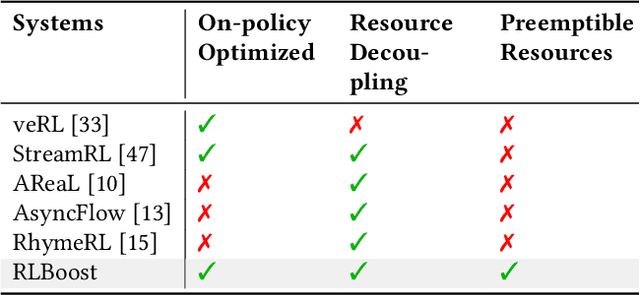
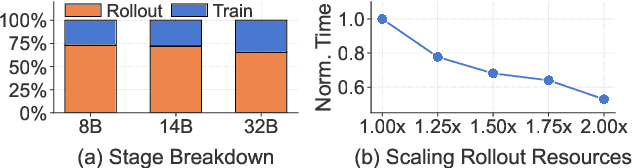
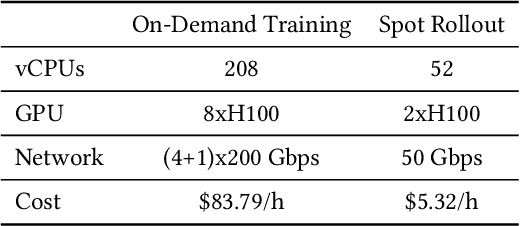
Reinforcement learning (RL) has become essential for unlocking advanced reasoning capabilities in large language models (LLMs). RL workflows involve interleaving rollout and training stages with fundamentally different resource requirements. Rollout typically dominates overall execution time, yet scales efficiently through multiple independent instances. In contrast, training requires tightly-coupled GPUs with full-mesh communication. Existing RL frameworks fall into two categories: co-located and disaggregated architectures. Co-located ones fail to address this resource tension by forcing both stages to share the same GPUs. Disaggregated architectures, without modifications of well-established RL algorithms, suffer from resource under-utilization. Meanwhile, preemptible GPU resources, i.e., spot instances on public clouds and spare capacity in production clusters, present significant cost-saving opportunities for accelerating RL workflows, if efficiently harvested for rollout. In this paper, we present RLBoost, a systematic solution for cost-efficient RL training that harvests preemptible GPU resources. Our key insight is that rollout's stateless and embarrassingly parallel nature aligns perfectly with preemptible and often fragmented resources. To efficiently utilize these resources despite frequent and unpredictable availability changes, RLBoost adopts a hybrid architecture with three key techniques: (1) adaptive rollout offload to dynamically adjust workloads on the reserved (on-demand) cluster, (2) pull-based weight transfer that quickly provisions newly available instances, and (3) token-level response collection and migration for efficient preemption handling and continuous load balancing. Extensive experiments show RLBoost increases training throughput by 1.51x-1.97x while improving cost efficiency by 28%-49% compared to using only on-demand GPU resources.
DeepScholar-Bench: A Live Benchmark and Automated Evaluation for Generative Research Synthesis
Aug 27, 2025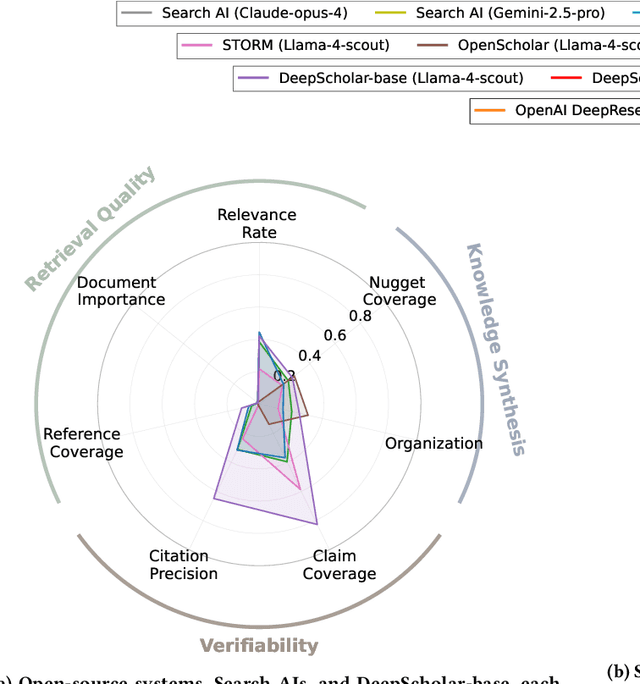
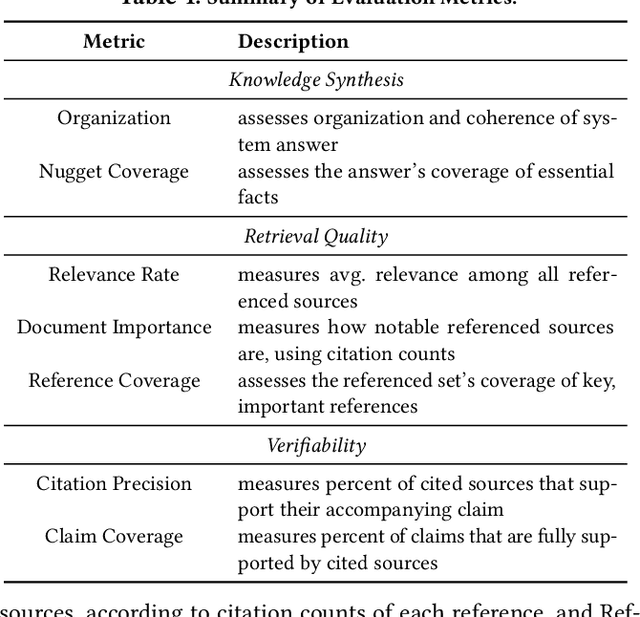
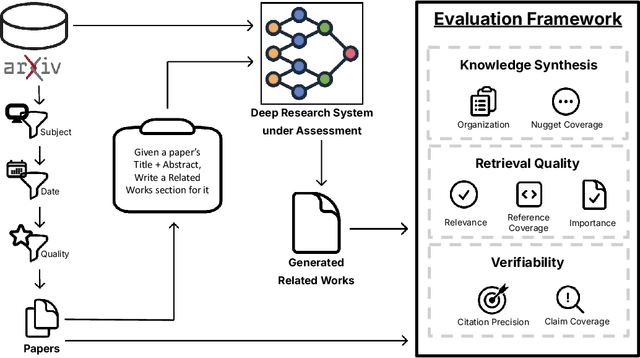
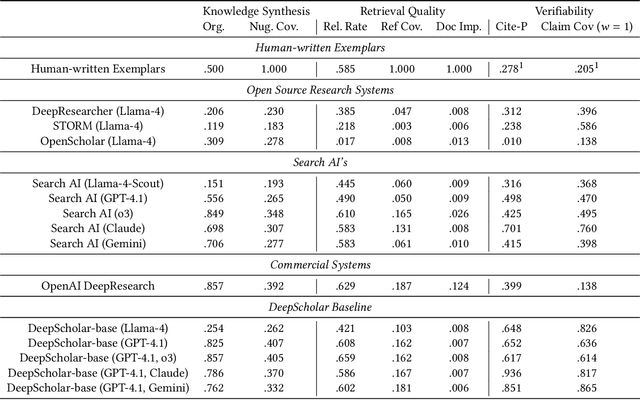
The ability to research and synthesize knowledge is central to human expertise and progress. An emerging class of systems promises these exciting capabilities through generative research synthesis, performing retrieval over the live web and synthesizing discovered sources into long-form, cited summaries. However, evaluating such systems remains an open challenge: existing question-answering benchmarks focus on short-form factual responses, while expert-curated datasets risk staleness and data contamination. Both fail to capture the complexity and evolving nature of real research synthesis tasks. In this work, we introduce DeepScholar-bench, a live benchmark and holistic, automated evaluation framework designed to evaluate generative research synthesis. DeepScholar-bench draws queries from recent, high-quality ArXiv papers and focuses on a real research synthesis task: generating the related work sections of a paper by retrieving, synthesizing, and citing prior research. Our evaluation framework holistically assesses performance across three key dimensions, knowledge synthesis, retrieval quality, and verifiability. We also develop DeepScholar-base, a reference pipeline implemented efficiently using the LOTUS API. Using the DeepScholar-bench framework, we perform a systematic evaluation of prior open-source systems, search AI's, OpenAI's DeepResearch, and DeepScholar-base. We find that DeepScholar-base establishes a strong baseline, attaining competitive or higher performance than each other method. We also find that DeepScholar-bench remains far from saturated, with no system exceeding a score of $19\%$ across all metrics. These results underscore the difficulty of DeepScholar-bench, as well as its importance for progress towards AI systems capable of generative research synthesis. We make our code available at https://github.com/guestrin-lab/deepscholar-bench.
Establishing Best Practices for Building Rigorous Agentic Benchmarks
Jul 03, 2025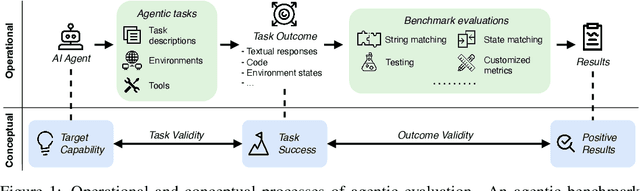
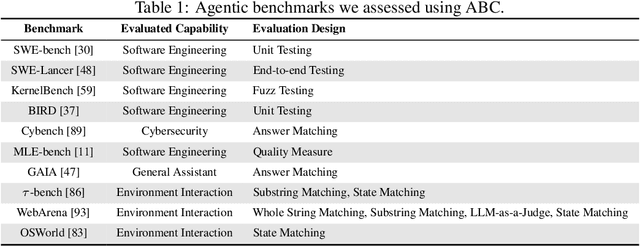
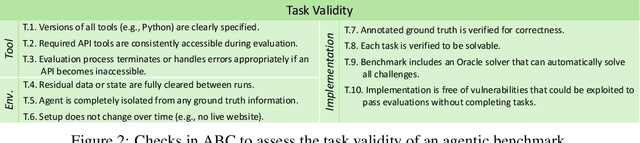
Benchmarks are essential for quantitatively tracking progress in AI. As AI agents become increasingly capable, researchers and practitioners have introduced agentic benchmarks to evaluate agents on complex, real-world tasks. These benchmarks typically measure agent capabilities by evaluating task outcomes via specific reward designs. However, we show that many agentic benchmarks have issues task setup or reward design. For example, SWE-bench Verified uses insufficient test cases, while TAU-bench counts empty responses as successful. Such issues can lead to under- or overestimation agents' performance by up to 100% in relative terms. To make agentic evaluation rigorous, we introduce the Agentic Benchmark Checklist (ABC), a set of guidelines that we synthesized from our benchmark-building experience, a survey of best practices, and previously reported issues. When applied to CVE-Bench, a benchmark with a particularly complex evaluation design, ABC reduces the performance overestimation by 33%.
Radial Attention: $O(n\log n)$ Sparse Attention with Energy Decay for Long Video Generation
Jun 24, 2025Recent advances in diffusion models have enabled high-quality video generation, but the additional temporal dimension significantly increases computational costs, making training and inference on long videos prohibitively expensive. In this paper, we identify a phenomenon we term Spatiotemporal Energy Decay in video diffusion models: post-softmax attention scores diminish as spatial and temporal distance between tokens increase, akin to the physical decay of signal or waves over space and time in nature. Motivated by this, we propose Radial Attention, a scalable sparse attention mechanism with $O(n \log n)$ complexity that translates energy decay into exponentially decaying compute density, which is significantly more efficient than standard $O(n^2)$ dense attention and more expressive than linear attention. Specifically, Radial Attention employs a simple, static attention mask where each token attends to spatially nearby tokens, with the attention window size shrinking with temporal distance. Moreover, it allows pre-trained video diffusion models to extend their generation length with efficient LoRA-based fine-tuning. Extensive experiments show that Radial Attention maintains video quality across Wan2.1-14B, HunyuanVideo, and Mochi 1, achieving up to a 1.9$\times$ speedup over the original dense attention. With minimal tuning, it enables video generation up to 4$\times$ longer while reducing training costs by up to 4.4$\times$ compared to direct fine-tuning and accelerating inference by up to 3.7$\times$ compared to dense attention inference.