 Add to Chrome
 Add to Firefox
 Add to Edge
FlexComposer: Unified Video Compositing from Images to Dynamic Footage with Flexible Trajectory Control
Jul 31, 2026
Generative video compositing, which involves inserting external assets seamlessly into existing video sequences, is essential for content creation and visual effects. However, existing approaches suffer from a control-fidelity trade-off: they either hallucinate motion from static images, failing to preserve the dynamics of pre-animated assets, or lack fine-grained spatial control for precise asset placement along user-defined trajectories. We propose FlexComposer, a unified framework that standardizes video compositing as a trajectory-guided conditional generation task, enabling the seamless integration of both static images and dynamic footage. Our approach introduces three key designs: (1) a Unified Canonical Foreground Representation that decouples an object's intrinsic motion from its global displacement, standardizing heterogeneous inputs into a stabilized, centered latent space; (2) a Spatial-Aware Latent Injection strategy that exploits the translation equivariance of VAE latent spaces to transport canonical features onto target trajectories via a parameter-free mechanism; and (3) a Hybrid Dataset and Synthetic-to-Real Curriculum that synergizes procedural simulation, real-world cinematic footage, and generative data to implicitly learn physically plausible illumination and shadow harmonization. This unified design handles diverse inputs from product photos to dynamic subjects achieving high-fidelity motion control and environmental integration without the need for explicit 3D reconstruction or auxiliary learnable adapters. Extensive experiments demonstrate that FlexComposer outperforms state-of-the-art methods in visual quality, temporal consistency, and trajectory adherence.

Masked Visual Actions for Unified World Modeling
Jul 21, 2026Video models absorb rich priors over how the visual world moves, interacts, and responds to contact, making them promising substrates for robotic world modeling. The central challenge is how to communicate action to such models in a form aligned with the visual space in which they learned these interaction priors, yet still grounded in physical manipulation. We introduce Masked Visual Actions, a pixel-space control interface that expresses action as a partially revealed trajectory of an arbitrary entity in a video. Revealing robot motion makes the model act as a forward dynamics model that predicts the scene's response to low-level robot actions, while revealing desired object motion makes the same model recover robot behavior consistent with that outcome. Finetuned with only 15 hours of masked examples from real videos and simulation, a single checkpoint achieves strong visual fidelity and controllability across diverse scenes and multiple embodiments. In downstream manipulation settings, the model produces imagined rollouts whose outcomes correlate with real-world execution for policy evaluation, improves decision making by ranking candidate futures in model-based planning, and supports inverse modeling by synthesizing robot motion from desired object motion.
FourTune: Towards Fully 4-Bit Efficient Post-Training for Diffusion Models
Jul 07, 2026Diffusion models have become a dominant paradigm for high-quality generative modeling, while post-training is essential for adapting them to diverse downstream applications. However, post-training of large diffusion models is still challenging due to the prohibitive memory footprints and slow training speed, which existing parameter-efficient fine-tuning methods only partially address. To overcome these limitations, we propose FourTune, an efficient post-training framework for diffusion models based on an end-to-end W4A4G4 paradigm. FourTune introduces a triple-branch hybrid pipeline that augments the standard LoRA architecture with a frozen numerical stabilizer to isolate quantization-sensitive outliers, enabling stable training under native 4-bit computation. In addition, FourTune employs hardware-efficient block-wise quantization and customized fused kernels to support efficient quantized backpropagation and reduce memory bandwidth overhead. Across customization, reinforcement learning, and distillation tasks, FourTune matches the quality of full-precision fine-tuning. On FLUX.1-dev (12B), FourTune reduces memory overhead by 2.25$\times$ and increases end-to-end training throughput by 2.27$\times$ compared to BF16 LoRA.
EvalVerse: Pipeline-Aware and Expert-Calibrated Benchmarking for Professional Cinematic Video Generation
May 22, 2026The rapid evolution of generative video foundation models has propelled the field toward professional-grade cinematic synthesis. To achieve such demanding quality, the community transitions towards Reinforcement Learning (RL) and agentic workflows. However, reliable evaluation has emerged as a critical bottleneck. Existing benchmarks predominantly evaluate ''whether it is right'' (basic prompt-following) while fundamentally neglecting ''whether it is good'' (cinematic quality, acting, and aesthetics). Furthermore, current automated metrics lack the domain-specific rigor required to provide trustworthy signals, creating a severe credibility gap between human aesthetic perception and machine scoring. To bridge this gap, we introduce EvalVerse, a comprehensive, pipeline-aware, and expert-calibrated evaluation framework. We treat video generation assessment not merely as an engineering task, but as a core scientific problem: the systematic digitization of subjective cinematic expertise. First, we organize domain knowledge into an evaluation taxonomy aligned with the professional filmmaking workflow (pre-production, production, and post-production). Second, we distill human expert judgments into a curated dataset with large-scale human annotations. Third, we inject this knowledge into Vision-Language Models (VLMs) through an expert-calibrated fine-tuning strategy, enabling the VLM to perform explicit Chain-of-Thought reasoning. Compared to previous works, EvalVerse not only retains compatibility with foundational ''rightness'' metrics, but also significantly expands the criteria to ''goodness'' and broaden the task coverage to complex multi-shot sequencing and audio-visual integration. Consequently, by providing granular diagnostic signals, EvalVerse transcends a static leaderboard and establishes a fundamental infrastructure for future work, such as reward models and evaluator agent.
View-oriented Conversation Compiler for Agent Trace Analysis
Apr 01, 2026Agent traces carry increasing analytical value in agentic systems and context engineering, yet most prior work treats conversation format as a trivial implementation detail. Modern agent conversations, however, contain deeply structured content, including nested tool calls and results, chain-of-thought reasoning blocks, sub-agent invocations, context-window compaction boundaries, and harness-injected system directives, whose complexity far exceeds that of simple user-assistant exchanges. Feeding such traces to a reflector or other analytical mechanism in plain text, JSON, YAML, or via grep can materially degrade analysis quality. This paper presents VCC (View-oriented Conversation Compiler), a compiler (lex, parse, IR, lower, emit) that transforms raw agent JSONL logs into a family of structured views: a full view (lossless transcript serving as the canonical line-number coordinate system), a user-interface (UI) view (reconstructing the interaction as the user actually perceived it), and an adaptive view (a structure-preserving projection governed by a relevance predicate). In a context-engineering experiment on AppWorld, replacing only the reflector's input format, from raw JSONL to VCC-compiled views, leads to higher pass rates across all three model configurations tested, while cutting reflector token consumption by half to two-thirds and producing more concise learned memory. These results suggest that message format functions as infrastructure for context engineering, not as an incidental implementation choice.
Mode Seeking meets Mean Seeking for Fast Long Video Generation
Feb 27, 2026Scaling video generation from seconds to minutes faces a critical bottleneck: while short-video data is abundant and high-fidelity, coherent long-form data is scarce and limited to narrow domains. To address this, we propose a training paradigm where Mode Seeking meets Mean Seeking, decoupling local fidelity from long-term coherence based on a unified representation via a Decoupled Diffusion Transformer. Our approach utilizes a global Flow Matching head trained via supervised learning on long videos to capture narrative structure, while simultaneously employing a local Distribution Matching head that aligns sliding windows to a frozen short-video teacher via a mode-seeking reverse-KL divergence. This strategy enables the synthesis of minute-scale videos that learns long-range coherence and motions from limited long videos via supervised flow matching, while inheriting local realism by aligning every sliding-window segment of the student to a frozen short-video teacher, resulting in a few-step fast long video generator. Evaluations show that our method effectively closes the fidelity-horizon gap by jointly improving local sharpness, motion and long-range consistency. Project website: https://primecai.github.io/mmm/.
Pretraining Frame Preservation in Autoregressive Video Memory Compression
Dec 29, 2025We present PFP, a neural network structure to compress long videos into short contexts, with an explicit pretraining objective to preserve the high-frequency details of single frames at arbitrary temporal positions. The baseline model can compress a 20-second video into a context at about 5k length, where random frames can be retrieved with perceptually preserved appearances. Such pretrained models can be directly fine-tuned as memory encoders for autoregressive video models, enabling long history memory with low context cost and relatively low fidelity loss. We evaluate the framework with ablative settings and discuss the trade-offs of possible neural architecture designs.
StreamDiffusionV2: A Streaming System for Dynamic and Interactive Video Generation
Nov 10, 2025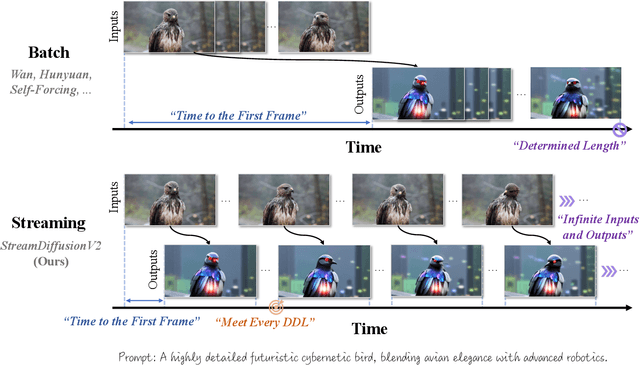

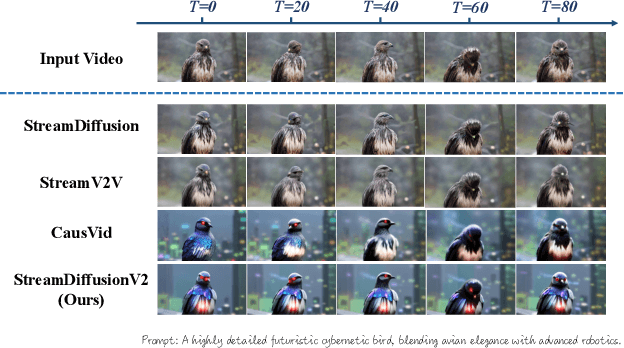
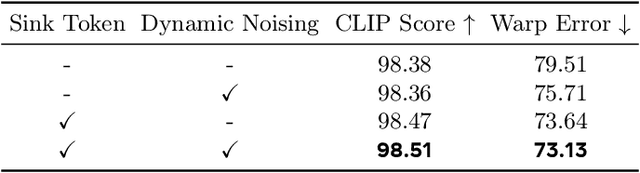
Generative models are reshaping the live-streaming industry by redefining how content is created, styled, and delivered. Previous image-based streaming diffusion models have powered efficient and creative live streaming products but have hit limits on temporal consistency due to the foundation of image-based designs. Recent advances in video diffusion have markedly improved temporal consistency and sampling efficiency for offline generation. However, offline generation systems primarily optimize throughput by batching large workloads. In contrast, live online streaming operates under strict service-level objectives (SLOs): time-to-first-frame must be minimal, and every frame must meet a per-frame deadline with low jitter. Besides, scalable multi-GPU serving for real-time streams remains largely unresolved so far. To address this, we present StreamDiffusionV2, a training-free pipeline for interactive live streaming with video diffusion models. StreamDiffusionV2 integrates an SLO-aware batching scheduler and a block scheduler, together with a sink-token--guided rolling KV cache, a motion-aware noise controller, and other system-level optimizations. Moreover, we introduce a scalable pipeline orchestration that parallelizes the diffusion process across denoising steps and network layers, achieving near-linear FPS scaling without violating latency guarantees. The system scales seamlessly across heterogeneous GPU environments and supports flexible denoising steps (e.g., 1--4), enabling both ultra-low-latency and higher-quality modes. Without TensorRT or quantization, StreamDiffusionV2 renders the first frame within 0.5s and attains 58.28 FPS with a 14B-parameter model and 64.52 FPS with a 1.3B-parameter model on four H100 GPUs, making state-of-the-art generative live streaming practical and accessible--from individual creators to enterprise-scale platforms.
Taming Flow-based I2V Models for Creative Video Editing
Sep 26, 2025Although image editing techniques have advanced significantly, video editing, which aims to manipulate videos according to user intent, remains an emerging challenge. Most existing image-conditioned video editing methods either require inversion with model-specific design or need extensive optimization, limiting their capability of leveraging up-to-date image-to-video (I2V) models to transfer the editing capability of image editing models to the video domain. To this end, we propose IF-V2V, an Inversion-Free method that can adapt off-the-shelf flow-matching-based I2V models for video editing without significant computational overhead. To circumvent inversion, we devise Vector Field Rectification with Sample Deviation to incorporate information from the source video into the denoising process by introducing a deviation term into the denoising vector field. To further ensure consistency with the source video in a model-agnostic way, we introduce Structure-and-Motion-Preserving Initialization to generate motion-aware temporally correlated noise with structural information embedded. We also present a Deviation Caching mechanism to minimize the additional computational cost for denoising vector rectification without significantly impacting editing quality. Evaluations demonstrate that our method achieves superior editing quality and consistency over existing approaches, offering a lightweight plug-and-play solution to realize visual creativity.
Mixture of Contexts for Long Video Generation
Aug 28, 2025Long video generation is fundamentally a long context memory problem: models must retain and retrieve salient events across a long range without collapsing or drifting. However, scaling diffusion transformers to generate long-context videos is fundamentally limited by the quadratic cost of self-attention, which makes memory and computation intractable and difficult to optimize for long sequences. We recast long-context video generation as an internal information retrieval task and propose a simple, learnable sparse attention routing module, Mixture of Contexts (MoC), as an effective long-term memory retrieval engine. In MoC, each query dynamically selects a few informative chunks plus mandatory anchors (caption, local windows) to attend to, with causal routing that prevents loop closures. As we scale the data and gradually sparsify the routing, the model allocates compute to salient history, preserving identities, actions, and scenes over minutes of content. Efficiency follows as a byproduct of retrieval (near-linear scaling), which enables practical training and synthesis, and the emergence of memory and consistency at the scale of minutes.