 Add to Chrome
 Add to Firefox
 Add to Edge
FrontierCS: Evolving Challenges for Evolving Intelligence
Dec 17, 2025
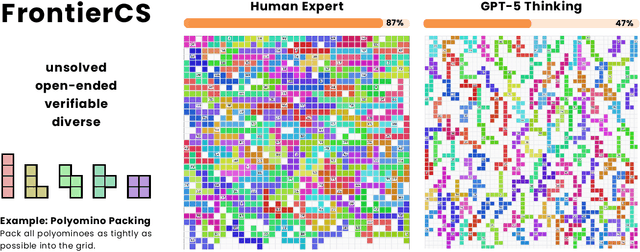

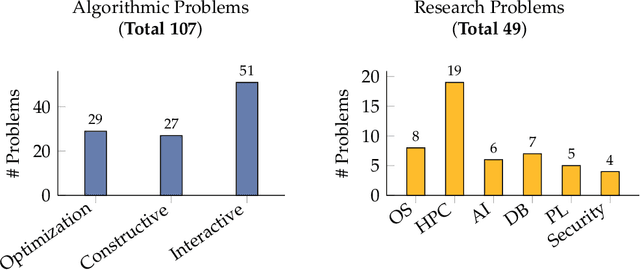

We introduce FrontierCS, a benchmark of 156 open-ended problems across diverse areas of computer science, designed and reviewed by experts, including CS PhDs and top-tier competitive programming participants and problem setters. Unlike existing benchmarks that focus on tasks with known optimal solutions, FrontierCS targets problems where the optimal solution is unknown, but the quality of a solution can be objectively evaluated. Models solve these tasks by implementing executable programs rather than outputting a direct answer. FrontierCS includes algorithmic problems, which are often NP-hard variants of competitive programming problems with objective partial scoring, and research problems with the same property. For each problem we provide an expert reference solution and an automatic evaluator. Combining open-ended design, measurable progress, and expert curation, FrontierCS provides a benchmark at the frontier of computer-science difficulty. Empirically, we find that frontier reasoning models still lag far behind human experts on both the algorithmic and research tracks, that increasing reasoning budgets alone does not close this gap, and that models often over-optimize for generating merely workable code instead of discovering high-quality algorithms and system designs.

A Novel Convolution and Attention Mechanism-based Model for 6D Object Pose Estimation
Dec 31, 2024

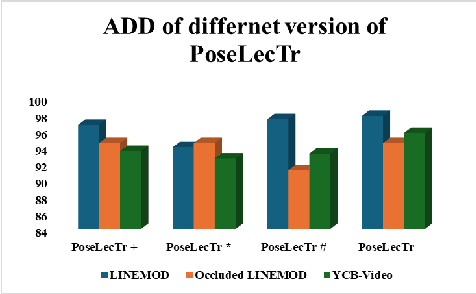

Estimating 6D object poses from RGB images is challenging because the lack of depth information requires inferring a three dimensional structure from 2D projections. Traditional methods often rely on deep learning with grid based data structures but struggle to capture complex dependencies among extracted features. To overcome this, we introduce a graph based representation derived directly from images, where spatial temporal features of each pixel serve as nodes, and relationships between them are defined through node connectivity and spatial interactions. We also employ feature selection mechanisms that use spatial attention and self attention distillation, along with a Legendre convolution layer leveraging the orthogonality of Legendre polynomials for numerical stability. Experiments on the LINEMOD, Occluded LINEMOD, and YCB Video datasets demonstrate that our method outperforms nine existing approaches and achieves state of the art benchmark in object pose estimation.