 Add to Chrome
 Add to Firefox
 Add to Edge
Invariant Discovery for Networked Systems
Jul 24, 2026
Invariants, the relations expected to hold among measured signals of a network, underpin applications from verification to traffic generation, telemetry imputation, and input validation, yet writing them by hand demands rare expertise in both formal logic and networking. Automatic miners can help but fall short on two fronts: they still require the hardest input (the grammar of admissible invariants) and they learn only exact, ``hard'' rules, struggling with real-world approximation caused by inherent noise in data. LLMs are tools that can provide semantic reasoning over data, but are non-deterministic and opaque in their learning. Our key idea is to partition the invariant search problem into an AI-driven grammar ``discovery'' problem, followed by a statistics-driven ``search'' problem within the learned grammar. Taken together, this allows non-deterministic, hallucination-prone AI to help produce auditable invariants with formal guarantees. We design and implement such a system, Autogram, and evaluate it on both public and production telemetry data, recovering expert-derived invariants with high coverage and low false positives. We close with discussion on open problems on the path toward fully open-ended discovery.

Fantastic Adaptive Taxonomies and How to Use Them
Jul 17, 2026An agent system's execution traces record how it fails, and procedures that improve such a system without changing model weights (trajectory selection, prompt and workflow optimization, runtime monitoring) read these traces for feedback. Yet raw traces are a poor medium for accumulating that feedback: long, instance-specific, and lacking a stable vocabulary for recurring failures. We argue that an agent system should instead maintain an explicit representation of how it fails, induced from its own behavior and reusable wherever failure feedback is needed. AdaMAST builds this representation by converting a target system's traces into a compact, evidence-grounded failure taxonomy: named failure codes organized along three fixed axes (system-level, role-specific, and domain-specific), with every name, definition, and evidence pattern induced from the traces; no code is hand-authored, no trace human-annotated. The taxonomy is not merely a post-hoc diagnostic but a shared feedback interface, improving agents in three ways. In agent-system search, taxonomy-coded diagnoses of failed candidates outperform free-form reflection on all five benchmarks we test. At runtime, taxonomy feedback raises SWE-agent's resolution on SWE-bench Verified Mini from 60% with free-text reflection to 70%, and improves Claude Code from 64.0% to 70.7% as a runtime skill. In trajectory selection, AdaMAST-Judge, a verifier built on the induced codes, improves best-of-5 accuracy on Terminal-Bench 2.0 by 8-15 points over Pass@1. The vocabulary itself is compact (an order-of-magnitude compression that preserves trace distinctions), human-faithful (matching expert failure annotations more closely than a hand-crafted reference vocabulary), and adaptive (taxonomies induced for different domains share few codes). Adaptive failure taxonomies close the loop between the traces agents produce and the procedures that improve them.
Inductive Deductive Synthesis: Enabling AI to Generate Formally Verified Systems
May 22, 2026AI agents increasingly excel at generating, testing, and refining code. However, they fall short on tasks requiring formal guarantees of full coverage that testing alone cannot provide. Distributed systems are a prime example: properties such as consistency between reads and writes must hold under every possible interleaving of events. Mechanized formal verification can guarantee such correctness, but typically demands months to years of expert effort. As evidence, even SOTA coding agents (Codex with GPT-5.4 and Claude Code with Opus 4.6) succeed on only 2/7 distributed key-value-store specifications. In this paper, we present the first effective approach to addressing this gap, Inductive Deductive Synthesis (IDS), which jointly and incrementally synthesizes implementation and proof, and learns from failed attempts to systematically try promising strategies. Built as an agentic LLM system, IDS achieves 7/7 in about 6.8 hours and $106 per spec on average, roughly 200x faster than expert effort and 17% cheaper than SOTA agents. IDS further incorporates performance feedback into the same loop, yielding implementations up to 3x faster than published verified systems.
The Time is Here for Just-in-Time Systems: Challenges and Opportunities
May 22, 2026Core systems like key-value stores have historically taken years to build, and are designed to be general so as to amortize cost across deployments, paying a significant performance cost. We argue that LLM-based coding agents now make a different approach tractable: Just-in-Time Systems, in which the entire system is synthesized from scratch, specialized to the environment, workload, and required system properties. We present a JIT system synthesis pipeline, Jitskit, and explore its effectiveness in synthesizing key-value stores from spec cards that span different YCSB workloads, deployment constraints (e.g., compute resources), and system properties (e.g., consistency and durability). Jitskit iteratively refines a system implementation to match the specification against an evolving evaluation test suite. The resulting synthesized systems are performant, beating comparable state-of-the-art systems on 18 of 18 specs tried, by up to 4.6x over the best off-the-shelf baseline on the most favorable spec. Naively running Claude Code either reward-hacks or underperforms Jitskit by up to 5.4x. We discuss the challenges we overcame in building Jitskit and our key takeaways.
Let the Barbarians In: How AI Can Accelerate Systems Performance Research
Dec 22, 2025Artificial Intelligence (AI) is beginning to transform the research process by automating the discovery of new solutions. This shift depends on the availability of reliable verifiers, which AI-driven approaches require to validate candidate solutions. Research focused on improving systems performance is especially well-suited to this paradigm because system performance problems naturally admit such verifiers: candidates can be implemented in real systems or simulators and evaluated against predefined workloads. We term this iterative cycle of generation, evaluation, and refinement AI-Driven Research for Systems (ADRS). Using several open-source ADRS instances (i.e., OpenEvolve, GEPA, and ShinkaEvolve), we demonstrate across ten case studies (e.g., multi-region cloud scheduling, mixture-of-experts load balancing, LLM-based SQL, transaction scheduling) that ADRS-generated solutions can match or even outperform human state-of-the-art designs. Based on these findings, we outline best practices (e.g., level of prompt specification, amount of feedback, robust evaluation) for effectively using ADRS, and we discuss future research directions and their implications. Although we do not yet have a universal recipe for applying ADRS across all of systems research, we hope our preliminary findings, together with the challenges we identify, offer meaningful guidance for future work as researcher effort shifts increasingly toward problem formulation and strategic oversight. Note: This paper is an extension of our prior work [14]. It adds extensive evaluation across multiple ADRS frameworks and provides deeper analysis and insights into best practices.
Bandwidth Allocation for Cloud-Augmented Autonomous Driving
Mar 26, 2025Autonomous vehicle (AV) control systems increasingly rely on ML models for tasks such as perception and planning. Current practice is to run these models on the car's local hardware due to real-time latency constraints and reliability concerns, which limits model size and thus accuracy. Prior work has observed that we could augment current systems by running larger models in the cloud, relying on faster cloud runtimes to offset the cellular network latency. However, prior work does not account for an important practical constraint: limited cellular bandwidth. We show that, for typical bandwidth levels, proposed techniques for cloud-augmented AV models take too long to transfer data, thus mostly falling back to the on-car models and resulting in no accuracy improvement. In this work, we show that realizing cloud-augmented AV models requires intelligent use of this scarce bandwidth, i.e. carefully allocating bandwidth across tasks and providing multiple data compression and model options. We formulate this as a resource allocation problem to maximize car utility, and present our system \sysname which achieves an increase in average model accuracy by up to 15 percentage points on driving scenarios from the Waymo Open Dataset.
Managing Bandwidth: The Key to Cloud-Assisted Autonomous Driving
Oct 21, 2024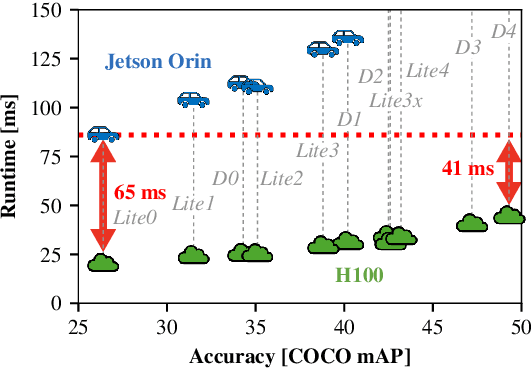
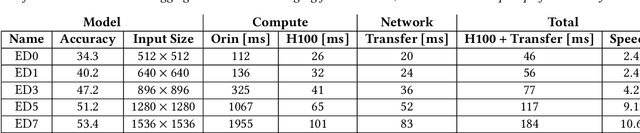

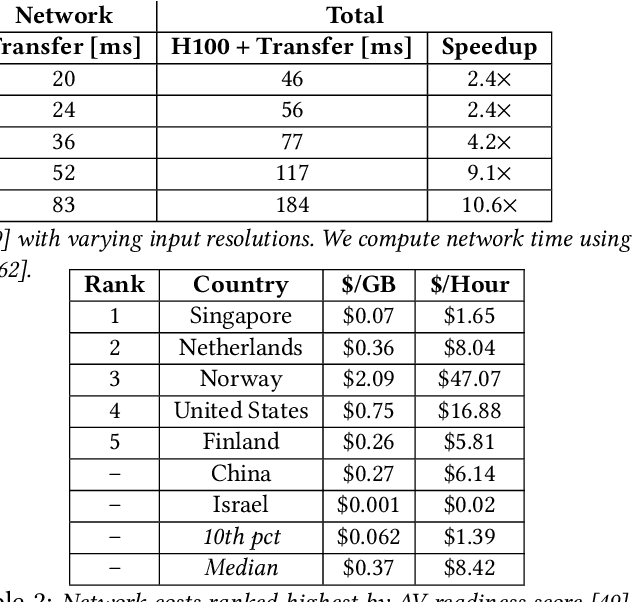
Prevailing wisdom asserts that one cannot rely on the cloud for critical real-time control systems like self-driving cars. We argue that we can, and must. Following the trends of increasing model sizes, improvements in hardware, and evolving mobile networks, we identify an opportunity to offload parts of time-sensitive and latency-critical compute to the cloud. Doing so requires carefully allocating bandwidth to meet strict latency SLOs, while maximizing benefit to the car.