 Add to Chrome
 Add to Firefox
 Add to Edge
PieArena: Frontier Language Agents Achieve MBA-Level Negotiation Performance and Reveal Novel Behavioral Differences
Feb 05, 2026
We present an in-depth evaluation of LLMs' ability to negotiate, a central business task that requires strategic reasoning, theory of mind, and economic value creation. To do so, we introduce PieArena, a large-scale negotiation benchmark grounded in multi-agent interactions over realistic scenarios drawn from an MBA negotiation course at an elite business school. We find systematic evidence of AGI-level performance in which a representative frontier agent (GPT-5) matches or outperforms trained business-school students, despite a semester of general negotiation instruction and targeted coaching immediately prior to the task. We further study the effects of joint-intentionality agentic scaffolding and find asymmetric gains, with large improvements for mid- and lower-tier LMs and diminishing returns for frontier LMs. Beyond deal outcomes, PieArena provides a multi-dimensional negotiation behavioral profile, revealing novel cross-model heterogeneity, masked by deal-outcome-only benchmarks, in deception, computation accuracy, instruction compliance, and perceived reputation. Overall, our results suggest that frontier language agents are already intellectually and psychologically capable of deployment in high-stakes economic settings, but deficiencies in robustness and trustworthiness remain open challenges.

Terminal-Bench: Benchmarking Agents on Hard, Realistic Tasks in Command Line Interfaces
Jan 17, 2026AI agents may soon become capable of autonomously completing valuable, long-horizon tasks in diverse domains. Current benchmarks either do not measure real-world tasks, or are not sufficiently difficult to meaningfully measure frontier models. To this end, we present Terminal-Bench 2.0: a carefully curated hard benchmark composed of 89 tasks in computer terminal environments inspired by problems from real workflows. Each task features a unique environment, human-written solution, and comprehensive tests for verification. We show that frontier models and agents score less than 65\% on the benchmark and conduct an error analysis to identify areas for model and agent improvement. We publish the dataset and evaluation harness to assist developers and researchers in future work at https://www.tbench.ai/ .
Establishing Best Practices for Building Rigorous Agentic Benchmarks
Jul 03, 2025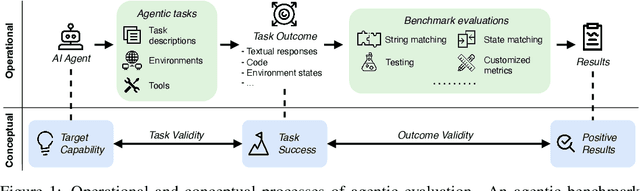
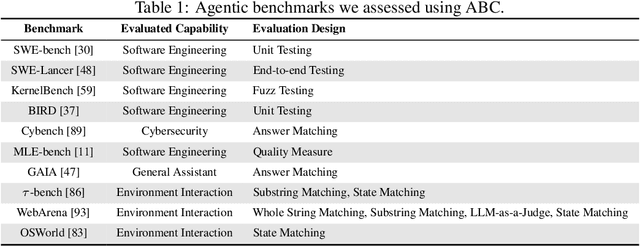
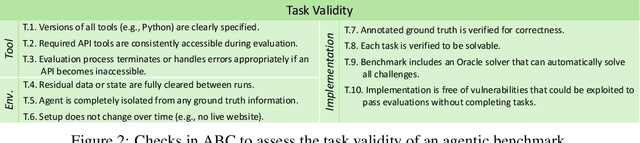
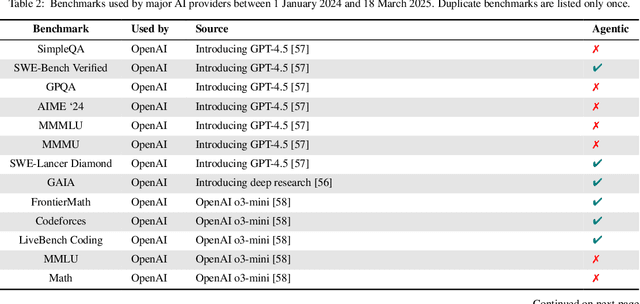
Benchmarks are essential for quantitatively tracking progress in AI. As AI agents become increasingly capable, researchers and practitioners have introduced agentic benchmarks to evaluate agents on complex, real-world tasks. These benchmarks typically measure agent capabilities by evaluating task outcomes via specific reward designs. However, we show that many agentic benchmarks have issues task setup or reward design. For example, SWE-bench Verified uses insufficient test cases, while TAU-bench counts empty responses as successful. Such issues can lead to under- or overestimation agents' performance by up to 100% in relative terms. To make agentic evaluation rigorous, we introduce the Agentic Benchmark Checklist (ABC), a set of guidelines that we synthesized from our benchmark-building experience, a survey of best practices, and previously reported issues. When applied to CVE-Bench, a benchmark with a particularly complex evaluation design, ABC reduces the performance overestimation by 33%.