 Add to Chrome
 Add to Firefox
 Add to Edge
FrontierSmith: Synthesizing Open-Ended Coding Problems at Scale
May 14, 2026
Many real-world coding challenges are open-ended and admit no known optimal solution. Yet, recent progress in LLM coding has focused on well-defined tasks such as feature implementation, bug fixing, and competitive programming. Open-ended coding remains a weak spot for LLMs, largely because open-ended training problems are scarce and expensive to construct. Our goal is to synthesize open-ended coding problems at scale to train stronger LLM coders. We introduce FrontierSmith, an automated system for iteratively evolving open-ended problems from existing closed-ended coding tasks. Starting from competitive programming problems, FrontierSmith generates candidate open-ended variants by changing the problems'goals, restricting outputs, and generalizing inputs. It then uses a quantitative idea divergence metric to select problems that elicit genuinely diverse approaches from different solvers. Agents then generate test cases and verifiers for the surviving candidates. On two open-ended coding benchmarks, training on our synthesized data yields substantial gains over the base models: Qwen3.5-9B improves by +8.82 score on FrontierCS and +306.36 (Elo-rating-based performance) on ALE-bench; Qwen3.5-27B improves by +12.12 and +309.12, respectively. The synthesized problems also make agents take more turns and use more tokens, similar to human-curated ones, suggesting that closed-ended seeds can be a practical starting point for long-horizon coding data.

OpenDeepThink: Parallel Reasoning via Bradley--Terry Aggregation
May 14, 2026Test-time compute scaling is a primary axis for improving LLM reasoning. Existing methods primarily scale depth by extending a single reasoning trace. Scaling breadth by sampling multiple candidates in parallel is straightforward, but introduces a selection bottleneck: choosing the best candidate without a ground-truth verifier, since pointwise LLM judging is noisy and biased. To address this, we introduce OpenDeepThink, a population-based test-time compute framework that selects via pairwise Bradley-Terry comparison. Each generation, the LLM judges random pairs of candidates and aggregates votes via Bradley-Terry into a global ranking; top-ranked candidates are preserved and the top three quarters are mutated using the natural-language critiques produced during comparison; the bottom quarter is discarded. OpenDeepThink raises Gemini 3.1 Pro's effective Codeforces Elo by +405 points in eight sequential LLM-call rounds (~27 minutes wall-clock). The pipeline transfers across weaker and stronger models without retuning, and on the multi-domain HLE benchmark, gains appear concentrated in objectively verifiable domains and reverse in subjective ones. We release CF-73, a curated set of 73 expert-rated Codeforces problems with International Grandmaster annotation and 99% local-evaluation agreement against the official verdict.
Terminal-Bench: Benchmarking Agents on Hard, Realistic Tasks in Command Line Interfaces
Jan 17, 2026AI agents may soon become capable of autonomously completing valuable, long-horizon tasks in diverse domains. Current benchmarks either do not measure real-world tasks, or are not sufficiently difficult to meaningfully measure frontier models. To this end, we present Terminal-Bench 2.0: a carefully curated hard benchmark composed of 89 tasks in computer terminal environments inspired by problems from real workflows. Each task features a unique environment, human-written solution, and comprehensive tests for verification. We show that frontier models and agents score less than 65\% on the benchmark and conduct an error analysis to identify areas for model and agent improvement. We publish the dataset and evaluation harness to assist developers and researchers in future work at https://www.tbench.ai/ .
FrontierCS: Evolving Challenges for Evolving Intelligence
Dec 17, 2025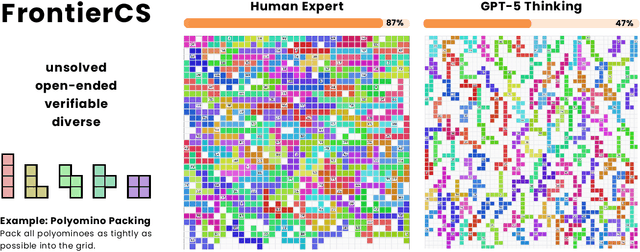

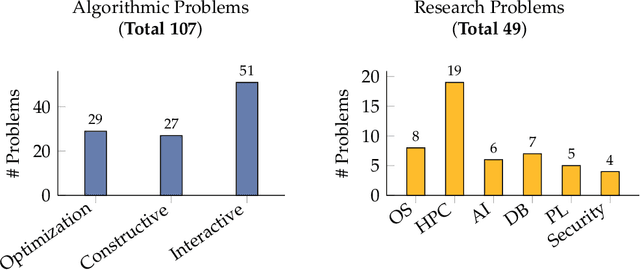

We introduce FrontierCS, a benchmark of 156 open-ended problems across diverse areas of computer science, designed and reviewed by experts, including CS PhDs and top-tier competitive programming participants and problem setters. Unlike existing benchmarks that focus on tasks with known optimal solutions, FrontierCS targets problems where the optimal solution is unknown, but the quality of a solution can be objectively evaluated. Models solve these tasks by implementing executable programs rather than outputting a direct answer. FrontierCS includes algorithmic problems, which are often NP-hard variants of competitive programming problems with objective partial scoring, and research problems with the same property. For each problem we provide an expert reference solution and an automatic evaluator. Combining open-ended design, measurable progress, and expert curation, FrontierCS provides a benchmark at the frontier of computer-science difficulty. Empirically, we find that frontier reasoning models still lag far behind human experts on both the algorithmic and research tracks, that increasing reasoning budgets alone does not close this gap, and that models often over-optimize for generating merely workable code instead of discovering high-quality algorithms and system designs.
LiveCodeBench Pro: How Do Olympiad Medalists Judge LLMs in Competitive Programming?
Jun 13, 2025Recent reports claim that large language models (LLMs) now outperform elite humans in competitive programming. Drawing on knowledge from a group of medalists in international algorithmic contests, we revisit this claim, examining how LLMs differ from human experts and where limitations still remain. We introduce LiveCodeBench Pro, a benchmark composed of problems from Codeforces, ICPC, and IOI that are continuously updated to reduce the likelihood of data contamination. A team of Olympiad medalists annotates every problem for algorithmic categories and conducts a line-by-line analysis of failed model-generated submissions. Using this new data and benchmark, we find that frontier models still have significant limitations: without external tools, the best model achieves only 53% pass@1 on medium-difficulty problems and 0% on hard problems, domains where expert humans still excel. We also find that LLMs succeed at implementation-heavy problems but struggle with nuanced algorithmic reasoning and complex case analysis, often generating confidently incorrect justifications. High performance appears largely driven by implementation precision and tool augmentation, not superior reasoning. LiveCodeBench Pro thus highlights the significant gap to human grandmaster levels, while offering fine-grained diagnostics to steer future improvements in code-centric LLM reasoning.
Scaling LLM Inference with Optimized Sample Compute Allocation
Oct 29, 2024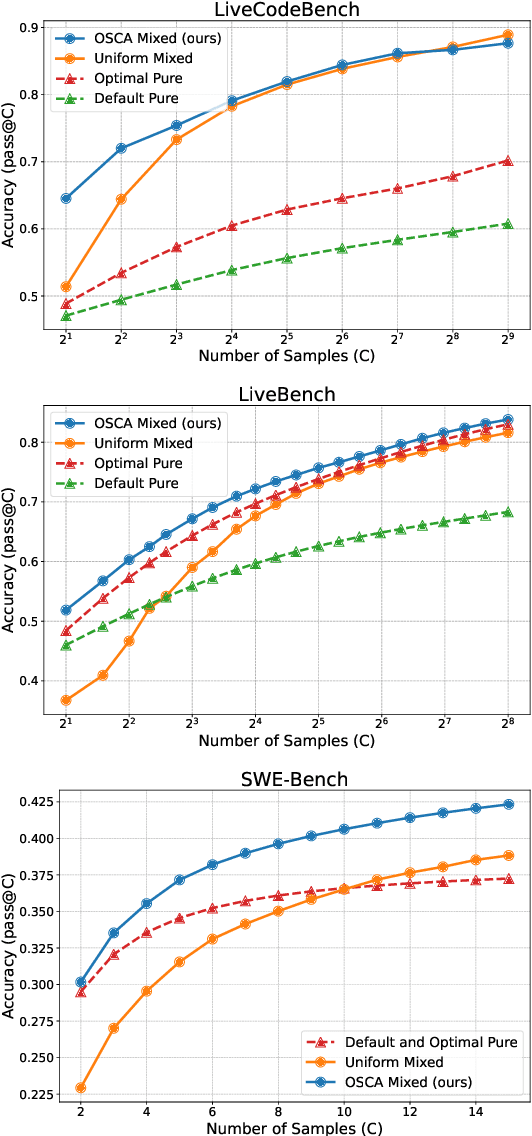
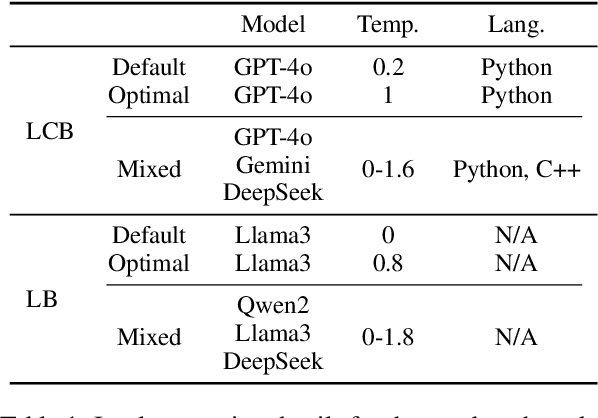
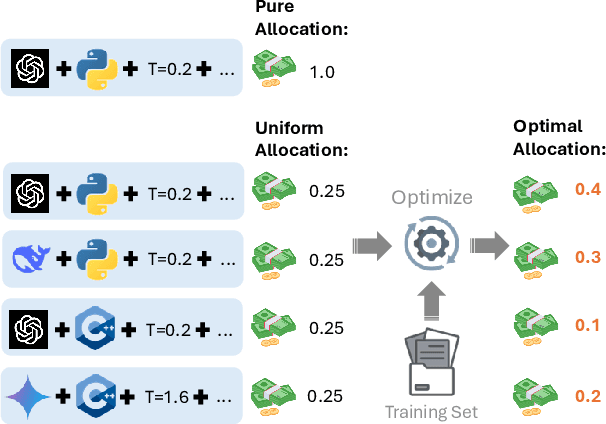
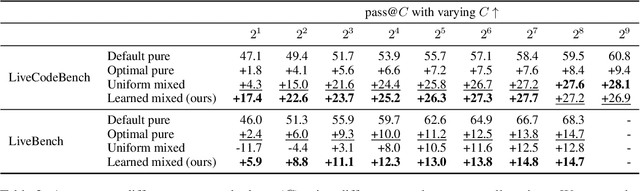
Sampling is a basic operation in many inference-time algorithms of large language models (LLMs). To scale up inference efficiently with a limited compute, it is crucial to find an optimal allocation for sample compute budgets: Which sampling configurations (model, temperature, language, etc.) do we use? How many samples do we generate in each configuration? We formulate these choices as a learning problem and propose OSCA, an algorithm that Optimizes Sample Compute Allocation by finding an optimal mix of different inference configurations. Our experiments show that with our learned mixed allocation, we can achieve accuracy better than the best single configuration with 128x less compute on code generation and 25x less compute on 4 reasoning tasks. OSCA is also shown to be effective in agentic workflows beyond single-turn tasks, achieving a better accuracy on SWE-Bench with 3x less compute than the default configuration. Our code and generations are released at https://github.com/LeiLiLab/OSCA.
Evaluating the Smooth Control of Attribute Intensity in Text Generation with LLMs
Jun 06, 2024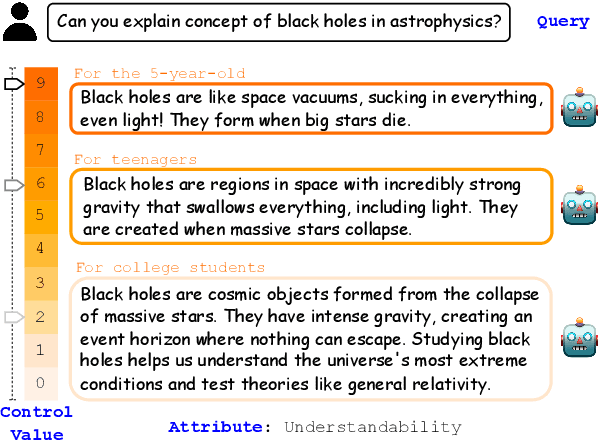
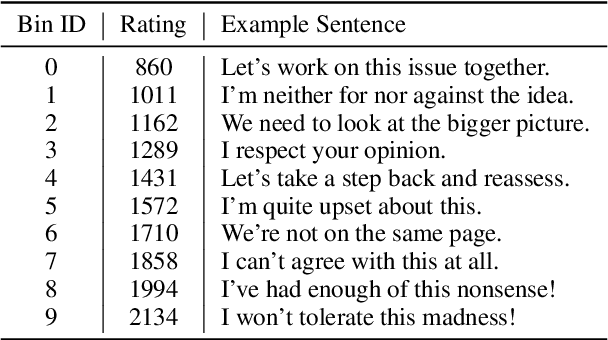
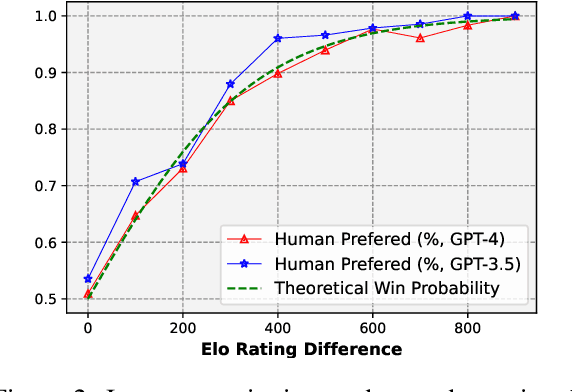
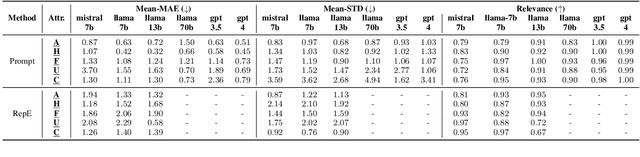
Controlling the attribute intensity of text generation is crucial across scenarios (e.g., writing conciseness, chatting emotion, and explanation clarity). The remarkable capabilities of large language models (LLMs) have revolutionized text generation, prompting us to explore such \emph{smooth control} of LLM generation. Specifically, we propose metrics to assess the range, calibration, and consistency of the generated text's attribute intensity in response to varying control values, as well as its relevance to the intended context. To quantify the attribute intensity and context relevance, we propose an effective evaluation framework leveraging the Elo rating system and GPT4, both renowned for their robust alignment with human judgment. We look into two viable training-free methods for achieving smooth control of LLMs: (1) Prompting with semantic shifters, and (2) Modifying internal model representations. The evaluations of these two methods are conducted on $5$ different attributes with various models. Our code and dataset can be obtained from \url{https://github.com/ShangDataLab/Smooth-Control}.