 Add to Chrome
 Add to Firefox
 Add to Edge
HyNeuralMap: Hyperbolic Mapping of Visual Semantics to Neural Hierarchies
May 10, 2026
Understanding the intricate mappings between visual stimuli and neural responses is a fundamental challenge in cognitive neuroscience. While current approaches predominantly align images and functional magnetic resonance imaging (fMRI) responses in Euclidean space, this geometry often struggles to preserve fine-grained semantic relationships and latent hierarchical structures across visual and neural modalities. To overcome this, we propose HyNeuralMap, a framework that employ hyperbolic Lorentz model to map visual semantics into a shared, cross-subject neural hierarchy. By leveraging the negative curvature of hyperbolic space as an inductive bias, the proposed framework better captures hierarchical semantic organization and cross-subject neural similarities. Specifically, visual and neural embeddings are jointly optimized through hyperbolic geometric alignment, where geodesic distances preserve semantic proximity and hierarchical relationships more effectively than Euclidean embeddings. Experiments demonstrate that HyNeuralMap consistently outperforms state-of-the-art Euclidean baselines in both multi-label semantic prediction and cross-modal retrieval tasks. This confirms hyperbolic geometry's superiority for cross-modal semantic alignment and hierarchical modeling, providing a new avenue for vision-neural representation learning.

GeGS-PCR: Effective and Robust 3D Point Cloud Registration with Two-Stage Color-Enhanced Geometric-3DGS Fusion
Apr 20, 2026We address the challenge of point cloud registration using color information, where traditional methods relying solely on geometric features often struggle in low-overlap and incomplete scenarios. To overcome these limitations, we propose GeGS-PCR, a novel two-stage method that combines geometric, color, and Gaussian information for robust registration. Our approach incorporates a dedicated color encoder that enhances color features by extracting multi-level geometric and color data from the original point cloud. We introduce the \textbf{Ge}ometric-3D\textbf{GS} module, which encodes the local neighborhood information of colored superpoints to ensure a globally invariant geometric-color context. Leveraging LORA optimization, we maintain high performance while preserving the expressiveness of 3DGS. Additionally, fast differentiable rendering is utilized to refine the registration process, leading to improved convergence. To further enhance performance, we propose a joint photometric loss that exploits both geometric and color features. This enables strong performance in challenging conditions with extremely low point cloud overlap. We validate our method by colorizing the Kitti dataset as ColorKitti and testing on both Color3DMatch and Color3DLoMatch datasets. Our method achieves state-of-the-art performance with \textit{Registration Recall} at 99.9\%, \textit{Relative Rotation Error} as low as 0.013, and \textit{Relative Translation Error} as low as 0.024, improving precision by at least a factor of 2.
Data-Free Layer-Adaptive Merging via Fisher Information for Long-to-Short Reasoning LLMs
Mar 23, 2026Model merging has emerged as a practical approach to combine capabilities of specialized large language models (LLMs) without additional training. In the Long-to-Short (L2S) scenario, merging a base model with a long-chain-of-thought reasoning model aims to preserve reasoning accuracy while reducing output length. Existing methods rely on Task Arithmetic and its variants, which implicitly assume that model outputs vary linearly with the merging coefficient -- an assumption we show is systematically violated in L2S settings. We provide the first theoretical justification for layer-adaptive merging: we prove that merging error is bounded by a term proportional to the per-layer Hessian norm (Proposition~1), and establish that the Fisher Information Matrix (FIM) is a principled, computable proxy for this bound via the Fisher-Hessian equivalence at local optima. Building on this theory, we propose \textbf{FIM-Merging}, which computes diagonal FIM using only random token inputs (no domain-specific calibration data required) and uses it to assign per-layer merging coefficients. On the 7B L2S benchmark, FIM-TIES achieves state-of-the-art performance on five out of six evaluation benchmarks, including a \textbf{+6.2} point gain on MATH500 over ACM-TIES (90.2 vs.\ 84.0), while requiring no calibration data. On the 1.5B benchmark, FIM-TIES achieves an average accuracy of \textbf{47.3}, surpassing the previous best ACM-TIES (43.3) by \textbf{+3.9} points, while reducing average response length by \textbf{91.9\%} relative to the long-CoT model. Our framework also provides a unified theoretical explanation for why existing layer-adaptive methods such as ACM empirically outperform uniform merging.
Positional Segmentor-Guided Counterfactual Fine-Tuning for Spatially Localized Image Synthesis
Mar 22, 2026Counterfactual image generation enables controlled data augmentation, bias mitigation, and disease modeling. However, existing methods guided by external classifiers or regressors are limited to subject-level factors (e.g., age) and fail to produce localized structural changes, often resulting in global artifacts. Pixel-level guidance using segmentation masks has been explored, but requires user-defined counterfactual masks, which are tedious and impractical. Segmentor-guided Counterfactual Fine-Tuning (Seg-CFT) addressed this by using segmentation-derived measurements to supervise structure-specific variables, yet it remains restricted to global interventions. We propose Positional Seg-CFT, which subdivides each structure into regional segments and derives independent measurements per region, enabling spatially localized and anatomically coherent counterfactuals. Experiments on coronary CT angiography show that Pos-Seg-CFT generates realistic, region-specific modifications, providing finer spatial control for modeling disease progression.
QARM V2: Quantitative Alignment Multi-Modal Recommendation for Reasoning User Sequence Modeling
Feb 09, 2026With the evolution of large language models (LLMs), there is growing interest in leveraging their rich semantic understanding to enhance industrial recommendation systems (RecSys). Traditional RecSys relies on ID-based embeddings for user sequence modeling in the General Search Unit (GSU) and Exact Search Unit (ESU) paradigm, which suffers from low information density, knowledge isolation, and weak generalization ability. While LLMs offer complementary strengths with dense semantic representations and strong generalization, directly applying LLM embeddings to RecSys faces critical challenges: representation unmatch with business objectives and representation unlearning end-to-end with downstream tasks. In this paper, we present QARM V2, a unified framework that bridges LLM semantic understanding with RecSys business requirements for user sequence modeling.
Let the Barbarians In: How AI Can Accelerate Systems Performance Research
Dec 22, 2025Artificial Intelligence (AI) is beginning to transform the research process by automating the discovery of new solutions. This shift depends on the availability of reliable verifiers, which AI-driven approaches require to validate candidate solutions. Research focused on improving systems performance is especially well-suited to this paradigm because system performance problems naturally admit such verifiers: candidates can be implemented in real systems or simulators and evaluated against predefined workloads. We term this iterative cycle of generation, evaluation, and refinement AI-Driven Research for Systems (ADRS). Using several open-source ADRS instances (i.e., OpenEvolve, GEPA, and ShinkaEvolve), we demonstrate across ten case studies (e.g., multi-region cloud scheduling, mixture-of-experts load balancing, LLM-based SQL, transaction scheduling) that ADRS-generated solutions can match or even outperform human state-of-the-art designs. Based on these findings, we outline best practices (e.g., level of prompt specification, amount of feedback, robust evaluation) for effectively using ADRS, and we discuss future research directions and their implications. Although we do not yet have a universal recipe for applying ADRS across all of systems research, we hope our preliminary findings, together with the challenges we identify, offer meaningful guidance for future work as researcher effort shifts increasingly toward problem formulation and strategic oversight. Note: This paper is an extension of our prior work [14]. It adds extensive evaluation across multiple ADRS frameworks and provides deeper analysis and insights into best practices.
FrontierCS: Evolving Challenges for Evolving Intelligence
Dec 17, 2025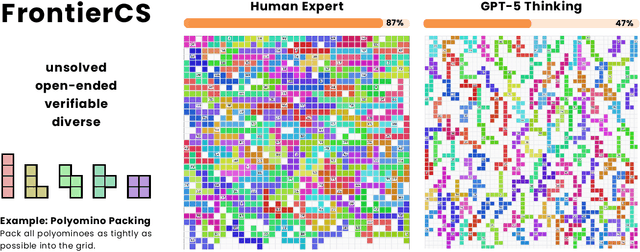

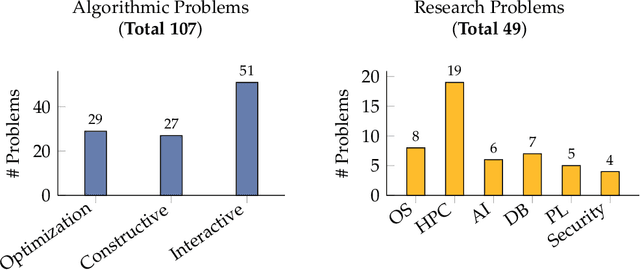

We introduce FrontierCS, a benchmark of 156 open-ended problems across diverse areas of computer science, designed and reviewed by experts, including CS PhDs and top-tier competitive programming participants and problem setters. Unlike existing benchmarks that focus on tasks with known optimal solutions, FrontierCS targets problems where the optimal solution is unknown, but the quality of a solution can be objectively evaluated. Models solve these tasks by implementing executable programs rather than outputting a direct answer. FrontierCS includes algorithmic problems, which are often NP-hard variants of competitive programming problems with objective partial scoring, and research problems with the same property. For each problem we provide an expert reference solution and an automatic evaluator. Combining open-ended design, measurable progress, and expert curation, FrontierCS provides a benchmark at the frontier of computer-science difficulty. Empirically, we find that frontier reasoning models still lag far behind human experts on both the algorithmic and research tracks, that increasing reasoning budgets alone does not close this gap, and that models often over-optimize for generating merely workable code instead of discovering high-quality algorithms and system designs.
Phys-Liquid: A Physics-Informed Dataset for Estimating 3D Geometry and Volume of Transparent Deformable Liquids
Nov 14, 2025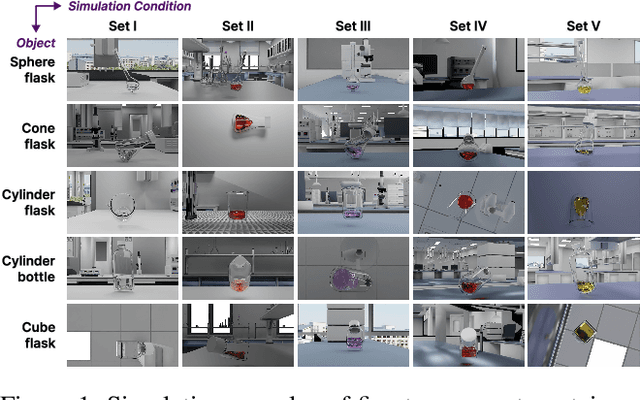
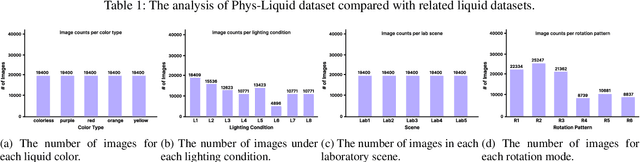
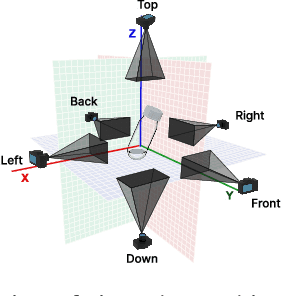

Estimating the geometric and volumetric properties of transparent deformable liquids is challenging due to optical complexities and dynamic surface deformations induced by container movements. Autonomous robots performing precise liquid manipulation tasks, such as dispensing, aspiration, and mixing, must handle containers in ways that inevitably induce these deformations, complicating accurate liquid state assessment. Current datasets lack comprehensive physics-informed simulation data representing realistic liquid behaviors under diverse dynamic scenarios. To bridge this gap, we introduce Phys-Liquid, a physics-informed dataset comprising 97,200 simulation images and corresponding 3D meshes, capturing liquid dynamics across multiple laboratory scenes, lighting conditions, liquid colors, and container rotations. To validate the realism and effectiveness of Phys-Liquid, we propose a four-stage reconstruction and estimation pipeline involving liquid segmentation, multi-view mask generation, 3D mesh reconstruction, and real-world scaling. Experimental results demonstrate improved accuracy and consistency in reconstructing liquid geometry and volume, outperforming existing benchmarks. The dataset and associated validation methods facilitate future advancements in transparent liquid perception tasks. The dataset and code are available at https://dualtransparency.github.io/Phys-Liquid/.
BrainMCLIP: Brain Image Decoding with Multi-Layer feature Fusion of CLIP
Oct 22, 2025Decoding images from fMRI often involves mapping brain activity to CLIP's final semantic layer. To capture finer visual details, many approaches add a parameter-intensive VAE-based pipeline. However, these approaches overlook rich object information within CLIP's intermediate layers and contradicts the brain's functionally hierarchical. We introduce BrainMCLIP, which pioneers a parameter-efficient, multi-layer fusion approach guided by human visual system's functional hierarchy, eliminating the need for such a separate VAE pathway. BrainMCLIP aligns fMRI signals from functionally distinct visual areas (low-/high-level) to corresponding intermediate and final CLIP layers, respecting functional hierarchy. We further introduce a Cross-Reconstruction strategy and a novel multi-granularity loss. Results show BrainMCLIP achieves highly competitive performance, particularly excelling on high-level semantic metrics where it matches or surpasses SOTA(state-of-the-art) methods, including those using VAE pipelines. Crucially, it achieves this with substantially fewer parameters, demonstrating a reduction of 71.7\%(Table.\ref{tab:compare_clip_vae}) compared to top VAE-based SOTA methods, by avoiding the VAE pathway. By leveraging intermediate CLIP features, it effectively captures visual details often missed by CLIP-only approaches, striking a compelling balance between semantic accuracy and detail fidelity without requiring a separate VAE pipeline.
Decoupled Classifier-Free Guidance for Counterfactual Diffusion Models
Jun 17, 2025Counterfactual image generation aims to simulate realistic visual outcomes under specific causal interventions. Diffusion models have recently emerged as a powerful tool for this task, combining DDIM inversion with conditional generation via classifier-free guidance (CFG). However, standard CFG applies a single global weight across all conditioning variables, which can lead to poor identity preservation and spurious attribute changes - a phenomenon known as attribute amplification. To address this, we propose Decoupled Classifier-Free Guidance (DCFG), a flexible and model-agnostic framework that introduces group-wise conditioning control. DCFG builds on an attribute-split embedding strategy that disentangles semantic inputs, enabling selective guidance on user-defined attribute groups. For counterfactual generation, we partition attributes into intervened and invariant sets based on a causal graph and apply distinct guidance to each. Experiments on CelebA-HQ, MIMIC-CXR, and EMBED show that DCFG improves intervention fidelity, mitigates unintended changes, and enhances reversibility, enabling more faithful and interpretable counterfactual image generation.