 Add to Chrome
 Add to Firefox
 Add to Edge
Can AI agents conduct open-ended AI research? Early evidence from two case studies
Jul 29, 2026
Forecasts of explosive AI progress hinge on AI agents automating AI research. But evidence on whether agents can carry out open-ended AI research is thin. Current evaluations either test agents on narrow, verifiable tasks, which excludes open-ended research, or submit AI-generated papers to blind peer review, which is overstretched, stochastic, and suffers from poor review quality. We introduce a third way to measure progress towards AI R\&D automation. An agent takes on the central, open-ended research question of a high-quality unpublished paper, and the paper's original authors grade its output. We call these shadow evaluations. We ran shadow evaluations on two unpublished NeurIPS 2026 submissions, giving frontier agents six days and thousands of dollars of compute. The agents completed all of the engineering without human help, yet could not make substantial progress towards answering the research questions. As a result, both papers were unambiguously rejected by the authors. We identify five recurring failure modes: poor judgment about the bar for publishable research, uncreative responses to shortcomings in the research design, ineffective backtracking from dead ends, poor resource awareness, and instruction drift. A robustness check with a second model and scaffold reproduced these failures. We release the expert reviews, survey responses, agent repositories, and logs. Our results provide early evidence that today's agents can do the engineering of AI research, but struggle with critical parts of the research lifecycle.

FLARE-AI: Flaw Reporting for AI
Jun 30, 2026Flaw reporting for deployed AI systems is fundamental to identifying system failures and improving AI safety. Yet the AI reporting ecosystem is fragmented: researchers who identify flaws often do not know what or where to report, and groups who receive reports rarely share them with other relevant stakeholders. As a result, good-faith reporters duplicate effort by submitting many different forms, and recipients lack standardized, triage-ready information. We audit 12 reporting systems published by AI developers, cybersecurity groups, and AI flaw aggregators, identifying five recurring design challenges spanning discoverability, scope, information collection, coordination, and guidance for strict-liability cases. Building on this analysis and feedback from 49 experts across 32 organizations representing developers, security researchers, and ecosystem coordinators, we introduce FLARE-AI, an open-source AI flaw reporting system designed for interoperability with existing systems. FLARE-AI streamlines flaw report creation by collecting triage-relevant information through conditional logic and early classification, then enables optional dissemination of standardized, machine-readable reports to multiple developers, coordinators, and incident registries from a single submission. By lowering barriers to reporting AI flaws and improving interoperability across stakeholders, FLARE-AI helps break down silos and accelerate remediation across the AI ecosystem.
Life After Benchmark Saturation: A Case Study of CORE-Bench
Jun 23, 2026When a benchmark's accuracy saturates, it is often retired and replaced with a more challenging version. We show that this approach privileges accuracy and misses the opportunity to study six other key dimensions of agent performance: construct validity issues such as shortcuts, out-of-distribution generalizability, efficiency, reliability, the relative importance of the model versus the scaffold, and uplift from human-agent collaboration. We use CORE-Bench Hard, a benchmark for computational reproducibility of scientific code, as a case study to demonstrate that measuring agents along these dimensions yields meaningful insights into agent performance even after accuracy saturates. First, we surface threats to construct validity in CORE-Bench Hard that are difficult to anticipate with less capable agents. We introduce an improved benchmark, CORE-Bench v1.1, and an out-of-distribution task suite, CORE-Bench OOD. Second, we find that despite accuracy saturation, CORE-Bench v1.1 remains useful for measuring efficiency, reliability, model performance, and scaffold performance. Finally, we conduct a small-scale randomized experiment to measure uplift from human-agent collaboration on real-world computational reproducibility tasks. We find a statistically significant speedup by about a factor of two -- likely underestimated due to one-fifth of human-only reproductions reaching the time limit before completing -- and describe various other findings. Together, our contributions present a more rigorous alternative to the dominant accuracy-centric evaluation paradigm.
Open-World Evaluations for Measuring Frontier AI Capabilities
May 19, 2026Benchmark-based evaluation remains important for tracking frontier AI progress. But it can both overstate and understate deployed capability because it privileges tasks that can be precisely specified, automatically graded, easy to optimize for, and run with low budgets and short time horizons. We advocate for a complementary class of evaluations, which we term open-world evaluations: long-horizon, messy, real-world tasks assessed through small-sample qualitative analysis rather than benchmark-scale automation. In this paper we survey recent open-world evaluations, identify their strengths and limitations, and introduce CRUX (Collaborative Research for Updating AI eXpectations), a project for conducting such evaluations regularly. As a first instance, we task an AI agent with developing and publishing a simple iOS application to the Apple App Store. The agent completed the task with only a single avoidable manual intervention, suggesting that open-world evaluations can provide early warning of capabilities that may soon become widespread. We conclude with recommendations for designing and reporting open-world evals.
Towards a Science of AI Agent Reliability
Feb 18, 2026AI agents are increasingly deployed to execute important tasks. While rising accuracy scores on standard benchmarks suggest rapid progress, many agents still continue to fail in practice. This discrepancy highlights a fundamental limitation of current evaluations: compressing agent behavior into a single success metric obscures critical operational flaws. Notably, it ignores whether agents behave consistently across runs, withstand perturbations, fail predictably, or have bounded error severity. Grounded in safety-critical engineering, we provide a holistic performance profile by proposing twelve concrete metrics that decompose agent reliability along four key dimensions: consistency, robustness, predictability, and safety. Evaluating 14 agentic models across two complementary benchmarks, we find that recent capability gains have only yielded small improvements in reliability. By exposing these persistent limitations, our metrics complement traditional evaluations while offering tools for reasoning about how agents perform, degrade, and fail.
The 2025 Foundation Model Transparency Index
Dec 11, 2025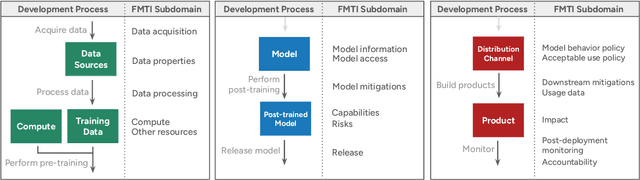
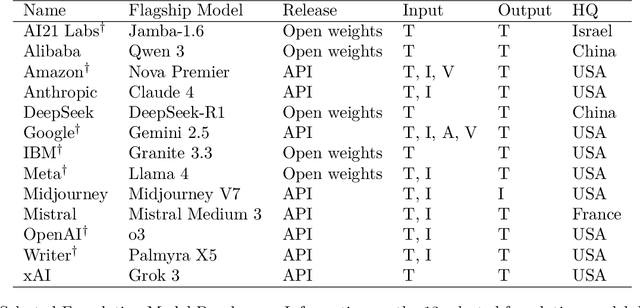
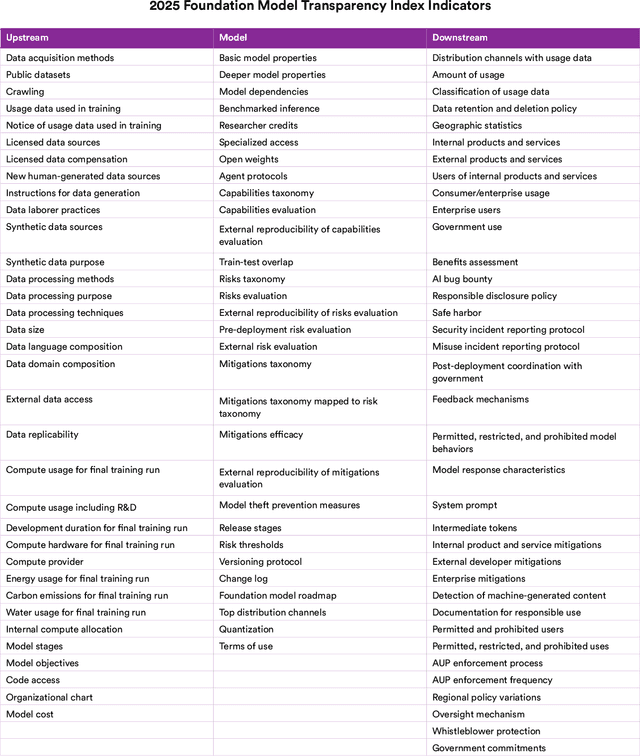
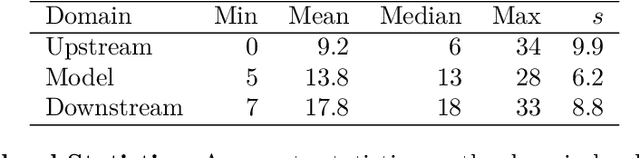
Foundation model developers are among the world's most important companies. As these companies become increasingly consequential, how do their transparency practices evolve? The 2025 Foundation Model Transparency Index is the third edition of an annual effort to characterize and quantify the transparency of foundation model developers. The 2025 FMTI introduces new indicators related to data acquisition, usage data, and monitoring and evaluates companies like Alibaba, DeepSeek, and xAI for the first time. The 2024 FMTI reported that transparency was improving, but the 2025 FMTI finds this progress has deteriorated: the average score out of 100 fell from 58 in 2024 to 40 in 2025. Companies are most opaque about their training data and training compute as well as the post-deployment usage and impact of their flagship models. In spite of this general trend, IBM stands out as a positive outlier, scoring 95, in contrast to the lowest scorers, xAI and Midjourney, at just 14. The five members of the Frontier Model Forum we score end up in the middle of the Index: we posit that these companies avoid reputational harms from low scores but lack incentives to be transparency leaders. As policymakers around the world increasingly mandate certain types of transparency, this work reveals the current state of transparency for foundation model developers, how it may change given newly enacted policy, and where more aggressive policy interventions are necessary to address critical information deficits.
Establishing Best Practices for Building Rigorous Agentic Benchmarks
Jul 03, 2025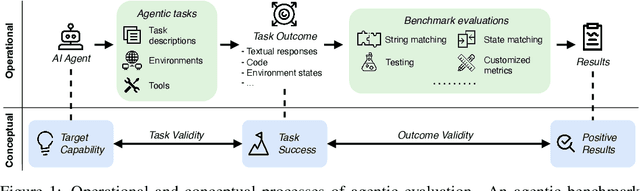
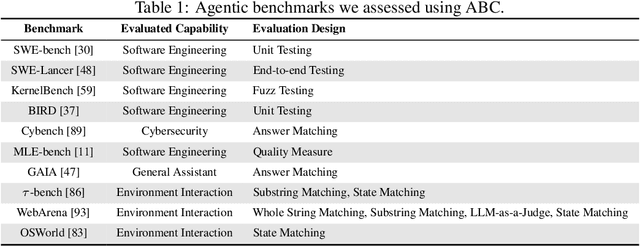
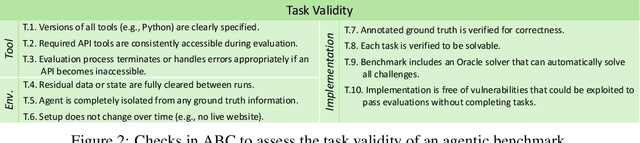
Benchmarks are essential for quantitatively tracking progress in AI. As AI agents become increasingly capable, researchers and practitioners have introduced agentic benchmarks to evaluate agents on complex, real-world tasks. These benchmarks typically measure agent capabilities by evaluating task outcomes via specific reward designs. However, we show that many agentic benchmarks have issues task setup or reward design. For example, SWE-bench Verified uses insufficient test cases, while TAU-bench counts empty responses as successful. Such issues can lead to under- or overestimation agents' performance by up to 100% in relative terms. To make agentic evaluation rigorous, we introduce the Agentic Benchmark Checklist (ABC), a set of guidelines that we synthesized from our benchmark-building experience, a survey of best practices, and previously reported issues. When applied to CVE-Bench, a benchmark with a particularly complex evaluation design, ABC reduces the performance overestimation by 33%.
The Leaderboard Illusion
Apr 29, 2025Measuring progress is fundamental to the advancement of any scientific field. As benchmarks play an increasingly central role, they also grow more susceptible to distortion. Chatbot Arena has emerged as the go-to leaderboard for ranking the most capable AI systems. Yet, in this work we identify systematic issues that have resulted in a distorted playing field. We find that undisclosed private testing practices benefit a handful of providers who are able to test multiple variants before public release and retract scores if desired. We establish that the ability of these providers to choose the best score leads to biased Arena scores due to selective disclosure of performance results. At an extreme, we identify 27 private LLM variants tested by Meta in the lead-up to the Llama-4 release. We also establish that proprietary closed models are sampled at higher rates (number of battles) and have fewer models removed from the arena than open-weight and open-source alternatives. Both these policies lead to large data access asymmetries over time. Providers like Google and OpenAI have received an estimated 19.2% and 20.4% of all data on the arena, respectively. In contrast, a combined 83 open-weight models have only received an estimated 29.7% of the total data. We show that access to Chatbot Arena data yields substantial benefits; even limited additional data can result in relative performance gains of up to 112% on the arena distribution, based on our conservative estimates. Together, these dynamics result in overfitting to Arena-specific dynamics rather than general model quality. The Arena builds on the substantial efforts of both the organizers and an open community that maintains this valuable evaluation platform. We offer actionable recommendations to reform the Chatbot Arena's evaluation framework and promote fairer, more transparent benchmarking for the field
Toward an Evaluation Science for Generative AI Systems
Mar 07, 2025There is an increasing imperative to anticipate and understand the performance and safety of generative AI systems in real-world deployment contexts. However, the current evaluation ecosystem is insufficient: Commonly used static benchmarks face validity challenges, and ad hoc case-by-case audits rarely scale. In this piece, we advocate for maturing an evaluation science for generative AI systems. While generative AI creates unique challenges for system safety engineering and measurement science, the field can draw valuable insights from the development of safety evaluation practices in other fields, including transportation, aerospace, and pharmaceutical engineering. In particular, we present three key lessons: Evaluation metrics must be applicable to real-world performance, metrics must be iteratively refined, and evaluation institutions and norms must be established. Applying these insights, we outline a concrete path toward a more rigorous approach for evaluating generative AI systems.
International AI Safety Report
Jan 29, 2025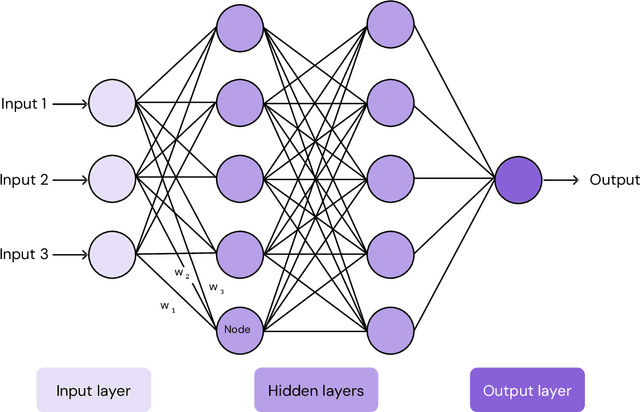
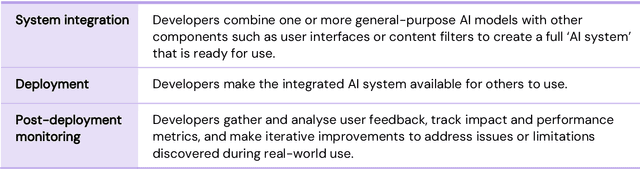

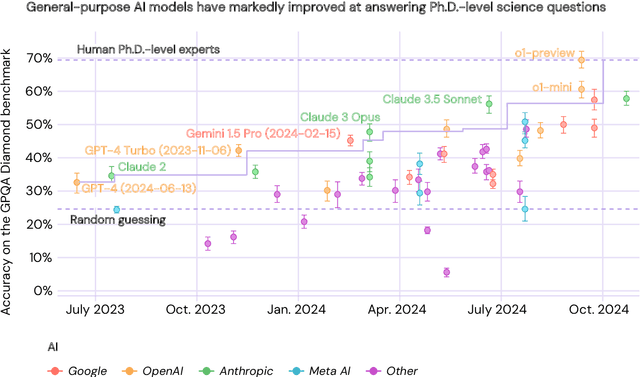
The first International AI Safety Report comprehensively synthesizes the current evidence on the capabilities, risks, and safety of advanced AI systems. The report was mandated by the nations attending the AI Safety Summit in Bletchley, UK. Thirty nations, the UN, the OECD, and the EU each nominated a representative to the report's Expert Advisory Panel. A total of 100 AI experts contributed, representing diverse perspectives and disciplines. Led by the report's Chair, these independent experts collectively had full discretion over the report's content.