 Add to Chrome
 Add to Firefox
 Add to Edge
ELT-Bench-Verified: Benchmark Quality Issues Underestimate AI Agent Capabilities
Apr 02, 2026
Constructing Extract-Load-Transform (ELT) pipelines is a labor-intensive data engineering task and a high-impact target for AI automation. On ELT-Bench, the first benchmark for end-to-end ELT pipeline construction, AI agents initially showed low success rates, suggesting they lacked practical utility. We revisit these results and identify two factors causing a substantial underestimation of agent capabilities. First, re-evaluating ELT-Bench with upgraded large language models reveals that the extraction and loading stage is largely solved, while transformation performance improves significantly. Second, we develop an Auditor-Corrector methodology that combines scalable LLM-driven root-cause analysis with rigorous human validation (inter-annotator agreement Fleiss' kappa = 0.85) to audit benchmark quality. Applying this to ELT-Bench uncovers that most failed transformation tasks contain benchmark-attributable errors -- including rigid evaluation scripts, ambiguous specifications, and incorrect ground truth -- that penalize correct agent outputs. Based on these findings, we construct ELT-Bench-Verified, a revised benchmark with refined evaluation logic and corrected ground truth. Re-evaluating on this version yields significant improvement attributable entirely to benchmark correction. Our results show that both rapid model improvement and benchmark quality issues contributed to underestimating agent capabilities. More broadly, our findings echo observations of pervasive annotation errors in text-to-SQL benchmarks, suggesting quality issues are systemic in data engineering evaluation. Systematic quality auditing should be standard practice for complex agentic tasks. We release ELT-Bench-Verified to provide a more reliable foundation for progress in AI-driven data engineering automation.

ReViSQL: Achieving Human-Level Text-to-SQL
Mar 20, 2026Translating natural language to SQL (Text-to-SQL) is a critical challenge in both database research and data analytics applications. Recent efforts have focused on enhancing SQL reasoning by developing large language models and AI agents that decompose Text-to-SQL tasks into manually designed, step-by-step pipelines. However, despite these extensive architectural engineering efforts, a significant gap remains: even state-of-the-art (SOTA) AI agents have not yet achieved the human-level accuracy on the BIRD benchmark. In this paper, we show that closing this gap does not require further architectural complexity, but rather clean training data to improve SQL reasoning of the underlying models. We introduce ReViSQL, a streamlined framework that achieves human-level accuracy on BIRD for the first time. Instead of complex AI agents, ReViSQL leverages reinforcement learning with verifiable rewards (RLVR) on BIRD-Verified, a dataset we curated comprising 2.5k verified Text-to-SQL instances based on the BIRD Train set. To construct BIRD-Verified, we design a data correction and verification workflow involving SQL experts. We identified and corrected data errors in 61.1% of a subset of BIRD Train. By training on BIRD-Verified, we show that improving data quality alone boosts the single-generation accuracy by 8.2-13.9% under the same RLVR algorithm. To further enhance performance, ReViSQL performs inference-time scaling via execution-based reconciliation and majority voting. Empirically, we demonstrate the superiority of our framework with two model scales: ReViSQL-235B-A22B and ReViSQL-30B-A3B. On an expert-verified BIRD Mini-Dev set, ReViSQL-235B-A22B achieves 93.2% execution accuracy, exceeding the proxy human-level accuracy (92.96%) and outperforming the prior open-source SOTA method by 9.8%. Our lightweight ReViSQL-30B-A3B matches the prior SOTA at a 7.5$\times$ lower per-query cost.
Pervasive Annotation Errors Break Text-to-SQL Benchmarks and Leaderboards
Jan 13, 2026Researchers have proposed numerous text-to-SQL techniques to streamline data analytics and accelerate the development of database-driven applications. To compare these techniques and select the best one for deployment, the community depends on public benchmarks and their leaderboards. Since these benchmarks heavily rely on human annotations during question construction and answer evaluation, the validity of the annotations is crucial. In this paper, we conduct an empirical study that (i) benchmarks annotation error rates for two widely used text-to-SQL benchmarks, BIRD and Spider 2.0-Snow, and (ii) corrects a subset of the BIRD development (Dev) set to measure the impact of annotation errors on text-to-SQL agent performance and leaderboard rankings. Through expert analysis, we show that BIRD Mini-Dev and Spider 2.0-Snow have error rates of 52.8% and 62.8%, respectively. We re-evaluate all 16 open-source agents from the BIRD leaderboard on both the original and the corrected BIRD Dev subsets. We show that performance changes range from -7% to 31% (in relative terms) and rank changes range from $-9$ to $+9$ positions. We further assess whether these impacts generalize to the full BIRD Dev set. We find that the rankings of agents on the uncorrected subset correlate strongly with those on the full Dev set (Spearman's $r_s$=0.85, $p$=3.26e-5), whereas they correlate weakly with those on the corrected subset (Spearman's $r_s$=0.32, $p$=0.23). These findings show that annotation errors can significantly distort reported performance and rankings, potentially misguiding research directions or deployment choices. Our code and data are available at https://github.com/uiuc-kang-lab/text_to_sql_benchmarks.
Establishing Best Practices for Building Rigorous Agentic Benchmarks
Jul 03, 2025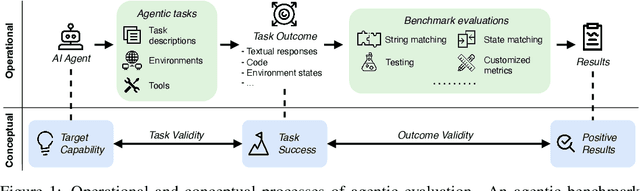
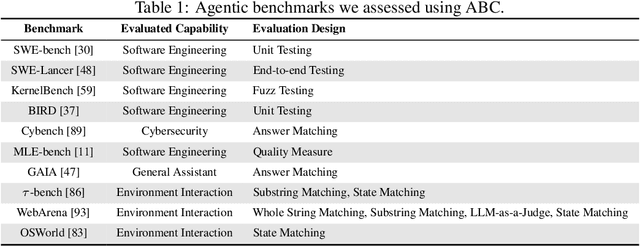
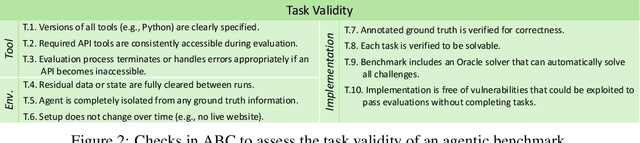
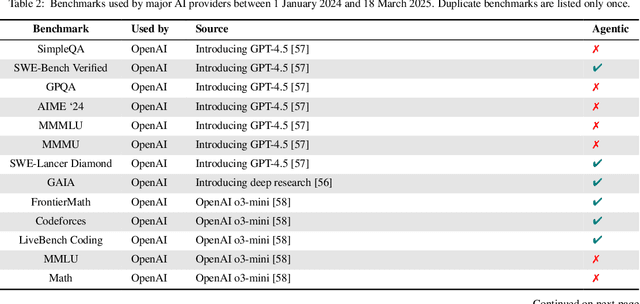
Benchmarks are essential for quantitatively tracking progress in AI. As AI agents become increasingly capable, researchers and practitioners have introduced agentic benchmarks to evaluate agents on complex, real-world tasks. These benchmarks typically measure agent capabilities by evaluating task outcomes via specific reward designs. However, we show that many agentic benchmarks have issues task setup or reward design. For example, SWE-bench Verified uses insufficient test cases, while TAU-bench counts empty responses as successful. Such issues can lead to under- or overestimation agents' performance by up to 100% in relative terms. To make agentic evaluation rigorous, we introduce the Agentic Benchmark Checklist (ABC), a set of guidelines that we synthesized from our benchmark-building experience, a survey of best practices, and previously reported issues. When applied to CVE-Bench, a benchmark with a particularly complex evaluation design, ABC reduces the performance overestimation by 33%.
ELT-Bench: An End-to-End Benchmark for Evaluating AI Agents on ELT Pipelines
Apr 07, 2025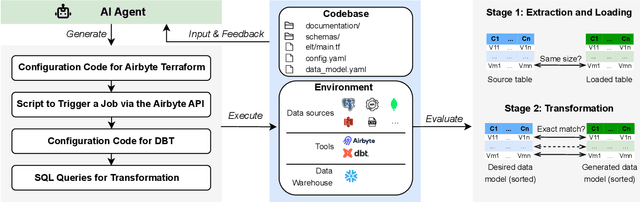

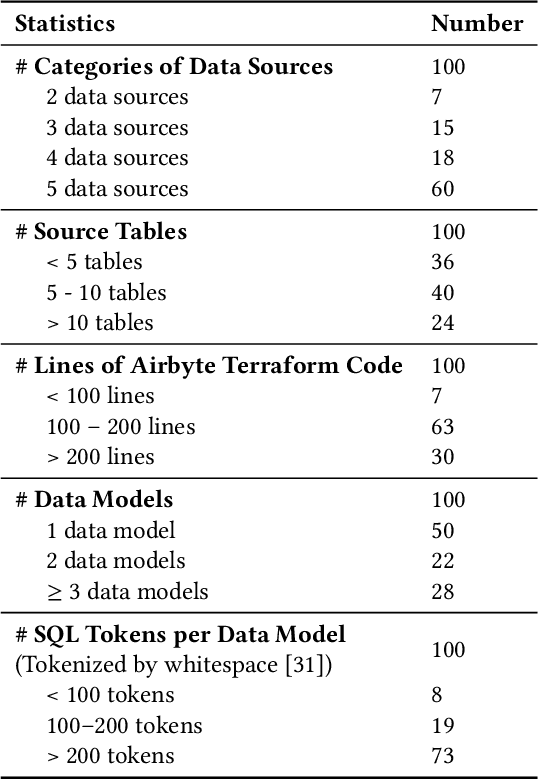
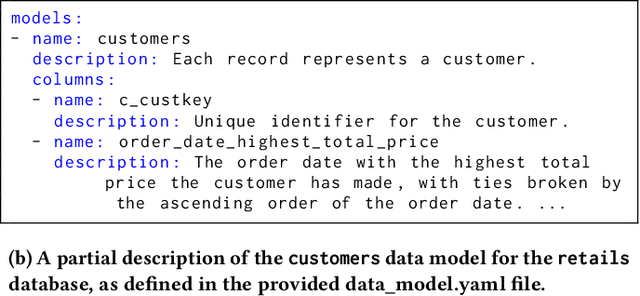
Practitioners are increasingly turning to Extract-Load-Transform (ELT) pipelines with the widespread adoption of cloud data warehouses. However, designing these pipelines often involves significant manual work to ensure correctness. Recent advances in AI-based methods, which have shown strong capabilities in data tasks, such as text-to-SQL, present an opportunity to alleviate manual efforts in developing ELT pipelines. Unfortunately, current benchmarks in data engineering only evaluate isolated tasks, such as using data tools and writing data transformation queries, leaving a significant gap in evaluating AI agents for generating end-to-end ELT pipelines. To fill this gap, we introduce ELT-Bench, an end-to-end benchmark designed to assess the capabilities of AI agents to build ELT pipelines. ELT-Bench consists of 100 pipelines, including 835 source tables and 203 data models across various domains. By simulating realistic scenarios involving the integration of diverse data sources and the use of popular data tools, ELT-Bench evaluates AI agents' abilities in handling complex data engineering workflows. AI agents must interact with databases and data tools, write code and SQL queries, and orchestrate every pipeline stage. We evaluate two representative code agent frameworks, Spider-Agent and SWE-Agent, using six popular Large Language Models (LLMs) on ELT-Bench. The highest-performing agent, Spider-Agent Claude-3.7-Sonnet with extended thinking, correctly generates only 3.9% of data models, with an average cost of $4.30 and 89.3 steps per pipeline. Our experimental results demonstrate the challenges of ELT-Bench and highlight the need for a more advanced AI agent to reduce manual effort in ELT workflows. Our code and data are available at https://github.com/uiuc-kang-lab/ETL.git.