 Add to Chrome
 Add to Firefox
 Add to Edge
The Generalization Spectrum: A Chromatographic Approach to Evaluating Learning Algorithms
Jun 25, 2026
Traditional evaluations measure a learning algorithm's final performance on an i.i.d. test set, reducing learning to a single aggregate score. This approach obscures a fundamental question: to what extent does learning from a specific example generalize to others? Such per-sample generalization, akin to learning by analogy in human cognition, captures how far the knowledge extracted from one example can transfer, yet remains invisible to standard benchmarks. We introduce the Generalization Spectrum, an evaluation framework designed to expose this hidden dimension. For each training example, we construct a controlled suite of test variants arranged by increasing transfer distance, from exact recall to implementation transfer across languages, context transfer under complete narrative re-framing, category-matched in-domain problems, and an unpaired baseline. By tracking performance across these distances, we reveal not just whether an algorithm learns, but how far that learning extends. We instantiate this framework on competitive programming, using a selection-and-synthesis pipeline seeded with recent problems to mitigate contamination. We first compare three canonical learning paradigms under matched memorization. RL converts memorization into near-transfer more efficiently than SFT-family baselines, while ICL exhibits strong but correspondence-dependent transfer. We then use the Spectrum to diagnose within-family variants. The resulting profiles show that local gains need not expand the generalization radius: abstractions and hints mainly lift local transfer, RFT preserves a stronger far-transfer tail than reference SFT, and self-distillation or hint-assisted RL can reduce far transfer even when local transfer or optimization improves.

Beyond Problem Solving: UOJ-Bench for Evaluating Code Generation, Hacking, and Repair in Competitive Programming
Jun 11, 2026Despite strong performance in competitive programming, the role of Large Language Models (LLMs) in supporting human learning in the same setting remains largely unexplored. In this work, we introduce UOJ-Bench, a benchmark designed to evaluate not only the problem-solving ability of LLMs, but also their ability to identify errors in human-written code -- a crucial educational activity traditionally supported by running test cases over online judge systems. UOJ-Bench consists of three distinct tasks: code generation, code hacking, and code repair, all constructed from real-world code submissions on the Universal Online Judge (UOJ) and evaluated through UOJ's native judging infrastructure. Our results show that under one-shot evaluation, even the strongest models fail to identify errors in more than 50% of a set of submissions that have been found to be incorrect by UOJ users. While test-time scaling improves success rates to above 90%, the substantial computational costs incurred from model inference limit its practicality for large-scale deployment. Despite these limitations, we find that the best-performing models under test-time scaling can uncover errors in over 5% of full-score submissions across roughly 30 problems, suggesting that frontier LLMs can already provide complementary signals beyond standard judging systems.
In-Place Test-Time Training
Apr 07, 2026The static ``train then deploy" paradigm fundamentally limits Large Language Models (LLMs) from dynamically adapting their weights in response to continuous streams of new information inherent in real-world tasks. Test-Time Training (TTT) offers a compelling alternative by updating a subset of model parameters (fast weights) at inference time, yet its potential in the current LLM ecosystem is hindered by critical barriers including architectural incompatibility, computational inefficiency and misaligned fast weight objectives for language modeling. In this work, we introduce In-Place Test-Time Training (In-Place TTT), a framework that seamlessly endows LLMs with Test-Time Training ability. In-Place TTT treats the final projection matrix of the ubiquitous MLP blocks as its adaptable fast weights, enabling a ``drop-in" enhancement for LLMs without costly retraining from scratch. Furthermore, we replace TTT's generic reconstruction objective with a tailored, theoretically-grounded objective explicitly aligned with the Next-Token-Prediction task governing autoregressive language modeling. This principled objective, combined with an efficient chunk-wise update mechanism, results in a highly scalable algorithm compatible with context parallelism. Extensive experiments validate our framework's effectiveness: as an in-place enhancement, it enables a 4B-parameter model to achieve superior performance on tasks with contexts up to 128k, and when pretrained from scratch, it consistently outperforms competitive TTT-related approaches. Ablation study results further provide deeper insights on our design choices. Collectively, our results establish In-Place TTT as a promising step towards a paradigm of continual learning in LLMs.
Learn Hard Problems During RL with Reference Guided Fine-tuning
Mar 05, 2026Reinforcement learning (RL) for mathematical reasoning can suffer from reward sparsity: for challenging problems, LLM fails to sample any correct trajectories, preventing RL from receiving meaningful positive feedback. At the same time, there often exist human-written reference solutions along with the problem (e.g., problems from AoPS), but directly fine-tuning on these solutions offers no benefit because models often cannot imitate human proofs that lie outside their own reasoning distribution. We introduce Reference-Guided Fine-Tuning (ReGFT), a simple and effective method that utilizes human-written reference solutions to synthesize positive trajectories on hard problems and train on them before RL. For each problem, we provide the model with a partial reference solution and let it generate its own reasoning trace, ensuring the resulting trajectories remain in the model's reasoning space while still benefiting from reference guidance. Fine-tuning on these reference-guided trajectories increases the number of solvable problems and produces a checkpoint that receives more positive rewards during RL. Across three benchmarks (AIME24, AIME25, BeyondAIME), ReGFT consistently improves supervised accuracy, accelerates DAPO training, and raises the final performance plateau of RL. Our results show that ReGFT effectively overcomes reward sparsity and unlocks stronger RL-based mathematical reasoning.
The Optimal Token Baseline: Variance Reduction for Long-Horizon LLM-RL
Feb 06, 2026Reinforcement Learning (RL) for Large Language Models (LLMs) often suffers from training collapse in long-horizon tasks due to exploding gradient variance. To mitigate this, a baseline is commonly introduced for advantage computation; however, traditional value models remain difficult to optimize, and standard group-based baselines overlook sequence heterogeneity. Although classic optimal baseline theory can achieve global variance reduction, it neglects token heterogeneity and requires prohibitive gradient-based computation. In this work, we derive the Optimal Token Baseline (OTB) from first principles, proving that gradient updates should be weighted inversely to their cumulative gradient norm. To ensure efficiency, we propose the Logit-Gradient Proxy that approximates the gradient norm using only forward-pass probabilities. Our method achieves training stability and matches the performance of large group sizes ($N=32$) with only $N=4$, reducing token consumption by over 65% across single-turn and tool-integrated reasoning tasks.
Taming the Tail: Stable LLM Reinforcement Learning via Dynamic Vocabulary Pruning
Dec 28, 2025Reinforcement learning for large language models (LLMs) faces a fundamental tension: high-throughput inference engines and numerically-precise training systems produce different probability distributions from the same parameters, creating a training-inference mismatch. We prove this mismatch has an asymmetric effect: the bound on log-probability mismatch scales as $(1-p)$ where $p$ is the token probability. For high-probability tokens, this bound vanishes, contributing negligibly to sequence-level mismatch. For low-probability tokens in the tail, the bound remains large, and moreover, when sampled, these tokens exhibit systematically biased mismatches that accumulate over sequences, destabilizing gradient estimation. Rather than applying post-hoc corrections, we propose constraining the RL objective to a dynamically-pruned ``safe'' vocabulary that excludes the extreme tail. By pruning such tokens, we trade large, systematically biased mismatches for a small, bounded optimization bias. Empirically, our method achieves stable training; theoretically, we bound the optimization bias introduced by vocabulary pruning.
Scaling Latent Reasoning via Looped Language Models
Oct 29, 2025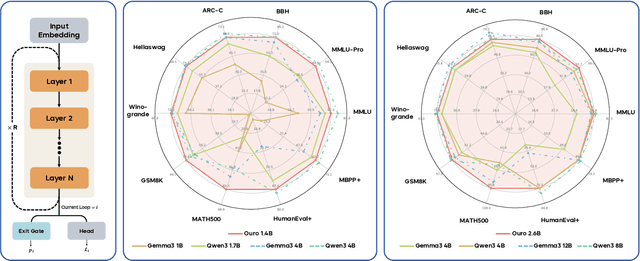
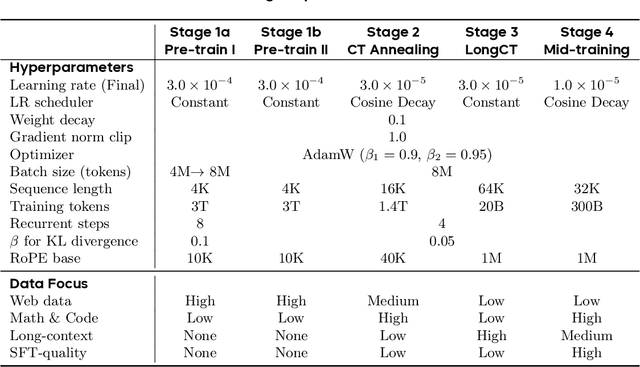
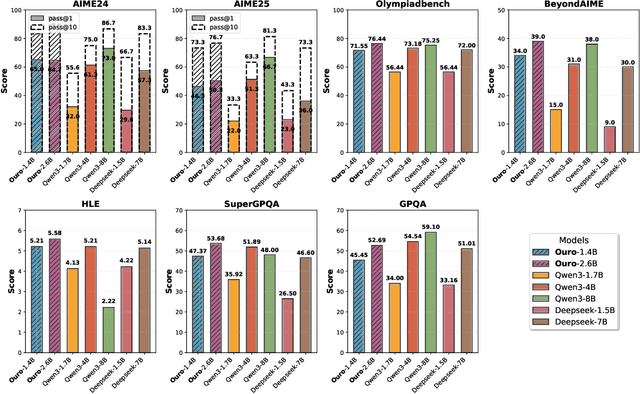

Modern LLMs are trained to "think" primarily via explicit text generation, such as chain-of-thought (CoT), which defers reasoning to post-training and under-leverages pre-training data. We present and open-source Ouro, named after the recursive Ouroboros, a family of pre-trained Looped Language Models (LoopLM) that instead build reasoning into the pre-training phase through (i) iterative computation in latent space, (ii) an entropy-regularized objective for learned depth allocation, and (iii) scaling to 7.7T tokens. Ouro 1.4B and 2.6B models enjoy superior performance that match the results of up to 12B SOTA LLMs across a wide range of benchmarks. Through controlled experiments, we show this advantage stems not from increased knowledge capacity, but from superior knowledge manipulation capabilities. We also show that LoopLM yields reasoning traces more aligned with final outputs than explicit CoT. We hope our results show the potential of LoopLM as a novel scaling direction in the reasoning era. Our model could be found in: http://ouro-llm.github.io.
A Survey on Latent Reasoning
Jul 08, 2025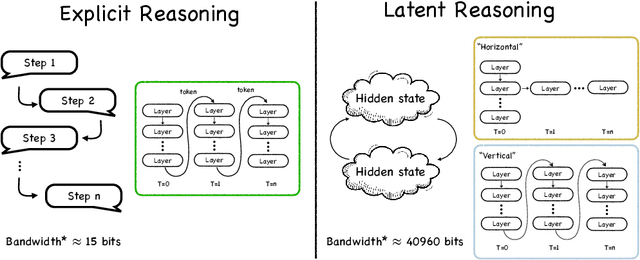

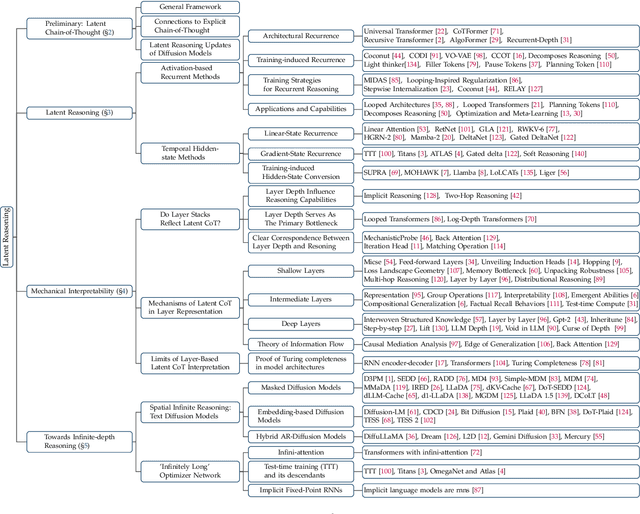
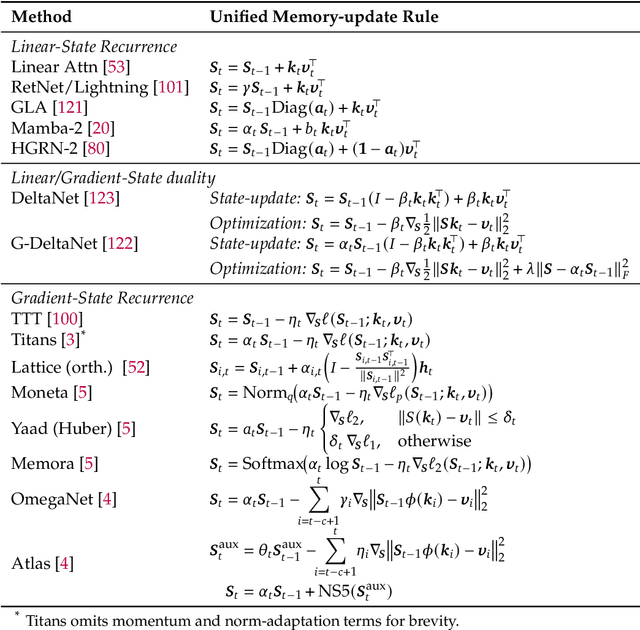
Large Language Models (LLMs) have demonstrated impressive reasoning capabilities, especially when guided by explicit chain-of-thought (CoT) reasoning that verbalizes intermediate steps. While CoT improves both interpretability and accuracy, its dependence on natural language reasoning limits the model's expressive bandwidth. Latent reasoning tackles this bottleneck by performing multi-step inference entirely in the model's continuous hidden state, eliminating token-level supervision. To advance latent reasoning research, this survey provides a comprehensive overview of the emerging field of latent reasoning. We begin by examining the foundational role of neural network layers as the computational substrate for reasoning, highlighting how hierarchical representations support complex transformations. Next, we explore diverse latent reasoning methodologies, including activation-based recurrence, hidden state propagation, and fine-tuning strategies that compress or internalize explicit reasoning traces. Finally, we discuss advanced paradigms such as infinite-depth latent reasoning via masked diffusion models, which enable globally consistent and reversible reasoning processes. By unifying these perspectives, we aim to clarify the conceptual landscape of latent reasoning and chart future directions for research at the frontier of LLM cognition. An associated GitHub repository collecting the latest papers and repos is available at: https://github.com/multimodal-art-projection/LatentCoT-Horizon/.
Radial Attention: $O(n\log n)$ Sparse Attention with Energy Decay for Long Video Generation
Jun 24, 2025Recent advances in diffusion models have enabled high-quality video generation, but the additional temporal dimension significantly increases computational costs, making training and inference on long videos prohibitively expensive. In this paper, we identify a phenomenon we term Spatiotemporal Energy Decay in video diffusion models: post-softmax attention scores diminish as spatial and temporal distance between tokens increase, akin to the physical decay of signal or waves over space and time in nature. Motivated by this, we propose Radial Attention, a scalable sparse attention mechanism with $O(n \log n)$ complexity that translates energy decay into exponentially decaying compute density, which is significantly more efficient than standard $O(n^2)$ dense attention and more expressive than linear attention. Specifically, Radial Attention employs a simple, static attention mask where each token attends to spatially nearby tokens, with the attention window size shrinking with temporal distance. Moreover, it allows pre-trained video diffusion models to extend their generation length with efficient LoRA-based fine-tuning. Extensive experiments show that Radial Attention maintains video quality across Wan2.1-14B, HunyuanVideo, and Mochi 1, achieving up to a 1.9$\times$ speedup over the original dense attention. With minimal tuning, it enables video generation up to 4$\times$ longer while reducing training costs by up to 4.4$\times$ compared to direct fine-tuning and accelerating inference by up to 3.7$\times$ compared to dense attention inference.
CommVQ: Commutative Vector Quantization for KV Cache Compression
Jun 23, 2025Large Language Models (LLMs) are increasingly used in applications requiring long context lengths, but the key-value (KV) cache often becomes a memory bottleneck on GPUs as context grows. To address this, we propose Commutative Vector Quantization (CommVQ) to significantly reduce memory usage for long-context LLM inference. We first introduce additive quantization with a lightweight encoder and codebook to compress the KV cache, which can be decoded via simple matrix multiplication. To further reduce computational costs during decoding, we design the codebook to be commutative with Rotary Position Embedding (RoPE) and train it using an Expectation-Maximization (EM) algorithm. This enables efficient integration of decoding into the self-attention mechanism. Our approach achieves high accuracy with additive quantization and low overhead via the RoPE-commutative codebook. Experiments on long-context benchmarks and GSM8K show that our method reduces FP16 KV cache size by 87.5% with 2-bit quantization, while outperforming state-of-the-art KV cache quantization methods. Notably, it enables 1-bit KV cache quantization with minimal accuracy loss, allowing a LLaMA-3.1 8B model to run with a 128K context length on a single RTX 4090 GPU. The source code is available at: https://github.com/UMass-Embodied-AGI/CommVQ.