 Add to Chrome
 Add to Firefox
 Add to Edge
FourTune: Towards Fully 4-Bit Efficient Post-Training for Diffusion Models
Jul 07, 2026
Diffusion models have become a dominant paradigm for high-quality generative modeling, while post-training is essential for adapting them to diverse downstream applications. However, post-training of large diffusion models is still challenging due to the prohibitive memory footprints and slow training speed, which existing parameter-efficient fine-tuning methods only partially address. To overcome these limitations, we propose FourTune, an efficient post-training framework for diffusion models based on an end-to-end W4A4G4 paradigm. FourTune introduces a triple-branch hybrid pipeline that augments the standard LoRA architecture with a frozen numerical stabilizer to isolate quantization-sensitive outliers, enabling stable training under native 4-bit computation. In addition, FourTune employs hardware-efficient block-wise quantization and customized fused kernels to support efficient quantized backpropagation and reduce memory bandwidth overhead. Across customization, reinforcement learning, and distillation tasks, FourTune matches the quality of full-precision fine-tuning. On FLUX.1-dev (12B), FourTune reduces memory overhead by 2.25$\times$ and increases end-to-end training throughput by 2.27$\times$ compared to BF16 LoRA.

SIRI: Self-Internalizing Reinforcement Learning with Intrinsic Skills for LLM Agent Training
Jun 01, 2026Long-horizon LLM agents can benefit from reusable skills, yet existing skill-based methods often rely on external skill generators during training or persistent skill retrieval at inference, increasing engineering complexity, context length, and deployment latency. We propose Self-Internalizing Reinforcement learning with Intrinsic skills (SIRI), a three-phase framework that enables agents to discover, validate, and internalize skills without external skill generators or inference-time skill banks. SIRI first warms up the policy with GiGPO to acquire basic interaction ability and collect successful skill-free trajectories. It then performs self-skill mining, where the current policy summarizes compact skills from its own successful plain rollouts and validates them through paired skill-augmented and skill-free rollouts. Finally, SIRI distills only beneficial skill-guided action tokens into the plain policy using trajectory-level utility and action-level advantage. At inference, the agent runs with the original prompt only. On ALFWorld and WebShop with Qwen2.5-7B-Instruct, SIRI improves GiGPO from 0.908 to 0.930 on ALFWorld and from 0.728 to 0.813 on WebShop, outperforming prompt-based, RL-based, and memory-augmented baselines. Further analysis shows that our self-mining strategy can achieve performance comparable to distillation with closed-source large model. Our code is available at https://github.com/kirito618/SIRI.
Quant VideoGen: Auto-Regressive Long Video Generation via 2-Bit KV-Cache Quantization
Feb 03, 2026Despite rapid progress in autoregressive video diffusion, an emerging system algorithm bottleneck limits both deployability and generation capability: KV cache memory. In autoregressive video generation models, the KV cache grows with generation history and quickly dominates GPU memory, often exceeding 30 GB, preventing deployment on widely available hardware. More critically, constrained KV cache budgets restrict the effective working memory, directly degrading long horizon consistency in identity, layout, and motion. To address this challenge, we present Quant VideoGen (QVG), a training free KV cache quantization framework for autoregressive video diffusion models. QVG leverages video spatiotemporal redundancy through Semantic Aware Smoothing, producing low magnitude, quantization friendly residuals. It further introduces Progressive Residual Quantization, a coarse to fine multi stage scheme that reduces quantization error while enabling a smooth quality memory trade off. Across LongCat Video, HY WorldPlay, and Self Forcing benchmarks, QVG establishes a new Pareto frontier between quality and memory efficiency, reducing KV cache memory by up to 7.0 times with less than 4% end to end latency overhead while consistently outperforming existing baselines in generation quality.
Radial Attention: $O(n\log n)$ Sparse Attention with Energy Decay for Long Video Generation
Jun 24, 2025Recent advances in diffusion models have enabled high-quality video generation, but the additional temporal dimension significantly increases computational costs, making training and inference on long videos prohibitively expensive. In this paper, we identify a phenomenon we term Spatiotemporal Energy Decay in video diffusion models: post-softmax attention scores diminish as spatial and temporal distance between tokens increase, akin to the physical decay of signal or waves over space and time in nature. Motivated by this, we propose Radial Attention, a scalable sparse attention mechanism with $O(n \log n)$ complexity that translates energy decay into exponentially decaying compute density, which is significantly more efficient than standard $O(n^2)$ dense attention and more expressive than linear attention. Specifically, Radial Attention employs a simple, static attention mask where each token attends to spatially nearby tokens, with the attention window size shrinking with temporal distance. Moreover, it allows pre-trained video diffusion models to extend their generation length with efficient LoRA-based fine-tuning. Extensive experiments show that Radial Attention maintains video quality across Wan2.1-14B, HunyuanVideo, and Mochi 1, achieving up to a 1.9$\times$ speedup over the original dense attention. With minimal tuning, it enables video generation up to 4$\times$ longer while reducing training costs by up to 4.4$\times$ compared to direct fine-tuning and accelerating inference by up to 3.7$\times$ compared to dense attention inference.
KETA: Kinematic-Phrases-Enhanced Text-to-Motion Generation via Fine-grained Alignment
Jan 25, 2025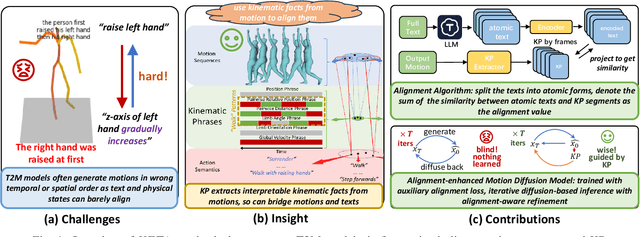
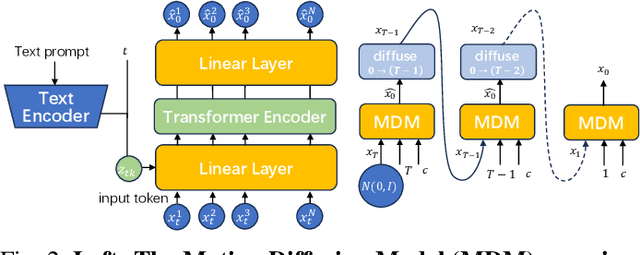
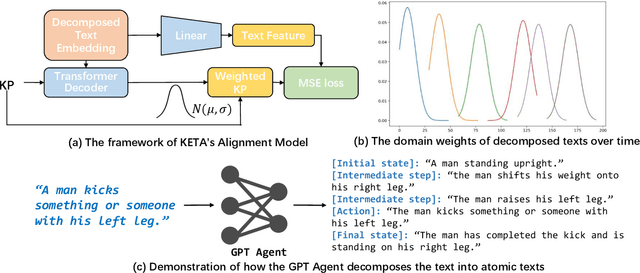
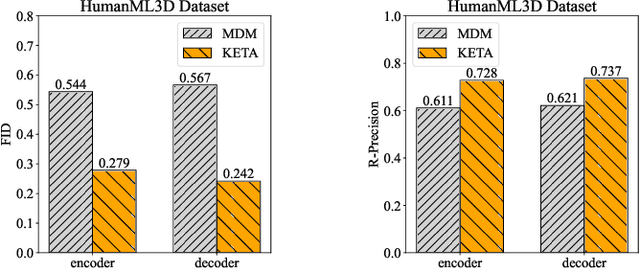
Motion synthesis plays a vital role in various fields of artificial intelligence. Among the various conditions of motion generation, text can describe motion details elaborately and is easy to acquire, making text-to-motion(T2M) generation important. State-of-the-art T2M techniques mainly leverage diffusion models to generate motions with text prompts as guidance, tackling the many-to-many nature of T2M tasks. However, existing T2M approaches face challenges, given the gap between the natural language domain and the physical domain, making it difficult to generate motions fully consistent with the texts. We leverage kinematic phrases(KP), an intermediate representation that bridges these two modalities, to solve this. Our proposed method, KETA, decomposes the given text into several decomposed texts via a language model. It trains an aligner to align decomposed texts with the KP segments extracted from the generated motions. Thus, it's possible to restrict the behaviors for diffusion-based T2M models. During the training stage, we deploy the text-KP alignment loss as an auxiliary goal to supervise the models. During the inference stage, we refine our generated motions for multiple rounds in our decoder structure, where we compute the text-KP distance as the guidance signal in each new round. Experiments demonstrate that KETA achieves up to 1.19x, 2.34x better R precision and FID value on both backbones of the base model, motion diffusion model. Compared to a wide range of T2M generation models. KETA achieves either the best or the second-best performance.