 Add to Chrome
 Add to Firefox
 Add to Edge
Channel Knowledge Map Enabled Low-Complexity Dynamic Radio Environment Reconstruction
Aug 18, 2026
Accurate and timely radio environment reconstruction is important but challenging under particularly dynamic transmitter configurations. The conventional methods such as compressed sensing (CS), Kriging method or U-Net typically require environment measurements and reconstruction overhead for radio environment updating as the transmitter locations or radiation patterns change. In this paper, we propose a novel channel knowledge map (CKM)-enabled dynamic radio environment reconstruction method for efficient radio map updating. Specifically, the recently proposed CKM can store reusable path-level propagation knowledge that is decoupled from the transmitter-side radiation characteristics. We can leverage CKM for lightweight forward radio map generation as the transmitter locations and radiation patterns are known, without requiring new target-map measurements. Simulation results show that the proposed method outperforms CS, Kriging, and U-Net in reconstruction accuracy and exhibits strong robustness performance under dynamic transmitter configurations, which demonstrates the potential of the proposed method for flexible and efficient radio environment reconstruction in dynamic wireless networks.

FourTune: Towards Fully 4-Bit Efficient Post-Training for Diffusion Models
Jul 07, 2026Diffusion models have become a dominant paradigm for high-quality generative modeling, while post-training is essential for adapting them to diverse downstream applications. However, post-training of large diffusion models is still challenging due to the prohibitive memory footprints and slow training speed, which existing parameter-efficient fine-tuning methods only partially address. To overcome these limitations, we propose FourTune, an efficient post-training framework for diffusion models based on an end-to-end W4A4G4 paradigm. FourTune introduces a triple-branch hybrid pipeline that augments the standard LoRA architecture with a frozen numerical stabilizer to isolate quantization-sensitive outliers, enabling stable training under native 4-bit computation. In addition, FourTune employs hardware-efficient block-wise quantization and customized fused kernels to support efficient quantized backpropagation and reduce memory bandwidth overhead. Across customization, reinforcement learning, and distillation tasks, FourTune matches the quality of full-precision fine-tuning. On FLUX.1-dev (12B), FourTune reduces memory overhead by 2.25$\times$ and increases end-to-end training throughput by 2.27$\times$ compared to BF16 LoRA.
Quant VideoGen: Auto-Regressive Long Video Generation via 2-Bit KV-Cache Quantization
Feb 03, 2026Despite rapid progress in autoregressive video diffusion, an emerging system algorithm bottleneck limits both deployability and generation capability: KV cache memory. In autoregressive video generation models, the KV cache grows with generation history and quickly dominates GPU memory, often exceeding 30 GB, preventing deployment on widely available hardware. More critically, constrained KV cache budgets restrict the effective working memory, directly degrading long horizon consistency in identity, layout, and motion. To address this challenge, we present Quant VideoGen (QVG), a training free KV cache quantization framework for autoregressive video diffusion models. QVG leverages video spatiotemporal redundancy through Semantic Aware Smoothing, producing low magnitude, quantization friendly residuals. It further introduces Progressive Residual Quantization, a coarse to fine multi stage scheme that reduces quantization error while enabling a smooth quality memory trade off. Across LongCat Video, HY WorldPlay, and Self Forcing benchmarks, QVG establishes a new Pareto frontier between quality and memory efficiency, reducing KV cache memory by up to 7.0 times with less than 4% end to end latency overhead while consistently outperforming existing baselines in generation quality.
Jet-RL: Enabling On-Policy FP8 Reinforcement Learning with Unified Training and Rollout Precision Flow
Jan 20, 2026Reinforcement learning (RL) is essential for enhancing the complex reasoning capabilities of large language models (LLMs). However, existing RL training pipelines are computationally inefficient and resource-intensive, with the rollout phase accounting for over 70% of total training time. Quantized RL training, particularly using FP8 precision, offers a promising approach to mitigating this bottleneck. A commonly adopted strategy applies FP8 precision during rollout while retaining BF16 precision for training. In this work, we present the first comprehensive study of FP8 RL training and demonstrate that the widely used BF16-training + FP8-rollout strategy suffers from severe training instability and catastrophic accuracy collapse under long-horizon rollouts and challenging tasks. Our analysis shows that these failures stem from the off-policy nature of the approach, which introduces substantial numerical mismatch between training and inference. Motivated by these observations, we propose Jet-RL, an FP8 RL training framework that enables robust and stable RL optimization. The key idea is to adopt a unified FP8 precision flow for both training and rollout, thereby minimizing numerical discrepancies and eliminating the need for inefficient inter-step calibration. Extensive experiments validate the effectiveness of Jet-RL: our method achieves up to 33% speedup in the rollout phase, up to 41% speedup in the training phase, and a 16% end-to-end speedup over BF16 training, while maintaining stable convergence across all settings and incurring negligible accuracy degradation.
Radial Attention: $O(n\log n)$ Sparse Attention with Energy Decay for Long Video Generation
Jun 24, 2025Recent advances in diffusion models have enabled high-quality video generation, but the additional temporal dimension significantly increases computational costs, making training and inference on long videos prohibitively expensive. In this paper, we identify a phenomenon we term Spatiotemporal Energy Decay in video diffusion models: post-softmax attention scores diminish as spatial and temporal distance between tokens increase, akin to the physical decay of signal or waves over space and time in nature. Motivated by this, we propose Radial Attention, a scalable sparse attention mechanism with $O(n \log n)$ complexity that translates energy decay into exponentially decaying compute density, which is significantly more efficient than standard $O(n^2)$ dense attention and more expressive than linear attention. Specifically, Radial Attention employs a simple, static attention mask where each token attends to spatially nearby tokens, with the attention window size shrinking with temporal distance. Moreover, it allows pre-trained video diffusion models to extend their generation length with efficient LoRA-based fine-tuning. Extensive experiments show that Radial Attention maintains video quality across Wan2.1-14B, HunyuanVideo, and Mochi 1, achieving up to a 1.9$\times$ speedup over the original dense attention. With minimal tuning, it enables video generation up to 4$\times$ longer while reducing training costs by up to 4.4$\times$ compared to direct fine-tuning and accelerating inference by up to 3.7$\times$ compared to dense attention inference.
Sparse VideoGen2: Accelerate Video Generation with Sparse Attention via Semantic-Aware Permutation
May 24, 2025Diffusion Transformers (DiTs) are essential for video generation but suffer from significant latency due to the quadratic complexity of attention. By computing only critical tokens, sparse attention reduces computational costs and offers a promising acceleration approach. However, we identify that existing methods fail to approach optimal generation quality under the same computation budget for two reasons: (1) Inaccurate critical token identification: current methods cluster tokens based on position rather than semantics, leading to imprecise aggregated representations. (2) Excessive computation waste: critical tokens are scattered among non-critical ones, leading to wasted computation on GPUs, which are optimized for processing contiguous tokens. In this paper, we propose SVG2, a training-free framework that maximizes identification accuracy and minimizes computation waste, achieving a Pareto frontier trade-off between generation quality and efficiency. The core of SVG2 is semantic-aware permutation, which clusters and reorders tokens based on semantic similarity using k-means. This approach ensures both a precise cluster representation, improving identification accuracy, and a densified layout of critical tokens, enabling efficient computation without padding. Additionally, SVG2 integrates top-p dynamic budget control and customized kernel implementations, achieving up to 2.30x and 1.89x speedup while maintaining a PSNR of up to 30 and 26 on HunyuanVideo and Wan 2.1, respectively.
LServe: Efficient Long-sequence LLM Serving with Unified Sparse Attention
Feb 20, 2025Large language models (LLMs) have shown remarkable potential in processing long sequences, yet efficiently serving these long-context models remains challenging due to the quadratic computational complexity of attention in the prefilling stage and the large memory footprint of the KV cache in the decoding stage. To address these issues, we introduce LServe, an efficient system that accelerates long-sequence LLM serving via hybrid sparse attention. This method unifies different hardware-friendly, structured sparsity patterns for both prefilling and decoding attention into a single framework, where computations on less important tokens are skipped block-wise. LServe demonstrates the compatibility of static and dynamic sparsity in long-context LLM attention. This design enables multiplicative speedups by combining these optimizations. Specifically, we convert half of the attention heads to nearly free streaming heads in both the prefilling and decoding stages. Additionally, we find that only a constant number of KV pages is required to preserve long-context capabilities, irrespective of context length. We then design a hierarchical KV page selection policy that dynamically prunes KV pages based on query-centric similarity. On average, LServe accelerates LLM prefilling by up to 2.9x and decoding by 1.3-2.1x over vLLM, maintaining long-context accuracy. Code is released at https://github.com/mit-han-lab/omniserve.
Sparse VideoGen: Accelerating Video Diffusion Transformers with Spatial-Temporal Sparsity
Feb 03, 2025
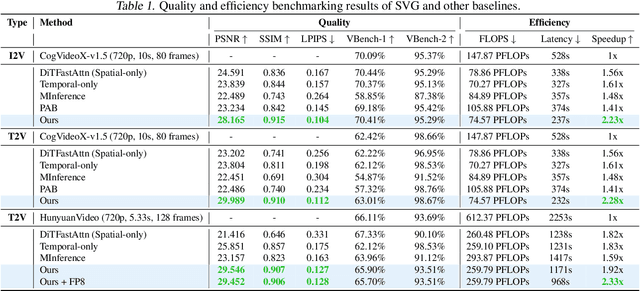

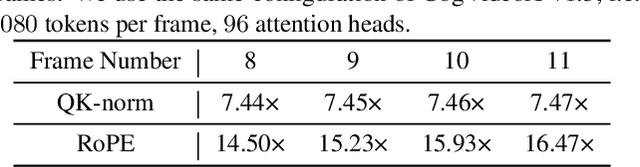
Diffusion Transformers (DiTs) dominate video generation but their high computational cost severely limits real-world applicability, usually requiring tens of minutes to generate a few seconds of video even on high-performance GPUs. This inefficiency primarily arises from the quadratic computational complexity of 3D Full Attention with respect to the context length. In this paper, we propose a training-free framework termed Sparse VideoGen (SVG) that leverages the inherent sparsity in 3D Full Attention to boost inference efficiency. We reveal that the attention heads can be dynamically classified into two groups depending on distinct sparse patterns: (1) Spatial Head, where only spatially-related tokens within each frame dominate the attention output, and (2) Temporal Head, where only temporally-related tokens across different frames dominate. Based on this insight, SVG proposes an online profiling strategy to capture the dynamic sparse patterns and predicts the type of attention head. Combined with a novel hardware-efficient tensor layout transformation and customized kernel implementations, SVG achieves up to 2.28x and 2.33x end-to-end speedup on CogVideoX-v1.5 and HunyuanVideo, respectively, while preserving generation quality.
SANA 1.5: Efficient Scaling of Training-Time and Inference-Time Compute in Linear Diffusion Transformer
Jan 30, 2025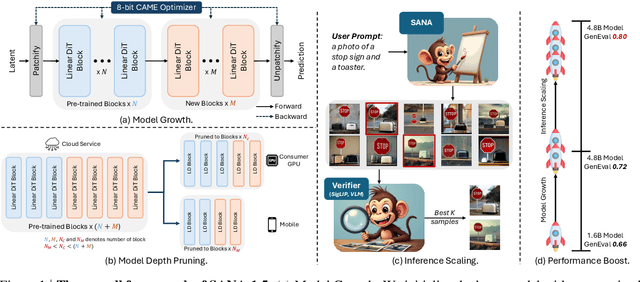


This paper presents SANA-1.5, a linear Diffusion Transformer for efficient scaling in text-to-image generation. Building upon SANA-1.0, we introduce three key innovations: (1) Efficient Training Scaling: A depth-growth paradigm that enables scaling from 1.6B to 4.8B parameters with significantly reduced computational resources, combined with a memory-efficient 8-bit optimizer. (2) Model Depth Pruning: A block importance analysis technique for efficient model compression to arbitrary sizes with minimal quality loss. (3) Inference-time Scaling: A repeated sampling strategy that trades computation for model capacity, enabling smaller models to match larger model quality at inference time. Through these strategies, SANA-1.5 achieves a text-image alignment score of 0.72 on GenEval, which can be further improved to 0.80 through inference scaling, establishing a new SoTA on GenEval benchmark. These innovations enable efficient model scaling across different compute budgets while maintaining high quality, making high-quality image generation more accessible.
SVDQuant: Absorbing Outliers by Low-Rank Components for 4-Bit Diffusion Models
Nov 07, 2024

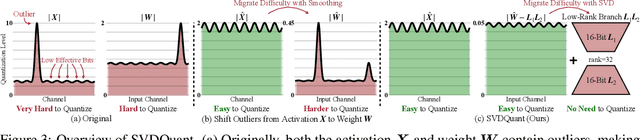

Diffusion models have been proven highly effective at generating high-quality images. However, as these models grow larger, they require significantly more memory and suffer from higher latency, posing substantial challenges for deployment. In this work, we aim to accelerate diffusion models by quantizing their weights and activations to 4 bits. At such an aggressive level, both weights and activations are highly sensitive, where conventional post-training quantization methods for large language models like smoothing become insufficient. To overcome this limitation, we propose SVDQuant, a new 4-bit quantization paradigm. Different from smoothing which redistributes outliers between weights and activations, our approach absorbs these outliers using a low-rank branch. We first consolidate the outliers by shifting them from activations to weights, then employ a high-precision low-rank branch to take in the weight outliers with Singular Value Decomposition (SVD). This process eases the quantization on both sides. However, na\"{\i}vely running the low-rank branch independently incurs significant overhead due to extra data movement of activations, negating the quantization speedup. To address this, we co-design an inference engine Nunchaku that fuses the kernels of the low-rank branch into those of the low-bit branch to cut off redundant memory access. It can also seamlessly support off-the-shelf low-rank adapters (LoRAs) without the need for re-quantization. Extensive experiments on SDXL, PixArt-$\Sigma$, and FLUX.1 validate the effectiveness of SVDQuant in preserving image quality. We reduce the memory usage for the 12B FLUX.1 models by 3.5$\times$, achieving 3.0$\times$ speedup over the 4-bit weight-only quantized baseline on the 16GB laptop 4090 GPU, paving the way for more interactive applications on PCs. Our quantization library and inference engine are open-sourced.