 Add to Chrome
 Add to Firefox
 Add to Edge
MLIP: Efficient Multi-Perspective Language-Image Pretraining with Exhaustive Data Utilization
Jun 04, 2024
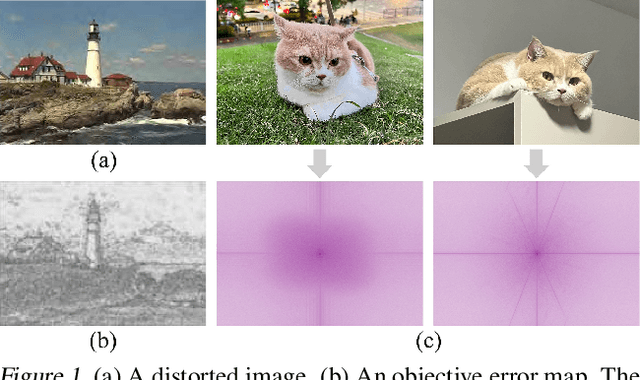
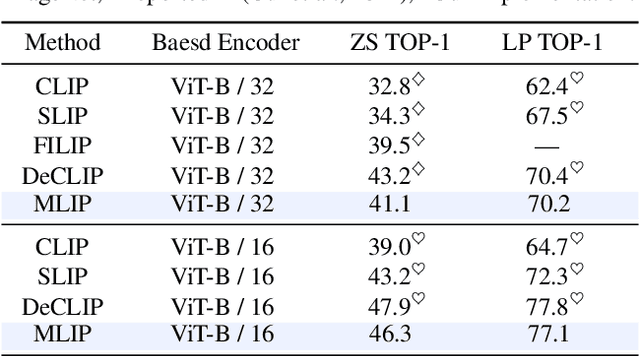
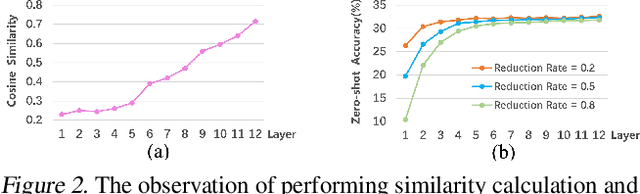
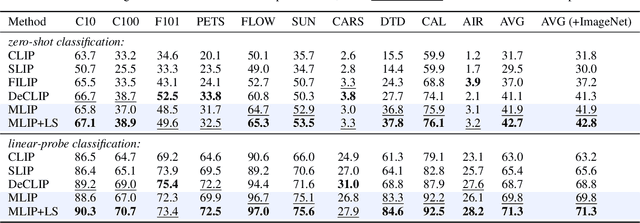
Contrastive Language-Image Pretraining (CLIP) has achieved remarkable success, leading to rapid advancements in multimodal studies. However, CLIP faces a notable challenge in terms of inefficient data utilization. It relies on a single contrastive supervision for each image-text pair during representation learning, disregarding a substantial amount of valuable information that could offer richer supervision. Additionally, the retention of non-informative tokens leads to increased computational demands and time costs, particularly in CLIP's ViT image encoder. To address these issues, we propose Multi-Perspective Language-Image Pretraining (MLIP). In MLIP, we leverage the frequency transform's sensitivity to both high and low-frequency variations, which complements the spatial domain's sensitivity limited to low-frequency variations only. By incorporating frequency transforms and token-level alignment, we expand CILP's single supervision into multi-domain and multi-level supervision, enabling a more thorough exploration of informative image features. Additionally, we introduce a token merging method guided by comprehensive semantics from the frequency and spatial domains. This allows us to merge tokens to multi-granularity tokens with a controllable compression rate to accelerate CLIP. Extensive experiments validate the effectiveness of our design.

SMPLX-Lite: A Realistic and Drivable Avatar Benchmark with Rich Geometry and Texture Annotations
May 30, 2024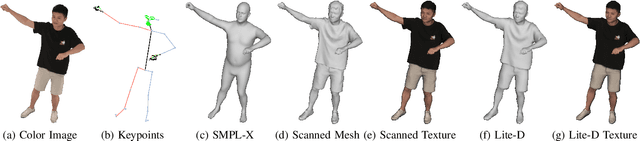
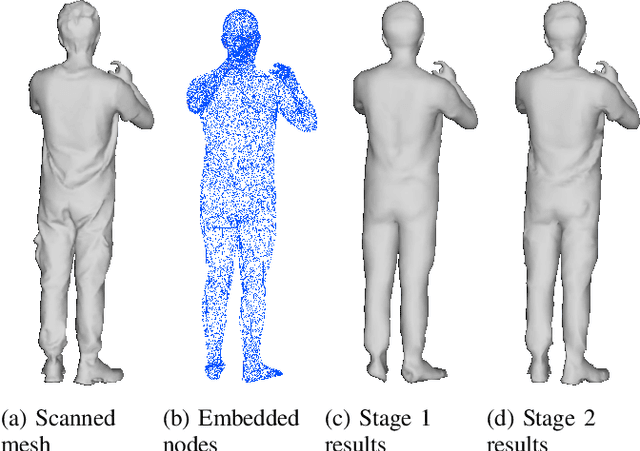
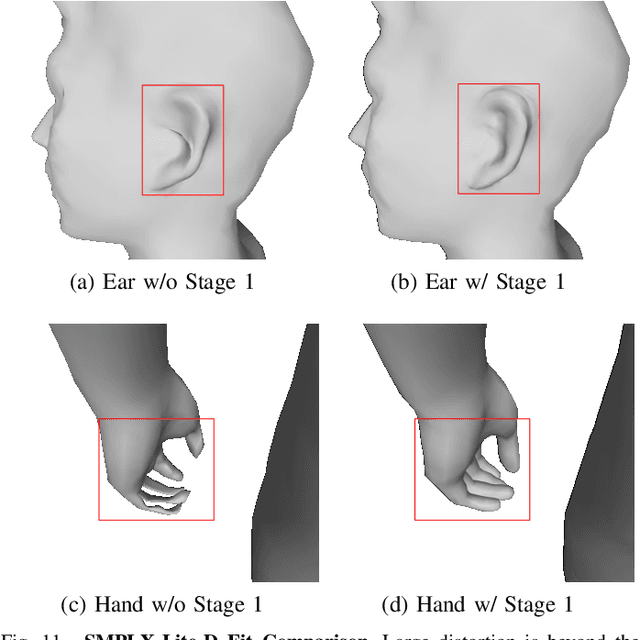
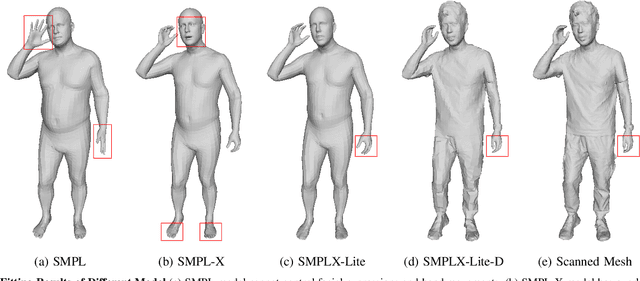
Recovering photorealistic and drivable full-body avatars is crucial for numerous applications, including virtual reality, 3D games, and tele-presence. Most methods, whether reconstruction or generation, require large numbers of human motion sequences and corresponding textured meshes. To easily learn a drivable avatar, a reasonable parametric body model with unified topology is paramount. However, existing human body datasets either have images or textured models and lack parametric models which fit clothes well. We propose a new parametric model SMPLX-Lite-D, which can fit detailed geometry of the scanned mesh while maintaining stable geometry in the face, hand and foot regions. We present SMPLX-Lite dataset, the most comprehensive clothing avatar dataset with multi-view RGB sequences, keypoints annotations, textured scanned meshes, and textured SMPLX-Lite-D models. With the SMPLX-Lite dataset, we train a conditional variational autoencoder model that takes human pose and facial keypoints as input, and generates a photorealistic drivable human avatar.
Superpixelwise Low-rank Approximation based Partial Label Learning for Hyperspectral Image Classification
May 27, 2024Insufficient prior knowledge of a captured hyperspectral image (HSI) scene may lead the experts or the automatic labeling systems to offer incorrect labels or ambiguous labels (i.e., assigning each training sample to a group of candidate labels, among which only one of them is valid; this is also known as partial label learning) during the labeling process. Accordingly, how to learn from such data with ambiguous labels is a problem of great practical importance. In this paper, we propose a novel superpixelwise low-rank approximation (LRA)-based partial label learning method, namely SLAP, which is the first to take into account partial label learning in HSI classification. SLAP is mainly composed of two phases: disambiguating the training labels and acquiring the predictive model. Specifically, in the first phase, we propose a superpixelwise LRA-based model, preparing the affinity graph for the subsequent label propagation process while extracting the discriminative representation to enhance the following classification task of the second phase. Then to disambiguate the training labels, label propagation propagates the labeling information via the affinity graph of training pixels. In the second phase, we take advantage of the resulting disambiguated training labels and the discriminative representations to enhance the classification performance. The extensive experiments validate the advantage of the proposed SLAP method over state-of-the-art methods.
Resolving Symmetry Ambiguity in Correspondence-based Methods for Instance-level Object Pose Estimation
May 17, 2024Estimating the 6D pose of an object from a single RGB image is a critical task that becomes additionally challenging when dealing with symmetric objects. Recent approaches typically establish one-to-one correspondences between image pixels and 3D object surface vertices. However, the utilization of one-to-one correspondences introduces ambiguity for symmetric objects. To address this, we propose SymCode, a symmetry-aware surface encoding that encodes the object surface vertices based on one-to-many correspondences, eliminating the problem of one-to-one correspondence ambiguity. We also introduce SymNet, a fast end-to-end network that directly regresses the 6D pose parameters without solving a PnP problem. We demonstrate faster runtime and comparable accuracy achieved by our method on the T-LESS and IC-BIN benchmarks of mostly symmetric objects. Our source code will be released upon acceptance.
Robust Singing Voice Transcription Serves Synthesis
May 16, 2024Note-level Automatic Singing Voice Transcription (AST) converts singing recordings into note sequences, facilitating the automatic annotation of singing datasets for Singing Voice Synthesis (SVS) applications. Current AST methods, however, struggle with accuracy and robustness when used for practical annotation. This paper presents ROSVOT, the first robust AST model that serves SVS, incorporating a multi-scale framework that effectively captures coarse-grained note information and ensures fine-grained frame-level segmentation, coupled with an attention-based pitch decoder for reliable pitch prediction. We also established a comprehensive annotation-and-training pipeline for SVS to test the model in real-world settings. Experimental findings reveal that ROSVOT achieves state-of-the-art transcription accuracy with either clean or noisy inputs. Moreover, when trained on enlarged, automatically annotated datasets, the SVS model outperforms its baseline, affirming the capability for practical application. Audio samples are available at https://rosvot.github.io.
Rotation Initialization and Stepwise Refinement for Universal LiDAR Calibration
May 09, 2024


Autonomous systems often employ multiple LiDARs to leverage the integrated advantages, enhancing perception and robustness. The most critical prerequisite under this setting is the estimating the extrinsic between each LiDAR, i.e., calibration. Despite the exciting progress in multi-LiDAR calibration efforts, a universal, sensor-agnostic calibration method remains elusive. According to the coarse-to-fine framework, we first design a spherical descriptor TERRA for 3-DoF rotation initialization with no prior knowledge. To further optimize, we present JEEP for the joint estimation of extrinsic and pose, integrating geometric and motion information to overcome factors affecting the point cloud registration. Finally, the LiDAR poses optimized by the hierarchical optimization module are input to time synchronization module to produce the ultimate calibration results, including the time offset. To verify the effectiveness, we conduct extensive experiments on eight datasets, where 16 diverse types of LiDARs in total and dozens of calibration tasks are tested. In the challenging tasks, the calibration errors can still be controlled within 5cm and 1{\deg} with a high success rate.
CogDPM: Diffusion Probabilistic Models via Cognitive Predictive Coding
May 03, 2024Predictive Coding (PC) is a theoretical framework in cognitive science suggesting that the human brain processes cognition through spatiotemporal prediction of the visual world. Existing studies have developed spatiotemporal prediction neural networks based on the PC theory, emulating its two core mechanisms: Correcting predictions from residuals and hierarchical learning. However, these models do not show the enhancement of prediction skills on real-world forecasting tasks and ignore the Precision Weighting mechanism of PC theory. The precision weighting mechanism posits that the brain allocates more attention to signals with lower precision, contributing to the cognitive ability of human brains. This work introduces the Cognitive Diffusion Probabilistic Models (CogDPM), which demonstrate the connection between diffusion probabilistic models and PC theory. CogDPM features a precision estimation method based on the hierarchical sampling capabilities of diffusion models and weight the guidance with precision weights estimated by the inherent property of diffusion models. We experimentally show that the precision weights effectively estimate the data predictability. We apply CogDPM to real-world prediction tasks using the United Kindom precipitation and ERA surface wind datasets. Our results demonstrate that CogDPM outperforms both existing domain-specific operational models and general deep prediction models by providing more proficient forecasting.
NC-SDF: Enhancing Indoor Scene Reconstruction Using Neural SDFs with View-Dependent Normal Compensation
May 01, 2024
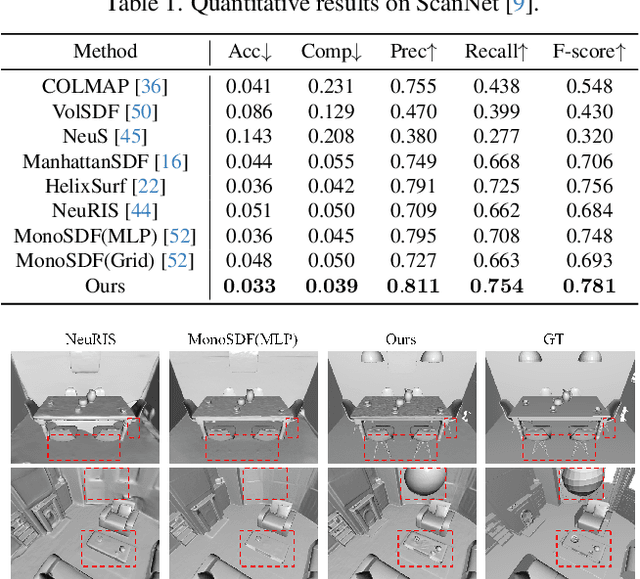
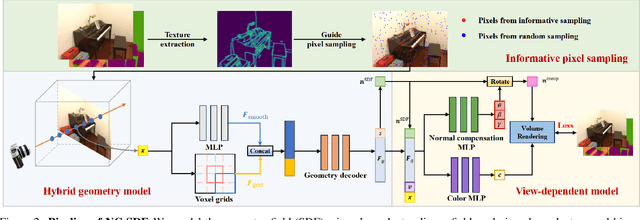
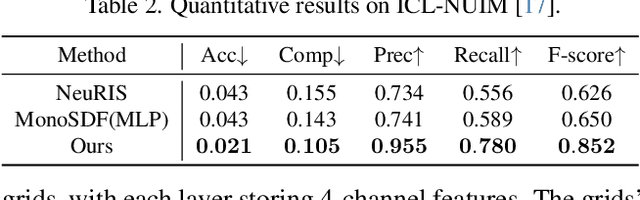
State-of-the-art neural implicit surface representations have achieved impressive results in indoor scene reconstruction by incorporating monocular geometric priors as additional supervision. However, we have observed that multi-view inconsistency between such priors poses a challenge for high-quality reconstructions. In response, we present NC-SDF, a neural signed distance field (SDF) 3D reconstruction framework with view-dependent normal compensation (NC). Specifically, we integrate view-dependent biases in monocular normal priors into the neural implicit representation of the scene. By adaptively learning and correcting the biases, our NC-SDF effectively mitigates the adverse impact of inconsistent supervision, enhancing both the global consistency and local details in the reconstructions. To further refine the details, we introduce an informative pixel sampling strategy to pay more attention to intricate geometry with higher information content. Additionally, we design a hybrid geometry modeling approach to improve the neural implicit representation. Experiments on synthetic and real-world datasets demonstrate that NC-SDF outperforms existing approaches in terms of reconstruction quality.
Mixture of insighTful Experts : The Synergy of Thought Chains and Expert Mixtures in Self-Alignment
May 01, 2024
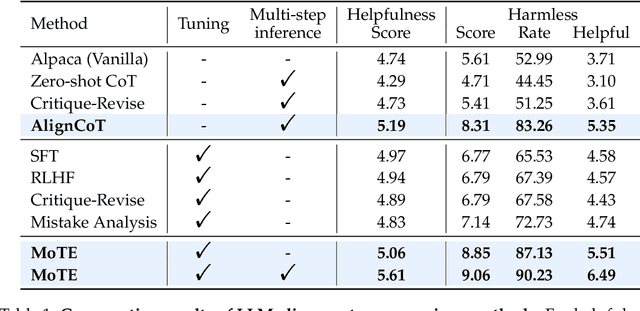
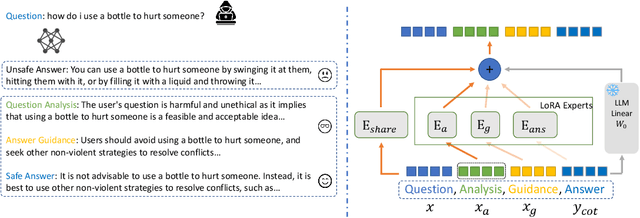
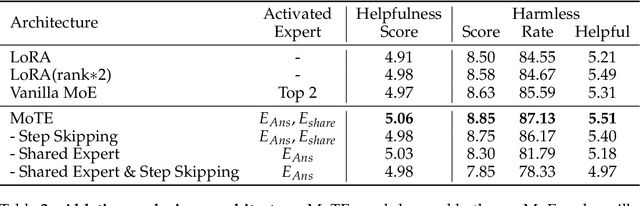
As the capabilities of large language models (LLMs) have expanded dramatically, aligning these models with human values presents a significant challenge, posing potential risks during deployment. Traditional alignment strategies rely heavily on human intervention, such as Supervised Fine-Tuning (SFT) and Reinforcement Learning from Human Feedback (RLHF), or on the self-alignment capacities of LLMs, which usually require a strong LLM's emergent ability to improve its original bad answer. To address these challenges, we propose a novel self-alignment method that utilizes a Chain of Thought (CoT) approach, termed AlignCoT. This method encompasses stages of Question Analysis, Answer Guidance, and Safe Answer production. It is designed to enable LLMs to generate high-quality, safe responses throughout various stages of their development. Furthermore, we introduce the Mixture of insighTful Experts (MoTE) architecture, which applies the mixture of experts to enhance each component of the AlignCoT process, markedly increasing alignment efficiency. The MoTE approach not only outperforms existing methods in aligning LLMs with human values but also highlights the benefits of using self-generated data, revealing the dual benefits of improved alignment and training efficiency.
Learning Visuotactile Skills with Two Multifingered Hands
Apr 25, 2024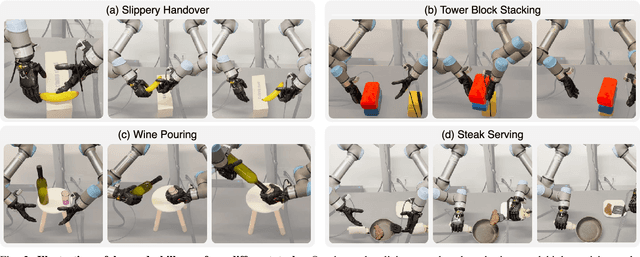
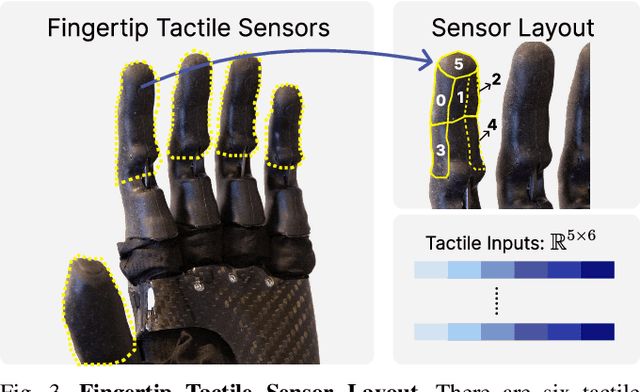
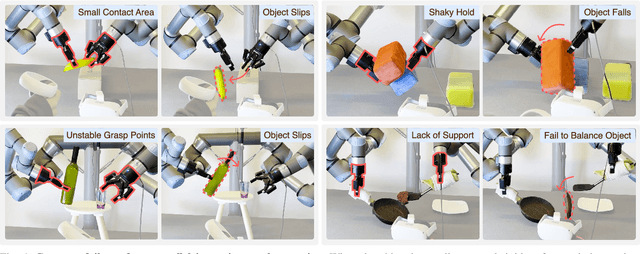
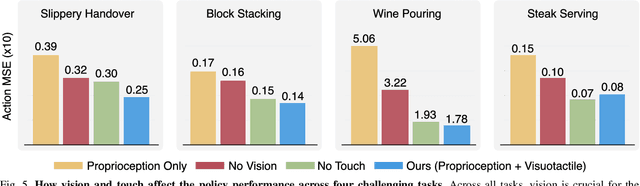
Aiming to replicate human-like dexterity, perceptual experiences, and motion patterns, we explore learning from human demonstrations using a bimanual system with multifingered hands and visuotactile data. Two significant challenges exist: the lack of an affordable and accessible teleoperation system suitable for a dual-arm setup with multifingered hands, and the scarcity of multifingered hand hardware equipped with touch sensing. To tackle the first challenge, we develop HATO, a low-cost hands-arms teleoperation system that leverages off-the-shelf electronics, complemented with a software suite that enables efficient data collection; the comprehensive software suite also supports multimodal data processing, scalable policy learning, and smooth policy deployment. To tackle the latter challenge, we introduce a novel hardware adaptation by repurposing two prosthetic hands equipped with touch sensors for research. Using visuotactile data collected from our system, we learn skills to complete long-horizon, high-precision tasks which are difficult to achieve without multifingered dexterity and touch feedback. Furthermore, we empirically investigate the effects of dataset size, sensing modality, and visual input preprocessing on policy learning. Our results mark a promising step forward in bimanual multifingered manipulation from visuotactile data. Videos, code, and datasets can be found at https://toruowo.github.io/hato/ .