 Add to Chrome
 Add to Firefox
 Add to Edge
Beyond Sufficiency: Time Series Explanation with Counterfactual Necessity
Jul 23, 2026
Faithful explanations of time-series classifiers should identify subsequences that are not only sufficient to preserve a black-box model's prediction, but also necessary for maintaining it. However, existing sufficiency-oriented methods can assign high importance to spurious subsequences that support the prediction without being essential to the model's decision. We introduce \textbf{TimePNS}, a necessity-aware framework for time-series explanation. Inspired by Pearl's counterfactual notion of necessity, TimePNS assesses whether a temporal factor is necessary by intervening on it and measuring whether the original prediction is disrupted. The framework adopts a two-stage design. Stage I learns an identifiable causal generative process together with a sufficiency-oriented explanation mask. Stage II performs counterfactual interventions on temporal factors to derive necessity signals, which supervise a temporal gate that refines the initial explanation by suppressing non-essential components and emphasizing counterfactually necessary ones. Experiments on synthetic and real-world time-series benchmarks show that TimePNS more accurately identifies decision-critical subsequences and consistently improves sufficiency-necessity trade-offs over strong baselines.

StakeBench: Evaluating Language Understanding Grounded in Market Commitment
May 25, 2026Existing financial NLP benchmarks often rely on labels supplied by outside observers, measuring how language is perceived rather than what speakers have committed to in the market. We introduce StakeBench, an evaluation framework for language understanding grounded in market commitment. StakeBench links 560,876 comments from 2,261 resolved markets to verified position, action, and market-odds records across Polymarket and Manifold. Supervision is derived from observable market behavior. Position sides, post-comment trading actions, and market-odds trajectories replace human annotation. Four diagnostic tasks test whether models detect market commitment, identify the revealed side, anticipate future action, and perform collective odds projection. Three commitment-aware metrics measure alignment with revealed preferences rather than perceived sentiment. Validity audits and explicit interpretation boundaries help distinguish observable commitment signals from latent belief and causal market-odds impact. Across 15 LLMs and 18 topics and platform settings, models partially recover position-side signals, with Directed Accuracy from 0.506 to 0.599, but show structural failures on later tasks. Ten of the fifteen models collapse to one or two action labels in future action anticipation, and no model consistently improves on the naive odds-direction baseline in collective odds projection. Model scale is not correlated with performance, finance-domain tuning does not improve revealed-side identification, and platform incentives strongly shape higher-order results. StakeBench is packaged with evaluation code and dataset under CC-BY 4.0.
CreativeGame:Toward Mechanic-Aware Creative Game Generation
Apr 21, 2026Large language models can generate plausible game code, but turning this capability into \emph{iterative creative improvement} remains difficult. In practice, single-shot generation often produces brittle runtime behavior, weak accumulation of experience across versions, and creativity scores that are too subjective to serve as reliable optimization signals. A further limitation is that mechanics are frequently treated only as post-hoc descriptions, rather than as explicit objects that can be planned, tracked, preserved, and evaluated during generation. This report presents \textbf{CreativeGame}, a multi-agent system for iterative HTML5 game generation that addresses these issues through four coupled ideas: a proxy reward centered on programmatic signals rather than pure LLM judgment; lineage-scoped memory for cross-version experience accumulation; runtime validation integrated into both repair and reward; and a mechanic-guided planning loop in which retrieved mechanic knowledge is converted into an explicit mechanic plan before code generation begins. The goal is not merely to produce a playable artifact in one step, but to support interpretable version-to-version evolution. The current system contains 71 stored lineages, 88 saved nodes, and a 774-entry global mechanic archive, implemented in 6{,}181 lines of Python together with inspection and visualization tooling. The system is therefore substantial enough to support architectural analysis, reward inspection, and real lineage-level case studies rather than only prompt-level demos. A real 4-generation lineage shows that mechanic-level innovation can emerge in later versions and can be inspected directly through version-to-version records. The central contribution is therefore not only game generation, but a concrete pipeline for observing progressive evolution through explicit mechanic change.
Invariant Causal Routing for Governing Social Norms in Online Market Economies
Mar 04, 2026Social norms are stable behavioral patterns that emerge endogenously within economic systems through repeated interactions among agents. In online market economies, such norms -- like fair exposure, sustained participation, and balanced reinvestment -- are critical for long-term stability. We aim to understand the causal mechanisms driving these emergent norms and to design principled interventions that can steer them toward desired outcomes. This is challenging because norms arise from countless micro-level interactions that aggregate into macro-level regularities, making causal attribution and policy transferability difficult. To address this, we propose \textbf{Invariant Causal Routing (ICR)}, a causal governance framework that identifies policy-norm relations stable across heterogeneous environments. ICR integrates counterfactual reasoning with invariant causal discovery to separate genuine causal effects from spurious correlations and to construct interpretable, auditable policy rules that remain effective under distribution shift. In heterogeneous agent simulations calibrated with real data, ICR yields more stable norms, smaller generalization gaps, and more concise rules than correlation or coverage baselines, demonstrating that causal invariance offers a principled and interpretable foundation for governance.
Swordsman: Entropy-Driven Adaptive Block Partition for Efficient Diffusion Language Models
Feb 04, 2026Block-wise decoding effectively improves the inference speed and quality in diffusion language models (DLMs) by combining inter-block sequential denoising and intra-block parallel unmasking. However, existing block-wise decoding methods typically partition blocks in a rigid and fixed manner, which inevitably fragments complete semantic or syntactic constituents, leading to suboptimal performance. Inspired by the entropy reduction hypothesis (ERH), we recognize that constituent boundaries offer greater opportunities for uncertainty reduction, which motivates us to employ entropy analysis for identifying constituent boundaries. Therefore, we propose Swordsman, an entropy-driven adaptive block-wise decoding framework for DLMs. Swordsman adaptively partitions blocks by identifying entropy shifts between adjacent tokens to better align with semantic or syntactic constituent boundaries. In addition, Swordsman dynamically adjusts unmasking thresholds conditioned on the real-time unmasking status within a block, further improving both efficiency and stability. As a training-free framework, supported by KV Cache, Swordsman demonstrates state-of-the-art performance across extensive evaluations.
FourierSampler: Unlocking Non-Autoregressive Potential in Diffusion Language Models via Frequency-Guided Generation
Jan 30, 2026Despite the non-autoregressive potential of diffusion language models (dLLMs), existing decoding strategies demonstrate positional bias, failing to fully unlock the potential of arbitrary generation. In this work, we delve into the inherent spectral characteristics of dLLMs and present the first frequency-domain analysis showing that low-frequency components in hidden states primarily encode global structural information and long-range dependencies, while high-frequency components are responsible for characterizing local details. Based on this observation, we propose FourierSampler, which leverages a frequency-domain sliding window mechanism to dynamically guide the model to achieve a "structure-to-detail" generation. FourierSampler outperforms other inference enhancement strategies on LLADA and SDAR, achieving relative improvements of 20.4% on LLaDA1.5-8B and 16.0% on LLaDA-8B-Instruct. It notably surpasses similarly sized autoregressive models like Llama3.1-8B-Instruct.
TriShGAN: Enhancing Sparsity and Robustness in Multivariate Time Series Counterfactuals Explanation
Nov 09, 2025In decision-making processes, stakeholders often rely on counterfactual explanations, which provide suggestions about what should be changed in the queried instance to alter the outcome of an AI system. However, generating these explanations for multivariate time series presents challenges due to their complex, multi-dimensional nature. Traditional Nearest Unlike Neighbor-based methods typically substitute subsequences in a queried time series with influential subsequences from an NUN, which is not always realistic in real-world scenarios due to the rigid direct substitution. Counterfactual with Residual Generative Adversarial Networks-based methods aim to address this by learning from the distribution of observed data to generate synthetic counterfactual explanations. However, these methods primarily focus on minimizing the cost from the queried time series to the counterfactual explanations and often neglect the importance of distancing the counterfactual explanation from the decision boundary. This oversight can result in explanations that no longer qualify as counterfactual if minor changes occur within the model. To generate a more robust counterfactual explanation, we introduce TriShGAN, under the CounteRGAN framework enhanced by the incorporation of triplet loss. This unsupervised learning approach uses distance metric learning to encourage the counterfactual explanations not only to remain close to the queried time series but also to capture the feature distribution of the instance with the desired outcome, thereby achieving a better balance between minimal cost and robustness. Additionally, we integrate a Shapelet Extractor that strategically selects the most discriminative parts of the high-dimensional queried time series to enhance the sparsity of counterfactual explanation and efficiency of the training process.
PMAT: Optimizing Action Generation Order in Multi-Agent Reinforcement Learning
Feb 23, 2025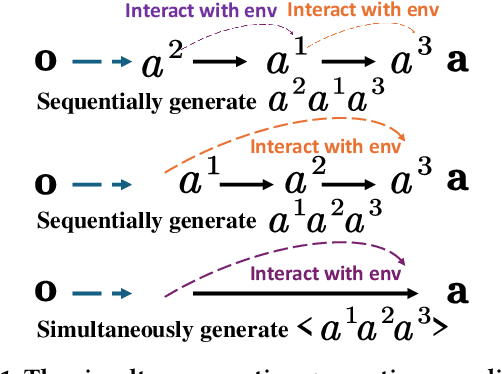

Multi-agent reinforcement learning (MARL) faces challenges in coordinating agents due to complex interdependencies within multi-agent systems. Most MARL algorithms use the simultaneous decision-making paradigm but ignore the action-level dependencies among agents, which reduces coordination efficiency. In contrast, the sequential decision-making paradigm provides finer-grained supervision for agent decision order, presenting the potential for handling dependencies via better decision order management. However, determining the optimal decision order remains a challenge. In this paper, we introduce Action Generation with Plackett-Luce Sampling (AGPS), a novel mechanism for agent decision order optimization. We model the order determination task as a Plackett-Luce sampling process to address issues such as ranking instability and vanishing gradient during the network training process. AGPS realizes credit-based decision order determination by establishing a bridge between the significance of agents' local observations and their decision credits, thus facilitating order optimization and dependency management. Integrating AGPS with the Multi-Agent Transformer, we propose the Prioritized Multi-Agent Transformer (PMAT), a sequential decision-making MARL algorithm with decision order optimization. Experiments on benchmarks including StarCraft II Multi-Agent Challenge, Google Research Football, and Multi-Agent MuJoCo show that PMAT outperforms state-of-the-art algorithms, greatly enhancing coordination efficiency.
Beyond Prior Limits: Addressing Distribution Misalignment in Particle Filtering
Jan 30, 2025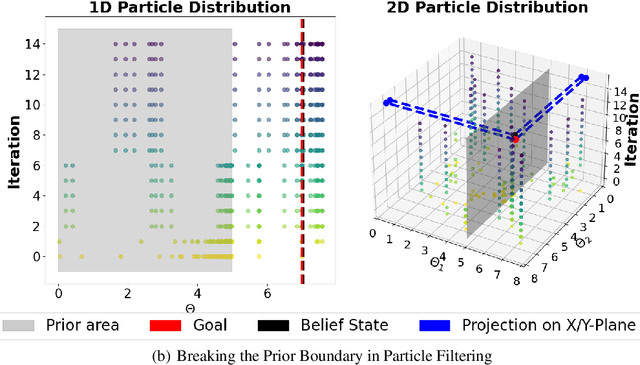
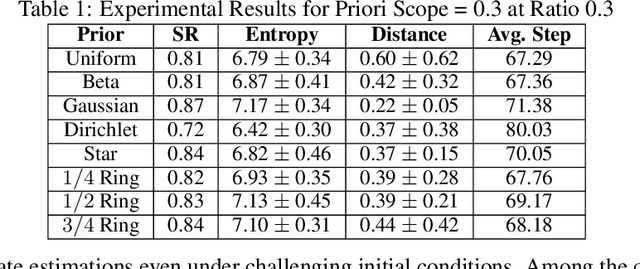
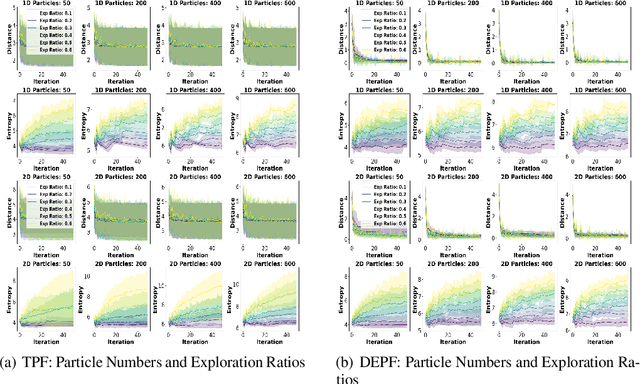
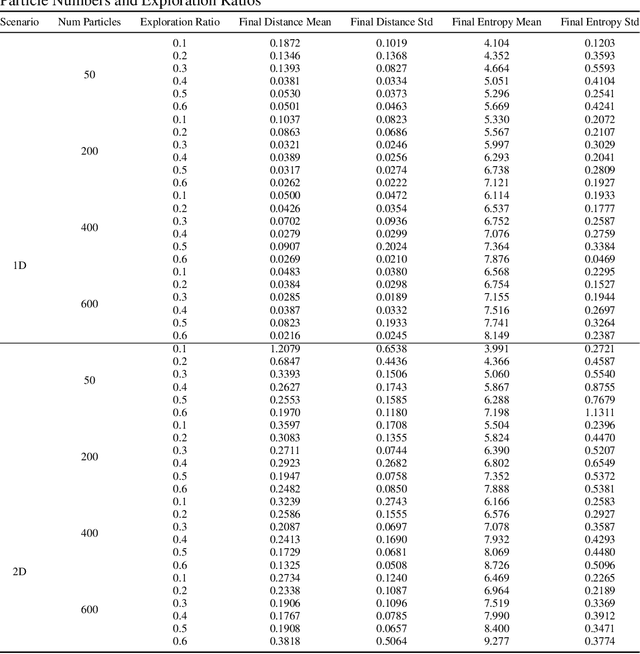
Particle filtering is a Bayesian inference method and a fundamental tool in state estimation for dynamic systems, but its effectiveness is often limited by the constraints of the initial prior distribution, a phenomenon we define as the Prior Boundary Phenomenon. This challenge arises when target states lie outside the prior's support, rendering traditional particle filtering methods inadequate for accurate estimation. Although techniques like unbounded priors and larger particle sets have been proposed, they remain computationally prohibitive and lack adaptability in dynamic scenarios. To systematically overcome these limitations, we propose the Diffusion-Enhanced Particle Filtering Framework, which introduces three key innovations: adaptive diffusion through exploratory particles, entropy-driven regularisation to prevent weight collapse, and kernel-based perturbations for dynamic support expansion. These mechanisms collectively enable particle filtering to explore beyond prior boundaries, ensuring robust state estimation for out-of-boundary targets. Theoretical analysis and extensive experiments validate framework's effectiveness, indicating significant improvements in success rates and estimation accuracy across high-dimensional and non-convex scenarios.
Autonomous Goal Detection and Cessation in Reinforcement Learning: A Case Study on Source Term Estimation
Sep 14, 2024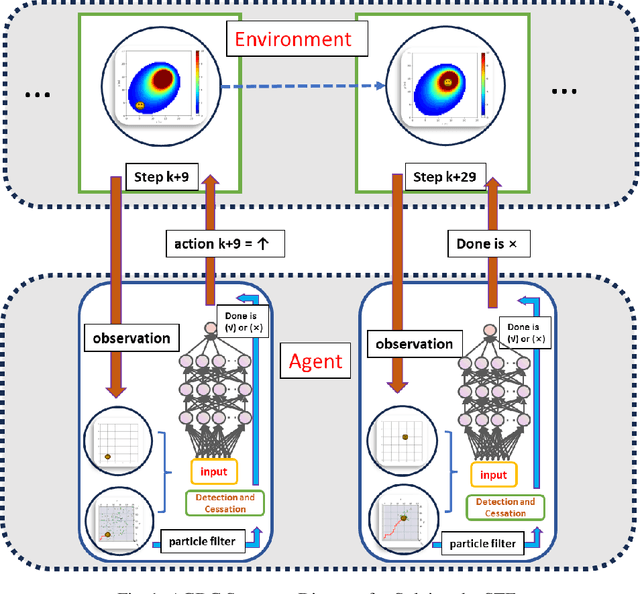
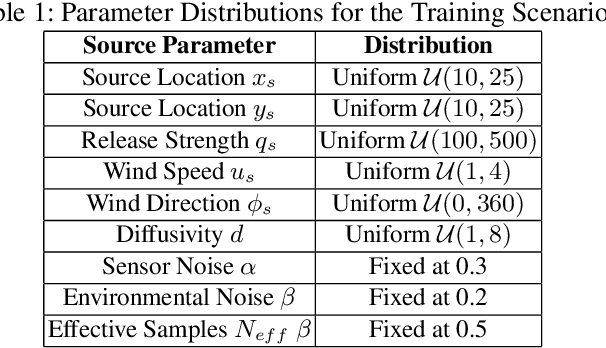
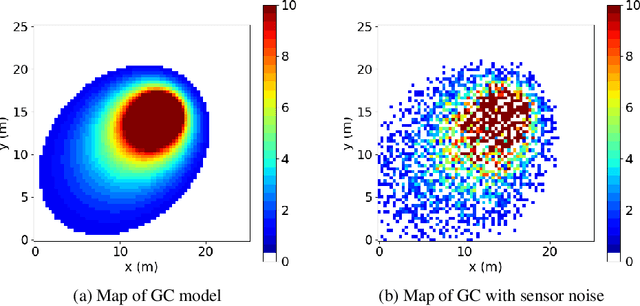
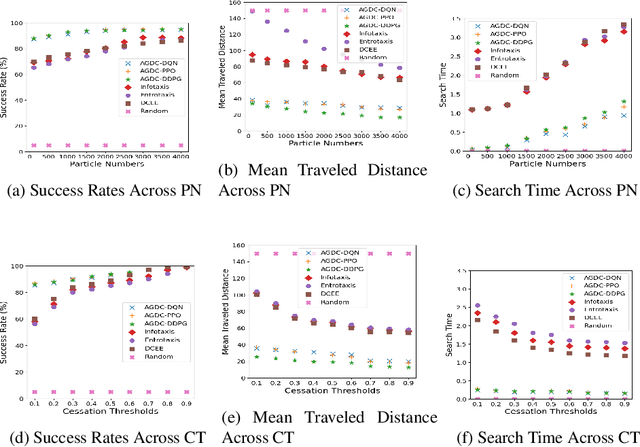
Reinforcement Learning has revolutionized decision-making processes in dynamic environments, yet it often struggles with autonomously detecting and achieving goals without clear feedback signals. For example, in a Source Term Estimation problem, the lack of precise environmental information makes it challenging to provide clear feedback signals and to define and evaluate how the source's location is determined. To address this challenge, the Autonomous Goal Detection and Cessation (AGDC) module was developed, enhancing various RL algorithms by incorporating a self-feedback mechanism for autonomous goal detection and cessation upon task completion. Our method effectively identifies and ceases undefined goals by approximating the agent's belief, significantly enhancing the capabilities of RL algorithms in environments with limited feedback. To validate effectiveness of our approach, we integrated AGDC with deep Q-Network, proximal policy optimization, and deep deterministic policy gradient algorithms, and evaluated its performance on the Source Term Estimation problem. The experimental results showed that AGDC-enhanced RL algorithms significantly outperformed traditional statistical methods such as infotaxis, entrotaxis, and dual control for exploitation and exploration, as well as a non-statistical random action selection method. These improvements were evident in terms of success rate, mean traveled distance, and search time, highlighting AGDC's effectiveness and efficiency in complex, real-world scenarios.