 Add to Chrome
 Add to Firefox
 Add to Edge
Scope3Trace: Evidence-Based Identification and Extraction of Scope 3 GHG Emissions from Sustainability Reports
Jul 19, 2026
Scope 3 greenhouse gas (GHG) emissions account for the majority of corporate carbon footprints, yet remain difficult to analyze at scale due to sparse disclosures, heterogeneous report document formats, and limited evidence traceability. Existing approaches typically rely on large language models to extract emissions information from ESG reports, but often lack explicit evidence grounding or depend on costly manual annotation and verification to ensure extraction reliability. To address these challenges, we propose Scope3Trace, an evidence-grounded information extraction framework designed to extract interpretable and traceable Scope 3 emissions information from real-world ESG and sustainability reports. The framework integrates a document information extraction pipeline that performs PDF collection and OCR parsing, LLM-assisted page localization and table reconstruction, and hybrid rule-LLM extraction of organization- and building-level emissions disclosures with evidence-grounded verification. Building upon this framework, we further contribute a dual-level, evidence-grounded, multimodal dataset comprising organization-level Scope 3 disclosures extracted from heterogeneous sustainability reports. Scope3Trace enables reliable extraction and transparent integration of heterogeneous sustainability disclosures, achieving high accuracy in extracting Scope 1-3 totals and category-level disclosures from sustainability reports.

DynaHMRC: Decentralized Heterogeneous Multi-Robot Collaboration for Dynamic Tasks with Large Language Models
Jun 12, 2026Large language models (LLMs) provide robots with richer task understanding and adaptability, making them promising for coordinating heterogeneous multi-robot systems in long-horizon tasks. Despite this potential, several challenges remain underexplored: (1) Centralized LLM schedulers scale poorly as team size and environmental complexity increase. A single model must process excessive contextual information, and long-context approximation may degrade reasoning quality; (2) Existing task formulations insufficiently consider dynamic settings, while robust adaptation to evolving task conditions is essential for real-world deployment; (3) Domain-specific data scarcity limits specialized robotic reasoning, making proprietary general-purpose models inefficient for expert tasks. To address these limitations, we propose DynaHMRC, a decentralized framework in which each robot acts as a role-aware LLM agent. This design mitigates the single-model context bottleneck and supports flexible collaboration across heterogeneous team configurations. DynaHMRC organizes collaboration as a four-stage closed-loop process: self-description, task allocation with leadership bidding, leader election, and reflective execution, supported by executable robot interfaces. We further develop a benchmark covering three task families, four dynamic variations, and six team configurations to systematically study dynamic task modeling. In addition, we conduct an empirical analysis to guide the construction of domain-specific expert datasets and fine-tune pretrained LLMs to improve specialized competence. Experiments show that DynaHMRC achieves higher success rates than strong baselines with fewer action and communication steps, while demonstrating promising scalability trends as team size grows within the evaluated settings.
HoliDubber: Holistic Video Dubbing for Complex Acoustic Scenes via Text-Guided Audio Synthesis
Jun 08, 2026Video dubbing is a cornerstone of multimedia content creation, aiming to synthesize synchronized acoustic sequences for visual streams. While Text-to-Speech (TTS) and Text-to-Audio (TTA) generation have each achieved remarkable progress, existing dubbing systems remain confined to isolated speech synthesis without incorporating sound effects and ambient audio, forcing practitioners to rely on fragmented workflows and laborious manual post-mixing. To address this limitation, we present HoliDubber, a holistic video dubbing framework that moves beyond speech-only generation by enabling the joint synthesis of speech and sound effects from a single text prompt. Specifically, HoliDubber adopts a patch-based autoregressive diffusion transformer architecture, where a causal language model autoregressively models aggregated patch embeddings to capture global temporal structure, and a Diffusion Transformer decoder generates high-fidelity continuous tokens within each patch, following a divide-and-conquer strategy. To achieve cross-modal alignment, visual features are encoded into patch-level representations and fused with audio patches via cross-attention, enabling the model to ground speech generation in the speaker's visual articulation dynamics. In addition, we introduce HoliDub-Bench, a benchmark curated from established datasets with synchronized video-text-audio triplets designed for holistic dubbing evaluation. Extensive experiments demonstrate that HoliDubber significantly outperforms existing methods across multiple benchmarks in speech quality, synchronization, and speaker similarity. Furthermore, results on HoliDub-Bench validate the effectiveness of joint speech-and-sound generation, establishing a new paradigm for holistic video dubbing in complex acoustic scenes. \footnote{The demo page of the project is https://holidubber.github.io}
GHGbench: A Unified Multi-Entity, Multi-Task Benchmark for Carbon Emission Prediction
May 13, 2026Open datasets and benchmarks for entity-level carbon-emission prediction remain fragmented across access, scale, granularity, and evaluation. We introduce GHGbench, an open dataset and benchmark for company- and building-level greenhouse-gas prediction. The company track contains 32,000+ company-year records from 12,000+ firms with Scope 1+2 and Scope 3 disclosures and financial/sectoral signals; the building track harmonises 491,591 building-year records from 13 open sources into a single schema across 26 metropolitan areas (10 U.S., 15 Australian, 1 Singaporean), with climate covariates and multimodal remote-sensing embeddings. GHGbench defines canonical splits with in-distribution and cross-region/city transfer as primary tasks and temporal hold-out plus short-horizon forecasting as supplementary appendix evidence; headline baselines span gradient-boosted trees, a tabular foundation model, MLP, FT-Transformer, and multimodal fusion, with an LLM panel as auxiliary, all evaluated under multi-seed paired-bootstrap tests. Three benchmark-level findings emerge: (i) building emissions are structurally harder than company emissions; (ii) the in-distribution to out-of-distribution gap dwarfs any within-model gap across both the company track and the building track, and a tabular foundation model is, to our knowledge, the first baseline to open a paired-bootstrap-significant gap over tuned trees on a multi-city building-emissions task; (iii) multimodal remote-sensing embeddings help precisely where tabular generalisation breaks. GHGbench also exposes catastrophic city transfer and the sector-factor lookup ceiling as systematic failure modes. Code and reconstruction recipes are available at GHGbench.
TrajPrism: A Multi-Task Benchmark for Language-Grounded Urban Trajectory Understanding
May 11, 2026Urban mobility is naturally expressed both as trajectories in space and as natural-language descriptions of travel intent, constraints, and preferences. However, prior work rarely evaluates these two modalities together on the same real-world trajectories: trajectory modeling often stays geometry-centric, while language-centric mobility benchmarks frequently target route planning and tool use rather than fine-grained, verifiable alignment between text and the underlying route. We introduce TrajPrism, a multi-task benchmark for language-trajectory alignment that unifies (i) instruction-conditioned trajectory generation, (ii) language-driven semantic trajectory retrieval, and (iii) trajectory captioning, together with an evaluation protocol that measures trajectory fidelity, retrieval quality, and language groundedness. We construct TrajPrism by pairing real urban trajectories with judge-filtered language annotations generated under a four-dimensional travel-intent taxonomy. The benchmark contains 300K selected trajectories across Porto, San Francisco, and Beijing, yielding 2.1M task instances from three instruction variants, three retrieval queries, and one caption per trajectory. We further develop proof-of-concept models for each task: TrajAnchor for instruction-conditioned trajectory generation, TrajFuse for semantic trajectory retrieval, and TrajRap for trajectory captioning. These models instantiate the proposed tasks and show that geometry-only trajectory baselines leave a large gap on our protocol, especially where language is part of the input-output interface. We release TrajPrism with code and a reproducible annotation pipeline that is designed to be portable across cities, given compatible trajectory inputs and map resources.
GA-GS: Generation-Assisted Gaussian Splatting for Static Scene Reconstruction
Apr 06, 2026Reconstructing static 3D scene from monocular video with dynamic objects is important for numerous applications such as virtual reality and autonomous driving. Current approaches typically rely on background for static scene reconstruction, limiting the ability to recover regions occluded by dynamic objects. In this paper, we propose GA-GS, a Generation-Assisted Gaussian Splatting method for Static Scene Reconstruction. The key innovation of our work lies in leveraging generation to assist in reconstructing occluded regions. We employ a motion-aware module to segment and remove dynamic regions, and thenuse a diffusion model to inpaint the occluded areas, providing pseudo-ground-truth supervision. To balance contributions from real background and generated region, we introduce a learnable authenticity scalar for each Gaussian primitive, which dynamically modulates opacity during splatting for authenticity-aware rendering and supervision. Since no existing dataset provides ground-truth static scene of video with dynamic objects, we construct a dataset named Trajectory-Match, using a fixed-path robot to record each scene with/without dynamic objects, enabling quantitative evaluation in reconstruction of occluded regions. Extensive experiments on both the DAVIS and our dataset show that GA-GS achieves state-of-the-art performance in static scene reconstruction, especially in challenging scenarios with large-scale, persistent occlusions.
Drift-Based Policy Optimization: Native One-Step Policy Learning for Online Robot Control
Apr 04, 2026Although multi-step generative policies achieve strong performance in robotic manipulation by modeling multimodal action distributions, they require multi-step iterative denoising at inference time. Each action therefore needs tens to hundreds of network function evaluations (NFEs), making them costly for high-frequency closed-loop control and online reinforcement learning (RL). To address this limitation, we propose a two-stage framework for native one-step generative policies that shifts refinement from inference to training. First, we introduce the Drift-Based Policy (DBP), which leverages fixed-point drifting objectives to internalize iterative refinement into the model parameters, yielding a one-step generative backbone by design while preserving multimodal action modeling capacity. Second, we develop Drift-Based Policy Optimization (DBPO), an online RL framework that equips the pretrained backbone with a compatible stochastic interface, enabling stable on-policy updates without sacrificing the one-step deployment property. Extensive experiments demonstrate the effectiveness of the proposed framework across offline imitation learning, online fine-tuning, and real-world control scenarios. DBP matches or exceeds the performance of multi-step diffusion policies while achieving up to $100\times$ faster inference. It also consistently outperforms existing one-step baselines on challenging manipulation benchmarks. Moreover, DBPO enables effective and stable policy improvement in online settings. Experiments on a real-world dual-arm robot demonstrate reliable high-frequency control at 105.2 Hz.
FAVLA: A Force-Adaptive Fast-Slow VLA model for Contact-Rich Robotic Manipulation
Feb 27, 2026Force/torque feedback can substantially improve Vision-Language-Action (VLA) models on contact-rich manipulation, but most existing approaches fuse all modalities at a single operating frequency. This design ignores the mismatched sampling rates of real robot sensors, forcing downsampling of the high-frequency contact cues needed for reactive correction. Combined with common VLM-action-expert (AE) pipelines that execute action chunks largely open loop between expensive VLM updates, unified-frequency fusion often yields delayed responses to impacts, stick-slip, and force spikes. We propose FAVLA, a force-adaptive fast-slow VLA that decouples slow perception planning from fast contact-aware control. FAVLA runs a slow VLM at a fixed low frequency to encode modalities to produce latent representations and to predict near-future force variation. A fast AE then executes at a variable high frequency, conditioning on the latest force sequence data to generate reactive actions. We further introduce a force adapter that injects high-frequency force features into multiple AE layers, and adaptively schedules the AE's execution frequency based on the VLM's predicted force variation. Extensive experiments on contact-rich tasks demonstrate that FAVLA significantly outperforms baselines, achieving superior reactivity and success rates, especially with a smaller contact force during manipulation.
STDArm: Transferring Visuomotor Policies From Static Data Training to Dynamic Robot Manipulation
Apr 26, 2025Recent advances in mobile robotic platforms like quadruped robots and drones have spurred a demand for deploying visuomotor policies in increasingly dynamic environments. However, the collection of high-quality training data, the impact of platform motion and processing delays, and limited onboard computing resources pose significant barriers to existing solutions. In this work, we present STDArm, a system that directly transfers policies trained under static conditions to dynamic platforms without extensive modifications. The core of STDArm is a real-time action correction framework consisting of: (1) an action manager to boost control frequency and maintain temporal consistency, (2) a stabilizer with a lightweight prediction network to compensate for motion disturbances, and (3) an online latency estimation module for calibrating system parameters. In this way, STDArm achieves centimeter-level precision in mobile manipulation tasks. We conduct comprehensive evaluations of the proposed STDArm on two types of robotic arms, four types of mobile platforms, and three tasks. Experimental results indicate that the STDArm enables real-time compensation for platform motion disturbances while preserving the original policy's manipulation capabilities, achieving centimeter-level operational precision during robot motion.
MT-PCR: Leveraging Modality Transformation for Large-Scale Point Cloud Registration with Limited Overlap
Mar 17, 2025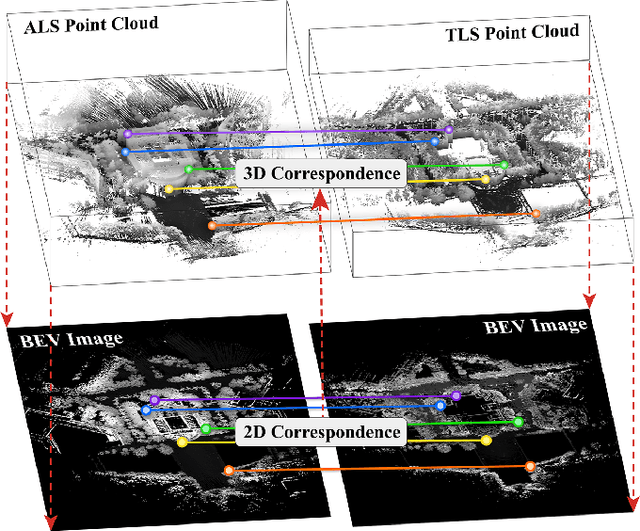
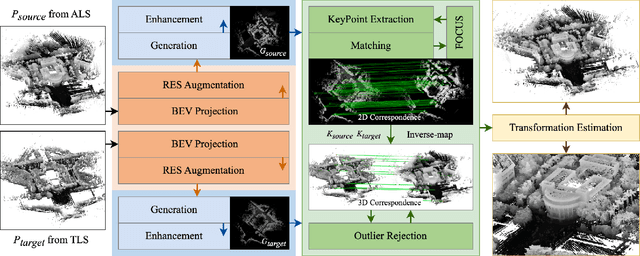
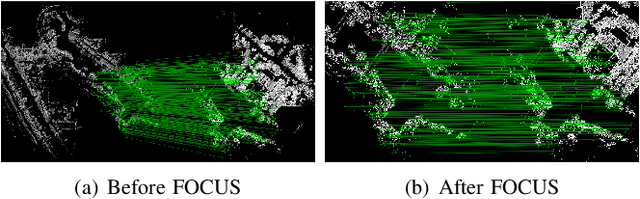
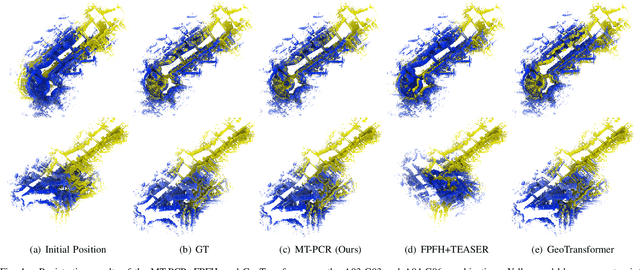
Large-scale scene point cloud registration with limited overlap is a challenging task due to computational load and constrained data acquisition. To tackle these issues, we propose a point cloud registration method, MT-PCR, based on Modality Transformation. MT-PCR leverages a BEV capturing the maximal overlap information to improve the accuracy and utilizes images to provide complementary spatial features. Specifically, MT-PCR converts 3D point clouds to BEV images and eastimates correspondence by 2D image keypoints extraction and matching. Subsequently, the 2D correspondence estimates are then transformed back to 3D point clouds using inverse mapping. We have applied MT-PCR to Terrestrial Laser Scanning and Aerial Laser Scanning point cloud registration on the GrAco dataset, involving 8 low-overlap, square-kilometer scale registration scenarios. Experiments and comparisons with commonly used methods demonstrate that MT-PCR can achieve superior accuracy and robustness in large-scale scenes with limited overlap.