 Add to Chrome
 Add to Firefox
 Add to Edge
Auditable agentic AI for evidence-grounded thyroid ultrasound diagnosis and reporting
Aug 12, 2026
Thyroid ultrasound diagnosis requires coordinated lesion localization, measurement, risk stratification and reporting, yet most AI systems address these tasks in isolation and provide limited support for clinical review. We present ThyroidXAgent, a clinician-interactive agentic AI system that coordinates specialized diagnostic tools and stores their outputs as an auditable case-level evidence record. The system was developed using OpenThyroidDB, a multicentre, multitask resource integrating approximately 0.3 million ultrasound images and 24,000 paired reports, and was evaluated on 28,458 non-overlapping test cases, including 8,721 cases from 35 centres in the private NHC-MISD-TUS cohort. Across heterogeneous datasets, ThyroidXAgent achieved a mean Dice score of 87.21 percent for nodule segmentation and a mean AUROC of 0.9466 for benign-malignant classification. The same workflow supported lymph-node metastasis prediction and follicular versus papillary thyroid carcinoma classification, with AUROCs of 0.864 and 0.805, respectively. For report generation, evidence-grounded assembly outperformed multimodal language-model baselines across three cohorts. ThyClinScore, a lesion-level clinical semantic metric introduced here, showed the strongest correlation with a location-aware language-model judge. ThyroidXAgent improved physician classification accuracy, increased report diagnostic consistency from 70.3 percent to 86.2 percent, and reduced segmentation and reporting time by 35.9 percent and 27.4 percent, respectively. These findings support auditable, clinician-correctable agentic AI for thyroid ultrasound diagnosis and reporting.

Learning How Much, Not Just What: Cross-Patient Burden Order for CT Vision-Language Pretraining
Jul 31, 2026Volumetric CT vision-language pretraining learns 3D representations from scan-report pairs, but global and anatomy-aware objectives supervise only correspondence: they establish what is present and leave how much unconstrained. Nothing separates a mild from an extensive case of the same finding along a consistent direction, so the graded burden language in reports collapses into a present/absent signal. Longitudinal supervision would supply this order, but patient-matched CT pairs are scarce at scale; cross-sectional cohorts already encode weak burden cues across different patients. We introduce Spectrum, an anatomy-conditioned framework that represents each study at whole-study and organ scopes. For each organ-mapped pathology, a rule-based scorer mines confidence-filtered lower-to-higher pairs of different patients, and Burden-Direction Alignment (BDA) aligns the pathology-conditioned image delta with the report delta at each scope, separating that direction from its reverse. Because the endpoints are different people, a target-conditioned aligner first makes them comparable, so the delta reflects burden rather than between-patient variation. BDA further separates the selected direction from its reverse, anchors it to the observed higher-burden endpoint, and enforces consistency across ordered triplets. Since every pair is drawn within a single pathology, BDA is designed to constrain intra-class structure that image-report contrast alone never touches. Spectrum attains 85.6 zero-shot AUROC on CT-RATE and 72.7 on external RAD-ChestCT, with consistent gains in linear probing and retrieval. Weak cross-patient order is thus a scalable complement to anatomy-aware correspondence, yielding burden-aware CT representations without longitudinal data.
Semantically Calibrated Evidence Composition for CT Vision-Language Learning
Jul 31, 2026Learning transferable representations from CT-report pairs requires combining whole-volume context with anatomy-specific evidence. Existing methods typically emphasize either global CT-report alignment or fine-grained anatomy-level correspondence. Global alignment preserves broad study context but leaves the contribution of localized evidence implicit, whereas anatomy-level alignment explicitly grounds local findings but does not specify how independently represented evidence should interact, acquire study-level meaning, and contribute to a global CT representation. To address this gap, we propose SCOPE (Semantic Calibration Of comPosed Evidence), a framework for semantically calibrated evidence composition in CT vision-language learning. Under organ-specific report supervision, mask-guided queries with fixed anatomical identities extract context-aware organ evidence from shared, uncropped volumetric features, while an unrestricted global query retains access to whole-volume context. The global query then drives Local-Global Coupling to compose the organ evidence into a unified evidence representation. The composed evidence is subsequently calibrated using the diagnostic summary, providing study-level semantic supervision beyond local organ descriptions, and is finally integrated as a controlled residual into a context-preserving whole-volume representation aligned with the complete report. This progressive pathway connects localized evidence with study-level semantics without reducing the CT representation to a predefined set of organs. On CT-RATE and RadChestCT, SCOPE achieves macro AUCs of 85.0 and 72.2, respectively, outperforming the previous SOTA by 7.2 and 4.2, while also yielding substantial gains in linear probing and cross-modal retrieval. These results demonstrate the effectiveness of semantically calibrated evidence composition.
Fine-Grained Vision-Language Pretraining with Organ-Conditioned Pattern Tokens for CT Understanding
Jul 15, 2026Computed tomography (CT) vision-language pretraining from paired volumes and radiology reports is a scalable yet challenging task. Existing methods commonly adopt global scan-report contrast, which is scalable but obscures heterogeneous organ evidence. Meanwhile, direct organ-level alignment remains coarse, since the same anatomy can exhibit multiple distinct radiological appearances. Therefore, pretraining requires a finer alignment unit: the organ-conditioned radiological pattern. In this work, we propose OCP-CT, an organ-conditioned pattern-token alignment framework for CT vision-language pretraining. Specifically, OCP-CT preserves a stable global CT-report contrastive branch and introduces an organ pattern interface: sparse Mixture-of-Experts (MoE) routes image and text tokens according to latent radiological patterns, learnable slots query the routed tokens into continuous pattern tokens, and paired token contrast aligns image-text pattern tokens with structured soft targets built from report-derived clinical similarity. On the publicly available CT-RATE and RAD-ChestCT benchmarks, OCP-CT achieves average AUROCs of 84.5% and 69.9% for zero-shot abnormality diagnosis, respectively. Compared with the strongest prior reported results, these results yield absolute AUROC gains of 6.7 and 0.8 percentage points.
Learning Anatomy-Grounded CT Vision-Language Representations with Organ-Hierarchical Report Knowledge
Jul 12, 2026Medical vision-language pretraining (VLP) from paired CT images and radiology reports enables scalable representation learning, but most existing methods align either whole scans with entire reports or local image regions with text fragments. These formulations underuse a key property of radiology reports: findings are organized around anatomical structures, with abnormalities described by organs, disease concepts, locations, and severity-related attributes. We propose OKA-CT, an organ-hierarchical knowledge-augmented framework for CT-report VLP. OKA-CT first converts free-text reports into organ-conditioned knowledge using radiology report parsing and LLM-assisted semantic structuring. The extracted hierarchy is used across two learning stages. Stage~1 injects anatomy-grounded evidence into the CT visual representation through fine-grained organ-conditioned supervision, while Stage~2 uses organ-specific report evidence to guide structured report-CT contrastive learning, where hierarchy-derived semantic soft targets treat non-paired cases with shared organ-level findings as weak semantic positives rather than uniform negatives. A lightweight query-based global branch further aggregates disease-relevant volumetric evidence for whole-scan representation. On CT-RATE and RAD-ChestCT datasets, OKA-CT achieves zero-shot abnormality diagnosis AUROCs of 84.9 and 72.2, outperforming prior CT VLP baselines. Retrieval and patch-occlusion analyses further show improved report-image alignment and stronger sensitivity to disease-associated anatomical regions.
VLMPlanner: Integrating Visual Language Models with Motion Planning
Jul 27, 2025Integrating large language models (LLMs) into autonomous driving motion planning has recently emerged as a promising direction, offering enhanced interpretability, better controllability, and improved generalization in rare and long-tail scenarios. However, existing methods often rely on abstracted perception or map-based inputs, missing crucial visual context, such as fine-grained road cues, accident aftermath, or unexpected obstacles, which are essential for robust decision-making in complex driving environments. To bridge this gap, we propose VLMPlanner, a hybrid framework that combines a learning-based real-time planner with a vision-language model (VLM) capable of reasoning over raw images. The VLM processes multi-view images to capture rich, detailed visual information and leverages its common-sense reasoning capabilities to guide the real-time planner in generating robust and safe trajectories. Furthermore, we develop the Context-Adaptive Inference Gate (CAI-Gate) mechanism that enables the VLM to mimic human driving behavior by dynamically adjusting its inference frequency based on scene complexity, thereby achieving an optimal balance between planning performance and computational efficiency. We evaluate our approach on the large-scale, challenging nuPlan benchmark, with comprehensive experimental results demonstrating superior planning performance in scenarios with intricate road conditions and dynamic elements. Code will be available.
ElectricSight: 3D Hazard Monitoring for Power Lines Using Low-Cost Sensors
May 10, 2025Protecting power transmission lines from potential hazards involves critical tasks, one of which is the accurate measurement of distances between power lines and potential threats, such as large cranes. The challenge with this task is that the current sensor-based methods face challenges in balancing accuracy and cost in distance measurement. A common practice is to install cameras on transmission towers, which, however, struggle to measure true 3D distances due to the lack of depth information. Although 3D lasers can provide accurate depth data, their high cost makes large-scale deployment impractical. To address this challenge, we present ElectricSight, a system designed for 3D distance measurement and monitoring of potential hazards to power transmission lines. This work's key innovations lie in both the overall system framework and a monocular depth estimation method. Specifically, the system framework combines real-time images with environmental point cloud priors, enabling cost-effective and precise 3D distance measurements. As a core component of the system, the monocular depth estimation method enhances the performance by integrating 3D point cloud data into image-based estimates, improving both the accuracy and reliability of the system. To assess ElectricSight's performance, we conducted tests with data from a real-world power transmission scenario. The experimental results demonstrate that ElectricSight achieves an average accuracy of 1.08 m for distance measurements and an early warning accuracy of 92%.
GraspCoT: Integrating Physical Property Reasoning for 6-DoF Grasping under Flexible Language Instructions
Mar 20, 2025Flexible instruction-guided 6-DoF grasping is a significant yet challenging task for real-world robotic systems. Existing methods utilize the contextual understanding capabilities of the large language models (LLMs) to establish mappings between expressions and targets, allowing robots to comprehend users' intentions in the instructions. However, the LLM's knowledge about objects' physical properties remains underexplored despite its tight relevance to grasping. In this work, we propose GraspCoT, a 6-DoF grasp detection framework that integrates a Chain-of-Thought (CoT) reasoning mechanism oriented to physical properties, guided by auxiliary question-answering (QA) tasks. Particularly, we design a set of QA templates to enable hierarchical reasoning that includes three stages: target parsing, physical property analysis, and grasp action selection. Moreover, GraspCoT presents a unified multimodal LLM architecture, which encodes multi-view observations of 3D scenes into 3D-aware visual tokens, and then jointly embeds these visual tokens with CoT-derived textual tokens within LLMs to generate grasp pose predictions. Furthermore, we present IntentGrasp, a large-scale benchmark that fills the gap in public datasets for multi-object grasp detection under diverse and indirect verbal commands. Extensive experiments on IntentGrasp demonstrate the superiority of our method, with additional validation in real-world robotic applications confirming its practicality. Codes and data will be released.
RaCFormer: Towards High-Quality 3D Object Detection via Query-based Radar-Camera Fusion
Dec 17, 2024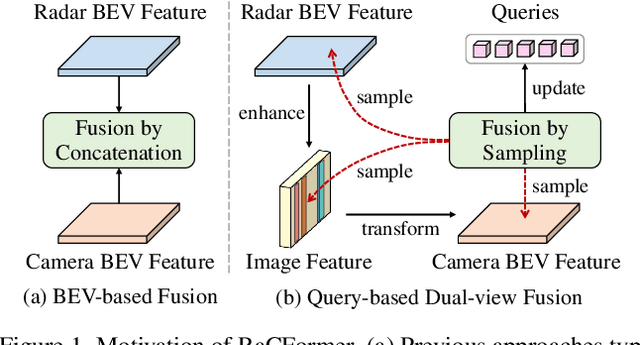
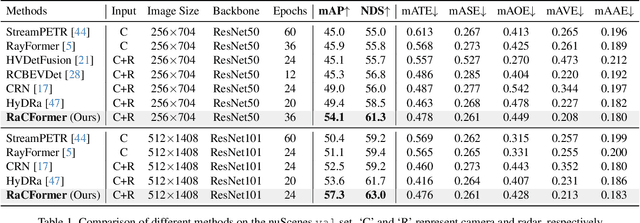
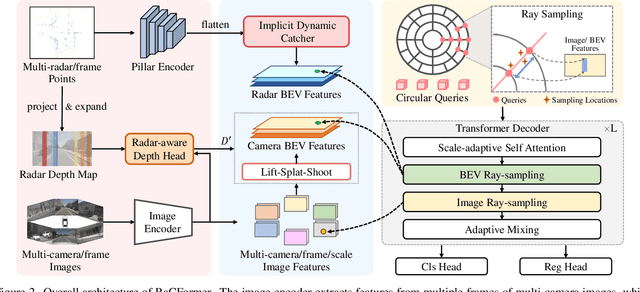
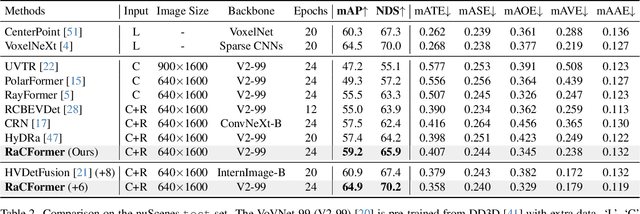
We propose Radar-Camera fusion transformer (RaCFormer) to boost the accuracy of 3D object detection by the following insight. The Radar-Camera fusion in outdoor 3D scene perception is capped by the image-to-BEV transformation--if the depth of pixels is not accurately estimated, the naive combination of BEV features actually integrates unaligned visual content. To avoid this problem, we propose a query-based framework that enables adaptively sample instance-relevant features from both the BEV and the original image view. Furthermore, we enhance system performance by two key designs: optimizing query initialization and strengthening the representational capacity of BEV. For the former, we introduce an adaptive circular distribution in polar coordinates to refine the initialization of object queries, allowing for a distance-based adjustment of query density. For the latter, we initially incorporate a radar-guided depth head to refine the transformation from image view to BEV. Subsequently, we focus on leveraging the Doppler effect of radar and introduce an implicit dynamic catcher to capture the temporal elements within the BEV. Extensive experiments on nuScenes and View-of-Delft (VoD) datasets validate the merits of our design. Remarkably, our method achieves superior results of 64.9% mAP and 70.2% NDS on nuScenes, even outperforming several LiDAR-based detectors. RaCFormer also secures the 1st ranking on the VoD dataset. The code will be released.
CELLmap: Enhancing LiDAR SLAM through Elastic and Lightweight Spherical Map Representation
Sep 29, 2024
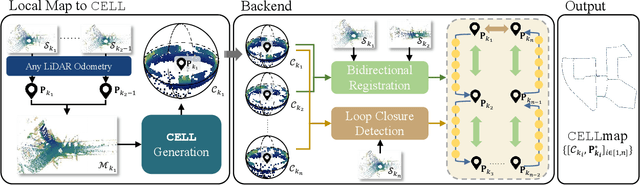


SLAM is a fundamental capability of unmanned systems, with LiDAR-based SLAM gaining widespread adoption due to its high precision. Current SLAM systems can achieve centimeter-level accuracy within a short period. However, there are still several challenges when dealing with largescale mapping tasks including significant storage requirements and difficulty of reusing the constructed maps. To address this, we first design an elastic and lightweight map representation called CELLmap, composed of several CELLs, each representing the local map at the corresponding location. Then, we design a general backend including CELL-based bidirectional registration module and loop closure detection module to improve global map consistency. Our experiments have demonstrated that CELLmap can represent the precise geometric structure of large-scale maps of KITTI dataset using only about 60 MB. Additionally, our general backend achieves up to a 26.88% improvement over various LiDAR odometry methods.