 Add to Chrome
 Add to Firefox
 Add to Edge
Towards a Data Flywheel for Embodied Intelligence in Logistics
Jun 04, 2026
Embodied intelligence is moving from laboratory demonstrations toward industrial deployment, with the logistics industry serving as a key application scenario. Learning-based policies offer a promising path beyond traditional perception-planning-control pipelines, but their scalability depends on how embodied data can be collected, organized, and reused. This research studies a data-centric framework for industrial embodied intelligence by constructing a logistics data flywheel. Our framework converts daily operations into reusable data assets, uses World Models to generate reliable supervision for long-tail parcel manipulation, and feeds deployment feedback back into policy improvement. As an initial result, \textit{WM-DAgger} introduces a World-Model-based data aggregation framework that synthesizes out-of-distribution recovery data for robust imitation learning. Building on this result, ongoing work explores how large-scale in-the-wild multimodal data, including labeled human demonstrations, unlabeled operational videos, and system-level robot logs, can be aligned for policy learning and transformed into feedback for continual system improvement.

GenHAR: Generalizing Cross-domain Human Activity Recognition for Last-mile Delivery
May 21, 2026Human Activity Recognition (HAR) has shown remarkable effectiveness in various applications, such as smart healthcare and intelligent manufacturing. However, a major challenge faced by HAR is the distribution shift across different sensor data domains, which often leads to decreased performance when deployed for real-world applications. To address this issue, this paper introduces GenHAR, a novel framework designed to mitigate the domain gap by learning domain-invariant sensor representations. GenHAR aims to enhance the generalization capabilities of HAR on target domains purely with data from the source domain. The key novelty of GenHAR lies in two aspects. Firstly, GenHAR tokenizes sensor data and learns correlations among frequency sensor channel dimensions to improve the robustness of HAR models. Secondly, GenHAR improves the efficiency via selective masking and an efficient attention mechanism. We conduct a systematic analysis of GenHAR by comparing it with state-of-the-art HAR methods on real-world human activity datasets. Results show that GenHAR outperforms state-of-the-art methods by 9.97% in accuracy, and reduces Floating Point Operations by 6.4 times. Moreover, we deploy GenHAR at a leading logistics company in 4 cities, and have detected 2.15 billion real-time activities. We release our code at: https://github.com/Sensor-FoundationModel/GenHAR.
WM-DAgger: Enabling Efficient Data Aggregation for Imitation Learning with World Models
Apr 13, 2026Imitation learning is a powerful paradigm for training robotic policies, yet its performance is limited by compounding errors: minor policy inaccuracies could drive robots into unseen out-of-distribution (OOD) states in the training set, where the policy could generate even bigger errors, leading to eventual failures. While the Data Aggregation (DAgger) framework tries to address this issue, its reliance on continuous human involvement severely limits scalability. In this paper, we propose WM-DAgger, an efficient data aggregation framework that leverages World Models to synthesize OOD recovery data without requiring human involvement. Specifically, we focus on manipulation tasks with an eye-in-hand robotic arm and only few-shot demonstrations. To avoid synthesizing misleading data and overcome the hallucination issues inherent to World Models, our framework introduces two key mechanisms: (1) a Corrective Action Synthesis Module that generates task-oriented recovery actions to prevent misleading supervision, and (2) a Consistency-Guided Filtering Module that discards physically implausible trajectories by anchoring terminal synthesized frames to corresponding real frames in expert demonstrations. We extensively validate WM-DAgger on multiple real-world robotic tasks. Results that our method significantly improves success rates, achieving a 93.3\% success rate in soft bag pushing with only five demonstrations. The source code is publicly available at https://github.com/czs12354-xxdbd/WM-Dagger.
Wearable AI in the Era of Large Sensor Models
Apr 11, 2026As an effective approach to understanding the human-centric physical world, Wearable Artificial Intelligence (AI), which leverages multimodal wearable sensors to understand human physiology and behavior, has attracted increasing attention in recent years. However, existing sensor models remain largely siloed by modality and task, lacking a unified paradigm for integrating diverse wearable modalities, training strategies, and achieving robust generalization in real-world applications. Motivated by the success of multimodal foundation models, which learn transferable representations from massive multimodal data, we argue that Large Sensor Models (LSMs), defined as foundation models trained on large-scale and multimodal wearable data, offer a promising pathway toward a more general and scalable framework for wearable AI. In this position paper, we formalize the data substrate underlying LSMs, analyze the unique challenges of large-scale wearable sensing, and articulate two directions: (i) LSMs without language capability and (ii) LSMs with language capability. We further discuss representative application areas that can be unlocked by such models. Through this paper, we encourage the community to explore LSMs as a foundational approach for the next generation of human-centric AI systems.
Learning Demographic-Conditioned Mobility Trajectories with Aggregate Supervision
Mar 03, 2026Human mobility trajectories are widely studied in public health and social science, where different demographic groups exhibit significantly different mobility patterns. However, existing trajectory generation models rarely capture this heterogeneity because most trajectory datasets lack demographic labels. To address this gap in data, we propose ATLAS, a weakly supervised approach for demographic-conditioned trajectory generation using only (i) individual trajectories without demographic labels, (ii) region-level aggregated mobility features, and (iii) region-level demographic compositions from census data. ATLAS trains a trajectory generator and fine-tunes it so that simulated mobility matches observed regional aggregates while conditioning on demographics. Experiments on real trajectory data with demographic labels show that ATLAS substantially improves demographic realism over baselines (JSD $\downarrow$ 12%--69%) and closes much of the gap to strongly supervised training. We further develop theoretical analyses for when and why ATLAS works, identifying key factors including demographic diversity across regions and the informativeness of the aggregate feature, paired with experiments demonstrating the practical implications of our theory. We release our code at https://github.com/schang-lab/ATLAS.
GeoGen: A Two-stage Coarse-to-Fine Framework for Fine-grained Synthetic Location-based Social Network Trajectory Generation
Oct 09, 2025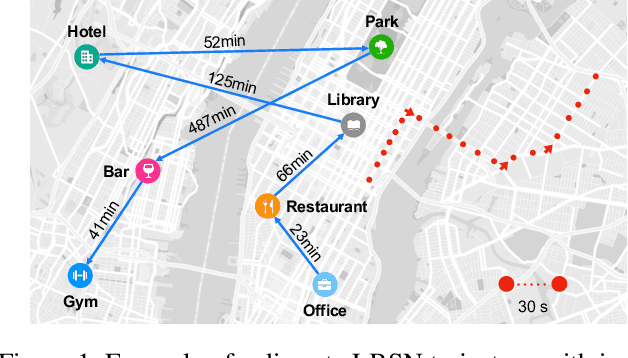
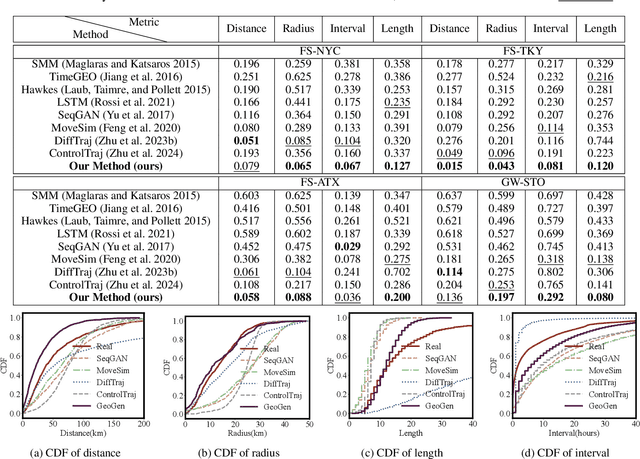
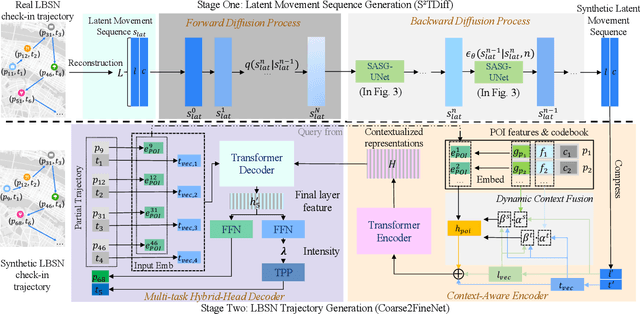
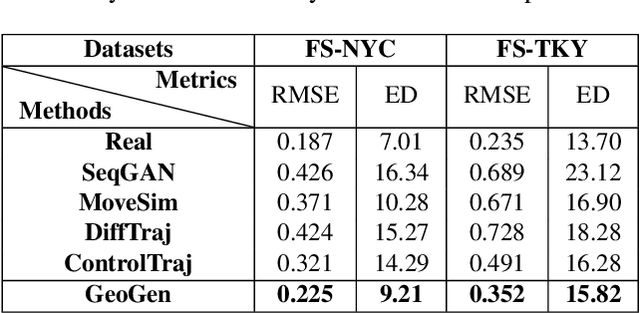
Location-Based Social Network (LBSN) check-in trajectory data are important for many practical applications, like POI recommendation, advertising, and pandemic intervention. However, the high collection costs and ever-increasing privacy concerns prevent us from accessing large-scale LBSN trajectory data. The recent advances in synthetic data generation provide us with a new opportunity to achieve this, which utilizes generative AI to generate synthetic data that preserves the characteristics of real data while ensuring privacy protection. However, generating synthetic LBSN check-in trajectories remains challenging due to their spatially discrete, temporally irregular nature and the complex spatio-temporal patterns caused by sparse activities and uncertain human mobility. To address this challenge, we propose GeoGen, a two-stage coarse-to-fine framework for large-scale LBSN check-in trajectory generation. In the first stage, we reconstruct spatially continuous, temporally regular latent movement sequences from the original LBSN check-in trajectories and then design a Sparsity-aware Spatio-temporal Diffusion model (S$^2$TDiff) with an efficient denosing network to learn their underlying behavioral patterns. In the second stage, we design Coarse2FineNet, a Transformer-based Seq2Seq architecture equipped with a dynamic context fusion mechanism in the encoder and a multi-task hybrid-head decoder, which generates fine-grained LBSN trajectories based on coarse-grained latent movement sequences by modeling semantic relevance and behavioral uncertainty. Extensive experiments on four real-world datasets show that GeoGen excels state-of-the-art models for both fidelity and utility evaluation, e.g., it increases over 69% and 55% in distance and radius metrics on the FS-TKY dataset.
Towards Generalizable Human Activity Recognition: A Survey
Aug 17, 2025As a critical component of Wearable AI, IMU-based Human Activity Recognition (HAR) has attracted increasing attention from both academia and industry in recent years. Although HAR performance has improved considerably in specific scenarios, its generalization capability remains a key barrier to widespread real-world adoption. For example, domain shifts caused by variations in users, sensor positions, or environments can significantly decrease the performance in practice. As a result, in this survey, we explore the rapidly evolving field of IMU-based generalizable HAR, reviewing 229 research papers alongside 25 publicly available datasets to provide a broad and insightful overview. We first present the background and overall framework of IMU-based HAR tasks, as well as the generalization-oriented training settings. Then, we categorize representative methodologies from two perspectives: (i) model-centric approaches, including pre-training method, end-to-end method, and large language model (LLM)-based learning method; and (ii) data-centric approaches, including multi-modal learning and data augmentation techniques. In addition, we summarize widely used datasets in this field, as well as relevant tools and benchmarks. Building on these methodological advances, the broad applicability of IMU-based HAR is also reviewed and discussed. Finally, we discuss persistent challenges (e.g., data scarcity, efficient training, and reliable evaluation) and also outline future directions for HAR, including the adoption of foundation and large language models, physics-informed and context-aware reasoning, generative modeling, and resource-efficient training and inference. The complete list of this survey is available at https://github.com/rh20624/Awesome-IMU-Sensing, which will be updated continuously.
Versatile Framework for Song Generation with Prompt-based Control
Apr 29, 2025Song generation focuses on producing controllable high-quality songs based on various prompts. However, existing methods struggle to generate vocals and accompaniments with prompt-based control and proper alignment. Additionally, they fall short in supporting various tasks. To address these challenges, we introduce VersBand, a multi-task song generation framework for synthesizing high-quality, aligned songs with prompt-based control. VersBand comprises these primary models: 1) VocalBand, a decoupled model, leverages the flow-matching method for generating singing styles, pitches, and mel-spectrograms, allowing fast, high-quality vocal generation with style control. 2) AccompBand, a flow-based transformer model, incorporates the Band-MOE, selecting suitable experts for enhanced quality, alignment, and control. This model allows for generating controllable, high-quality accompaniments aligned with vocals. 3) Two generation models, LyricBand for lyrics and MelodyBand for melodies, contribute to the comprehensive multi-task song generation system, allowing for extensive control based on multiple prompts. Experimental results demonstrate that VersBand performs better over baseline models across multiple song generation tasks using objective and subjective metrics. Audio samples are available at https://aaronz345.github.io/VersBandDemo.
AddrLLM: Address Rewriting via Large Language Model on Nationwide Logistics Data
Nov 17, 2024


Textual description of a physical location, commonly known as an address, plays an important role in location-based services(LBS) such as on-demand delivery and navigation. However, the prevalence of abnormal addresses, those containing inaccuracies that fail to pinpoint a location, have led to significant costs. Address rewriting has emerged as a solution to rectify these abnormal addresses. Despite the critical need, existing address rewriting methods are limited, typically tailored to correct specific error types, or frequently require retraining to process new address data effectively. In this study, we introduce AddrLLM, an innovative framework for address rewriting that is built upon a retrieval augmented large language model. AddrLLM overcomes aforementioned limitations through a meticulously designed Supervised Fine-Tuning module, an Address-centric Retrieval Augmented Generation module and a Bias-free Objective Alignment module. To the best of our knowledge, this study pioneers the application of LLM-based address rewriting approach to solve the issue of abnormal addresses. Through comprehensive offline testing with real-world data on a national scale and subsequent online deployment, AddrLLM has demonstrated superior performance in integration with existing logistics system. It has significantly decreased the rate of parcel re-routing by approximately 43\%, underscoring its exceptional efficacy in real-world applications.
Variational Language Concepts for Interpreting Foundation Language Models
Oct 04, 2024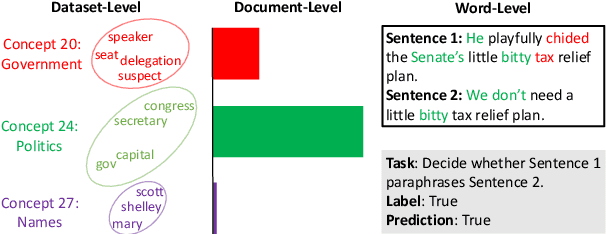
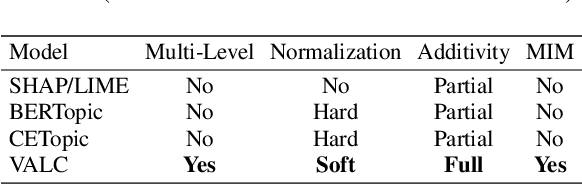
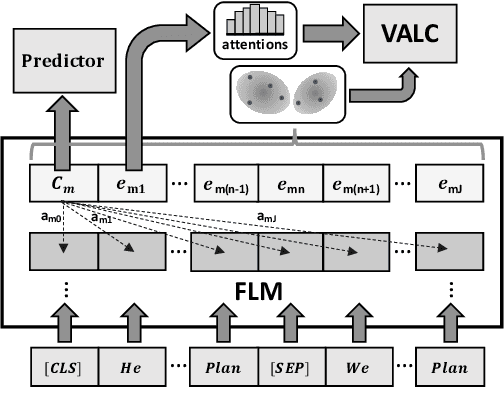
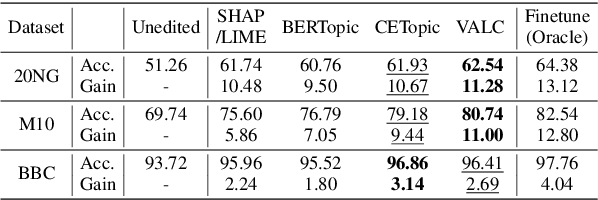
Foundation Language Models (FLMs) such as BERT and its variants have achieved remarkable success in natural language processing. To date, the interpretability of FLMs has primarily relied on the attention weights in their self-attention layers. However, these attention weights only provide word-level interpretations, failing to capture higher-level structures, and are therefore lacking in readability and intuitiveness. To address this challenge, we first provide a formal definition of conceptual interpretation and then propose a variational Bayesian framework, dubbed VAriational Language Concept (VALC), to go beyond word-level interpretations and provide concept-level interpretations. Our theoretical analysis shows that our VALC finds the optimal language concepts to interpret FLM predictions. Empirical results on several real-world datasets show that our method can successfully provide conceptual interpretation for FLMs.