 Add to Chrome
 Add to Firefox
 Add to Edge
Answer Presence Drives RAG Rewriting Gains
Jun 04, 2026
Retrieval-augmented QA pipelines often route retrieved passages through an LLM \emph{rewriter} before a smaller reader, lifting F1 by tens of points on multi-hop benchmarks; this gain is typically credited to improved evidence quality. We ask whether that lift is causally driven by the gold answer string appearing in the rewritten context rather than by curation per se, using a controlled intervention audit. For each rewritten context we re-run the reader after one of four controlled edits to the compile output: removing the gold answer span, replacing a length-matched random non-answer span (placebo), or injecting the gold into rewrites where it was absent (at the prefix or at a midpoint sentence boundary). Across twelve completed (cell, baseline) intervention runs spanning three reader families (Qwen2.5-7B, Qwen3.5-35B, GLM-4.7), two datasets (HotpotQA, 2WikiMultihopQA), and three compiler arrangements (MA-only, MB-only, MA$+$verify), removing the gold answer drops reader F1 by $28$ to $64$ points beyond the length-matched placebo on paired \texttt{answer-in-compile} strata, and prepending the gold into rewrites that lacked it raises F1 by $+0.7$ to $+9.7$ points in $10$ of $12$ (cell, baseline) combinations. A companion five-sentinel audit shows the conventional single-\texttt{[MASK]} probe is itself sentinel-fragile: on 2Wiki it reports a $+4.12$~F1 ``non-leakage residual'' that flips to $-3.33$ to $-7.81$~F1 under four alternative sentinels and fails an equivalence test for three of those four ($1/4$~pass). We do not propose a new rewriter or mitigation; we release the intervention runner and the sentinel panel so that other rewriter-gain claims can be tested against the same standard.

Towards Streaming Synchronized Spatial Audio Generation via Autoregressive Diffusion Transformer
May 29, 2026Real-time and accurate spatial audio generation is pivotal for delivering an immersive experience. However, existing spatial audio synthesis technologies are often encumbered by a tradeoff between generation quality and high inference latency, as well as difficulty in capturing precise spatial information from multimodal inputs. To address these challenges, we propose SwanSphere, a unified streaming framework for high-fidelity spatial audio generation from panoramic videos and text prompts. SwanSphere mainly makes the following contributions: 1) We introduce a causal autoregressive diffusion transformer architecture that enables streaming high-quality spatial audio generation. 2) We design a Spatial Video-Audio Contrastive (SVAC) learning strategy to align the video encoder with the acoustic domain, and further employ a multi-objective online direct preference optimization (ODPO) scheme, resulting in strong spatial perception and robust multimodal spatial audio synthesis. 3) To alleviate the current scarcity of spatial audio datasets, we also develop an automated annotation pipeline for generating detailed spatial captions. Experimental results demonstrate that SwanSphere achieves superior performance in both video-to-spatial and text-to-spatial audio generation tasks. Demos can be found at: https://swanaigc.github.io.
SwanVoice: Expressive Long-Form Zero-Shot Speech Synthesis for Both Monologue and Dialogue
May 29, 2026Zero-shot text-to-speech (TTS) has improved substantially for single-speaker synthesis, yet expressive long-form multi-speaker dialogue remains difficult. A common workaround is to synthesize each turn with a monologue TTS model and stitch the outputs together. This adds inference cost and often breaks acoustic consistency, conversational coherence, and affective continuity across turns. Recent dialogue TTS systems have begun to address this setting, but they still struggle to keep expressive coherence, controllable speaker switching, and monologue quality at the same time. We present SwanData-Speech and SwanVoice. SwanData-Speech builds monologue and dialogue corpora from in-the-wild audio, using Swan Forced Aligner for pause-aware word-level alignment and RobustMegaTTS3 for pronunciation-hard cases. Built on these data, SwanVoice is a zero-shot TTS model for 1--4 speakers, combining a 25 Hz VAE, raw-text conditioning with pause-aware symbols and pinyin substitution, and a flow-matching DiT with speaker-turn conditioning. Training starts from monologue speech, moves through mixed and real dialogue data, and then uses DiffusionNFT post-training with phone-level and speaker-similarity rewards. On SwanBench-Speech, SwanVoice obtains higher richness and hierarchy scores than all evaluated open-source baselines in both monologue and dialogue settings, while content accuracy remains the main limitation. Audio demos are available at https://swanaigc.github.io//#swanvoice.
Comprehensive Benchmarking of Long-Form Speech Generation in Diverse Scenarios
May 27, 2026Recent advances in speech generation have enabled high-fidelity synthesis, yet systematic evaluation of models under long-context conditions remains largely underexplored. A comprehensive evaluation benchmark for long-form speech is indispensable for two reasons: 1) existing test scenarios are often confined to limited domains, creating a significant gap with the diverse downstream applications; 2) existing metrics overlook critical long-text factors such as consistency and coherence, failing to generalize reliably. To this end, we propose Swanbench-Speech, a comprehensive benchmark that decomposes long-form speech quality into specific, disentangled dimensions. SwanBench-Speech has three key properties. 1) Rich speech scenarios: Focusing on long-form speech generation and dialog generation, SwanBench-Speech covers acoustics, semantics, and expressiveness challenges, and consists of 1,101 samples spanning 17 common speech scenarios; 2) Comprehensive evaluation dimensions: Along the acoustics, semantics, and expressiveness axes, SwanBench-Speech defines an automated evaluation protocol with seven metrics to provide a comprehensive, accurate, and standardized assessment; 3) Valuable Insights: Through extensive experiments, we reveal that current models still struggle in highly expressive scenarios and exhibit a notable gap in consistency and hierarchy compared to real recordings.
ComPrivDet: Efficient Privacy Object Detection in Compressed Domains Through Inference Reuse
Apr 04, 2026As the Internet of Things (IoT) becomes deeply embedded in daily life, users are increasingly concerned about privacy leakage, especially from video data. Since frame-by-frame protection in large-scale video analytics (e.g., smart communities) introduces significant latency, a more efficient solution is to selectively protect frames containing privacy objects (e.g., faces). Existing object detectors require fully decoded videos or per-frame processing in compressed videos, leading to decoding overhead or reduced accuracy. Therefore, we propose ComPrivDet, an efficient method for detecting privacy objects in compressed video by reusing I-frame inference results. By identifying the presence of new objects through compressed-domain cues, ComPrivDet either skips P- and B-frame detections or efficiently refines them with a lightweight detector. ComPrivDet maintains 99.75% accuracy in private face detection and 96.83% in private license plate detection while skipping over 80% of inferences. It averages 9.84% higher accuracy with 75.95% lower latency than existing compressed-domain detection methods.
ALIVE: Animate Your World with Lifelike Audio-Video Generation
Feb 09, 2026Video generation is rapidly evolving towards unified audio-video generation. In this paper, we present ALIVE, a generation model that adapts a pretrained Text-to-Video (T2V) model to Sora-style audio-video generation and animation. In particular, the model unlocks the Text-to-Video&Audio (T2VA) and Reference-to-Video&Audio (animation) capabilities compared to the T2V foundation models. To support the audio-visual synchronization and reference animation, we augment the popular MMDiT architecture with a joint audio-video branch which includes TA-CrossAttn for temporally-aligned cross-modal fusion and UniTemp-RoPE for precise audio-visual alignment. Meanwhile, a comprehensive data pipeline consisting of audio-video captioning, quality control, etc., is carefully designed to collect high-quality finetuning data. Additionally, we introduce a new benchmark to perform a comprehensive model test and comparison. After continue pretraining and finetuning on million-level high-quality data, ALIVE demonstrates outstanding performance, consistently outperforming open-source models and matching or surpassing state-of-the-art commercial solutions. With detailed recipes and benchmarks, we hope ALIVE helps the community develop audio-video generation models more efficiently. Official page: https://github.com/FoundationVision/Alive.
MCP-ITP: An Automated Framework for Implicit Tool Poisoning in MCP
Jan 12, 2026To standardize interactions between LLM-based agents and their environments, the Model Context Protocol (MCP) was proposed and has since been widely adopted. However, integrating external tools expands the attack surface, exposing agents to tool poisoning attacks. In such attacks, malicious instructions embedded in tool metadata are injected into the agent context during MCP registration phase, thereby manipulating agent behavior. Prior work primarily focuses on explicit tool poisoning or relied on manually crafted poisoned tools. In contrast, we focus on a particularly stealthy variant: implicit tool poisoning, where the poisoned tool itself remains uninvoked. Instead, the instructions embedded in the tool metadata induce the agent to invoke a legitimate but high-privilege tool to perform malicious operations. We propose MCP-ITP, the first automated and adaptive framework for implicit tool poisoning within the MCP ecosystem. MCP-ITP formulates poisoned tool generation as a black-box optimization problem and employs an iterative optimization strategy that leverages feedback from both an evaluation LLM and a detection LLM to maximize Attack Success Rate (ASR) while evading current detection mechanisms. Experimental results on the MCPTox dataset across 12 LLM agents demonstrate that MCP-ITP consistently outperforms the manually crafted baseline, achieving up to 84.2% ASR while suppressing the Malicious Tool Detection Rate (MDR) to as low as 0.3%.
STARS: A Unified Framework for Singing Transcription, Alignment, and Refined Style Annotation
Jul 09, 2025Recent breakthroughs in singing voice synthesis (SVS) have heightened the demand for high-quality annotated datasets, yet manual annotation remains prohibitively labor-intensive and resource-intensive. Existing automatic singing annotation (ASA) methods, however, primarily tackle isolated aspects of the annotation pipeline. To address this fundamental challenge, we present STARS, which is, to our knowledge, the first unified framework that simultaneously addresses singing transcription, alignment, and refined style annotation. Our framework delivers comprehensive multi-level annotations encompassing: (1) precise phoneme-audio alignment, (2) robust note transcription and temporal localization, (3) expressive vocal technique identification, and (4) global stylistic characterization including emotion and pace. The proposed architecture employs hierarchical acoustic feature processing across frame, word, phoneme, note, and sentence levels. The novel non-autoregressive local acoustic encoders enable structured hierarchical representation learning. Experimental validation confirms the framework's superior performance across multiple evaluation dimensions compared to existing annotation approaches. Furthermore, applications in SVS training demonstrate that models utilizing STARS-annotated data achieve significantly enhanced perceptual naturalness and precise style control. This work not only overcomes critical scalability challenges in the creation of singing datasets but also pioneers new methodologies for controllable singing voice synthesis. Audio samples are available at https://gwx314.github.io/stars-demo/.
Versatile Framework for Song Generation with Prompt-based Control
Apr 29, 2025Song generation focuses on producing controllable high-quality songs based on various prompts. However, existing methods struggle to generate vocals and accompaniments with prompt-based control and proper alignment. Additionally, they fall short in supporting various tasks. To address these challenges, we introduce VersBand, a multi-task song generation framework for synthesizing high-quality, aligned songs with prompt-based control. VersBand comprises these primary models: 1) VocalBand, a decoupled model, leverages the flow-matching method for generating singing styles, pitches, and mel-spectrograms, allowing fast, high-quality vocal generation with style control. 2) AccompBand, a flow-based transformer model, incorporates the Band-MOE, selecting suitable experts for enhanced quality, alignment, and control. This model allows for generating controllable, high-quality accompaniments aligned with vocals. 3) Two generation models, LyricBand for lyrics and MelodyBand for melodies, contribute to the comprehensive multi-task song generation system, allowing for extensive control based on multiple prompts. Experimental results demonstrate that VersBand performs better over baseline models across multiple song generation tasks using objective and subjective metrics. Audio samples are available at https://aaronz345.github.io/VersBandDemo.
Sparse Alignment Enhanced Latent Diffusion Transformer for Zero-Shot Speech Synthesis
Feb 26, 2025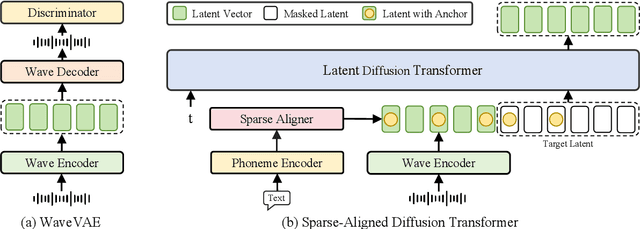
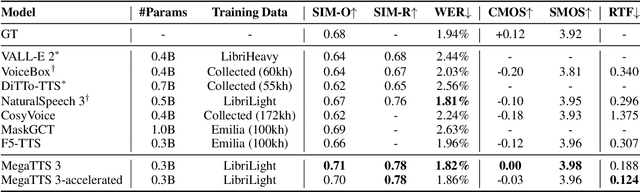
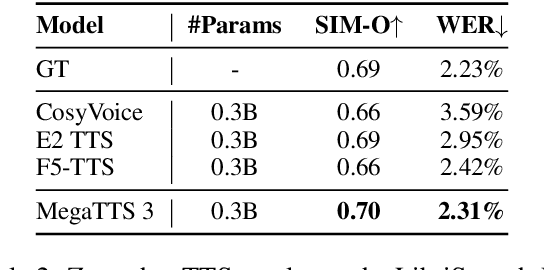
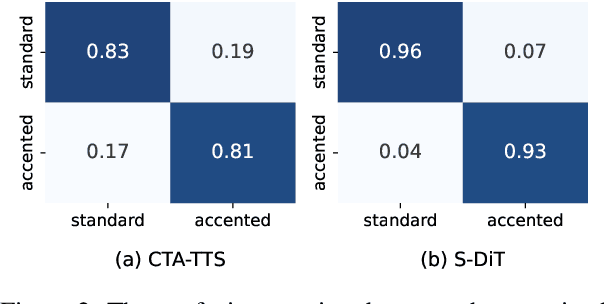
While recent zero-shot text-to-speech (TTS) models have significantly improved speech quality and expressiveness, mainstream systems still suffer from issues related to speech-text alignment modeling: 1) models without explicit speech-text alignment modeling exhibit less robustness, especially for hard sentences in practical applications; 2) predefined alignment-based models suffer from naturalness constraints of forced alignments. This paper introduces \textit{S-DiT}, a TTS system featuring an innovative sparse alignment algorithm that guides the latent diffusion transformer (DiT). Specifically, we provide sparse alignment boundaries to S-DiT to reduce the difficulty of alignment learning without limiting the search space, thereby achieving high naturalness. Moreover, we employ a multi-condition classifier-free guidance strategy for accent intensity adjustment and adopt the piecewise rectified flow technique to accelerate the generation process. Experiments demonstrate that S-DiT achieves state-of-the-art zero-shot TTS speech quality and supports highly flexible control over accent intensity. Notably, our system can generate high-quality one-minute speech with only 8 sampling steps. Audio samples are available at https://sditdemo.github.io/sditdemo/.