 Add to Chrome
 Add to Firefox
 Add to Edge
Towards Reward Fairness in RLHF: From a Resource Allocation Perspective
May 29, 2025
Rewards serve as proxies for human preferences and play a crucial role in Reinforcement Learning from Human Feedback (RLHF). However, if these rewards are inherently imperfect, exhibiting various biases, they can adversely affect the alignment of large language models (LLMs). In this paper, we collectively define the various biases present in rewards as the problem of reward unfairness. We propose a bias-agnostic method to address the issue of reward fairness from a resource allocation perspective, without specifically designing for each type of bias, yet effectively mitigating them. Specifically, we model preference learning as a resource allocation problem, treating rewards as resources to be allocated while considering the trade-off between utility and fairness in their distribution. We propose two methods, Fairness Regularization and Fairness Coefficient, to achieve fairness in rewards. We apply our methods in both verification and reinforcement learning scenarios to obtain a fairness reward model and a policy model, respectively. Experiments conducted in these scenarios demonstrate that our approach aligns LLMs with human preferences in a more fair manner.

UltraVSR: Achieving Ultra-Realistic Video Super-Resolution with Efficient One-Step Diffusion Space
May 26, 2025Diffusion models have shown great potential in generating realistic image detail. However, adapting these models to video super-resolution (VSR) remains challenging due to their inherent stochasticity and lack of temporal modeling. In this paper, we propose UltraVSR, a novel framework that enables ultra-realistic and temporal-coherent VSR through an efficient one-step diffusion space. A central component of UltraVSR is the Degradation-aware Restoration Schedule (DRS), which estimates a degradation factor from the low-resolution input and transforms iterative denoising process into a single-step reconstruction from from low-resolution to high-resolution videos. This design eliminates randomness from diffusion noise and significantly speeds up inference. To ensure temporal consistency, we propose a lightweight yet effective Recurrent Temporal Shift (RTS) module, composed of an RTS-convolution unit and an RTS-attention unit. By partially shifting feature components along the temporal dimension, these two units collaboratively facilitate effective feature propagation, fusion, and alignment across neighboring frames, without relying on explicit temporal layers. The RTS module is integrated into a pretrained text-to-image diffusion model and is further enhanced through Spatio-temporal Joint Distillation (SJD), which improves temporal coherence while preserving realistic details. Additionally, we introduce a Temporally Asynchronous Inference (TAI) strategy to capture long-range temporal dependencies under limited memory constraints. Extensive experiments show that UltraVSR achieves state-of-the-art performance, both qualitatively and quantitatively, in a single sampling step.
SRDiffusion: Accelerate Video Diffusion Inference via Sketching-Rendering Cooperation
May 25, 2025Leveraging the diffusion transformer (DiT) architecture, models like Sora, CogVideoX and Wan have achieved remarkable progress in text-to-video, image-to-video, and video editing tasks. Despite these advances, diffusion-based video generation remains computationally intensive, especially for high-resolution, long-duration videos. Prior work accelerates its inference by skipping computation, usually at the cost of severe quality degradation. In this paper, we propose SRDiffusion, a novel framework that leverages collaboration between large and small models to reduce inference cost. The large model handles high-noise steps to ensure semantic and motion fidelity (Sketching), while the smaller model refines visual details in low-noise steps (Rendering). Experimental results demonstrate that our method outperforms existing approaches, over 3$\times$ speedup for Wan with nearly no quality loss for VBench, and 2$\times$ speedup for CogVideoX. Our method is introduced as a new direction orthogonal to existing acceleration strategies, offering a practical solution for scalable video generation.
DLF: Enhancing Explicit-Implicit Interaction via Dynamic Low-Order-Aware Fusion for CTR Prediction
May 25, 2025Click-through rate (CTR) prediction is a critical task in online advertising and recommender systems, relying on effective modeling of feature interactions. Explicit interactions capture predefined relationships, such as inner products, but often suffer from data sparsity, while implicit interactions excel at learning complex patterns through non-linear transformations but lack inductive biases for efficient low-order modeling. Existing two-stream architectures integrate these paradigms but face challenges such as limited information sharing, gradient imbalance, and difficulty preserving low-order signals in sparse CTR data. We propose a novel framework, Dynamic Low-Order-Aware Fusion (DLF), which addresses these limitations through two key components: a Residual-Aware Low-Order Interaction Network (RLI) and a Network-Aware Attention Fusion Module (NAF). RLI explicitly preserves low-order signals while mitigating redundancy from residual connections, and NAF dynamically integrates explicit and implicit representations at each layer, enhancing information sharing and alleviating gradient imbalance. Together, these innovations balance low-order and high-order interactions, improving model expressiveness. Extensive experiments on public datasets demonstrate that DLF achieves state-of-the-art performance in CTR prediction, addressing key limitations of existing models. The implementation is publicly available at https://github.com/USTC-StarTeam/DLF.
Benchmarking Retrieval-Augmented Multimomal Generation for Document Question Answering
May 22, 2025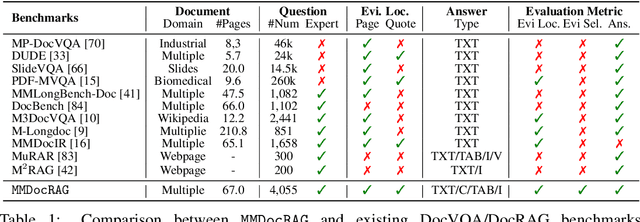
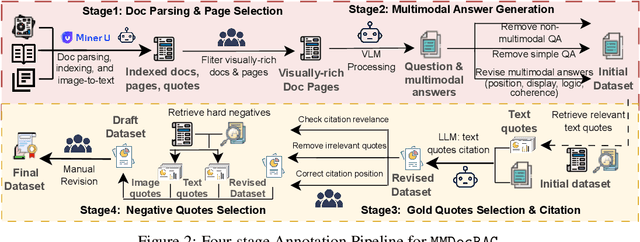
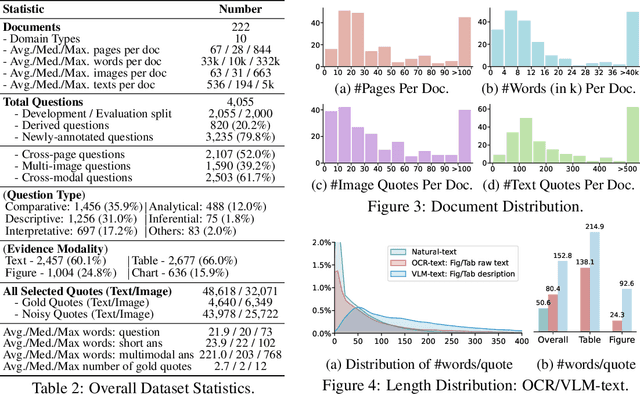
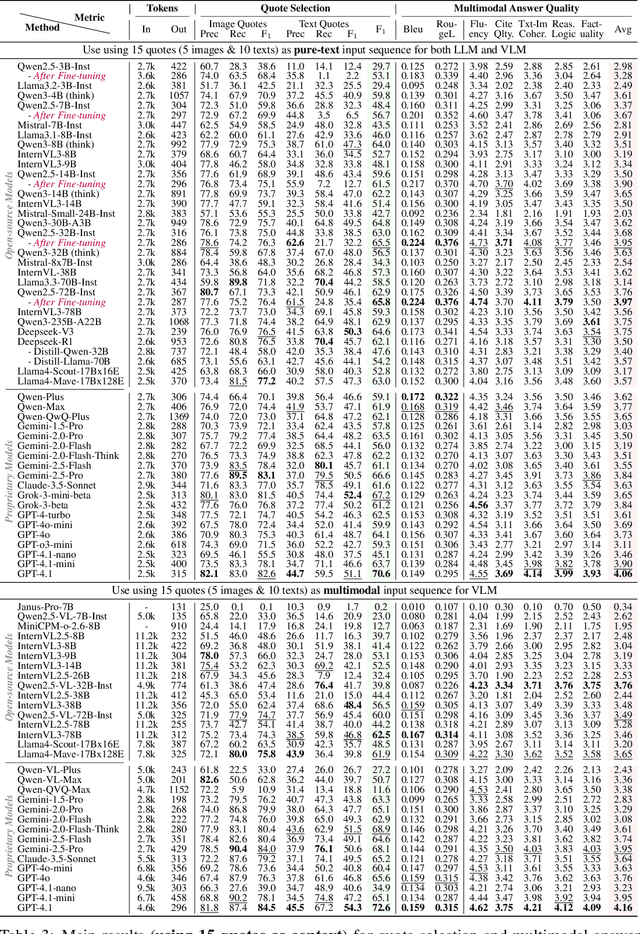
Document Visual Question Answering (DocVQA) faces dual challenges in processing lengthy multimodal documents (text, images, tables) and performing cross-modal reasoning. Current document retrieval-augmented generation (DocRAG) methods remain limited by their text-centric approaches, frequently missing critical visual information. The field also lacks robust benchmarks for assessing multimodal evidence selection and integration. We introduce MMDocRAG, a comprehensive benchmark featuring 4,055 expert-annotated QA pairs with multi-page, cross-modal evidence chains. Our framework introduces innovative metrics for evaluating multimodal quote selection and enables answers that interleave text with relevant visual elements. Through large-scale experiments with 60 VLM/LLM models and 14 retrieval systems, we identify persistent challenges in multimodal evidence retrieval, selection, and integration.Key findings reveal advanced proprietary LVMs show superior performance than open-sourced alternatives. Also, they show moderate advantages using multimodal inputs over text-only inputs, while open-source alternatives show significant performance degradation. Notably, fine-tuned LLMs achieve substantial improvements when using detailed image descriptions. MMDocRAG establishes a rigorous testing ground and provides actionable insights for developing more robust multimodal DocVQA systems. Our benchmark and code are available at https://mmdocrag.github.io/MMDocRAG/.
O$^2$-Searcher: A Searching-based Agent Model for Open-Domain Open-Ended Question Answering
May 22, 2025Large Language Models (LLMs), despite their advancements, are fundamentally limited by their static parametric knowledge, hindering performance on tasks requiring open-domain up-to-date information. While enabling LLMs to interact with external knowledge environments is a promising solution, current efforts primarily address closed-end problems. Open-ended questions, which characterized by lacking a standard answer or providing non-unique and diverse answers, remain underexplored. To bridge this gap, we present O$^2$-Searcher, a novel search agent leveraging reinforcement learning to effectively tackle both open-ended and closed-ended questions in the open domain. O$^2$-Searcher leverages an efficient, locally simulated search environment for dynamic knowledge acquisition, effectively decoupling the external world knowledge from model's sophisticated reasoning processes. It employs a unified training mechanism with meticulously designed reward functions, enabling the agent to identify problem types and adapt different answer generation strategies. Furthermore, to evaluate performance on complex open-ended tasks, we construct O$^2$-QA, a high-quality benchmark featuring 300 manually curated, multi-domain open-ended questions with associated web page caches. Extensive experiments show that O$^2$-Searcher, using only a 3B model, significantly surpasses leading LLM agents on O$^2$-QA. It also achieves SOTA results on various closed-ended QA benchmarks against similarly-sized models, while performing on par with much larger ones.
Effective and Efficient Schema-aware Information Extraction Using On-Device Large Language Models
May 21, 2025Information extraction (IE) plays a crucial role in natural language processing (NLP) by converting unstructured text into structured knowledge. Deploying computationally intensive large language models (LLMs) on resource-constrained devices for information extraction is challenging, particularly due to issues like hallucinations, limited context length, and high latency-especially when handling diverse extraction schemas. To address these challenges, we propose a two-stage information extraction approach adapted for on-device LLMs, called Dual-LoRA with Incremental Schema Caching (DLISC), which enhances both schema identification and schema-aware extraction in terms of effectiveness and efficiency. In particular, DLISC adopts an Identification LoRA module for retrieving the most relevant schemas to a given query, and an Extraction LoRA module for performing information extraction based on the previously selected schemas. To accelerate extraction inference, Incremental Schema Caching is incorporated to reduce redundant computation, substantially improving efficiency. Extensive experiments across multiple information extraction datasets demonstrate notable improvements in both effectiveness and efficiency.
UniVG-R1: Reasoning Guided Universal Visual Grounding with Reinforcement Learning
May 20, 2025Traditional visual grounding methods primarily focus on single-image scenarios with simple textual references. However, extending these methods to real-world scenarios that involve implicit and complex instructions, particularly in conjunction with multiple images, poses significant challenges, which is mainly due to the lack of advanced reasoning ability across diverse multi-modal contexts. In this work, we aim to address the more practical universal grounding task, and propose UniVG-R1, a reasoning guided multimodal large language model (MLLM) for universal visual grounding, which enhances reasoning capabilities through reinforcement learning (RL) combined with cold-start data. Specifically, we first construct a high-quality Chain-of-Thought (CoT) grounding dataset, annotated with detailed reasoning chains, to guide the model towards correct reasoning paths via supervised fine-tuning. Subsequently, we perform rule-based reinforcement learning to encourage the model to identify correct reasoning chains, thereby incentivizing its reasoning capabilities. In addition, we identify a difficulty bias arising from the prevalence of easy samples as RL training progresses, and we propose a difficulty-aware weight adjustment strategy to further strengthen the performance. Experimental results demonstrate the effectiveness of UniVG-R1, which achieves state-of-the-art performance on MIG-Bench with a 9.1% improvement over the previous method. Furthermore, our model exhibits strong generalizability, achieving an average improvement of 23.4% in zero-shot performance across four image and video reasoning grounding benchmarks. The project page can be accessed at https://amap-ml.github.io/UniVG-R1-page/.
AdaptCLIP: Adapting CLIP for Universal Visual Anomaly Detection
May 15, 2025Universal visual anomaly detection aims to identify anomalies from novel or unseen vision domains without additional fine-tuning, which is critical in open scenarios. Recent studies have demonstrated that pre-trained vision-language models like CLIP exhibit strong generalization with just zero or a few normal images. However, existing methods struggle with designing prompt templates, complex token interactions, or requiring additional fine-tuning, resulting in limited flexibility. In this work, we present a simple yet effective method called AdaptCLIP based on two key insights. First, adaptive visual and textual representations should be learned alternately rather than jointly. Second, comparative learning between query and normal image prompt should incorporate both contextual and aligned residual features, rather than relying solely on residual features. AdaptCLIP treats CLIP models as a foundational service, adding only three simple adapters, visual adapter, textual adapter, and prompt-query adapter, at its input or output ends. AdaptCLIP supports zero-/few-shot generalization across domains and possesses a training-free manner on target domains once trained on a base dataset. AdaptCLIP achieves state-of-the-art performance on 12 anomaly detection benchmarks from industrial and medical domains, significantly outperforming existing competitive methods. We will make the code and model of AdaptCLIP available at https://github.com/gaobb/AdaptCLIP.
OLinear: A Linear Model for Time Series Forecasting in Orthogonally Transformed Domain
May 14, 2025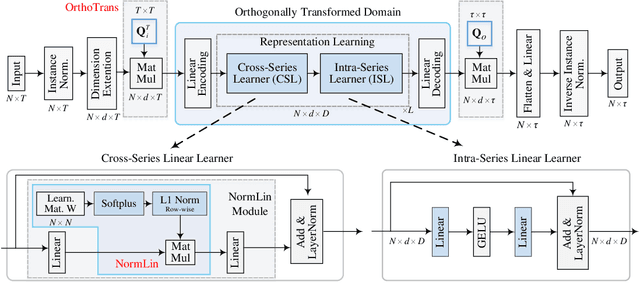
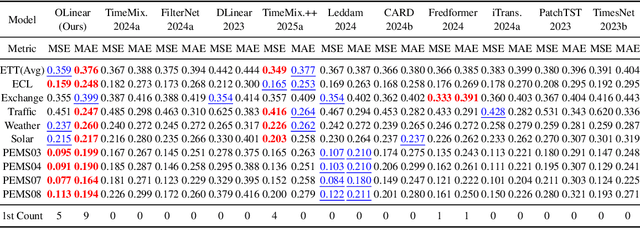
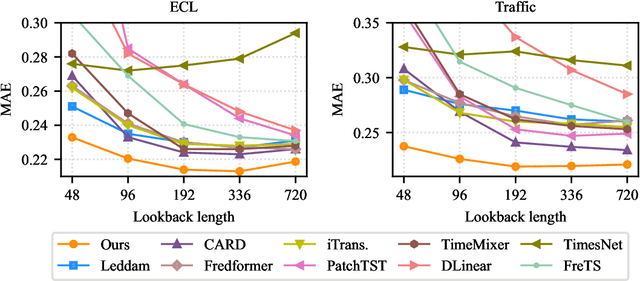
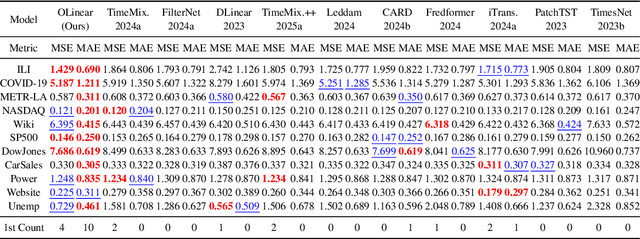
This paper presents $\mathbf{OLinear}$, a $\mathbf{linear}$-based multivariate time series forecasting model that operates in an $\mathbf{o}$rthogonally transformed domain. Recent forecasting models typically adopt the temporal forecast (TF) paradigm, which directly encode and decode time series in the time domain. However, the entangled step-wise dependencies in series data can hinder the performance of TF. To address this, some forecasters conduct encoding and decoding in the transformed domain using fixed, dataset-independent bases (e.g., sine and cosine signals in the Fourier transform). In contrast, we utilize $\mathbf{OrthoTrans}$, a data-adaptive transformation based on an orthogonal matrix that diagonalizes the series' temporal Pearson correlation matrix. This approach enables more effective encoding and decoding in the decorrelated feature domain and can serve as a plug-in module to enhance existing forecasters. To enhance the representation learning for multivariate time series, we introduce a customized linear layer, $\mathbf{NormLin}$, which employs a normalized weight matrix to capture multivariate dependencies. Empirically, the NormLin module shows a surprising performance advantage over multi-head self-attention, while requiring nearly half the FLOPs. Extensive experiments on 24 benchmarks and 140 forecasting tasks demonstrate that OLinear consistently achieves state-of-the-art performance with high efficiency. Notably, as a plug-in replacement for self-attention, the NormLin module consistently enhances Transformer-based forecasters. The code and datasets are available at https://anonymous.4open.science/r/OLinear