 Add to Chrome
 Add to Firefox
 Add to Edge
Restoring Collaborative Signals in Semantic-ID Generative Recommendation via Personalized Natural Language
Jul 30, 2026
Making LLM-based generative recommendation models stronger and more personalized through natural language and explicit reasoning is a widely anticipated yet still unsolved goal. Such models cast recommendation as autoregressively generating an item's semantic-ID (SID), a short tuple of discrete codes, so that recommending well reduces to emitting the right SID. In this setting the model verbalizes its knowledge poorly, and text and SID tokens live in misaligned embedding spaces. Deep reasoning therefore rarely turns into a correct SID, and enabling explicit "thinking" often gives no gain or even hurts. The deeper cause is that a compact SID cannot hold content and collaborative signal at once: the two compete, and collaboration loses. Because a mis-predicted SID is a wrong recommendation, this caps accuracy directly. Costly multi-round training barely helps, and few methods try to supply the missing signal at inference time. What is missing is a reliable channel that carries collaborative signal into SID generation. We therefore propose a framework, guided by personalized natural language, that adds hierarchical collaborative cues as the model generates, without altering the backbone or retraining the SIDs. Rather than mapping language onto SIDs directly, it uses language to attach analyzable links between collaborative patterns and their audiences, restoring the collaborative signal that SIDs miss. The result is consistent gains in recommendation accuracy, grounding generation in collaborative structure at inference time rather than relying on explicit reasoning or retraining.

OxygenREC-v2: Internalizing Discrimination into Generative Recommendation
Jul 27, 2026Generative recommendation unifies retrieval and ranking within a single model by autoregressively decoding semantic identifier (SID) sequences. Yet reliably incorporating behavior signals from clicks, cart additions, and orders remains challenging. Existing approaches either jointly optimize generative and discriminative objectives, requiring delicate trade-offs, or use a separate ranker as a post-hoc reinforcement-learning reward, risking out-of-distribution scoring and reward misalignment. We propose OxygenREC-v2, a generative recommender that Internalizes Discrimination into Generative Recommendation (IDGR). Rather than adding a separate discriminative objective, OxygenREC-v2 uses logged behavior to condition generation and supervise training. During pre-training, a behavior instruction conditions generation on the target behavior. During post-training, future interaction behaviors are exploited as privileged knowledge in our entropy-aware trajectory optimization self-distillation framework, enabling reward-model-free policy optimization. Throughout both training stages, OxygenREC-v2 maintains a single unified backbone. We implement OxygenREC-v2 as a 3B-parameter, 1B-activated MoE and deploy it on JD.com's large-scale e-commerce platform. Across multiple online A/B tests, OxygenREC-v2 improves user click-through conversion rate (UCTCVR) by 1.6--4.4% and GMV by 2.8--6.8% over OxygenREC-v1.
Dynamic Adaptive Attention and Supervised Contrastive Learning: A Novel Hybrid Framework for Text Sentiment Classification
Apr 12, 2026The exponential growth of user-generated movie reviews on digital platforms has made accurate text sentiment classification a cornerstone task in natural language processing. Traditional models, including standard BERT and recurrent architectures, frequently struggle to capture long-distance semantic dependencies and resolve ambiguous emotional expressions in lengthy review texts. This paper proposes a novel hybrid framework that seamlessly integrates dynamic adaptive multi-head attention with supervised contrastive learning into a BERT-based Transformer encoder. The dynamic adaptive attention module employs a global context pooling vector to dynamically regulate the contribution of each attention head, thereby focusing on critical sentiment-bearing tokens while suppressing noise. Simultaneously, the supervised contrastive learning branch enforces tighter intra-class compactness and larger inter-class separation in the embedding space. Extensive experiments on the IMDB dataset demonstrate that the proposed model achieves competitive performance with an accuracy of 94.67\%, outperforming strong baselines by 1.5--2.5 percentage points. The framework is lightweight, efficient, and readily extensible to other text classification tasks.
MalMoE: Mixture-of-Experts Enhanced Encrypted Malicious Traffic Detection Under Graph Drift
Feb 10, 2026Encryption has been commonly used in network traffic to secure transmission, but it also brings challenges for malicious traffic detection, due to the invisibility of the packet payload. Graph-based methods are emerging as promising solutions by leveraging multi-host interactions to promote detection accuracy. But most of them face a critical problem: Graph Drift, where the flow statistics or topological information of a graph change over time. To overcome these drawbacks, we propose a graph-assisted encrypted traffic detection system, MalMoE, which applies Mixture of Experts (MoE) to select the best expert model for drift-aware classification. Particularly, we design 1-hop-GNN-like expert models that handle different graph drifts by analyzing graphs with different features. Then, the redesigned gate model conducts expert selection according to the actual drift. MalMoE is trained with a stable two-stage training strategy with data augmentation, which effectively guides the gate on how to perform routing. Experiments on open-source, synthetic, and real-world datasets show that MalMoE can perform precise and real-time detection.
Facet: highly efficient E(3)-equivariant networks for interatomic potentials
Sep 10, 2025Computational materials discovery is limited by the high cost of first-principles calculations. Machine learning (ML) potentials that predict energies from crystal structures are promising, but existing methods face computational bottlenecks. Steerable graph neural networks (GNNs) encode geometry with spherical harmonics, respecting atomic symmetries -- permutation, rotation, and translation -- for physically realistic predictions. Yet maintaining equivariance is difficult: activation functions must be modified, and each layer must handle multiple data types for different harmonic orders. We present Facet, a GNN architecture for efficient ML potentials, developed through systematic analysis of steerable GNNs. Our innovations include replacing expensive multi-layer perceptrons (MLPs) for interatomic distances with splines, which match performance while cutting computational and memory demands. We also introduce a general-purpose equivariant layer that mixes node information via spherical grid projection followed by standard MLPs -- faster than tensor products and more expressive than linear or gate layers. On the MPTrj dataset, Facet matches leading models with far fewer parameters and under 10% of their training compute. On a crystal relaxation task, it runs twice as fast as MACE models. We further show SevenNet-0's parameters can be reduced by over 25% with no accuracy loss. These techniques enable more than 10x faster training of large-scale foundation models for ML potentials, potentially reshaping computational materials discovery.
Towards Reward Fairness in RLHF: From a Resource Allocation Perspective
May 29, 2025Rewards serve as proxies for human preferences and play a crucial role in Reinforcement Learning from Human Feedback (RLHF). However, if these rewards are inherently imperfect, exhibiting various biases, they can adversely affect the alignment of large language models (LLMs). In this paper, we collectively define the various biases present in rewards as the problem of reward unfairness. We propose a bias-agnostic method to address the issue of reward fairness from a resource allocation perspective, without specifically designing for each type of bias, yet effectively mitigating them. Specifically, we model preference learning as a resource allocation problem, treating rewards as resources to be allocated while considering the trade-off between utility and fairness in their distribution. We propose two methods, Fairness Regularization and Fairness Coefficient, to achieve fairness in rewards. We apply our methods in both verification and reinforcement learning scenarios to obtain a fairness reward model and a policy model, respectively. Experiments conducted in these scenarios demonstrate that our approach aligns LLMs with human preferences in a more fair manner.
MCBlock: Boosting Neural Radiance Field Training Speed by MCTS-based Dynamic-Resolution Ray Sampling
Apr 14, 2025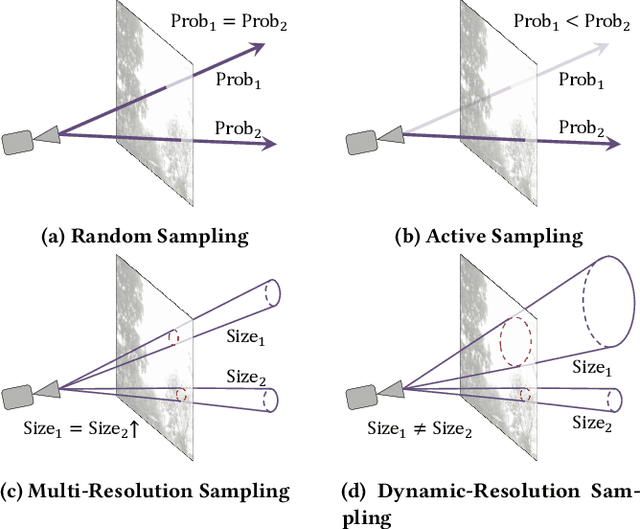
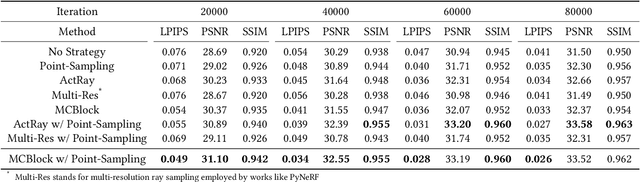


Neural Radiance Field (NeRF) is widely known for high-fidelity novel view synthesis. However, even the state-of-the-art NeRF model, Gaussian Splatting, requires minutes for training, far from the real-time performance required by multimedia scenarios like telemedicine. One of the obstacles is its inefficient sampling, which is only partially addressed by existing works. Existing point-sampling algorithms uniformly sample simple-texture regions (easy to fit) and complex-texture regions (hard to fit), while existing ray-sampling algorithms sample these regions all in the finest granularity (i.e. the pixel level), both wasting GPU training resources. Actually, regions with different texture intensities require different sampling granularities. To this end, we propose a novel dynamic-resolution ray-sampling algorithm, MCBlock, which employs Monte Carlo Tree Search (MCTS) to partition each training image into pixel blocks with different sizes for active block-wise training. Specifically, the trees are initialized according to the texture of training images to boost the initialization speed, and an expansion/pruning module dynamically optimizes the block partition. MCBlock is implemented in Nerfstudio, an open-source toolset, and achieves a training acceleration of up to 2.33x, surpassing other ray-sampling algorithms. We believe MCBlock can apply to any cone-tracing NeRF model and contribute to the multimedia community.
SPPD: Self-training with Process Preference Learning Using Dynamic Value Margin
Feb 19, 2025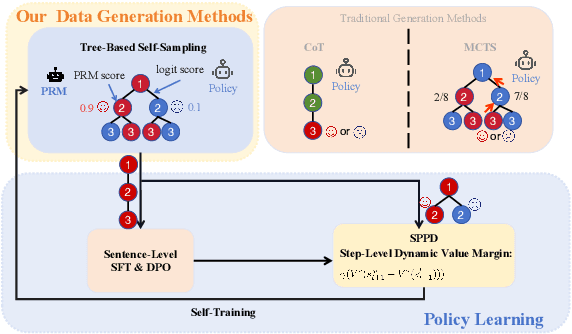
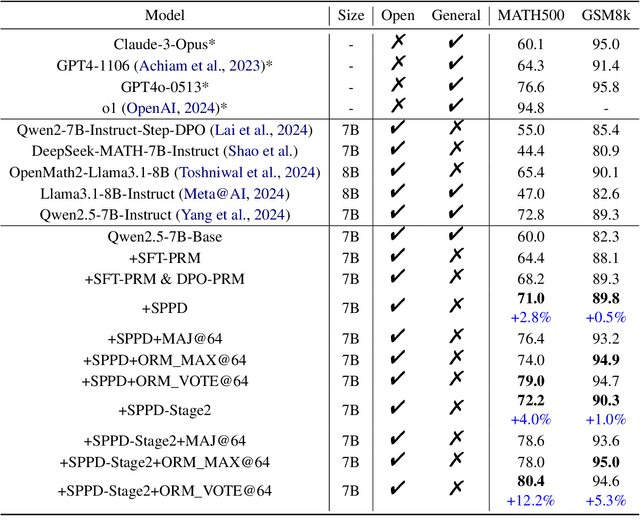
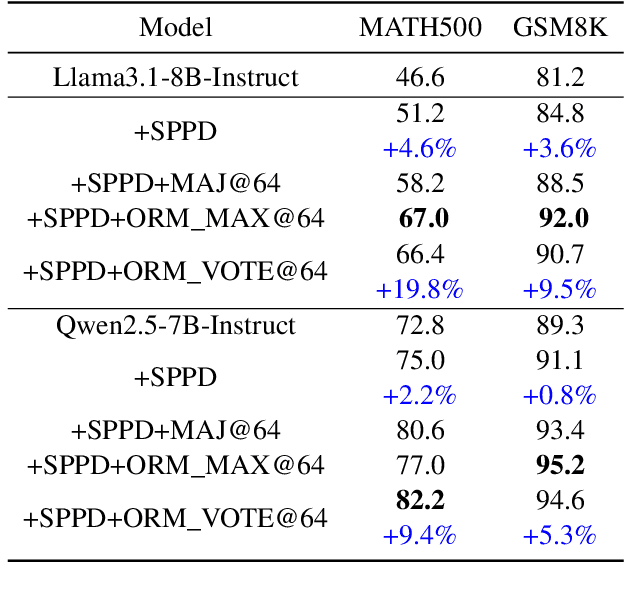
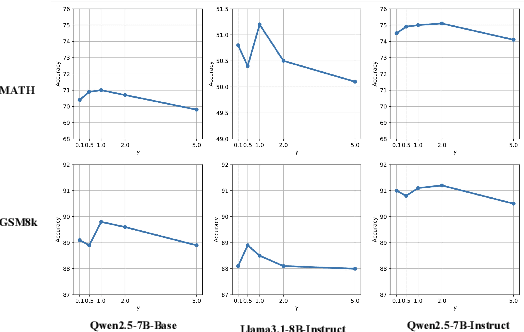
Recently, enhancing the numerical and logical reasoning capability of Large Language Models (LLMs) has emerged as a research hotspot. Existing methods face several limitations: inference-phase techniques (e.g., Chain of Thoughts) rely on prompt selection and the pretrained knowledge; sentence-level Supervised Fine-Tuning (SFT) and Direct Preference Optimization (DPO) struggle with step-wise mathematical correctness and depend on stronger models distillation or human annotations; while Reinforcement Learning (RL) approaches incur high GPU memory costs and unstable training. To address these, we propose \textbf{S}elf-training framework integrating \textbf{P}rocess \textbf{P}reference learning using \textbf{D}ynamic value margin (SPPD). SPPD leverages a process-based Markov Decision Process (MDP) and Bellman optimality equation to derive \textbf{dynamic value margin} on step-level preference optimization, which employs tree-based self-sampling on model responses \textbf{without any distillation} from other models. Furthermore, we theoretically prove that SPPD is \textbf{equivalent to on-policy policy gradient methods} under reward constraints. Experiments on 7B-scale models demonstrate superior performance across in-domain and out-domain mathematical benchmarks. We open-source our code at \href{https://anonymous.4open.science/r/SSDPO-D-DCDD}{https://anonymous.4open.science/r/SPPD-DCDD}.
Video-Text Dataset Construction from Multi-AI Feedback: Promoting Weak-to-Strong Preference Learning for Video Large Language Models
Nov 25, 2024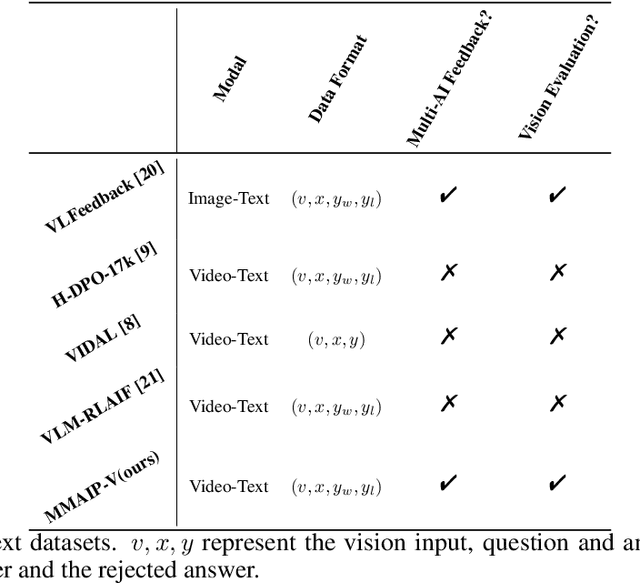
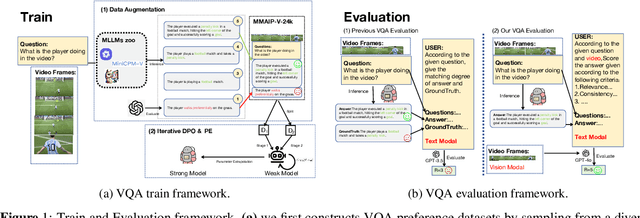
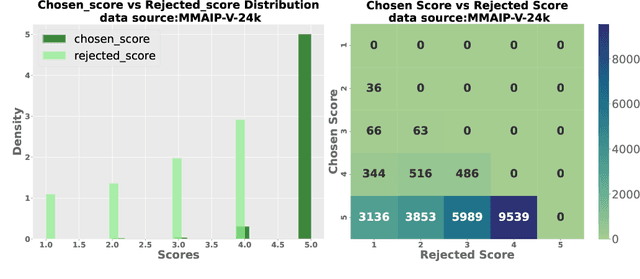
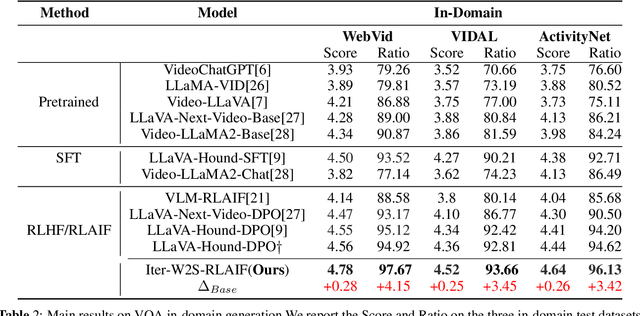
High-quality video-text preference data is crucial for Multimodal Large Language Models (MLLMs) alignment. However, existing preference data is very scarce. Obtaining VQA preference data for preference training is costly, and manually annotating responses is highly unreliable, which could result in low-quality pairs. Meanwhile, AI-generated responses controlled by temperature adjustment lack diversity. To address these issues, we propose a high-quality VQA preference dataset, called \textit{\textbf{M}ultiple \textbf{M}ultimodal \textbf{A}rtificial \textbf{I}ntelligence \textbf{P}reference Datasets in \textbf{V}QA} (\textbf{MMAIP-V}), which is constructed by sampling from the response distribution set and using an external scoring function for response evaluation. Furthermore, to fully leverage the preference knowledge in MMAIP-V and ensure sufficient optimization, we propose \textit{\textbf{Iter}ative \textbf{W}eak-to-\textbf{S}trong \textbf{R}einforcement \textbf{L}earning from \textbf{AI} \textbf{F}eedback for video MLLMs} (\textbf{Iter-W2S-RLAIF}), a framework that gradually enhances MLLMs' alignment capabilities by iteratively updating the reference model and performing parameter extrapolation. Finally, we propose an unbiased and information-complete evaluation scheme in VQA evaluation. Experiments demonstrate that MMAIP-V is beneficial for MLLMs in preference learning and Iter-W2S-RLAIF fully exploits the alignment information in MMAIP-V. We believe that the proposed automatic VQA preference data generation pipeline based on AI feedback can greatly promote future work in the MLLMs alignment. \textbf{Code and dataset are available} \href{https://anonymous.4open.science/r/MMAIP-V_Iter-W2S-RLAIF-702F}{MMAIP-V\_Iter-W2S-RLAIF-702F}.
Investigating the Synergistic Effects of Dropout and Residual Connections on Language Model Training
Oct 01, 2024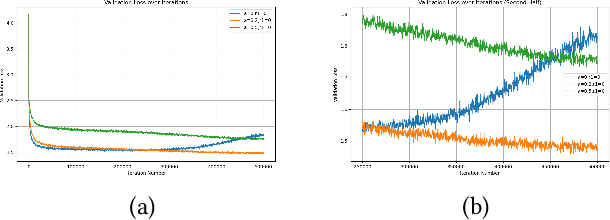
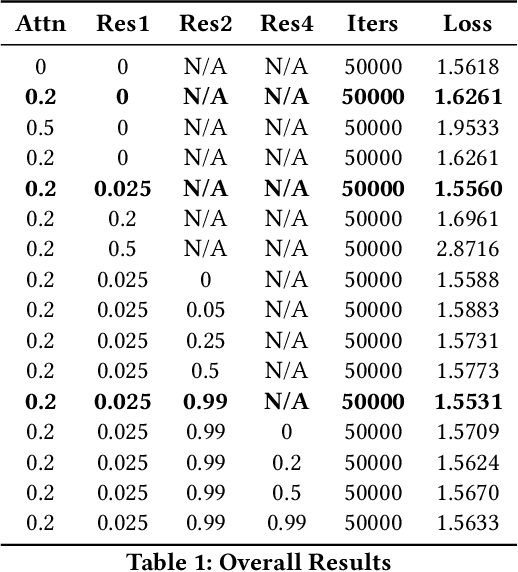
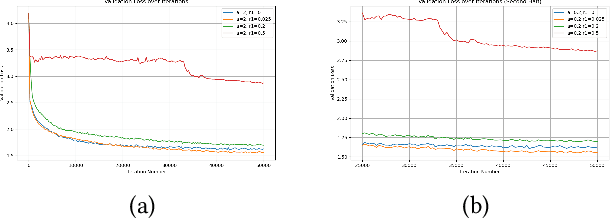
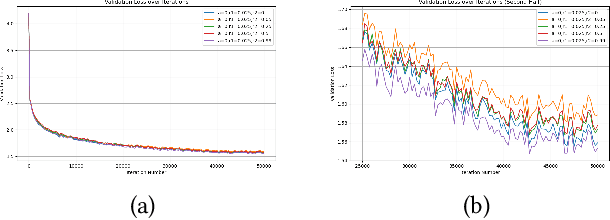
This paper examines the pivotal role of dropout techniques in mitigating overfitting in language model training. It conducts a comprehensive investigation into the influence of variable dropout rates on both individual layers and residual connections within the context of language modeling. Our study conducts training of a decoder implementation on the classic Tiny Shakespeare data to examine the effects of the adjustments on training efficiency and validation error. Results not only confirm the benefits of dropout for regularization and residuals for convergence, but also reveal their interesting interactions. There exists an important trade-off between the depth of residual connections and the dropout on these connections for optimal deep neural network convergence and generalization.