 Add to Chrome
 Add to Firefox
 Add to Edge
AutoMMLab: Automatically Generating Deployable Models from Language Instructions for Computer Vision Tasks
Feb 23, 2024
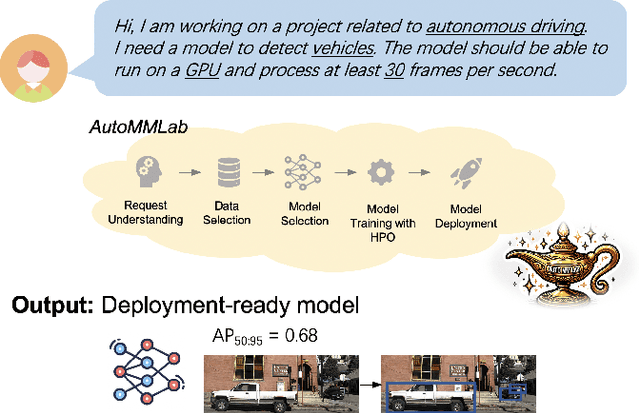
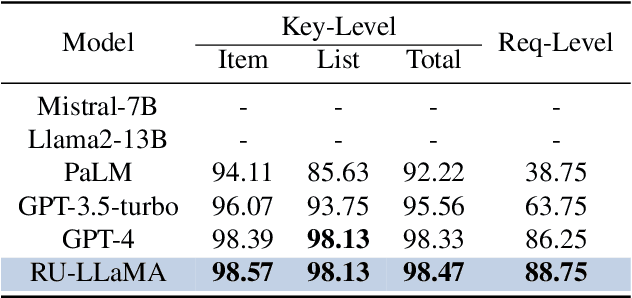
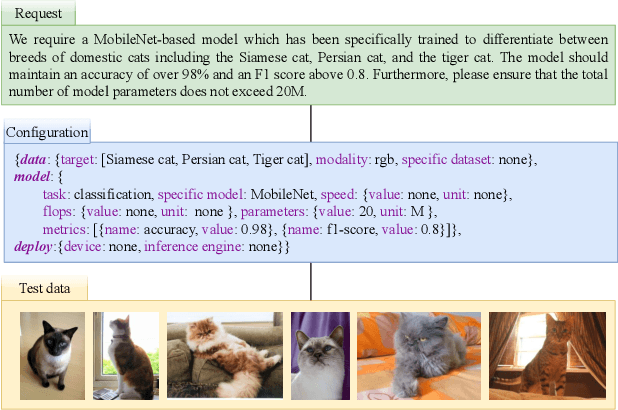
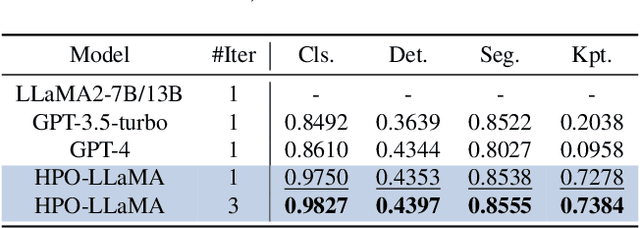
Automated machine learning (AutoML) is a collection of techniques designed to automate the machine learning development process. While traditional AutoML approaches have been successfully applied in several critical steps of model development (e.g. hyperparameter optimization), there lacks a AutoML system that automates the entire end-to-end model production workflow. To fill this blank, we present AutoMMLab, a general-purpose LLM-empowered AutoML system that follows user's language instructions to automate the whole model production workflow for computer vision tasks. The proposed AutoMMLab system effectively employs LLMs as the bridge to connect AutoML and OpenMMLab community, empowering non-expert individuals to easily build task-specific models via a user-friendly language interface. Specifically, we propose RU-LLaMA to understand users' request and schedule the whole pipeline, and propose a novel LLM-based hyperparameter optimizer called HPO-LLaMA to effectively search for the optimal hyperparameters. Experiments show that our AutoMMLab system is versatile and covers a wide range of mainstream tasks, including classification, detection, segmentation and keypoint estimation. We further develop a new benchmark, called LAMP, for studying key components in the end-to-end prompt-based model training pipeline. Code, model, and data will be released.

RoboScript: Code Generation for Free-Form Manipulation Tasks across Real and Simulation
Feb 22, 2024


Rapid progress in high-level task planning and code generation for open-world robot manipulation has been witnessed in Embodied AI. However, previous studies put much effort into general common sense reasoning and task planning capabilities of large-scale language or multi-modal models, relatively little effort on ensuring the deployability of generated code on real robots, and other fundamental components of autonomous robot systems including robot perception, motion planning, and control. To bridge this ``ideal-to-real'' gap, this paper presents \textbf{RobotScript}, a platform for 1) a deployable robot manipulation pipeline powered by code generation; and 2) a code generation benchmark for robot manipulation tasks in free-form natural language. The RobotScript platform addresses this gap by emphasizing the unified interface with both simulation and real robots, based on abstraction from the Robot Operating System (ROS), ensuring syntax compliance and simulation validation with Gazebo. We demonstrate the adaptability of our code generation framework across multiple robot embodiments, including the Franka and UR5 robot arms, and multiple grippers. Additionally, our benchmark assesses reasoning abilities for physical space and constraints, highlighting the differences between GPT-3.5, GPT-4, and Gemini in handling complex physical interactions. Finally, we present a thorough evaluation on the whole system, exploring how each module in the pipeline: code generation, perception, motion planning, and even object geometric properties, impact the overall performance of the system.
BESA: Pruning Large Language Models with Blockwise Parameter-Efficient Sparsity Allocation
Feb 18, 2024Large language models (LLMs) have demonstrated outstanding performance in various tasks, such as text summarization, text question-answering, and etc. While their performance is impressive, the computational footprint due to their vast number of parameters can be prohibitive. Existing solutions such as SparseGPT and Wanda attempt to alleviate this issue through weight pruning. However, their layer-wise approach results in significant perturbation to the model's output and requires meticulous hyperparameter tuning, such as the pruning rate, which can adversely affect overall model performance. To address this, this paper introduces a novel LLM pruning technique dubbed blockwise parameter-efficient sparsity allocation (BESA) by applying a blockwise reconstruction loss. In contrast to the typical layer-wise pruning techniques, BESA is characterized by two distinctive attributes: i) it targets the overall pruning error with respect to individual transformer blocks, and ii) it allocates layer-specific sparsity in a differentiable manner, both of which ensure reduced performance degradation after pruning. Our experiments show that BESA achieves state-of-the-art performance, efficiently pruning LLMs like LLaMA1, and LLaMA2 with 7B to 70B parameters on a single A100 GPU in just five hours. Code is available at \href{https://github.com/OpenGVLab/LLMPrune-BESA}{here}.
OmniMedVQA: A New Large-Scale Comprehensive Evaluation Benchmark for Medical LVLM
Feb 14, 2024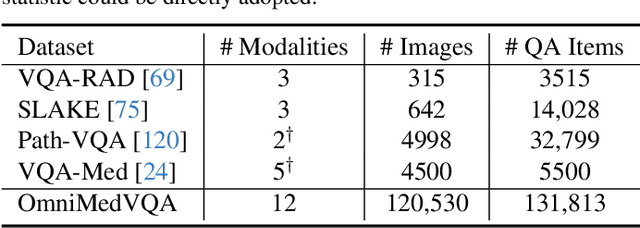
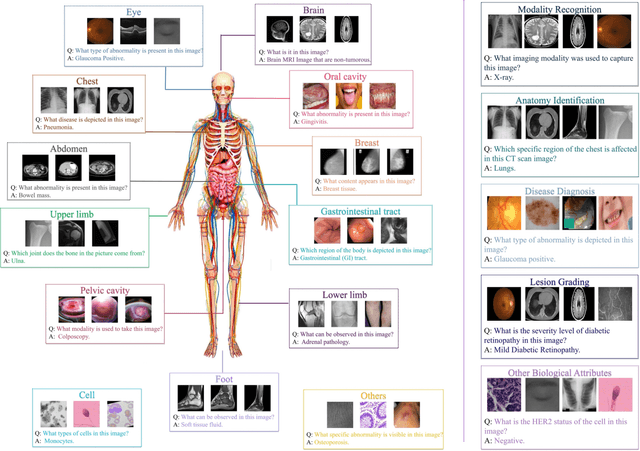
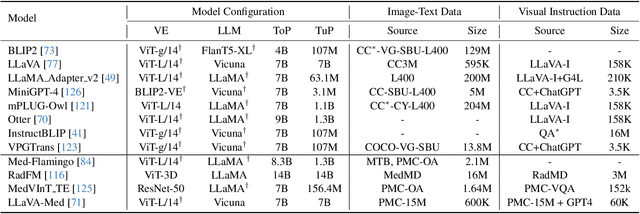
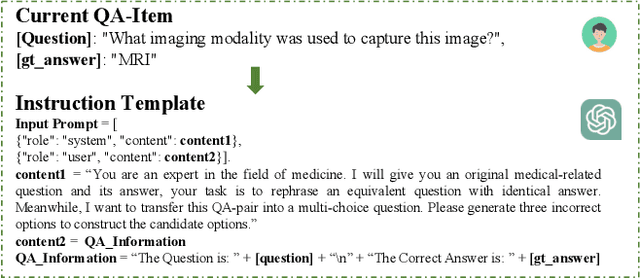
Large Vision-Language Models (LVLMs) have demonstrated remarkable capabilities in various multimodal tasks. However, their potential in the medical domain remains largely unexplored. A significant challenge arises from the scarcity of diverse medical images spanning various modalities and anatomical regions, which is essential in real-world medical applications. To solve this problem, in this paper, we introduce OmniMedVQA, a novel comprehensive medical Visual Question Answering (VQA) benchmark. This benchmark is collected from 75 different medical datasets, including 12 different modalities and covering more than 20 distinct anatomical regions. Importantly, all images in this benchmark are sourced from authentic medical scenarios, ensuring alignment with the requirements of the medical field and suitability for evaluating LVLMs. Through our extensive experiments, we have found that existing LVLMs struggle to address these medical VQA problems effectively. Moreover, what surprises us is that medical-specialized LVLMs even exhibit inferior performance to those general-domain models, calling for a more versatile and robust LVLM in the biomedical field. The evaluation results not only reveal the current limitations of LVLM in understanding real medical images but also highlight our dataset's significance. Our dataset will be made publicly available.
InternVL: Scaling up Vision Foundation Models and Aligning for Generic Visual-Linguistic Tasks
Jan 15, 2024The exponential growth of large language models (LLMs) has opened up numerous possibilities for multimodal AGI systems. However, the progress in vision and vision-language foundation models, which are also critical elements of multi-modal AGI, has not kept pace with LLMs. In this work, we design a large-scale vision-language foundation model (InternVL), which scales up the vision foundation model to 6 billion parameters and progressively aligns it with the LLM, using web-scale image-text data from various sources. This model can be broadly applied to and achieve state-of-the-art performance on 32 generic visual-linguistic benchmarks including visual perception tasks such as image-level or pixel-level recognition, vision-language tasks such as zero-shot image/video classification, zero-shot image/video-text retrieval, and link with LLMs to create multi-modal dialogue systems. It has powerful visual capabilities and can be a good alternative to the ViT-22B. We hope that our research could contribute to the development of multi-modal large models. Code and models are available at https://github.com/OpenGVLab/InternVL.
ChartAssisstant: A Universal Chart Multimodal Language Model via Chart-to-Table Pre-training and Multitask Instruction Tuning
Jan 10, 2024Charts play a vital role in data visualization, understanding data patterns, and informed decision-making. However, their unique combination of graphical elements (e.g., bars, lines) and textual components (e.g., labels, legends) poses challenges for general-purpose multimodal models. While vision-language models trained on chart data excel in comprehension, they struggle with generalization and require task-specific fine-tuning. To address these challenges, we propose ChartAssistant, a chart-based vision-language model for universal chart comprehension and reasoning. ChartAssistant leverages ChartSFT, a comprehensive dataset covering diverse chart-related tasks with basic and specialized chart types. It undergoes a two-stage training process, starting with pre-training on chart-to-table parsing to align chart and text, followed by multitask instruction-following fine-tuning. This approach enables ChartAssistant to achieve competitive performance across various chart tasks without task-specific fine-tuning. Experimental results demonstrate significant performance gains over the state-of-the-art UniChart method, outperforming OpenAI's GPT-4V(ision) on real-world chart data. The code and data are available at https://github.com/OpenGVLab/ChartAst.
PIXART-δ: Fast and Controllable Image Generation with Latent Consistency Models
Jan 10, 2024This technical report introduces PIXART-{\delta}, a text-to-image synthesis framework that integrates the Latent Consistency Model (LCM) and ControlNet into the advanced PIXART-{\alpha} model. PIXART-{\alpha} is recognized for its ability to generate high-quality images of 1024px resolution through a remarkably efficient training process. The integration of LCM in PIXART-{\delta} significantly accelerates the inference speed, enabling the production of high-quality images in just 2-4 steps. Notably, PIXART-{\delta} achieves a breakthrough 0.5 seconds for generating 1024x1024 pixel images, marking a 7x improvement over the PIXART-{\alpha}. Additionally, PIXART-{\delta} is designed to be efficiently trainable on 32GB V100 GPUs within a single day. With its 8-bit inference capability (von Platen et al., 2023), PIXART-{\delta} can synthesize 1024px images within 8GB GPU memory constraints, greatly enhancing its usability and accessibility. Furthermore, incorporating a ControlNet-like module enables fine-grained control over text-to-image diffusion models. We introduce a novel ControlNet-Transformer architecture, specifically tailored for Transformers, achieving explicit controllability alongside high-quality image generation. As a state-of-the-art, open-source image generation model, PIXART-{\delta} offers a promising alternative to the Stable Diffusion family of models, contributing significantly to text-to-image synthesis.
Video Understanding with Large Language Models: A Survey
Jan 04, 2024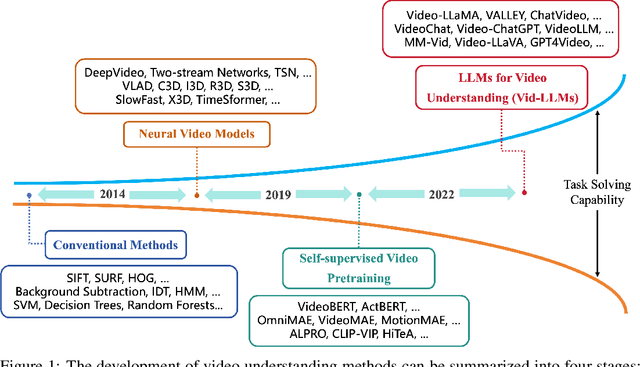

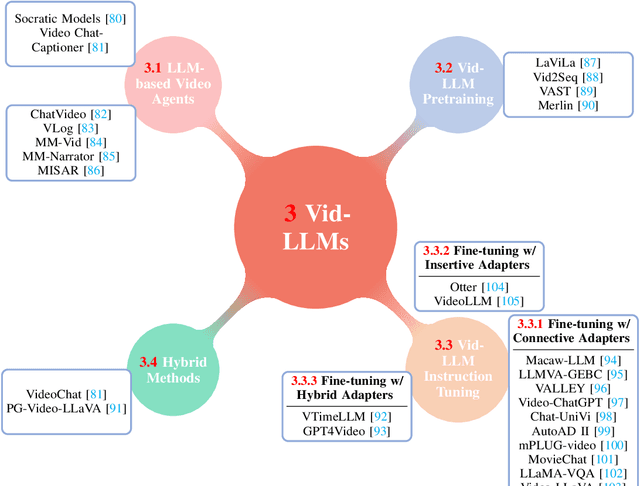
With the burgeoning growth of online video platforms and the escalating volume of video content, the demand for proficient video understanding tools has intensified markedly. Given the remarkable capabilities of Large Language Models (LLMs) in language and multimodal tasks, this survey provides a detailed overview of the recent advancements in video understanding harnessing the power of LLMs (Vid-LLMs). The emergent capabilities of Vid-LLMs are surprisingly advanced, particularly their ability for open-ended spatial-temporal reasoning combined with commonsense knowledge, suggesting a promising path for future video understanding. We examine the unique characteristics and capabilities of Vid-LLMs, categorizing the approaches into four main types: LLM-based Video Agents, Vid-LLMs Pretraining, Vid-LLMs Instruction Tuning, and Hybrid Methods. Furthermore, this survey presents a comprehensive study of the tasks, datasets, and evaluation methodologies for Vid-LLMs. Additionally, it explores the expansive applications of Vid-LLMs across various domains, highlighting their remarkable scalability and versatility in real-world video understanding challenges. Finally, it summarizes the limitations of existing Vid-LLMs and outlines directions for future research. For more information, readers are recommended to visit the repository at https://github.com/yunlong10/Awesome-LLMs-for-Video-Understanding.
LLaMA Pro: Progressive LLaMA with Block Expansion
Jan 04, 2024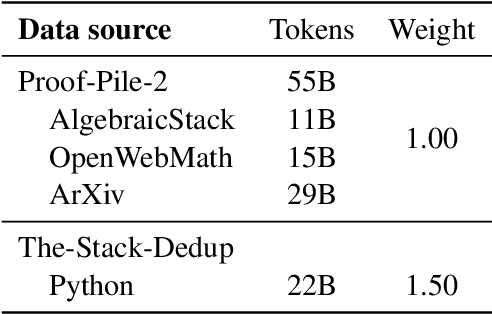
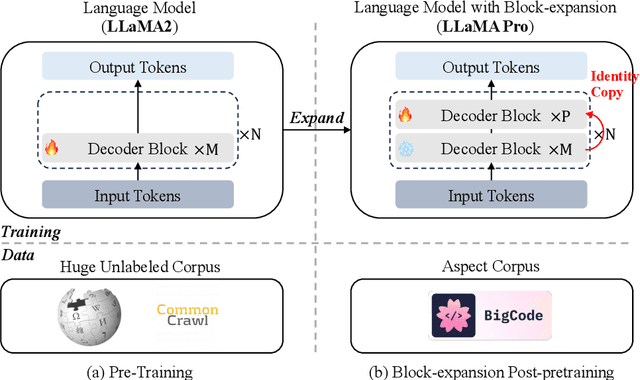
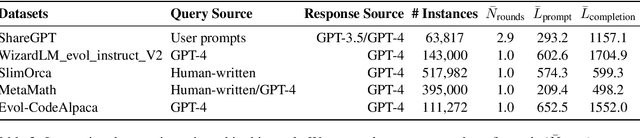
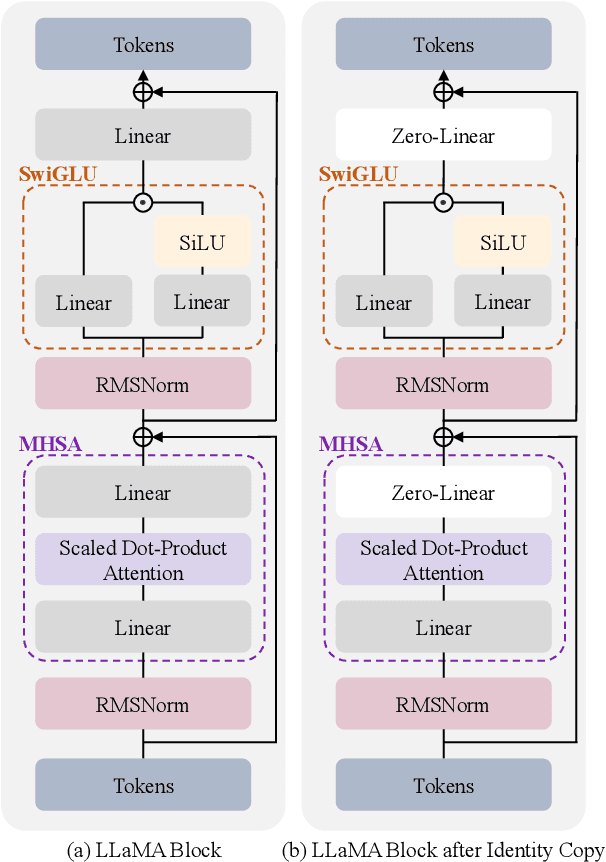
Humans generally acquire new skills without compromising the old; however, the opposite holds for Large Language Models (LLMs), e.g., from LLaMA to CodeLLaMA. To this end, we propose a new post-pretraining method for LLMs with an expansion of Transformer blocks. We tune the expanded blocks using only new corpus, efficiently and effectively improving the model's knowledge without catastrophic forgetting. In this paper, we experiment on the corpus of code and math, yielding LLaMA Pro-8.3B, a versatile foundation model initialized from LLaMA2-7B, excelling in general tasks, programming, and mathematics. LLaMA Pro and its instruction-following counterpart (LLaMA Pro-Instruct) achieve advanced performance among various benchmarks, demonstrating superiority over existing open models in the LLaMA family and the immense potential of reasoning and addressing diverse tasks as an intelligent agent. Our findings provide valuable insights into integrating natural and programming languages, laying a solid foundation for developing advanced language agents that operate effectively in various environments.
A Survey of Reasoning with Foundation Models
Dec 26, 2023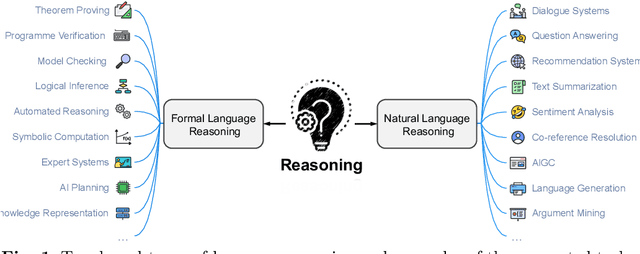


Reasoning, a crucial ability for complex problem-solving, plays a pivotal role in various real-world settings such as negotiation, medical diagnosis, and criminal investigation. It serves as a fundamental methodology in the field of Artificial General Intelligence (AGI). With the ongoing development of foundation models, there is a growing interest in exploring their abilities in reasoning tasks. In this paper, we introduce seminal foundation models proposed or adaptable for reasoning, highlighting the latest advancements in various reasoning tasks, methods, and benchmarks. We then delve into the potential future directions behind the emergence of reasoning abilities within foundation models. We also discuss the relevance of multimodal learning, autonomous agents, and super alignment in the context of reasoning. By discussing these future research directions, we hope to inspire researchers in their exploration of this field, stimulate further advancements in reasoning with foundation models, and contribute to the development of AGI.