 Add to Chrome
 Add to Firefox
 Add to Edge
MiroFlow: Towards High-Performance and Robust Open-Source Agent Framework for General Deep Research Tasks
Feb 26, 2026
Despite the remarkable progress of large language models (LLMs), the capabilities of standalone LLMs have begun to plateau when tackling real-world, complex tasks that require interaction with external tools and dynamic environments. Although recent agent frameworks aim to enhance model autonomy through tool integration and external interaction, they still suffer from naive workflows, unstable performance, limited support across diverse benchmarks and tasks, and heavy reliance on costly commercial APIs. In this work, we propose a high-performance and robust open-source agent framework, termed MiroFlow, which incorporates an agent graph for flexible orchestration, an optional deep reasoning mode to enhance performance, and a robust workflow execution to ensure stable and reproducible performance. Extensive experiments demonstrate that MiroFlow consistently achieves state-of-the-art performance across multiple agent benchmarks, including GAIA, BrowseComp-EN/ZH, HLE, xBench-DeepSearch, and notably FutureX. We hope it could serve as an easily accessible, reproducible, and comparable baseline for the deep research community.

MiroThinker: Pushing the Performance Boundaries of Open-Source Research Agents via Model, Context, and Interactive Scaling
Nov 18, 2025We present MiroThinker v1.0, an open-source research agent designed to advance tool-augmented reasoning and information-seeking capabilities. Unlike previous agents that only scale up model size or context length, MiroThinker explores interaction scaling at the model level, systematically training the model to handle deeper and more frequent agent-environment interactions as a third dimension of performance improvement. Unlike LLM test-time scaling, which operates in isolation and risks degradation with longer reasoning chains, interactive scaling leverages environment feedback and external information acquisition to correct errors and refine trajectories. Through reinforcement learning, the model achieves efficient interaction scaling: with a 256K context window, it can perform up to 600 tool calls per task, enabling sustained multi-turn reasoning and complex real-world research workflows. Across four representative benchmarks-GAIA, HLE, BrowseComp, and BrowseComp-ZH-the 72B variant achieves up to 81.9%, 37.7%, 47.1%, and 55.6% accuracy respectively, surpassing previous open-source agents and approaching commercial counterparts such as GPT-5-high. Our analysis reveals that MiroThinker benefits from interactive scaling consistently: research performance improves predictably as the model engages in deeper and more frequent agent-environment interactions, demonstrating that interaction depth exhibits scaling behaviors analogous to model size and context length. These findings establish interaction scaling as a third critical dimension for building next-generation open research agents, complementing model capacity and context windows.
MuLan: Adapting Multilingual Diffusion Models for Hundreds of Languages with Negligible Cost
Dec 02, 2024


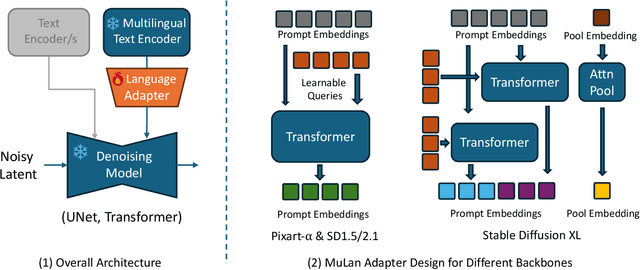
In this work, we explore a cost-effective framework for multilingual image generation. We find that, unlike models tuned on high-quality images with multilingual annotations, leveraging text encoders pre-trained on widely available, noisy Internet image-text pairs significantly enhances data efficiency in text-to-image (T2I) generation across multiple languages. Based on this insight, we introduce MuLan, Multi-Language adapter, a lightweight language adapter with fewer than 20M parameters, trained alongside a frozen text encoder and image diffusion model. Compared to previous multilingual T2I models, this framework offers: (1) Cost efficiency. Using readily accessible English data and off-the-shelf multilingual text encoders minimizes the training cost; (2) High performance. Achieving comparable generation capabilities in over 110 languages with CLIP similarity scores nearly matching those in English (38.61 for English vs. 37.61 for other languages); and (3) Broad applicability. Seamlessly integrating with compatible community tools like LoRA, LCM, ControlNet, and IP-Adapter, expanding its potential use cases.
VisionLLM v2: An End-to-End Generalist Multimodal Large Language Model for Hundreds of Vision-Language Tasks
Jun 12, 2024We present VisionLLM v2, an end-to-end generalist multimodal large model (MLLM) that unifies visual perception, understanding, and generation within a single framework. Unlike traditional MLLMs limited to text output, VisionLLM v2 significantly broadens its application scope. It excels not only in conventional visual question answering (VQA) but also in open-ended, cross-domain vision tasks such as object localization, pose estimation, and image generation and editing. To this end, we propose a new information transmission mechanism termed "super link", as a medium to connect MLLM with task-specific decoders. It not only allows flexible transmission of task information and gradient feedback between the MLLM and multiple downstream decoders but also effectively resolves training conflicts in multi-tasking scenarios. In addition, to support the diverse range of tasks, we carefully collected and combed training data from hundreds of public vision and vision-language tasks. In this way, our model can be joint-trained end-to-end on hundreds of vision language tasks and generalize to these tasks using a set of shared parameters through different user prompts, achieving performance comparable to task-specific models. We believe VisionLLM v2 will offer a new perspective on the generalization of MLLMs.
InternVL: Scaling up Vision Foundation Models and Aligning for Generic Visual-Linguistic Tasks
Jan 15, 2024The exponential growth of large language models (LLMs) has opened up numerous possibilities for multimodal AGI systems. However, the progress in vision and vision-language foundation models, which are also critical elements of multi-modal AGI, has not kept pace with LLMs. In this work, we design a large-scale vision-language foundation model (InternVL), which scales up the vision foundation model to 6 billion parameters and progressively aligns it with the LLM, using web-scale image-text data from various sources. This model can be broadly applied to and achieve state-of-the-art performance on 32 generic visual-linguistic benchmarks including visual perception tasks such as image-level or pixel-level recognition, vision-language tasks such as zero-shot image/video classification, zero-shot image/video-text retrieval, and link with LLMs to create multi-modal dialogue systems. It has powerful visual capabilities and can be a good alternative to the ViT-22B. We hope that our research could contribute to the development of multi-modal large models. Code and models are available at https://github.com/OpenGVLab/InternVL.
Asymmetric Masked Distillation for Pre-Training Small Foundation Models
Nov 06, 2023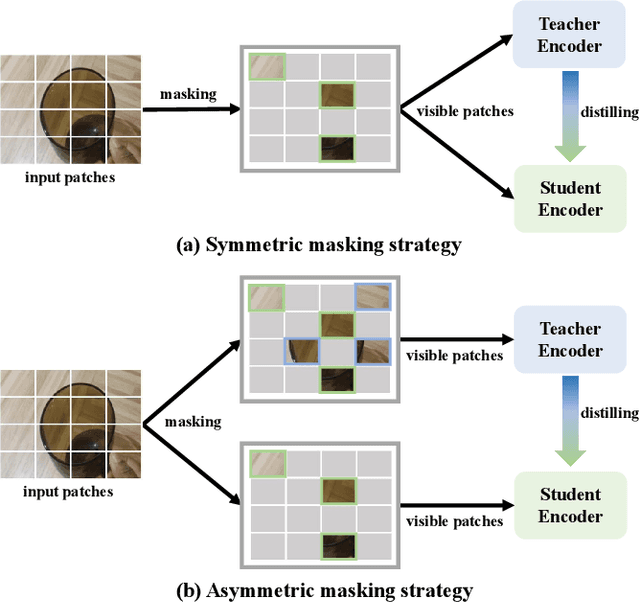
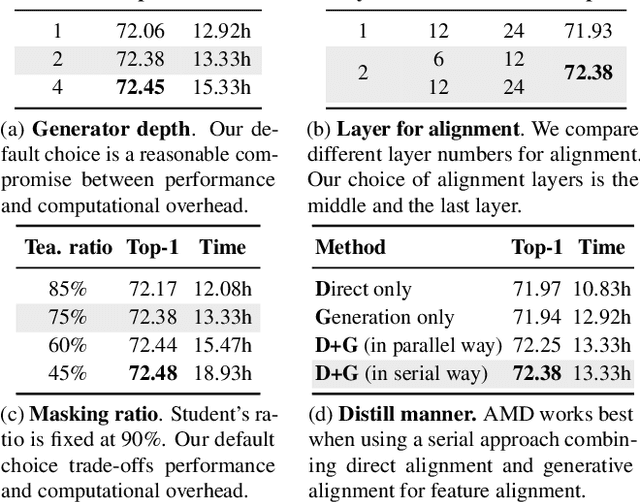
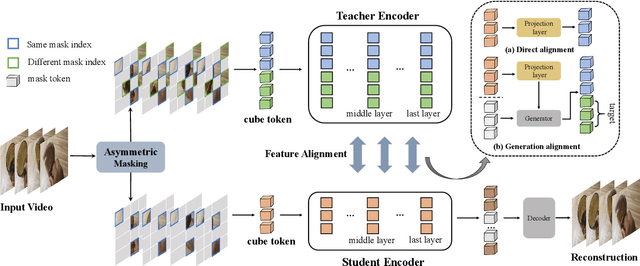

Self-supervised foundation models have shown great potential in computer vision thanks to the pre-training paradigm of masked autoencoding. Scale is a primary factor influencing the performance of these foundation models. However, these large foundation models often result in high computational cost that might limit their deployment. This paper focuses on pre-training relatively small vision transformer models that could be efficiently adapted to downstream tasks. Specifically, taking inspiration from knowledge distillation in model compression, we propose a new asymmetric masked distillation(AMD) framework for pre-training relatively small models with autoencoding. The core of AMD is to devise an asymmetric masking strategy, where the teacher model is enabled to see more context information with a lower masking ratio, while the student model still with high masking ratio to the original masked pre-training. We design customized multi-layer feature alignment between the teacher encoder and student encoder to regularize the pre-training of student MAE. To demonstrate the effectiveness and versatility of AMD, we apply it to both ImageMAE and VideoMAE for pre-training relatively small ViT models. AMD achieved 84.6% classification accuracy on IN1K using the ViT-B model. And AMD achieves 73.3% classification accuracy using the ViT-B model on the Something-in-Something V2 dataset, a 3.7% improvement over the original ViT-B model from VideoMAE. We also transfer AMD pre-trained models to downstream tasks and obtain consistent performance improvement over the standard pre-training.
InternVideo: General Video Foundation Models via Generative and Discriminative Learning
Dec 07, 2022The foundation models have recently shown excellent performance on a variety of downstream tasks in computer vision. However, most existing vision foundation models simply focus on image-level pretraining and adpation, which are limited for dynamic and complex video-level understanding tasks. To fill the gap, we present general video foundation models, InternVideo, by taking advantage of both generative and discriminative self-supervised video learning. Specifically, InternVideo efficiently explores masked video modeling and video-language contrastive learning as the pretraining objectives, and selectively coordinates video representations of these two complementary frameworks in a learnable manner to boost various video applications. Without bells and whistles, InternVideo achieves state-of-the-art performance on 39 video datasets from extensive tasks including video action recognition/detection, video-language alignment, and open-world video applications. Especially, our methods can obtain 91.1% and 77.2% top-1 accuracy on the challenging Kinetics-400 and Something-Something V2 benchmarks, respectively. All of these results effectively show the generality of our InternVideo for video understanding. The code will be released at https://github.com/OpenGVLab/InternVideo .
InternVideo-Ego4D: A Pack of Champion Solutions to Ego4D Challenges
Nov 17, 2022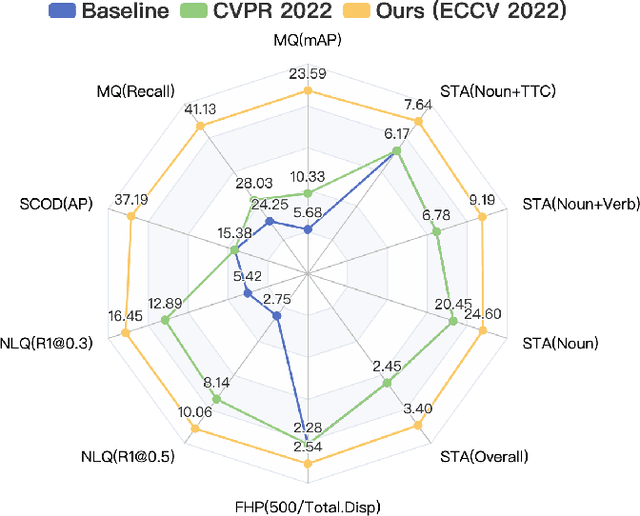
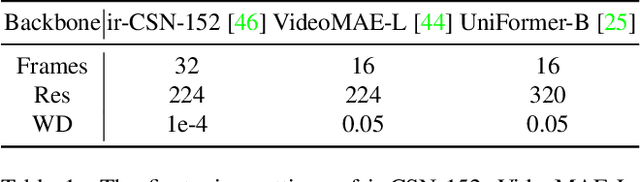
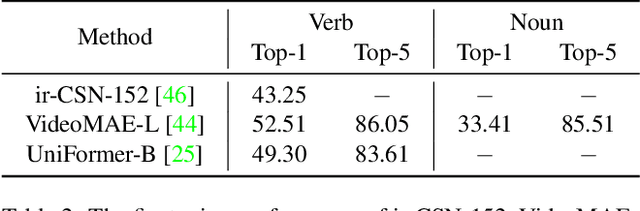
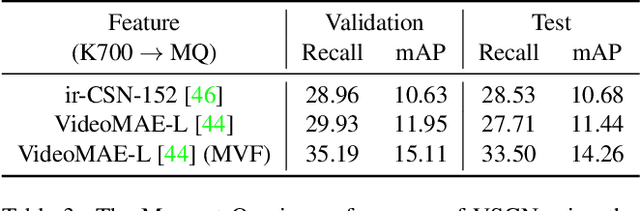
In this report, we present our champion solutions to five tracks at Ego4D challenge. We leverage our developed InternVideo, a video foundation model, for five Ego4D tasks, including Moment Queries, Natural Language Queries, Future Hand Prediction, State Change Object Detection, and Short-term Object Interaction Anticipation. InternVideo-Ego4D is an effective paradigm to adapt the strong foundation model to the downstream ego-centric video understanding tasks with simple head designs. In these five tasks, the performance of InternVideo-Ego4D comprehensively surpasses the baseline methods and the champions of CVPR2022, demonstrating the powerful representation ability of InternVideo as a video foundation model. Our code will be released at https://github.com/OpenGVLab/ego4d-eccv2022-solutions