 Add to Chrome
 Add to Firefox
 Add to Edge
Retrieval meets Long Context Large Language Models
Oct 04, 2023


Extending the context window of large language models (LLMs) is getting popular recently, while the solution of augmenting LLMs with retrieval has existed for years. The natural questions are: i) Retrieval-augmentation versus long context window, which one is better for downstream tasks? ii) Can both methods be combined to get the best of both worlds? In this work, we answer these questions by studying both solutions using two state-of-the-art pretrained LLMs, i.e., a proprietary 43B GPT and LLaMA2-70B. Perhaps surprisingly, we find that LLM with 4K context window using simple retrieval-augmentation at generation can achieve comparable performance to finetuned LLM with 16K context window via positional interpolation on long context tasks, while taking much less computation. More importantly, we demonstrate that retrieval can significantly improve the performance of LLMs regardless of their extended context window sizes. Our best model, retrieval-augmented LLaMA2-70B with 32K context window, outperforms GPT-3.5-turbo-16k and Davinci003 in terms of average score on seven long context tasks including question answering and query-based summarization. It also outperforms its non-retrieval LLaMA2-70B-32k baseline by a margin, while being much faster at generation. Our study provides general insights on the choice of retrieval-augmentation versus long context extension of LLM for practitioners.

ImageBind-LLM: Multi-modality Instruction Tuning
Sep 11, 2023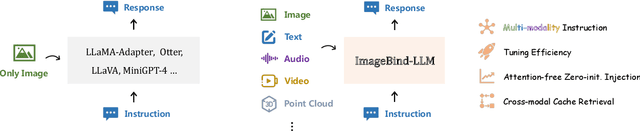
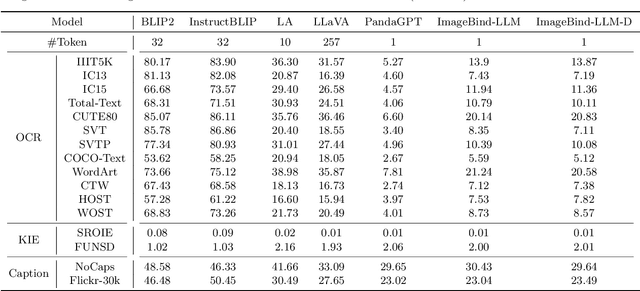
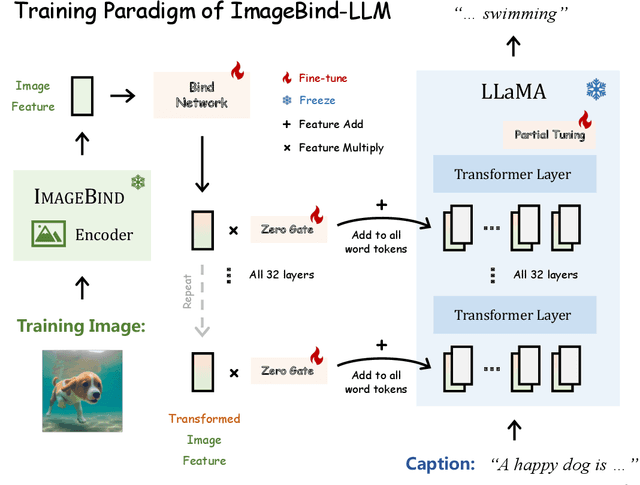
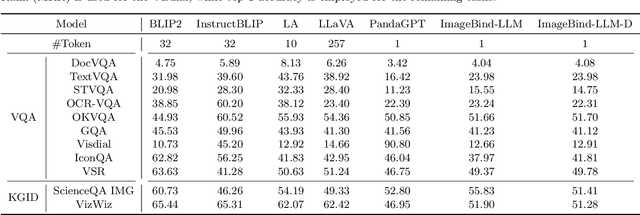
We present ImageBind-LLM, a multi-modality instruction tuning method of large language models (LLMs) via ImageBind. Existing works mainly focus on language and image instruction tuning, different from which, our ImageBind-LLM can respond to multi-modality conditions, including audio, 3D point clouds, video, and their embedding-space arithmetic by only image-text alignment training. During training, we adopt a learnable bind network to align the embedding space between LLaMA and ImageBind's image encoder. Then, the image features transformed by the bind network are added to word tokens of all layers in LLaMA, which progressively injects visual instructions via an attention-free and zero-initialized gating mechanism. Aided by the joint embedding of ImageBind, the simple image-text training enables our model to exhibit superior multi-modality instruction-following capabilities. During inference, the multi-modality inputs are fed into the corresponding ImageBind encoders, and processed by a proposed visual cache model for further cross-modal embedding enhancement. The training-free cache model retrieves from three million image features extracted by ImageBind, which effectively mitigates the training-inference modality discrepancy. Notably, with our approach, ImageBind-LLM can respond to instructions of diverse modalities and demonstrate significant language generation quality. Code is released at https://github.com/OpenGVLab/LLaMA-Adapter.
Robotic Table Tennis: A Case Study into a High Speed Learning System
Sep 06, 2023


We present a deep-dive into a real-world robotic learning system that, in previous work, was shown to be capable of hundreds of table tennis rallies with a human and has the ability to precisely return the ball to desired targets. This system puts together a highly optimized perception subsystem, a high-speed low-latency robot controller, a simulation paradigm that can prevent damage in the real world and also train policies for zero-shot transfer, and automated real world environment resets that enable autonomous training and evaluation on physical robots. We complement a complete system description, including numerous design decisions that are typically not widely disseminated, with a collection of studies that clarify the importance of mitigating various sources of latency, accounting for training and deployment distribution shifts, robustness of the perception system, sensitivity to policy hyper-parameters, and choice of action space. A video demonstrating the components of the system and details of experimental results can be found at https://youtu.be/uFcnWjB42I0.
OmniQuant: Omnidirectionally Calibrated Quantization for Large Language Models
Aug 25, 2023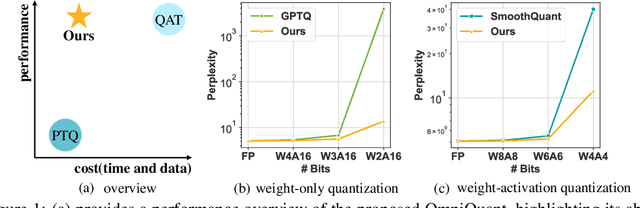

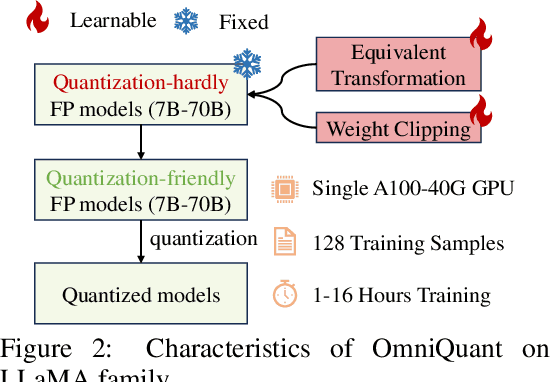

Large language models (LLMs) have revolutionized natural language processing tasks. However, their practical deployment is hindered by their immense memory and computation requirements. Although recent post-training quantization (PTQ) methods are effective in reducing memory footprint and improving the computational efficiency of LLM, they hand-craft quantization parameters, which leads to low performance and fails to deal with extremely low-bit quantization. To tackle this issue, we introduce an Omnidirectionally calibrated Quantization (OmniQuant) technique for LLMs, which achieves good performance in diverse quantization settings while maintaining the computational efficiency of PTQ by efficiently optimizing various quantization parameters. OmniQuant comprises two innovative components including Learnable Weight Clipping (LWC) and Learnable Equivalent Transformation (LET). LWC modulates the extreme values of weights by optimizing the clipping threshold. Meanwhile, LET tackles activation outliers by shifting the challenge of quantization from activations to weights through a learnable equivalent transformation. Operating within a differentiable framework using block-wise error minimization, OmniQuant can optimize the quantization process efficiently for both weight-only and weight-activation quantization. For instance, the LLaMA-2 model family with the size of 7-70B can be processed with OmniQuant on a single A100-40G GPU within 1-16 hours using 128 samples. Extensive experiments validate OmniQuant's superior performance across diverse quantization configurations such as W4A4, W6A6, W4A16, W3A16, and W2A16. Additionally, OmniQuant demonstrates effectiveness in instruction-tuned models and delivers notable improvements in inference speed and memory reduction on real devices. Codes and models are available at \url{https://github.com/OpenGVLab/OmniQuant}.
FastSurfer-HypVINN: Automated sub-segmentation of the hypothalamus and adjacent structures on high-resolutional brain MRI
Aug 24, 2023The hypothalamus plays a crucial role in the regulation of a broad range of physiological, behavioural, and cognitive functions. However, despite its importance, only a few small-scale neuroimaging studies have investigated its substructures, likely due to the lack of fully automated segmentation tools to address scalability and reproducibility issues of manual segmentation. While the only previous attempt to automatically sub-segment the hypothalamus with a neural network showed promise for 1.0 mm isotropic T1-weighted (T1w) MRI, there is a need for an automated tool to sub-segment also high-resolutional (HiRes) MR scans, as they are becoming widely available, and include structural detail also from multi-modal MRI. We, therefore, introduce a novel, fast, and fully automated deep learning method named HypVINN for sub-segmentation of the hypothalamus and adjacent structures on 0.8 mm isotropic T1w and T2w brain MR images that is robust to missing modalities. We extensively validate our model with respect to segmentation accuracy, generalizability, in-session test-retest reliability, and sensitivity to replicate hypothalamic volume effects (e.g. sex-differences). The proposed method exhibits high segmentation performance both for standalone T1w images as well as for T1w/T2w image pairs. Even with the additional capability to accept flexible inputs, our model matches or exceeds the performance of state-of-the-art methods with fixed inputs. We, further, demonstrate the generalizability of our method in experiments with 1.0 mm MR scans from both the Rhineland Study and the UK Biobank. Finally, HypVINN can perform the segmentation in less than a minute (GPU) and will be available in the open source FastSurfer neuroimaging software suite, offering a validated, efficient, and scalable solution for evaluating imaging-derived phenotypes of the hypothalamus.
RAVEN: In-Context Learning with Retrieval Augmented Encoder-Decoder Language Models
Aug 15, 2023In this paper, we investigate the in-context learning ability of retrieval-augmented encoder-decoder language models. We first conduct a comprehensive analysis of the state-of-the-art ATLAS model and identify its limitations in in-context learning, primarily due to a mismatch between pretraining and testing, as well as a restricted context length. To address these issues, we propose RAVEN, a model that combines retrieval-augmented masked language modeling and prefix language modeling. We further introduce Fusion-in-Context Learning to enhance the few-shot performance by enabling the model to leverage more in-context examples without requiring additional training or model modifications. Through extensive experiments, we demonstrate that RAVEN significantly outperforms ATLAS and achieves results comparable to the most advanced language models in certain scenarios, despite having substantially fewer parameters. Our work underscores the potential of retrieval-augmented encoder-decoder language models for in-context learning and encourages further research in this direction.
When Super-Resolution Meets Camouflaged Object Detection: A Comparison Study
Aug 08, 2023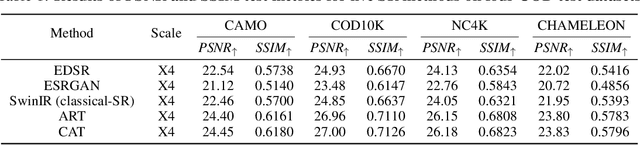
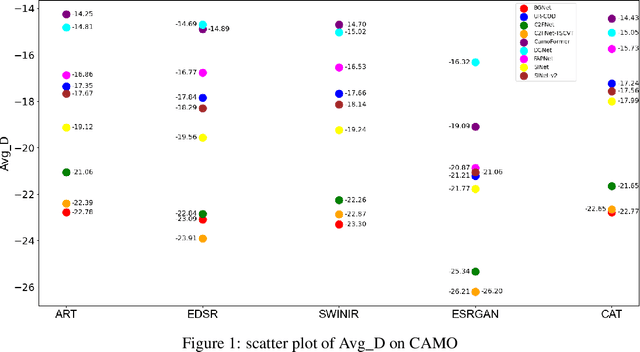
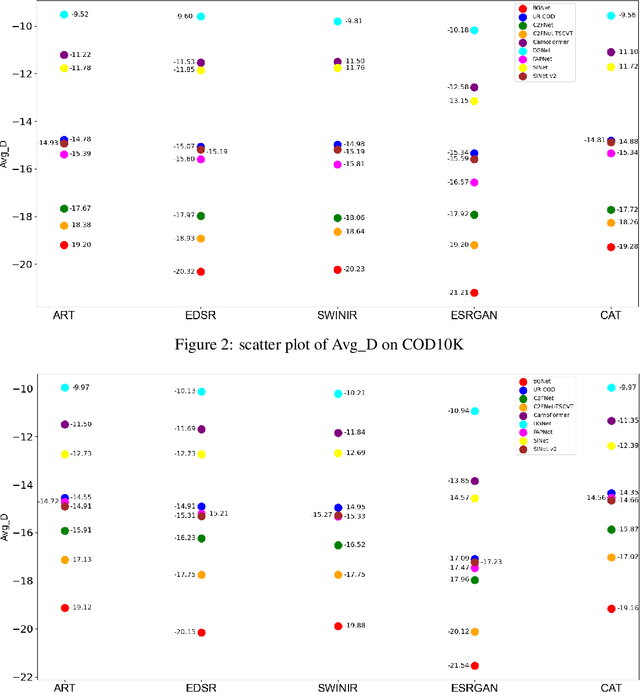
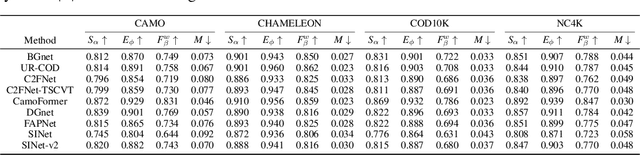
Super Resolution (SR) and Camouflaged Object Detection (COD) are two hot topics in computer vision with various joint applications. For instance, low-resolution surveillance images can be successively processed by super-resolution techniques and camouflaged object detection. However, in previous work, these two areas are always studied in isolation. In this paper, we, for the first time, conduct an integrated comparative evaluation for both. Specifically, we benchmark different super-resolution methods on commonly used COD datasets, and meanwhile, we evaluate the robustness of different COD models by using COD data processed by SR methods. Our goal is to bridge these two domains, discover novel experimental phenomena, summarize new experim.
Tiny LVLM-eHub: Early Multimodal Experiments with Bard
Aug 07, 2023Recent advancements in Large Vision-Language Models (LVLMs) have demonstrated significant progress in tackling complex multimodal tasks. Among these cutting-edge developments, Google's Bard stands out for its remarkable multimodal capabilities, promoting comprehensive comprehension and reasoning across various domains. This work presents an early and holistic evaluation of LVLMs' multimodal abilities, with a particular focus on Bard, by proposing a lightweight variant of LVLM-eHub, named Tiny LVLM-eHub. In comparison to the vanilla version, Tiny LVLM-eHub possesses several appealing properties. Firstly, it provides a systematic assessment of six categories of multimodal capabilities, including visual perception, visual knowledge acquisition, visual reasoning, visual commonsense, object hallucination, and embodied intelligence, through quantitative evaluation of $42$ standard text-related visual benchmarks. Secondly, it conducts an in-depth analysis of LVLMs' predictions using the ChatGPT Ensemble Evaluation (CEE), which leads to a robust and accurate evaluation and exhibits improved alignment with human evaluation compared to the word matching approach. Thirdly, it comprises a mere $2.1$K image-text pairs, facilitating ease of use for practitioners to evaluate their own offline LVLMs. Through extensive experimental analysis, this study demonstrates that Bard outperforms previous LVLMs in most multimodal capabilities except object hallucination, to which Bard is still susceptible. Tiny LVLM-eHub serves as a baseline evaluation for various LVLMs and encourages innovative strategies aimed at advancing multimodal techniques. Our project is publicly available at \url{https://github.com/OpenGVLab/Multi-Modality-Arena}.
RT-2: Vision-Language-Action Models Transfer Web Knowledge to Robotic Control
Jul 28, 2023We study how vision-language models trained on Internet-scale data can be incorporated directly into end-to-end robotic control to boost generalization and enable emergent semantic reasoning. Our goal is to enable a single end-to-end trained model to both learn to map robot observations to actions and enjoy the benefits of large-scale pretraining on language and vision-language data from the web. To this end, we propose to co-fine-tune state-of-the-art vision-language models on both robotic trajectory data and Internet-scale vision-language tasks, such as visual question answering. In contrast to other approaches, we propose a simple, general recipe to achieve this goal: in order to fit both natural language responses and robotic actions into the same format, we express the actions as text tokens and incorporate them directly into the training set of the model in the same way as natural language tokens. We refer to such category of models as vision-language-action models (VLA) and instantiate an example of such a model, which we call RT-2. Our extensive evaluation (6k evaluation trials) shows that our approach leads to performant robotic policies and enables RT-2 to obtain a range of emergent capabilities from Internet-scale training. This includes significantly improved generalization to novel objects, the ability to interpret commands not present in the robot training data (such as placing an object onto a particular number or icon), and the ability to perform rudimentary reasoning in response to user commands (such as picking up the smallest or largest object, or the one closest to another object). We further show that incorporating chain of thought reasoning allows RT-2 to perform multi-stage semantic reasoning, for example figuring out which object to pick up for use as an improvised hammer (a rock), or which type of drink is best suited for someone who is tired (an energy drink).
Robots That Ask For Help: Uncertainty Alignment for Large Language Model Planners
Jul 04, 2023Large language models (LLMs) exhibit a wide range of promising capabilities -- from step-by-step planning to commonsense reasoning -- that may provide utility for robots, but remain prone to confidently hallucinated predictions. In this work, we present KnowNo, which is a framework for measuring and aligning the uncertainty of LLM-based planners such that they know when they don't know and ask for help when needed. KnowNo builds on the theory of conformal prediction to provide statistical guarantees on task completion while minimizing human help in complex multi-step planning settings. Experiments across a variety of simulated and real robot setups that involve tasks with different modes of ambiguity (e.g., from spatial to numeric uncertainties, from human preferences to Winograd schemas) show that KnowNo performs favorably over modern baselines (which may involve ensembles or extensive prompt tuning) in terms of improving efficiency and autonomy, while providing formal assurances. KnowNo can be used with LLMs out of the box without model-finetuning, and suggests a promising lightweight approach to modeling uncertainty that can complement and scale with the growing capabilities of foundation models. Website: https://robot-help.github.io