 Add to Chrome
 Add to Firefox
 Add to Edge
BitLM: Unlocking Multi-Token Language Generation with Bitwise Continuous Diffusion
May 12, 2026
Autoregressive language models generate text one token at a time, yet natural language is inherently structured in multi-token units, including phrases, n-grams, and collocations that carry meaning jointly. This one-token bottleneck limits both the expressiveness of the model during pre-training and its throughput at inference time. Existing remedies such as speculative decoding or diffusion-based language models either leave the underlying bottleneck intact or sacrifice the causal structure essential to language modeling. We propose BitLM, a language model that represents each token as a fixed-length binary code and employs a lightweight diffusion head to denoise multiple tokens in parallel within each block. Crucially, BitLM preserves left-to-right causal attention across blocks while making joint lexical decisions within each block, combining the reliability of autoregressive modeling with the parallelism of iterative refinement. By replacing the large-vocabulary softmax with bitwise denoising, BitLM reframes token generation as iterative commitment in a compact binary space, enabling more efficient pre-training and substantially faster inference without altering the causal foundation that makes language models effective. Our results demonstrate that the one-token-at-a-time paradigm is not a fundamental requirement but an interface choice, and that changing it can yield a stronger and faster language model. We hope BitLM points toward a promising direction for next-generation language model architectures.

GIDE: Unlocking Diffusion LLMs for Precise Training-Free Image Editing
Mar 22, 2026While Diffusion Large Language Models (DLLMs) have demonstrated remarkable capabilities in multi-modal generation, performing precise, training-free image editing remains an open challenge. Unlike continuous diffusion models, the discrete tokenization inherent in DLLMs hinders the application of standard noise inversion techniques, often leading to structural degradation during editing. In this paper, we introduce GIDE (Grounded Inversion for DLLM Image Editing), a unified framework designed to bridge this gap. GIDE incorporates a novel Discrete Noise Inversion mechanism that accurately captures latent noise patterns within the discrete token space, ensuring high-fidelity reconstruction. We then decompose the editing pipeline into grounding, inversion, and refinement stages. This design enables GIDE supporting various editing instructions (text, point and box) and operations while strictly preserving the unedited background. Furthermore, to overcome the limitations of existing single-step evaluation protocols, we introduce GIDE-Bench, a rigorous benchmark comprising 805 compositional editing scenarios guided by diverse multi-modal inputs. Extensive experiments on GIDE-Bench demonstrate that GIDE significantly outperforms prior training-free methods, improving Semantic Correctness by 51.83% and Perceptual Quality by 50.39%. Additional evaluations on ImgEdit-Bench confirm its broad applicability, demonstrating consistent gains over trained baselines and yielding photorealistic consistency on par with leading models.
Cubic Discrete Diffusion: Discrete Visual Generation on High-Dimensional Representation Tokens
Mar 19, 2026Visual generation with discrete tokens has gained significant attention as it enables a unified token prediction paradigm shared with language models, promising seamless multimodal architectures. However, current discrete generation methods remain limited to low-dimensional latent tokens (typically 8-32 dims), sacrificing the semantic richness essential for understanding. While high-dimensional pretrained representations (768-1024 dims) could bridge this gap, their discrete generation poses fundamental challenges. In this paper, we present Cubic Discrete Diffusion (CubiD), the first discrete generation model for high-dimensional representations. CubiD performs fine-grained masking throughout the high-dimensional discrete representation -- any dimension at any position can be masked and predicted from partial observations. This enables the model to learn rich correlations both within and across spatial positions, with the number of generation steps fixed at $T$ regardless of feature dimensionality, where $T \ll hwd$. On ImageNet-256, CubiD achieves state-of-the-art discrete generation with strong scaling behavior from 900M to 3.7B parameters. Crucially, we validate that these discretized tokens preserve original representation capabilities, demonstrating that the same discrete tokens can effectively serve both understanding and generation tasks. We hope this work will inspire future research toward unified multimodal architectures. Code is available at: https://github.com/YuqingWang1029/CubiD.
UniWeTok: An Unified Binary Tokenizer with Codebook Size $\mathit{2^{128}}$ for Unified Multimodal Large Language Model
Feb 15, 2026Unified Multimodal Large Language Models (MLLMs) require a visual representation that simultaneously supports high-fidelity reconstruction, complex semantic extraction, and generative suitability. However, existing visual tokenizers typically struggle to satisfy these conflicting objectives within a single framework. In this paper, we introduce UniWeTok, a unified discrete tokenizer designed to bridge this gap using a massive binary codebook ($\mathit{2^{128}}$). For training framework, we introduce Pre-Post Distillation and a Generative-Aware Prior to enhance the semantic extraction and generative prior of the discrete tokens. In terms of model architecture, we propose a convolution-attention hybrid architecture with the SigLu activation function. SigLu activation not only bounds the encoder output and stabilizes the semantic distillation process but also effectively addresses the optimization conflict between token entropy loss and commitment loss. We further propose a three-stage training framework designed to enhance UniWeTok's adaptability cross various image resolutions and perception-sensitive scenarios, such as those involving human faces and textual content. On ImageNet, UniWeTok achieves state-of-the-art image generation performance (FID: UniWeTok 1.38 vs. REPA 1.42) while requiring a remarkably low training compute (Training Tokens: UniWeTok 33B vs. REPA 262B). On general-domain, UniWeTok demonstrates highly competitive capabilities across a broad range of tasks, including multimodal understanding, image generation (DPG Score: UniWeTok 86.63 vs. FLUX.1 [Dev] 83.84), and editing (GEdit Overall Score: UniWeTok 5.09 vs. OmniGen 5.06). We release code and models to facilitate community exploration of unified tokenizer and MLLM.
BitDance: Scaling Autoregressive Generative Models with Binary Tokens
Feb 15, 2026We present BitDance, a scalable autoregressive (AR) image generator that predicts binary visual tokens instead of codebook indices. With high-entropy binary latents, BitDance lets each token represent up to $2^{256}$ states, yielding a compact yet highly expressive discrete representation. Sampling from such a huge token space is difficult with standard classification. To resolve this, BitDance uses a binary diffusion head: instead of predicting an index with softmax, it employs continuous-space diffusion to generate the binary tokens. Furthermore, we propose next-patch diffusion, a new decoding method that predicts multiple tokens in parallel with high accuracy, greatly speeding up inference. On ImageNet 256x256, BitDance achieves an FID of 1.24, the best among AR models. With next-patch diffusion, BitDance beats state-of-the-art parallel AR models that use 1.4B parameters, while using 5.4x fewer parameters (260M) and achieving 8.7x speedup. For text-to-image generation, BitDance trains on large-scale multimodal tokens and generates high-resolution, photorealistic images efficiently, showing strong performance and favorable scaling. When generating 1024x1024 images, BitDance achieves a speedup of over 30x compared to prior AR models. We release code and models to facilitate further research on AR foundation models. Code and models are available at: https://github.com/shallowdream204/BitDance.
Growing Visual Generative Capacity for Pre-Trained MLLMs
Oct 02, 2025Multimodal large language models (MLLMs) extend the success of language models to visual understanding, and recent efforts have sought to build unified MLLMs that support both understanding and generation. However, constructing such models remains challenging: hybrid approaches combine continuous embeddings with diffusion or flow-based objectives, producing high-quality images but breaking the autoregressive paradigm, while pure autoregressive approaches unify text and image prediction over discrete visual tokens but often face trade-offs between semantic alignment and pixel-level fidelity. In this work, we present Bridge, a pure autoregressive unified MLLM that augments pre-trained visual understanding models with generative ability through a Mixture-of-Transformers architecture, enabling both image understanding and generation within a single next-token prediction framework. To further improve visual generation fidelity, we propose a semantic-to-pixel discrete representation that integrates compact semantic tokens with fine-grained pixel tokens, achieving strong language alignment and precise description of visual details with only a 7.9% increase in sequence length. Extensive experiments across diverse multimodal benchmarks demonstrate that Bridge achieves competitive or superior results in both understanding and generation benchmarks, while requiring less training data and reduced training time compared to prior unified MLLMs.
ScreenCoder: Advancing Visual-to-Code Generation for Front-End Automation via Modular Multimodal Agents
Jul 30, 2025Automating the transformation of user interface (UI) designs into front-end code holds significant promise for accelerating software development and democratizing design workflows. While recent large language models (LLMs) have demonstrated progress in text-to-code generation, many existing approaches rely solely on natural language prompts, limiting their effectiveness in capturing spatial layout and visual design intent. In contrast, UI development in practice is inherently multimodal, often starting from visual sketches or mockups. To address this gap, we introduce a modular multi-agent framework that performs UI-to-code generation in three interpretable stages: grounding, planning, and generation. The grounding agent uses a vision-language model to detect and label UI components, the planning agent constructs a hierarchical layout using front-end engineering priors, and the generation agent produces HTML/CSS code via adaptive prompt-based synthesis. This design improves robustness, interpretability, and fidelity over end-to-end black-box methods. Furthermore, we extend the framework into a scalable data engine that automatically produces large-scale image-code pairs. Using these synthetic examples, we fine-tune and reinforce an open-source VLM, yielding notable gains in UI understanding and code quality. Extensive experiments demonstrate that our approach achieves state-of-the-art performance in layout accuracy, structural coherence, and code correctness. Our code is made publicly available at https://github.com/leigest519/ScreenCoder.
Vision as a Dialect: Unifying Visual Understanding and Generation via Text-Aligned Representations
Jun 23, 2025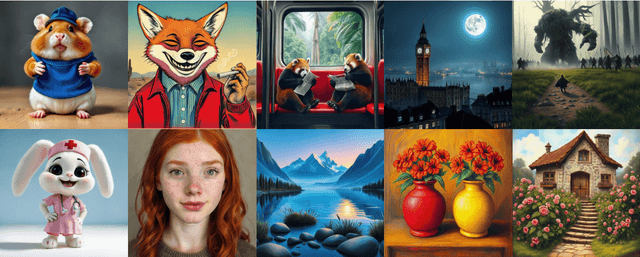
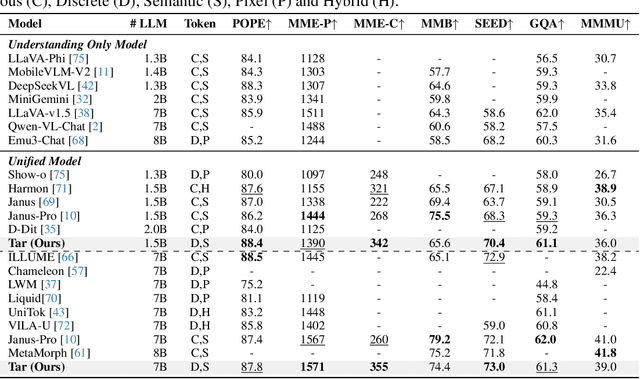
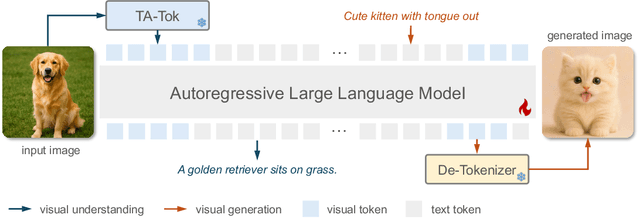
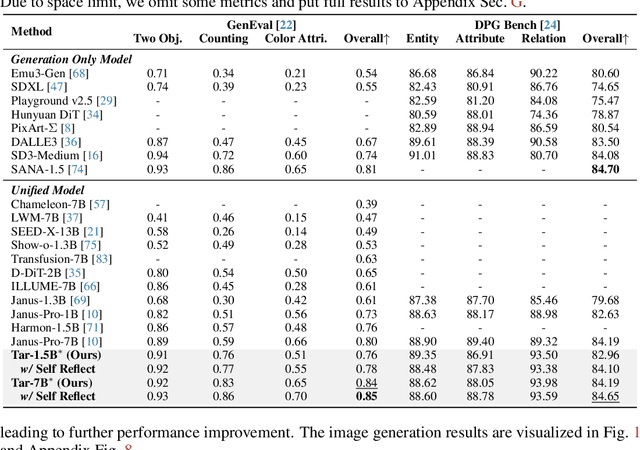
This paper presents a multimodal framework that attempts to unify visual understanding and generation within a shared discrete semantic representation. At its core is the Text-Aligned Tokenizer (TA-Tok), which converts images into discrete tokens using a text-aligned codebook projected from a large language model's (LLM) vocabulary. By integrating vision and text into a unified space with an expanded vocabulary, our multimodal LLM, Tar, enables cross-modal input and output through a shared interface, without the need for modality-specific designs. Additionally, we propose scale-adaptive encoding and decoding to balance efficiency and visual detail, along with a generative de-tokenizer to produce high-fidelity visual outputs. To address diverse decoding needs, we utilize two complementary de-tokenizers: a fast autoregressive model and a diffusion-based model. To enhance modality fusion, we investigate advanced pre-training tasks, demonstrating improvements in both visual understanding and generation. Experiments across benchmarks show that Tar matches or surpasses existing multimodal LLM methods, achieving faster convergence and greater training efficiency. Code, models, and data are available at https://tar.csuhan.com
CrossLMM: Decoupling Long Video Sequences from LMMs via Dual Cross-Attention Mechanisms
May 22, 2025The advent of Large Multimodal Models (LMMs) has significantly enhanced Large Language Models (LLMs) to process and interpret diverse data modalities (e.g., image and video). However, as input complexity increases, particularly with long video sequences, the number of required tokens has grown significantly, leading to quadratically computational costs. This has made the efficient compression of video tokens in LMMs, while maintaining performance integrity, a pressing research challenge. In this paper, we introduce CrossLMM, decoupling long video sequences from LMMs via a dual cross-attention mechanism, which substantially reduces visual token quantity with minimal performance degradation. Specifically, we first implement a significant token reduction from pretrained visual encoders through a pooling methodology. Then, within LLM layers, we employ a visual-to-visual cross-attention mechanism, wherein the pooled visual tokens function as queries against the original visual token set. This module enables more efficient token utilization while retaining fine-grained informational fidelity. In addition, we introduce a text-to-visual cross-attention mechanism, for which the text tokens are enhanced through interaction with the original visual tokens, enriching the visual comprehension of the text tokens. Comprehensive empirical evaluation demonstrates that our approach achieves comparable or superior performance across diverse video-based LMM benchmarks, despite utilizing substantially fewer computational resources.
Multimodal Long Video Modeling Based on Temporal Dynamic Context
Apr 14, 2025Recent advances in Large Language Models (LLMs) have led to significant breakthroughs in video understanding. However, existing models still struggle with long video processing due to the context length constraint of LLMs and the vast amount of information within the video. Although some recent methods are designed for long video understanding, they often lose crucial information during token compression and struggle with additional modality like audio. In this work, we propose a dynamic long video encoding method utilizing the temporal relationship between frames, named Temporal Dynamic Context (TDC). Firstly, we segment the video into semantically consistent scenes based on inter-frame similarities, then encode each frame into tokens using visual-audio encoders. Secondly, we propose a novel temporal context compressor to reduce the number of tokens within each segment. Specifically, we employ a query-based Transformer to aggregate video, audio, and instruction text tokens into a limited set of temporal context tokens. Finally, we feed the static frame tokens and the temporal context tokens into the LLM for video understanding. Furthermore, to handle extremely long videos, we propose a training-free chain-of-thought strategy that progressively extracts answers from multiple video segments. These intermediate answers serve as part of the reasoning process and contribute to the final answer. We conduct extensive experiments on general video understanding and audio-video understanding benchmarks, where our method demonstrates strong performance. The code and models are available at https://github.com/Hoar012/TDC-Video.