 Add to Chrome
 Add to Firefox
 Add to Edge
Context-Informed Machine Translation of Manga using Multimodal Large Language Models
Nov 04, 2024


Due to the significant time and effort required for handcrafting translations, most manga never leave the domestic Japanese market. Automatic manga translation is a promising potential solution. However, it is a budding and underdeveloped field and presents complexities even greater than those found in standard translation due to the need to effectively incorporate visual elements into the translation process to resolve ambiguities. In this work, we investigate to what extent multimodal large language models (LLMs) can provide effective manga translation, thereby assisting manga authors and publishers in reaching wider audiences. Specifically, we propose a methodology that leverages the vision component of multimodal LLMs to improve translation quality and evaluate the impact of translation unit size, context length, and propose a token efficient approach for manga translation. Moreover, we introduce a new evaluation dataset -- the first parallel Japanese-Polish manga translation dataset -- as part of a benchmark to be used in future research. Finally, we contribute an open-source software suite, enabling others to benchmark LLMs for manga translation. Our findings demonstrate that our proposed methods achieve state-of-the-art results for Japanese-English translation and set a new standard for Japanese-Polish.

ISAC Prototype System for Multi-Domain Cooperative Communication Networks
Oct 30, 2024Future wireless networks are poised to transform into integrated sensing and communication (ISAC) networks, unlocking groundbreaking services such as digital twinning. To harness the full potential of ISAC networks, it is essential to experimentally validate their sensing capabilities and the role of sensing in boosting communication. However, current prototype systems fall short in supporting multiple sensing functions or validating sensing-assisted communication. In response, we have developed an advanced ISAC prototype system that incorporates monostatic, bistatic, and network sensing modes. This system supports multimodal data collection and synchronization, ensuring comprehensive experimental validation. On the communication front, it excels in sensing-aided beam tracking and real-time high-definition video transmission. For sensing applications, it provides precise angle and range measurements, real-time angle-range imaging, and radio-based simultaneous localization and mapping (SLAM). Our prototype aligns with the 5G New Radio standard, offering scalability for up to 16 user equipments (UEs) in uplink transmission and 10 UEs in downlink transmission. Real-world tests showcase the system's superior accuracy, with root mean square errors of 2.3 degrees for angle estimation and 0.3 meters (m) for range estimation. Additionally, the estimation errors for multimodal-aided real-time radio SLAM localization and mapping are 0.25 m and 0.8 m, respectively.
Towards Homogeneous Lexical Tone Decoding from Heterogeneous Intracranial Recordings
Oct 13, 2024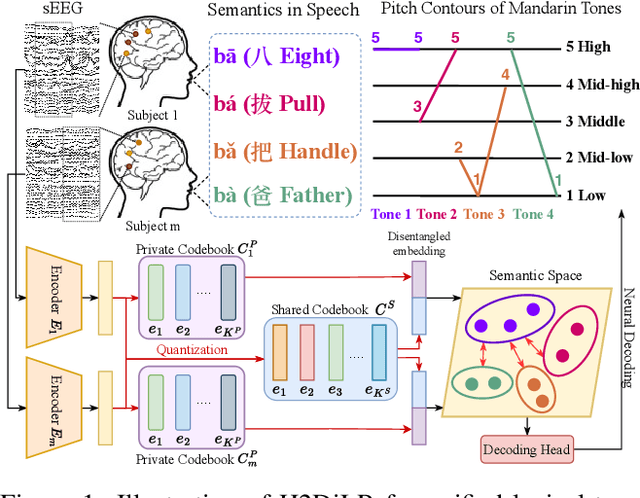
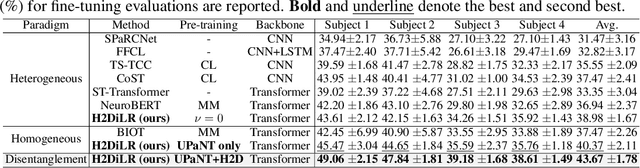
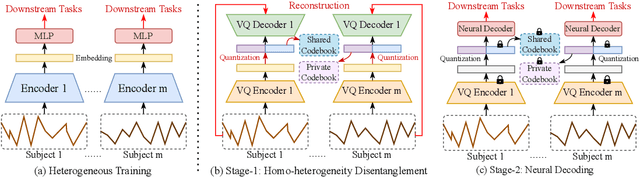
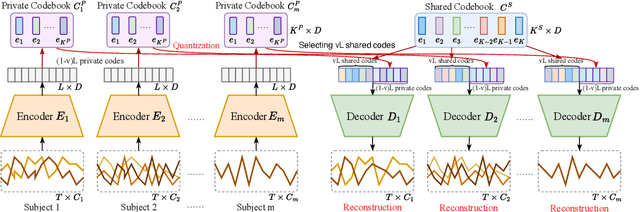
Recent advancements in brain-computer interfaces (BCIs) have enabled the decoding of lexical tones from intracranial recordings, offering the potential to restore the communication abilities of speech-impaired tonal language speakers. However, data heterogeneity induced by both physiological and instrumental factors poses a significant challenge for unified invasive brain tone decoding. Traditional subject-specific models, which operate under a heterogeneous decoding paradigm, fail to capture generalized neural representations and cannot effectively leverage data across subjects. To address these limitations, we introduce Homogeneity-Heterogeneity Disentangled Learning for neural Representations (H2DiLR), a novel framework that disentangles and learns both the homogeneity and heterogeneity from intracranial recordings across multiple subjects. To evaluate H2DiLR, we collected stereoelectroencephalography (sEEG) data from multiple participants reading Mandarin materials comprising 407 syllables, representing nearly all Mandarin characters. Extensive experiments demonstrate that H2DiLR, as a unified decoding paradigm, significantly outperforms the conventional heterogeneous decoding approach. Furthermore, we empirically confirm that H2DiLR effectively captures both homogeneity and heterogeneity during neural representation learning.
Emphasis Rendering for Conversational Text-to-Speech with Multi-modal Multi-scale Context Modeling
Oct 12, 2024


Conversational Text-to-Speech (CTTS) aims to accurately express an utterance with the appropriate style within a conversational setting, which attracts more attention nowadays. While recognizing the significance of the CTTS task, prior studies have not thoroughly investigated speech emphasis expression, which is essential for conveying the underlying intention and attitude in human-machine interaction scenarios, due to the scarcity of conversational emphasis datasets and the difficulty in context understanding. In this paper, we propose a novel Emphasis Rendering scheme for the CTTS model, termed ER-CTTS, that includes two main components: 1) we simultaneously take into account textual and acoustic contexts, with both global and local semantic modeling to understand the conversation context comprehensively; 2) we deeply integrate multi-modal and multi-scale context to learn the influence of context on the emphasis expression of the current utterance. Finally, the inferred emphasis feature is fed into the neural speech synthesizer to generate conversational speech. To address data scarcity, we create emphasis intensity annotations on the existing conversational dataset (DailyTalk). Both objective and subjective evaluations suggest that our model outperforms the baseline models in emphasis rendering within a conversational setting. The code and audio samples are available at https://github.com/CodeStoreTTS/ER-CTTS.
Revealing COVID-19's Social Dynamics: Diachronic Semantic Analysis of Vaccine and Symptom Discourse on Twitter
Oct 10, 2024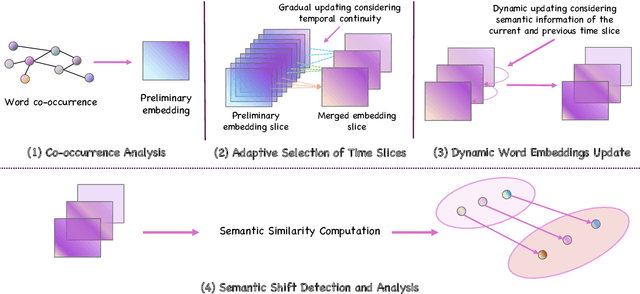
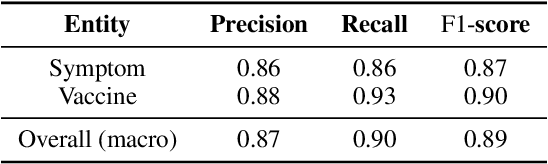
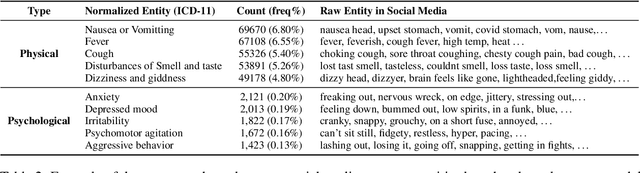
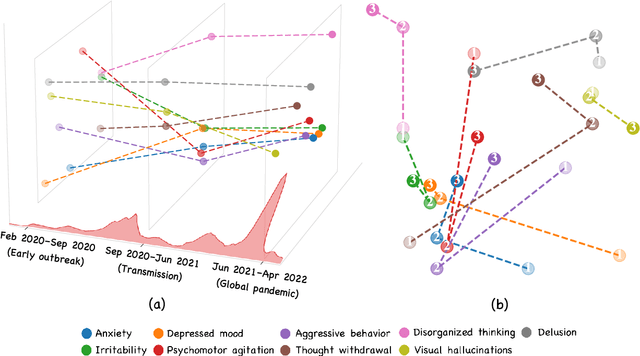
Social media is recognized as an important source for deriving insights into public opinion dynamics and social impacts due to the vast textual data generated daily and the 'unconstrained' behavior of people interacting on these platforms. However, such analyses prove challenging due to the semantic shift phenomenon, where word meanings evolve over time. This paper proposes an unsupervised dynamic word embedding method to capture longitudinal semantic shifts in social media data without predefined anchor words. The method leverages word co-occurrence statistics and dynamic updating to adapt embeddings over time, addressing the challenges of data sparseness, imbalanced distributions, and synergistic semantic effects. Evaluated on a large COVID-19 Twitter dataset, the method reveals semantic evolution patterns of vaccine- and symptom-related entities across different pandemic stages, and their potential correlations with real-world statistics. Our key contributions include the dynamic embedding technique, empirical analysis of COVID-19 semantic shifts, and discussions on enhancing semantic shift modeling for computational social science research. This study enables capturing longitudinal semantic dynamics on social media to understand public discourse and collective phenomena.
DDoS: Diffusion Distribution Similarity for Out-of-Distribution Detection
Sep 16, 2024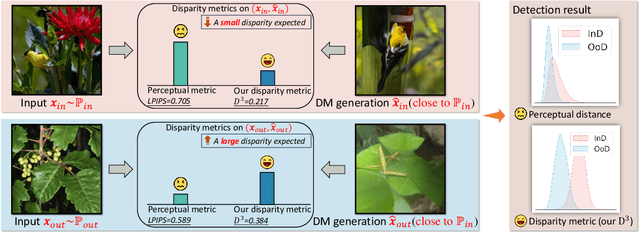
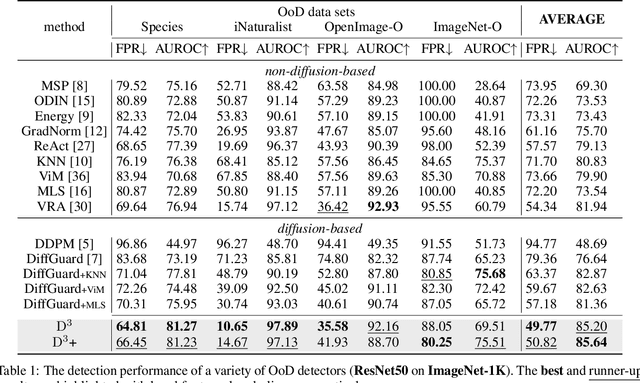
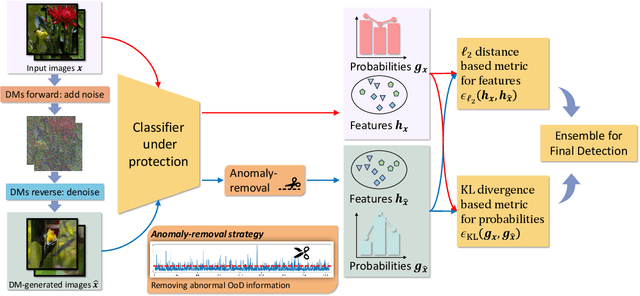
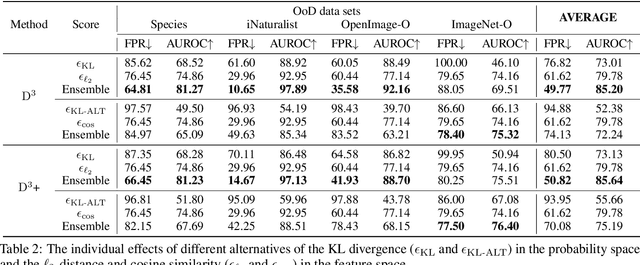
Out-of-Distribution (OoD) detection determines whether the given samples are from the training distribution of the classifier-under-protection, i.e., the In-Distribution (InD), or from a different OoD. Latest researches introduce diffusion models pre-trained on InD data to advocate OoD detection by transferring an OoD image into a generated one that is close to InD, so that one could capture the distribution disparities between original and generated images to detect OoD data. Existing diffusion-based detectors adopt perceptual metrics on the two images to measure such disparities, but ignore a fundamental fact: Perceptual metrics are devised essentially for human-perceived similarities of low-level image patterns, e.g., textures and colors, and are not advisable in evaluating distribution disparities, since images with different low-level patterns could possibly come from the same distribution. To address this issue, we formulate a diffusion-based detection framework that considers the distribution similarity between a tested image and its generated counterpart via a novel proper similarity metric in the informative feature space and probability space learned by the classifier-under-protection. An anomaly-removal strategy is further presented to enlarge such distribution disparities by removing abnormal OoD information in the feature space to facilitate the detection. Extensive empirical results unveil the insufficiency of perceptual metrics and the effectiveness of our distribution similarity framework with new state-of-the-art detection performance.
OPUS: Occupancy Prediction Using a Sparse Set
Sep 14, 2024


Occupancy prediction, aiming at predicting the occupancy status within voxelized 3D environment, is quickly gaining momentum within the autonomous driving community. Mainstream occupancy prediction works first discretize the 3D environment into voxels, then perform classification on such dense grids. However, inspection on sample data reveals that the vast majority of voxels is unoccupied. Performing classification on these empty voxels demands suboptimal computation resource allocation, and reducing such empty voxels necessitates complex algorithm designs. To this end, we present a novel perspective on the occupancy prediction task: formulating it as a streamlined set prediction paradigm without the need for explicit space modeling or complex sparsification procedures. Our proposed framework, called OPUS, utilizes a transformer encoder-decoder architecture to simultaneously predict occupied locations and classes using a set of learnable queries. Firstly, we employ the Chamfer distance loss to scale the set-to-set comparison problem to unprecedented magnitudes, making training such model end-to-end a reality. Subsequently, semantic classes are adaptively assigned using nearest neighbor search based on the learned locations. In addition, OPUS incorporates a suite of non-trivial strategies to enhance model performance, including coarse-to-fine learning, consistent point sampling, and adaptive re-weighting, etc. Finally, compared with current state-of-the-art methods, our lightest model achieves superior RayIoU on the Occ3D-nuScenes dataset at near 2x FPS, while our heaviest model surpasses previous best results by 6.1 RayIoU.
Optimizing Item-based Marketing Promotion Efficiency in C2C Marketplace with Dynamic Sequential Coupon Allocation Framework
Sep 13, 2024In e-commerce platforms, coupons play a crucial role in boosting transactions. In the customer-to-customer (C2C) marketplace, ensuring the satisfaction of both buyers and sellers is essential. While buyer-focused marketing strategies often receive more attention, addressing the needs of sellers is equally important. Additionally, the existing strategies tend to optimize each promotion independently, resulting in a lack of continuity between promotions and unnecessary costs in the pursuit of short-term impact within each promotion period. We introduce a Dynamic Sequential Coupon Allocation Framework (DSCAF) to optimize item coupon allocation strategies across a series of promotions. DSCAF provides sequential recommendations for coupon configurations and timing to target items. In cases where initial suggestions do not lead to sales, it dynamically adjusts the strategy and offers subsequent solutions. It integrates two predictors for estimating the sale propensity in the current and subsequent rounds of coupon allocation, and a decision-making process to determine the coupon allocation solution. It runs iteratively until the item is sold. The goal of the framework is to maximize Return on Investment (ROI) while ensuring lift Sell-through Rate (STR) remains above a specified threshold. DSCAF aims to optimize sequential coupon efficiency with a long-term perspective rather than solely focusing on the lift achieved in each individual promotion. It has been applied for item coupon allocation in Mercari.
CD-NGP: A Fast Scalable Continual Representation for Dynamic Scenes
Sep 08, 2024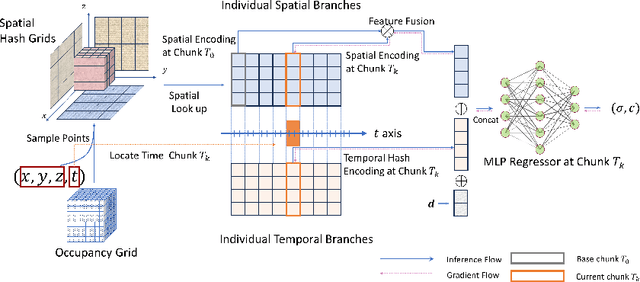
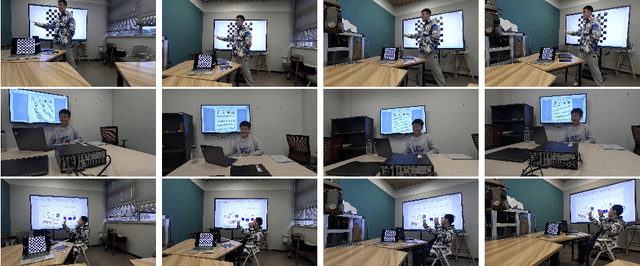
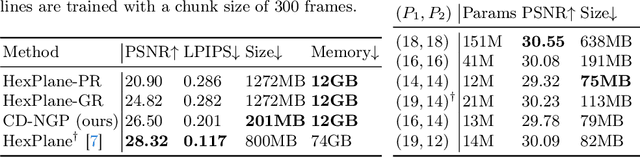
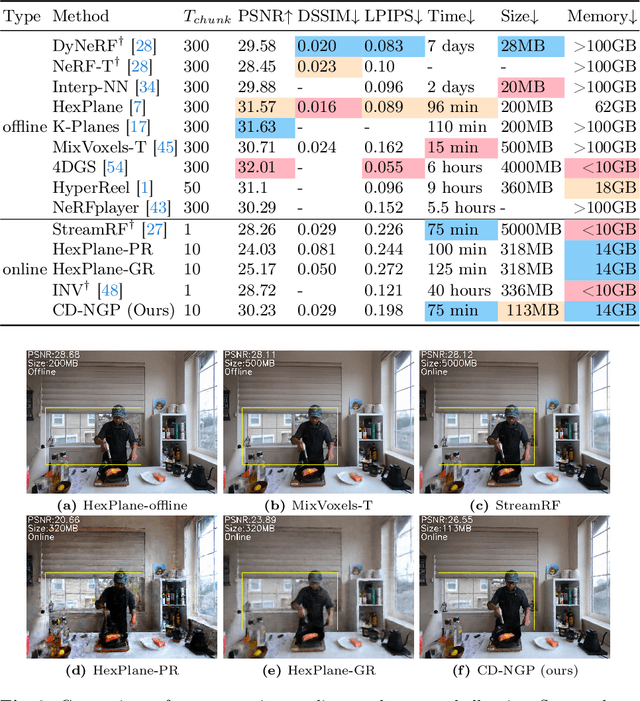
We present CD-NGP, which is a fast and scalable representation for 3D reconstruction and novel view synthesis in dynamic scenes. Inspired by continual learning, our method first segments input videos into multiple chunks, followed by training the model chunk by chunk, and finally, fuses features of the first branch and subsequent branches. Experiments on the prevailing DyNeRF dataset demonstrate that our proposed novel representation reaches a great balance between memory consumption, model size, training speed, and rendering quality. Specifically, our method consumes $85\%$ less training memory ($<14$GB) than offline methods and requires significantly lower streaming bandwidth ($<0.4$MB/frame) than other online alternatives.
Leveraging Open Knowledge for Advancing Task Expertise in Large Language Models
Aug 28, 2024

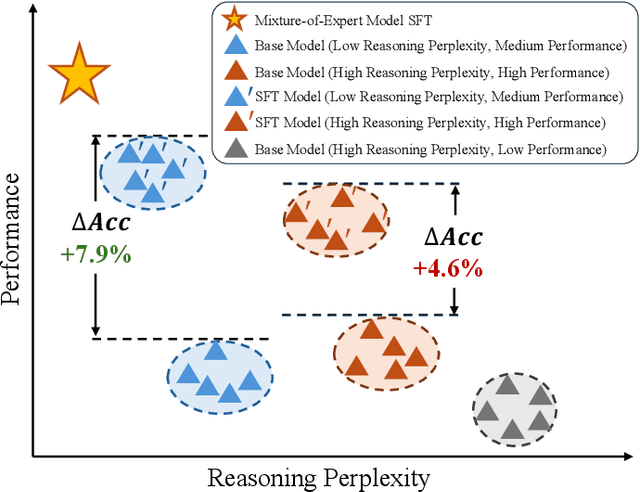

The cultivation of expertise for large language models (LLMs) to solve tasks of specific areas often requires special-purpose tuning with calibrated behaviors on the expected stable outputs. To avoid huge cost brought by manual preparation of instruction datasets and training resources up to hundreds of hours, the exploitation of open knowledge including a wealth of low rank adaptation (LoRA) models and instruction datasets serves as a good starting point. However, existing methods on model and data selection focus on the performance of general-purpose capabilities while neglecting the knowledge gap exposed in domain-specific deployment. In the present study, we propose to bridge such gap by introducing few human-annotated samples (i.e., K-shot) for advancing task expertise of LLMs with open knowledge. Specifically, we develop an efficient and scalable pipeline to cost-efficiently produce task experts where K-shot data intervene in selecting the most promising expert candidates and the task-relevant instructions. A mixture-of-expert (MoE) system is built to make the best use of individual-yet-complementary knowledge between multiple experts. We unveil the two keys to the success of a MoE system, 1) the abidance by K-shot, and 2) the insistence on diversity. For the former, we ensure that models that truly possess problem-solving abilities on K-shot are selected rather than those blind guessers. Besides, during data selection, instructions that share task-relevant contexts with K-shot are prioritized. For the latter, we highlight the diversity of constituting experts and that of the fine-tuning instructions throughout the model and data selection process. Extensive experimental results confirm the superiority of our approach over existing methods on utilization of open knowledge across various tasks. Codes and models will be released later.