 Add to Chrome
 Add to Firefox
 Add to Edge
InterSketch: An Interleaved Reasoning Model with Self-correcting Visual Sketch and Stepwise Reward
May 26, 2026
While vision-language models (VLMs) have exhibited multi-turn visual reasoning capabilities, their reasoning trajectories remain relatively shallow and are dominated by a text-centric paradigm, limiting their applicability to complex visual challenges. In contrast, human-like thought typically involves long-horizon reasoning with an interleaved visual-textual chain-of-thought (VT-CoT). To bridge this gap, we introduce InterSketch, an interleaved reasoning model to enhance the VT-CoT capability via self-correcting and stepwise reward mechanisms. InterSketch dynamically generates intermediate visual sketches using external tools and interleaves them with textual reasoning, enabling effective perception and logical reasoning over long-horizon visual understanding tasks. Specifically, in the first cold-start stage, we propose a synthesized high-quality interleaved VT-CoT dataset and include a reflection mechanism to enable the model's capability in multi-turn interleaved reasoning and self-correction. In the subsequent reinforcement learning (RL) stage, we design a stepwise reward mechanism to mitigate the sparsity of reward signals inherent in end-only supervision over long-horizon reasoning. Extensive experiments on visual reasoning benchmarks demonstrate the effectiveness of InterSketch, even outperforming proprietary models such as Gemini-3-Pro.

V-ABS: Action-Observer Driven Beam Search for Dynamic Visual Reasoning
May 11, 2026Multimodal large language models (MLLMs) have achieved remarkable success in general perception, yet complex multi-step visual reasoning remains a persistent challenge. Although recent agentic approaches incorporate tool use, they often neglect critical execution feedback. Consequently, they suffer from the imagination-action-observer (IAO) bias, a misalignment between prior imagination and observer feedback that undermines reasoning stability and optimality. To bridge this gap, we introduce V-ABS, an action-observer driven beam search framework that enables deliberate reasoning through thinker-actor-observer iterations. We also propose an entropy-based adaptive weighting algorithm to mitigate the IAO bias by dynamically balancing the confidence scores between the policy priors and the observational feedback. Moreover, we construct a large-scale supervised fine-tuning (SFT) dataset comprising over 80k samples to guide the model to assign higher prior confidence to correct action paths. Extensive experiments across eight diverse benchmarks show that V-ABS achieves state-of-the-art performance, delivering an average improvement of 19.7% on the Qwen3-VL-8B baseline and consistent gains across both open-source and proprietary models.
Fore-Mamba3D: Mamba-based Foreground-Enhanced Encoding for 3D Object Detection
Feb 23, 2026Linear modeling methods like Mamba have been merged as the effective backbone for the 3D object detection task. However, previous Mamba-based methods utilize the bidirectional encoding for the whole non-empty voxel sequence, which contains abundant useless background information in the scenes. Though directly encoding foreground voxels appears to be a plausible solution, it tends to degrade detection performance. We attribute this to the response attenuation and restricted context representation in the linear modeling for fore-only sequences. To address this problem, we propose a novel backbone, termed Fore-Mamba3D, to focus on the foreground enhancement by modifying Mamba-based encoder. The foreground voxels are first sampled according to the predicted scores. Considering the response attenuation existing in the interaction of foreground voxels across different instances, we design a regional-to-global slide window (RGSW) to propagate the information from regional split to the entire sequence. Furthermore, a semantic-assisted and state spatial fusion module (SASFMamba) is proposed to enrich contextual representation by enhancing semantic and geometric awareness within the Mamba model. Our method emphasizes foreground-only encoding and alleviates the distance-based and causal dependencies in the linear autoregression model. The superior performance across various benchmarks demonstrates the effectiveness of Fore-Mamba3D in the 3D object detection task.
CD-NGP: A Fast Scalable Continual Representation for Dynamic Scenes
Sep 08, 2024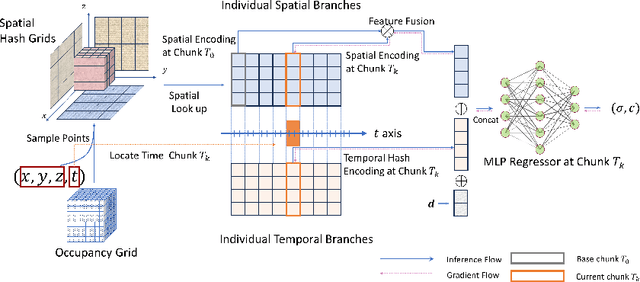
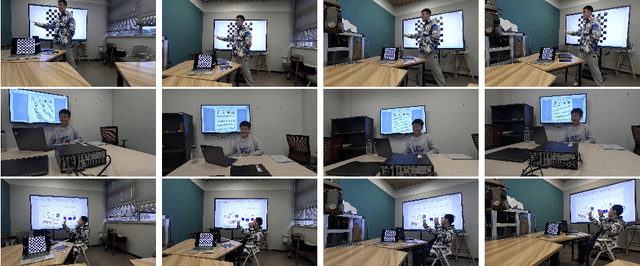
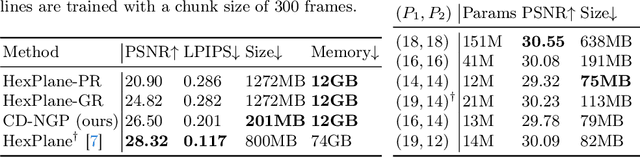
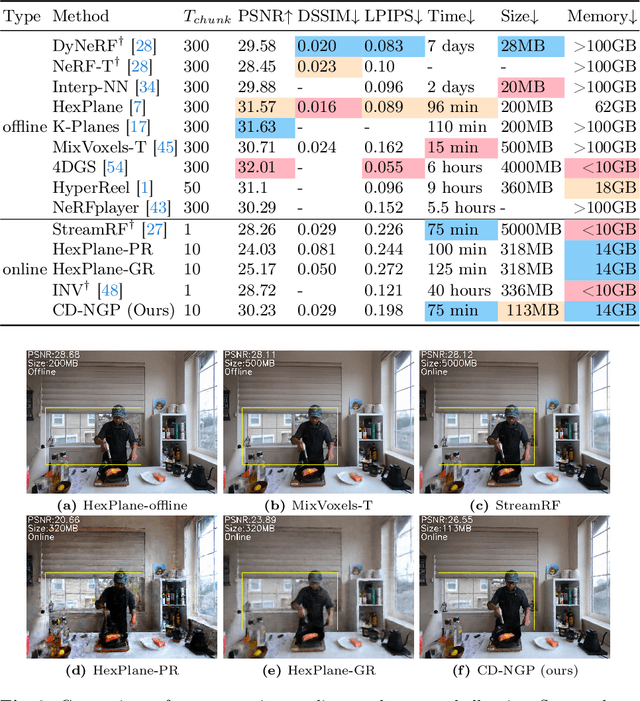
We present CD-NGP, which is a fast and scalable representation for 3D reconstruction and novel view synthesis in dynamic scenes. Inspired by continual learning, our method first segments input videos into multiple chunks, followed by training the model chunk by chunk, and finally, fuses features of the first branch and subsequent branches. Experiments on the prevailing DyNeRF dataset demonstrate that our proposed novel representation reaches a great balance between memory consumption, model size, training speed, and rendering quality. Specifically, our method consumes $85\%$ less training memory ($<14$GB) than offline methods and requires significantly lower streaming bandwidth ($<0.4$MB/frame) than other online alternatives.