 Add to Chrome
 Add to Firefox
 Add to Edge
UI-Mem: Self-Evolving Experience Memory for Online Reinforcement Learning in Mobile GUI Agents
Feb 05, 2026
Online Reinforcement Learning (RL) offers a promising paradigm for enhancing GUI agents through direct environment interaction. However, its effectiveness is severely hindered by inefficient credit assignment in long-horizon tasks and repetitive errors across tasks due to the lack of experience transfer. To address these challenges, we propose UI-Mem, a novel framework that enhances GUI online RL with a Hierarchical Experience Memory. Unlike traditional replay buffers, our memory accumulates structured knowledge, including high-level workflows, subtask skills, and failure patterns. These experiences are stored as parameterized templates that enable cross-task and cross-application transfer. To effectively integrate memory guidance into online RL, we introduce Stratified Group Sampling, which injects varying levels of guidance across trajectories within each rollout group to maintain outcome diversity, driving the unguided policy toward internalizing guided behaviors. Furthermore, a Self-Evolving Loop continuously abstracts novel strategies and errors to keep the memory aligned with the agent's evolving policy. Experiments on online GUI benchmarks demonstrate that UI-Mem significantly outperforms traditional RL baselines and static reuse strategies, with strong generalization to unseen applications. Project page: https://ui-mem.github.io

FullStack-Agent: Enhancing Agentic Full-Stack Web Coding via Development-Oriented Testing and Repository Back-Translation
Feb 03, 2026Assisting non-expert users to develop complex interactive websites has become a popular task for LLM-powered code agents. However, existing code agents tend to only generate frontend web pages, masking the lack of real full-stack data processing and storage with fancy visual effects. Notably, constructing production-level full-stack web applications is far more challenging than only generating frontend web pages, demanding careful control of data flow, comprehensive understanding of constantly updating packages and dependencies, and accurate localization of obscure bugs in the codebase. To address these difficulties, we introduce FullStack-Agent, a unified agent system for full-stack agentic coding that consists of three parts: (1) FullStack-Dev, a multi-agent framework with strong planning, code editing, codebase navigation, and bug localization abilities. (2) FullStack-Learn, an innovative data-scaling and self-improving method that back-translates crawled and synthesized website repositories to improve the backbone LLM of FullStack-Dev. (3) FullStack-Bench, a comprehensive benchmark that systematically tests the frontend, backend and database functionalities of the generated website. Our FullStack-Dev outperforms the previous state-of-the-art method by 8.7%, 38.2%, and 15.9% on the frontend, backend, and database test cases respectively. Additionally, FullStack-Learn raises the performance of a 30B model by 9.7%, 9.5%, and 2.8% on the three sets of test cases through self-improvement, demonstrating the effectiveness of our approach. The code is released at https://github.com/mnluzimu/FullStack-Agent.
PromptRL: Prompt Matters in RL for Flow-Based Image Generation
Feb 01, 2026Flow matching models (FMs) have revolutionized text-to-image (T2I) generation, with reinforcement learning (RL) serving as a critical post-training strategy for alignment with reward objectives. In this research, we show that current RL pipelines for FMs suffer from two underappreciated yet important limitations: sample inefficiency due to insufficient generation diversity, and pronounced prompt overfitting, where models memorize specific training formulations and exhibit dramatic performance collapse when evaluated on semantically equivalent but stylistically varied prompts. We present PromptRL (Prompt Matters in RL for Flow-Based Image Generation), a framework that incorporates language models (LMs) as trainable prompt refinement agents directly within the flow-based RL optimization loop. This design yields two complementary benefits: rapid development of sophisticated prompt rewriting capabilities and, critically, a synergistic training regime that reshapes the optimization dynamics. PromptRL achieves state-of-the-art performance across multiple benchmarks, obtaining scores of 0.97 on GenEval, 0.98 on OCR accuracy, and 24.05 on PickScore. Furthermore, we validate the effectiveness of our RL approach on large-scale image editing models, improving the EditReward of FLUX.1-Kontext from 1.19 to 1.43 with only 0.06 million rollouts, surpassing Gemini 2.5 Flash Image (also known as Nano Banana), which scores 1.37, and achieving comparable performance with ReasonNet (1.44), which relied on fine-grained data annotations along with a complex multi-stage training. Our extensive experiments empirically demonstrate that PromptRL consistently achieves higher performance ceilings while requiring over 2$\times$ fewer rollouts compared to naive flow-only RL. Our code is available at https://github.com/G-U-N/UniRL.
PhoStream: Benchmarking Real-World Streaming for Omnimodal Assistants in Mobile Scenarios
Jan 30, 2026Multimodal Large Language Models excel at offline audio-visual understanding, but their ability to serve as mobile assistants in continuous real-world streams remains underexplored. In daily phone use, mobile assistants must track streaming audio-visual inputs and respond at the right time, yet existing benchmarks are often restricted to multiple-choice questions or use shorter videos. In this paper, we introduce PhoStream, the first mobile-centric streaming benchmark that unifies on-screen and off-screen scenarios to evaluate video, audio, and temporal reasoning. PhoStream contains 5,572 open-ended QA pairs from 578 videos across 4 scenarios and 10 capabilities. We build it with an Automated Generative Pipeline backed by rigorous human verification, and evaluate models using a realistic Online Inference Pipeline and LLM-as-a-Judge evaluation for open-ended responses. Experiments reveal a temporal asymmetry in LLM-judged scores (0-100): models perform well on Instant and Backward tasks (Gemini 3 Pro exceeds 80), but drop sharply on Forward tasks (16.40), largely due to early responses before the required visual and audio cues appear. This highlights a fundamental limitation: current MLLMs struggle to decide when to speak, not just what to say. Code and datasets used in this work will be made publicly accessible at https://github.com/Lucky-Lance/PhoStream.
SlidesGen-Bench: Evaluating Slides Generation via Computational and Quantitative Metrics
Jan 14, 2026The rapid evolution of Large Language Models (LLMs) has fostered diverse paradigms for automated slide generation, ranging from code-driven layouts to image-centric synthesis. However, evaluating these heterogeneous systems remains challenging, as existing protocols often struggle to provide comparable scores across architectures or rely on uncalibrated judgments. In this paper, we introduce SlidesGen-Bench, a benchmark designed to evaluate slide generation through a lens of three core principles: universality, quantification, and reliability. First, to establish a unified evaluation framework, we ground our analysis in the visual domain, treating terminal outputs as renderings to remain agnostic to the underlying generation method. Second, we propose a computational approach that quantitatively assesses slides across three distinct dimensions - Content, Aesthetics, and Editability - offering reproducible metrics where prior works relied on subjective or reference-dependent proxies. Finally, to ensure high correlation with human preference, we construct the Slides-Align1.5k dataset, a human preference aligned dataset covering slides from nine mainstream generation systems across seven scenarios. Our experiments demonstrate that SlidesGen-Bench achieves a higher degree of alignment with human judgment than existing evaluation pipelines. Our code and data are available at https://github.com/YunqiaoYang/SlidesGen-Bench.
DrivingGen: A Comprehensive Benchmark for Generative Video World Models in Autonomous Driving
Jan 04, 2026Video generation models, as one form of world models, have emerged as one of the most exciting frontiers in AI, promising agents the ability to imagine the future by modeling the temporal evolution of complex scenes. In autonomous driving, this vision gives rise to driving world models: generative simulators that imagine ego and agent futures, enabling scalable simulation, safe testing of corner cases, and rich synthetic data generation. Yet, despite fast-growing research activity, the field lacks a rigorous benchmark to measure progress and guide priorities. Existing evaluations remain limited: generic video metrics overlook safety-critical imaging factors; trajectory plausibility is rarely quantified; temporal and agent-level consistency is neglected; and controllability with respect to ego conditioning is ignored. Moreover, current datasets fail to cover the diversity of conditions required for real-world deployment. To address these gaps, we present DrivingGen, the first comprehensive benchmark for generative driving world models. DrivingGen combines a diverse evaluation dataset curated from both driving datasets and internet-scale video sources, spanning varied weather, time of day, geographic regions, and complex maneuvers, with a suite of new metrics that jointly assess visual realism, trajectory plausibility, temporal coherence, and controllability. Benchmarking 14 state-of-the-art models reveals clear trade-offs: general models look better but break physics, while driving-specific ones capture motion realistically but lag in visual quality. DrivingGen offers a unified evaluation framework to foster reliable, controllable, and deployable driving world models, enabling scalable simulation, planning, and data-driven decision-making.
ColaVLA: Leveraging Cognitive Latent Reasoning for Hierarchical Parallel Trajectory Planning in Autonomous Driving
Dec 31, 2025Autonomous driving requires generating safe and reliable trajectories from complex multimodal inputs. Traditional modular pipelines separate perception, prediction, and planning, while recent end-to-end (E2E) systems learn them jointly. Vision-language models (VLMs) further enrich this paradigm by introducing cross-modal priors and commonsense reasoning, yet current VLM-based planners face three key challenges: (i) a mismatch between discrete text reasoning and continuous control, (ii) high latency from autoregressive chain-of-thought decoding, and (iii) inefficient or non-causal planners that limit real-time deployment. We propose ColaVLA, a unified vision-language-action framework that transfers reasoning from text to a unified latent space and couples it with a hierarchical, parallel trajectory decoder. The Cognitive Latent Reasoner compresses scene understanding into compact, decision-oriented meta-action embeddings through ego-adaptive selection and only two VLM forward passes. The Hierarchical Parallel Planner then generates multi-scale, causality-consistent trajectories in a single forward pass. Together, these components preserve the generalization and interpretability of VLMs while enabling efficient, accurate and safe trajectory generation. Experiments on the nuScenes benchmark show that ColaVLA achieves state-of-the-art performance in both open-loop and closed-loop settings with favorable efficiency and robustness.
Is your VLM Sky-Ready? A Comprehensive Spatial Intelligence Benchmark for UAV Navigation
Nov 17, 2025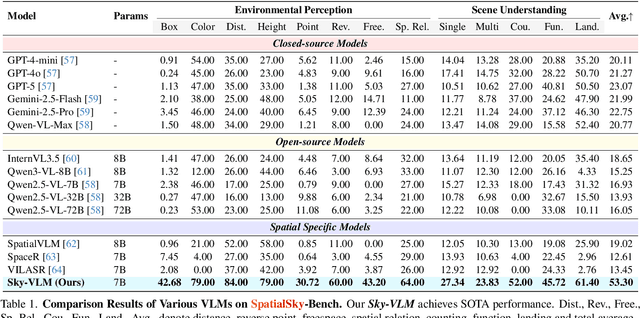
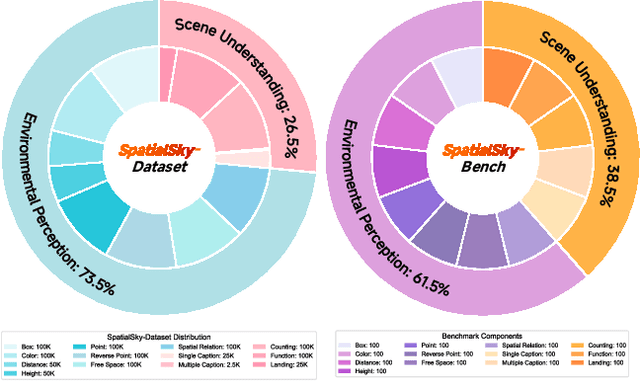
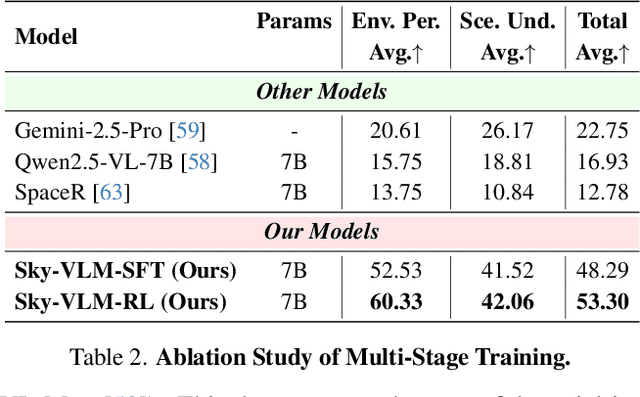
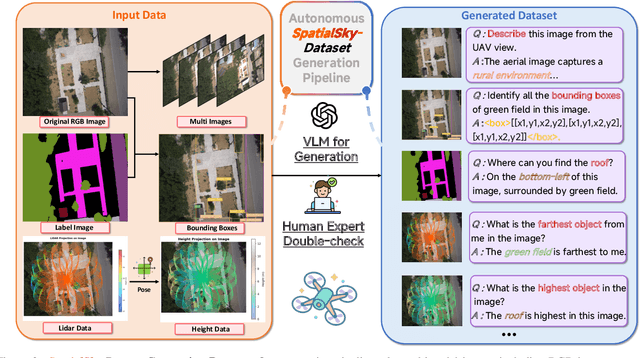
Vision-Language Models (VLMs), leveraging their powerful visual perception and reasoning capabilities, have been widely applied in Unmanned Aerial Vehicle (UAV) tasks. However, the spatial intelligence capabilities of existing VLMs in UAV scenarios remain largely unexplored, raising concerns about their effectiveness in navigating and interpreting dynamic environments. To bridge this gap, we introduce SpatialSky-Bench, a comprehensive benchmark specifically designed to evaluate the spatial intelligence capabilities of VLMs in UAV navigation. Our benchmark comprises two categories-Environmental Perception and Scene Understanding-divided into 13 subcategories, including bounding boxes, color, distance, height, and landing safety analysis, among others. Extensive evaluations of various mainstream open-source and closed-source VLMs reveal unsatisfactory performance in complex UAV navigation scenarios, highlighting significant gaps in their spatial capabilities. To address this challenge, we developed the SpatialSky-Dataset, a comprehensive dataset containing 1M samples with diverse annotations across various scenarios. Leveraging this dataset, we introduce Sky-VLM, a specialized VLM designed for UAV spatial reasoning across multiple granularities and contexts. Extensive experimental results demonstrate that Sky-VLM achieves state-of-the-art performance across all benchmark tasks, paving the way for the development of VLMs suitable for UAV scenarios. The source code is available at https://github.com/linglingxiansen/SpatialSKy.
RelightMaster: Precise Video Relighting with Multi-plane Light Images
Nov 09, 2025Recent advances in diffusion models enable high-quality video generation and editing, but precise relighting with consistent video contents, which is critical for shaping scene atmosphere and viewer attention, remains unexplored. Mainstream text-to-video (T2V) models lack fine-grained lighting control due to text's inherent limitation in describing lighting details and insufficient pre-training on lighting-related prompts. Additionally, constructing high-quality relighting training data is challenging, as real-world controllable lighting data is scarce. To address these issues, we propose RelightMaster, a novel framework for accurate and controllable video relighting. First, we build RelightVideo, the first dataset with identical dynamic content under varying precise lighting conditions based on the Unreal Engine. Then, we introduce Multi-plane Light Image (MPLI), a novel visual prompt inspired by Multi-Plane Image (MPI). MPLI models lighting via K depth-aligned planes, representing 3D light source positions, intensities, and colors while supporting multi-source scenarios and generalizing to unseen light setups. Third, we design a Light Image Adapter that seamlessly injects MPLI into pre-trained Video Diffusion Transformers (DiT): it compresses MPLI via a pre-trained Video VAE and injects latent light features into DiT blocks, leveraging the base model's generative prior without catastrophic forgetting. Experiments show that RelightMaster generates physically plausible lighting and shadows and preserves original scene content. Demos are available at https://wkbian.github.io/Projects/RelightMaster/.
Are Video Models Ready as Zero-Shot Reasoners? An Empirical Study with the MME-CoF Benchmark
Oct 30, 2025Recent video generation models can produce high-fidelity, temporally coherent videos, indicating that they may encode substantial world knowledge. Beyond realistic synthesis, they also exhibit emerging behaviors indicative of visual perception, modeling, and manipulation. Yet, an important question still remains: Are video models ready to serve as zero-shot reasoners in challenging visual reasoning scenarios? In this work, we conduct an empirical study to comprehensively investigate this question, focusing on the leading and popular Veo-3. We evaluate its reasoning behavior across 12 dimensions, including spatial, geometric, physical, temporal, and embodied logic, systematically characterizing both its strengths and failure modes. To standardize this study, we curate the evaluation data into MME-CoF, a compact benchmark that enables in-depth and thorough assessment of Chain-of-Frame (CoF) reasoning. Our findings reveal that while current video models demonstrate promising reasoning patterns on short-horizon spatial coherence, fine-grained grounding, and locally consistent dynamics, they remain limited in long-horizon causal reasoning, strict geometric constraints, and abstract logic. Overall, they are not yet reliable as standalone zero-shot reasoners, but exhibit encouraging signs as complementary visual engines alongside dedicated reasoning models. Project page: https://video-cof.github.io