 Add to Chrome
 Add to Firefox
 Add to Edge
SOLAR-RL: Semi-Online Long-horizon Assignment Reinforcement Learning
Apr 24, 2026
As Multimodal Large Language Models (MLLMs) mature, GUI agents are evolving from static interactions to complex navigation. While Reinforcement Learning (RL) has emerged as a promising paradigm for training MLLM agents on dynamic GUI tasks, its effective application faces a dilemma. Standard Offline RL often relies on static step-level data, neglecting global trajectory semantics such as task completion and execution quality. Conversely, Online RL captures the long-term dynamics but suffers from high interaction costs and potential environmental instability. To bridge this gap, we propose SOLAR-RL (Semi-Online Long-horizon Assignment Reinforcement Learning). Instead of relying solely on expensive online interactions, our framework integrates global trajectory insights directly into the offline learning process. Specifically, we reconstruct diverse rollout candidates from static data, detect the first failure point using per-step validity signals, and retroactively assign dense step-level rewards with target-aligned shaping to reflect trajectory-level execution quality, effectively simulating online feedback without interaction costs. Extensive experiments demonstrate that SOLAR-RL significantly improves long-horizon task completion rates and robustness compared to strong baselines, offering a sample-efficient solution for autonomous GUI navigation.

Skill-SD: Skill-Conditioned Self-Distillation for Multi-turn LLM Agents
Apr 12, 2026Reinforcement learning (RL) has been widely used to train LLM agents for multi-turn interactive tasks, but its sample efficiency is severely limited by sparse rewards and long horizons. On-policy self-distillation (OPSD) alleviates this by providing dense token-level supervision from a privileged teacher that has access to ground-truth answers. However, such fixed privileged information cannot capture the diverse valid strategies in agent tasks, and naively combining OPSD with RL often leads to training collapse. To address these limitations, we introduce Skill-SD, a framework that turns the agent's own trajectories into dynamic training-only supervision. Completed trajectories are summarized into compact natural language skills that describe successful behaviors, mistakes, and workflows. These skills serve as dynamic privileged information conditioning only the teacher, while the student always acts under the plain task prompt and learns to internalize the guidance through distillation. To stabilize the training, we derive an importance-weighted reverse-KL loss to provide gradient-correct token-level distillation, and dynamically synchronize the teacher with the improving student. Experimental results on agentic benchmarks demonstrate that Skill-SD substantially outperforms the standard RL baseline, improving both vanilla GRPO (+14.0%/+10.9% on AppWorld/Sokoban) and vanilla OPD (+42.1%/+40.6%). Project page: https://k1xe.github.io/skill-sd/
Meissa: Multi-modal Medical Agentic Intelligence
Mar 09, 2026Multi-modal large language models (MM-LLMs) have shown strong performance in medical image understanding and clinical reasoning. Recent medical agent systems extend them with tool use and multi-agent collaboration, enabling complex decision-making. However, these systems rely almost entirely on frontier models (e.g., GPT), whose API-based deployment incurs high cost, high latency, and privacy risks that conflict with on-premise clinical requirements. We present Meissa, a lightweight 4B-parameter medical MM-LLM that brings agentic capability offline. Instead of imitating static answers, Meissa learns both when to engage external interaction (strategy selection) and how to execute multi-step interaction (strategy execution) by distilling structured trajectories from frontier models. Specifically, we propose: (1) Unified trajectory modeling: trajectories (reasoning and action traces) are represented within a single state-action-observation formalism, allowing one model to generalize across heterogeneous medical environments. (2) Three-tier stratified supervision: the model's own errors trigger progressive escalation from direct reasoning to tool-augmented and multi-agent interaction, explicitly learning difficulty-aware strategy selection. (3) Prospective-retrospective supervision: pairing exploratory forward traces with hindsight-rationalized execution traces enables stable learning of effective interaction policies. Trained on 40K curated trajectories, Meissa matches or exceeds proprietary frontier agents in 10 of 16 evaluation settings across 13 medical benchmarks spanning radiology, pathology, and clinical reasoning. Using over 25x fewer parameters than typical frontier models like Gemini-3, Meissa operates fully offline with 22x lower end-to-end latency compared to API-based deployment. Data, models, and environments are released at https://github.com/Schuture/Meissa.
Continuous Telemonitoring of Heart Failure using Personalised Speech Dynamics
Feb 25, 2026Remote monitoring of heart failure (HF) via speech signals provides a non-invasive and cost-effective solution for long-term patient management. However, substantial inter-individual heterogeneity in vocal characteristics often limits the accuracy of traditional cross-sectional classification models. To address this, we propose a Longitudinal Intra-Patient Tracking (LIPT) scheme designed to capture the trajectory of relative symptomatic changes within individuals. Central to this framework is a Personalised Sequential Encoder (PSE), which transforms longitudinal speech recordings into context-aware latent representations. By incorporating historical data at each timestamp, the PSE facilitates a holistic assessment of the clinical trajectory rather than modelling discrete visits independently. Experimental results from a cohort of 225 patients demonstrate that the LIPT paradigm significantly outperforms the classic cross-sectional approaches, achieving a recognition accuracy of 99.7% for clinical status transitions. The model's high sensitivity was further corroborated by additional follow-up data, confirming its efficacy in predicting HF deterioration and its potential to secure patient safety in remote, home-based settings. Furthermore, this work addresses the gap in existing literature by providing a comprehensive analysis of different speech task designs and acoustic features. Taken together, the superior performance of the LIPT framework and PSE architecture validates their readiness for integration into long-term telemonitoring systems, offering a scalable solution for remote heart failure management.
UI-Mem: Self-Evolving Experience Memory for Online Reinforcement Learning in Mobile GUI Agents
Feb 05, 2026Online Reinforcement Learning (RL) offers a promising paradigm for enhancing GUI agents through direct environment interaction. However, its effectiveness is severely hindered by inefficient credit assignment in long-horizon tasks and repetitive errors across tasks due to the lack of experience transfer. To address these challenges, we propose UI-Mem, a novel framework that enhances GUI online RL with a Hierarchical Experience Memory. Unlike traditional replay buffers, our memory accumulates structured knowledge, including high-level workflows, subtask skills, and failure patterns. These experiences are stored as parameterized templates that enable cross-task and cross-application transfer. To effectively integrate memory guidance into online RL, we introduce Stratified Group Sampling, which injects varying levels of guidance across trajectories within each rollout group to maintain outcome diversity, driving the unguided policy toward internalizing guided behaviors. Furthermore, a Self-Evolving Loop continuously abstracts novel strategies and errors to keep the memory aligned with the agent's evolving policy. Experiments on online GUI benchmarks demonstrate that UI-Mem significantly outperforms traditional RL baselines and static reuse strategies, with strong generalization to unseen applications. Project page: https://ui-mem.github.io
ContextBench: A Benchmark for Context Retrieval in Coding Agents
Feb 05, 2026LLM-based coding agents have shown strong performance on automated issue resolution benchmarks, yet existing evaluations largely focus on final task success, providing limited insight into how agents retrieve and use code context during problem solving. We introduce ContextBench, a process-oriented evaluation of context retrieval in coding agents. ContextBench consists of 1,136 issue-resolution tasks from 66 repositories across eight programming languages, each augmented with human-annotated gold contexts. We further implement an automated evaluation framework that tracks agent trajectories and measures context recall, precision, and efficiency throughout issue resolution. Using ContextBench, we evaluate four frontier LLMs and five coding agents. Our results show that sophisticated agent scaffolding yields only marginal gains in context retrieval ("The Bitter Lesson" of coding agents), LLMs consistently favor recall over precision, and substantial gaps exist between explored and utilized context. ContextBench augments existing end-to-end benchmarks with intermediate gold-context metrics that unbox the issue-resolution process. These contexts offer valuable intermediate signals for guiding LLM reasoning in software tasks. Data and code are available at: https://cioutn.github.io/context-bench/.
CodeDelegator: Mitigating Context Pollution via Role Separation in Code-as-Action Agents
Jan 21, 2026Recent advances in large language models (LLMs) allow agents to represent actions as executable code, offering greater expressivity than traditional tool-calling. However, real-world tasks often demand both strategic planning and detailed implementation. Using a single agent for both leads to context pollution from debugging traces and intermediate failures, impairing long-horizon performance. We propose CodeDelegator, a multi-agent framework that separates planning from implementation via role specialization. A persistent Delegator maintains strategic oversight by decomposing tasks, writing specifications, and monitoring progress without executing code. For each sub-task, a new Coder agent is instantiated with a clean context containing only its specification, shielding it from prior failures. To coordinate between agents, we introduce Ephemeral-Persistent State Separation (EPSS), which isolates each Coder's execution state while preserving global coherence, preventing debugging traces from polluting the Delegator's context. Experiments on various benchmarks demonstrate the effectiveness of CodeDelegator across diverse scenarios.
An Intention-driven Lane Change Framework Considering Heterogeneous Dynamic Cooperation in Mixed-traffic Environment
Sep 26, 2025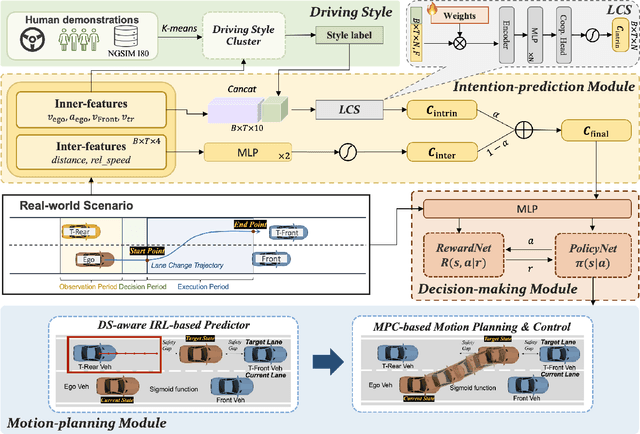
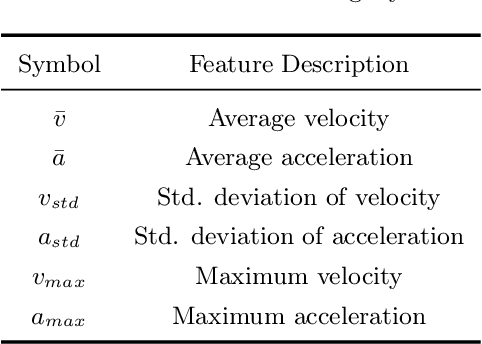
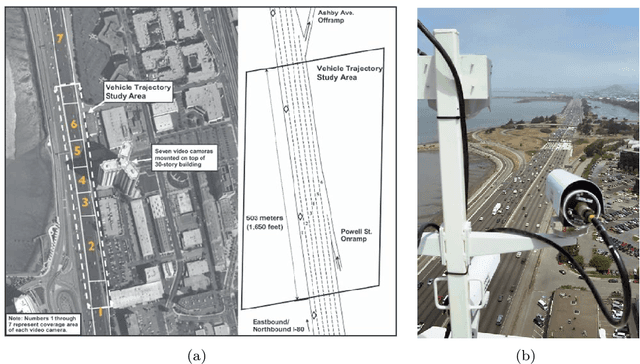
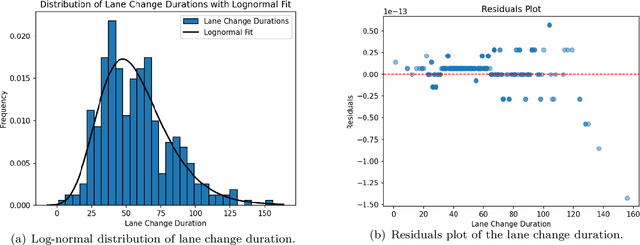
In mixed-traffic environments, where autonomous vehicles (AVs) interact with diverse human-driven vehicles (HVs), unpredictable intentions and heterogeneous behaviors make safe and efficient lane change maneuvers highly challenging. Existing methods often oversimplify these interactions by assuming uniform patterns. We propose an intention-driven lane change framework that integrates driving-style recognition, cooperation-aware decision-making, and coordinated motion planning. A deep learning classifier trained on the NGSIM dataset identifies human driving styles in real time. A cooperation score with intrinsic and interactive components estimates surrounding drivers' intentions and quantifies their willingness to cooperate with the ego vehicle. Decision-making combines behavior cloning with inverse reinforcement learning to determine whether a lane change should be initiated. For trajectory generation, model predictive control is integrated with IRL-based intention inference to produce collision-free and socially compliant maneuvers. Experiments show that the proposed model achieves 94.2\% accuracy and 94.3\% F1-score, outperforming rule-based and learning-based baselines by 4-15\% in lane change recognition. These results highlight the benefit of modeling inter-driver heterogeneity and demonstrate the potential of the framework to advance context-aware and human-like autonomous driving in complex traffic environments.
VPGS-SLAM: Voxel-based Progressive 3D Gaussian SLAM in Large-Scale Scenes
May 25, 2025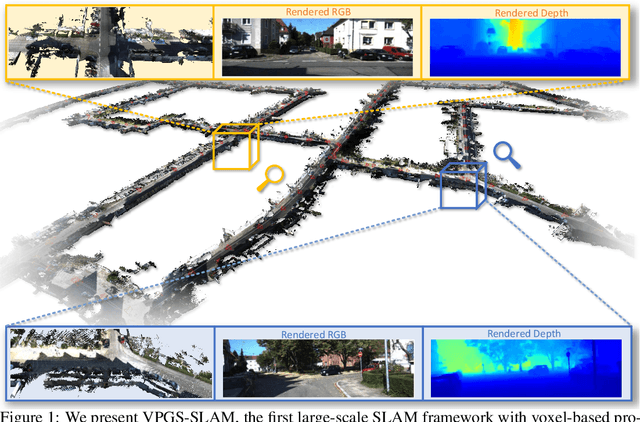
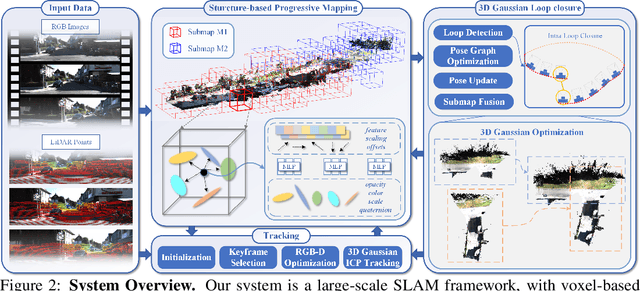
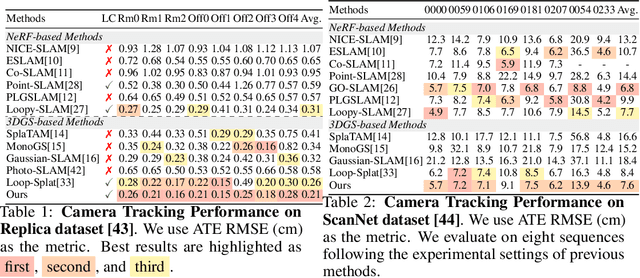
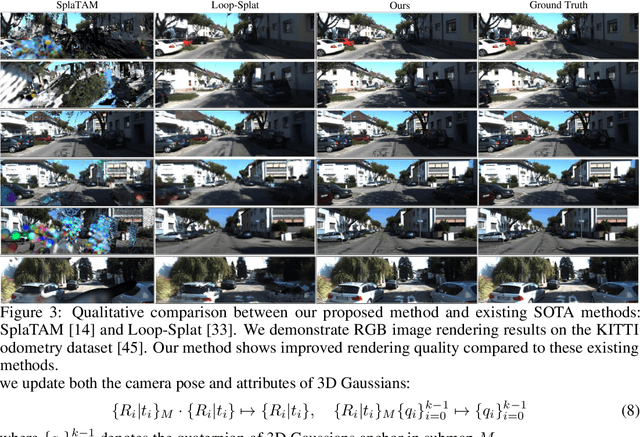
3D Gaussian Splatting has recently shown promising results in dense visual SLAM. However, existing 3DGS-based SLAM methods are all constrained to small-room scenarios and struggle with memory explosion in large-scale scenes and long sequences. To this end, we propose VPGS-SLAM, the first 3DGS-based large-scale RGBD SLAM framework for both indoor and outdoor scenarios. We design a novel voxel-based progressive 3D Gaussian mapping method with multiple submaps for compact and accurate scene representation in large-scale and long-sequence scenes. This allows us to scale up to arbitrary scenes and improves robustness (even under pose drifts). In addition, we propose a 2D-3D fusion camera tracking method to achieve robust and accurate camera tracking in both indoor and outdoor large-scale scenes. Furthermore, we design a 2D-3D Gaussian loop closure method to eliminate pose drift. We further propose a submap fusion method with online distillation to achieve global consistency in large-scale scenes when detecting a loop. Experiments on various indoor and outdoor datasets demonstrate the superiority and generalizability of the proposed framework. The code will be open source on https://github.com/dtc111111/vpgs-slam.
Improving Indoor Localization Accuracy by Using an Efficient Implicit Neural Map Representation
Mar 30, 2025Globally localizing a mobile robot in a known map is often a foundation for enabling robots to navigate and operate autonomously. In indoor environments, traditional Monte Carlo localization based on occupancy grid maps is considered the gold standard, but its accuracy is limited by the representation capabilities of the occupancy grid map. In this paper, we address the problem of building an effective map representation that allows to accurately perform probabilistic global localization. To this end, we propose an implicit neural map representation that is able to capture positional and directional geometric features from 2D LiDAR scans to efficiently represent the environment and learn a neural network that is able to predict both, the non-projective signed distance and a direction-aware projective distance for an arbitrary point in the mapped environment. This combination of neural map representation with a light-weight neural network allows us to design an efficient observation model within a conventional Monte Carlo localization framework for pose estimation of a robot in real time. We evaluated our approach to indoor localization on a publicly available dataset for global localization and the experimental results indicate that our approach is able to more accurately localize a mobile robot than other localization approaches employing occupancy or existing neural map representations. In contrast to other approaches employing an implicit neural map representation for 2D LiDAR localization, our approach allows to perform real-time pose tracking after convergence and near real-time global localization. The code of our approach is available at: https://github.com/PRBonn/enm-mcl.