 Add to Chrome
 Add to Firefox
 Add to Edge
LMGenDrive: Bridging Multimodal Understanding and Generative World Modeling for End-to-End Driving
Apr 09, 2026
Recent years have seen remarkable progress in autonomous driving, yet generalization to long-tail and open-world scenarios remains a major bottleneck for large-scale deployment. To address this challenge, some works use LLMs and VLMs for vision-language understanding and reasoning, enabling vehicles to interpret rare and safety-critical situations when generating actions. Others study generative world models to capture the spatio-temporal evolution of driving scenes, allowing agents to imagine possible futures before acting. Inspired by human intelligence, which unifies understanding and imagination, we explore a unified model for autonomous driving. We present LMGenDrive, the first framework that combines LLM-based multimodal understanding with generative world models for end-to-end closed-loop driving. Given multi-view camera inputs and natural-language instructions, LMGenDrive generates both future driving videos and control signals. This design provides complementary benefits: video prediction improves spatio-temporal scene modeling, while the LLM contributes strong semantic priors and instruction grounding from large-scale pretraining. We further propose a progressive three-stage training strategy, from vision pretraining to multi-step long-horizon driving, to improve stability and performance. LMGenDrive supports both low-latency online planning and autoregressive offline video generation. Experiments show that it significantly outperforms prior methods on challenging closed-loop benchmarks, with clear gains in instruction following, spatio-temporal understanding, and robustness to rare scenarios. These results suggest that unifying multimodal understanding and generation is a promising direction for more generalizable and robust embodied decision-making systems.

FullStack-Agent: Enhancing Agentic Full-Stack Web Coding via Development-Oriented Testing and Repository Back-Translation
Feb 03, 2026Assisting non-expert users to develop complex interactive websites has become a popular task for LLM-powered code agents. However, existing code agents tend to only generate frontend web pages, masking the lack of real full-stack data processing and storage with fancy visual effects. Notably, constructing production-level full-stack web applications is far more challenging than only generating frontend web pages, demanding careful control of data flow, comprehensive understanding of constantly updating packages and dependencies, and accurate localization of obscure bugs in the codebase. To address these difficulties, we introduce FullStack-Agent, a unified agent system for full-stack agentic coding that consists of three parts: (1) FullStack-Dev, a multi-agent framework with strong planning, code editing, codebase navigation, and bug localization abilities. (2) FullStack-Learn, an innovative data-scaling and self-improving method that back-translates crawled and synthesized website repositories to improve the backbone LLM of FullStack-Dev. (3) FullStack-Bench, a comprehensive benchmark that systematically tests the frontend, backend and database functionalities of the generated website. Our FullStack-Dev outperforms the previous state-of-the-art method by 8.7%, 38.2%, and 15.9% on the frontend, backend, and database test cases respectively. Additionally, FullStack-Learn raises the performance of a 30B model by 9.7%, 9.5%, and 2.8% on the three sets of test cases through self-improvement, demonstrating the effectiveness of our approach. The code is released at https://github.com/mnluzimu/FullStack-Agent.
SlidesGen-Bench: Evaluating Slides Generation via Computational and Quantitative Metrics
Jan 14, 2026The rapid evolution of Large Language Models (LLMs) has fostered diverse paradigms for automated slide generation, ranging from code-driven layouts to image-centric synthesis. However, evaluating these heterogeneous systems remains challenging, as existing protocols often struggle to provide comparable scores across architectures or rely on uncalibrated judgments. In this paper, we introduce SlidesGen-Bench, a benchmark designed to evaluate slide generation through a lens of three core principles: universality, quantification, and reliability. First, to establish a unified evaluation framework, we ground our analysis in the visual domain, treating terminal outputs as renderings to remain agnostic to the underlying generation method. Second, we propose a computational approach that quantitatively assesses slides across three distinct dimensions - Content, Aesthetics, and Editability - offering reproducible metrics where prior works relied on subjective or reference-dependent proxies. Finally, to ensure high correlation with human preference, we construct the Slides-Align1.5k dataset, a human preference aligned dataset covering slides from nine mainstream generation systems across seven scenarios. Our experiments demonstrate that SlidesGen-Bench achieves a higher degree of alignment with human judgment than existing evaluation pipelines. Our code and data are available at https://github.com/YunqiaoYang/SlidesGen-Bench.
DrivingGen: A Comprehensive Benchmark for Generative Video World Models in Autonomous Driving
Jan 04, 2026Video generation models, as one form of world models, have emerged as one of the most exciting frontiers in AI, promising agents the ability to imagine the future by modeling the temporal evolution of complex scenes. In autonomous driving, this vision gives rise to driving world models: generative simulators that imagine ego and agent futures, enabling scalable simulation, safe testing of corner cases, and rich synthetic data generation. Yet, despite fast-growing research activity, the field lacks a rigorous benchmark to measure progress and guide priorities. Existing evaluations remain limited: generic video metrics overlook safety-critical imaging factors; trajectory plausibility is rarely quantified; temporal and agent-level consistency is neglected; and controllability with respect to ego conditioning is ignored. Moreover, current datasets fail to cover the diversity of conditions required for real-world deployment. To address these gaps, we present DrivingGen, the first comprehensive benchmark for generative driving world models. DrivingGen combines a diverse evaluation dataset curated from both driving datasets and internet-scale video sources, spanning varied weather, time of day, geographic regions, and complex maneuvers, with a suite of new metrics that jointly assess visual realism, trajectory plausibility, temporal coherence, and controllability. Benchmarking 14 state-of-the-art models reveals clear trade-offs: general models look better but break physics, while driving-specific ones capture motion realistically but lag in visual quality. DrivingGen offers a unified evaluation framework to foster reliable, controllable, and deployable driving world models, enabling scalable simulation, planning, and data-driven decision-making.
WebGen-Agent: Enhancing Interactive Website Generation with Multi-Level Feedback and Step-Level Reinforcement Learning
Sep 26, 2025Agent systems powered by large language models (LLMs) have demonstrated impressive performance on repository-level code-generation tasks. However, for tasks such as website codebase generation, which depend heavily on visual effects and user-interaction feedback, current code agents rely only on simple code execution for feedback and verification. This approach fails to capture the actual quality of the generated code. In this paper, we propose WebGen-Agent, a novel website-generation agent that leverages comprehensive and multi-level visual feedback to iteratively generate and refine the website codebase. Detailed and expressive text descriptions and suggestions regarding the screenshots and GUI-agent testing of the websites are generated by a visual language model (VLM), together with scores that quantify their quality. The screenshot and GUI-agent scores are further integrated with a backtracking and select-best mechanism, enhancing the performance of the agent. Utilizing the accurate visual scores inherent in the WebGen-Agent workflow, we further introduce \textit{Step-GRPO with Screenshot and GUI-agent Feedback} to improve the ability of LLMs to act as the reasoning engine of WebGen-Agent. By using the screenshot and GUI-agent scores at each step as the reward in Step-GRPO, we provide a dense and reliable process supervision signal, which effectively improves the model's website-generation ability. On the WebGen-Bench dataset, WebGen-Agent increases the accuracy of Claude-3.5-Sonnet from 26.4% to 51.9% and its appearance score from 3.0 to 3.9, outperforming the previous state-of-the-art agent system. Additionally, our Step-GRPO training approach increases the accuracy of Qwen2.5-Coder-7B-Instruct from 38.9% to 45.4% and raises the appearance score from 3.4 to 3.7.
T2I-R1: Reinforcing Image Generation with Collaborative Semantic-level and Token-level CoT
May 01, 2025Recent advancements in large language models have demonstrated how chain-of-thought (CoT) and reinforcement learning (RL) can improve performance. However, applying such reasoning strategies to the visual generation domain remains largely unexplored. In this paper, we present T2I-R1, a novel reasoning-enhanced text-to-image generation model, powered by RL with a bi-level CoT reasoning process. Specifically, we identify two levels of CoT that can be utilized to enhance different stages of generation: (1) the semantic-level CoT for high-level planning of the prompt and (2) the token-level CoT for low-level pixel processing during patch-by-patch generation. To better coordinate these two levels of CoT, we introduce BiCoT-GRPO with an ensemble of generation rewards, which seamlessly optimizes both generation CoTs within the same training step. By applying our reasoning strategies to the baseline model, Janus-Pro, we achieve superior performance with 13% improvement on T2I-CompBench and 19% improvement on the WISE benchmark, even surpassing the state-of-the-art model FLUX.1. Code is available at: https://github.com/CaraJ7/T2I-R1
ADT: Tuning Diffusion Models with Adversarial Supervision
Apr 15, 2025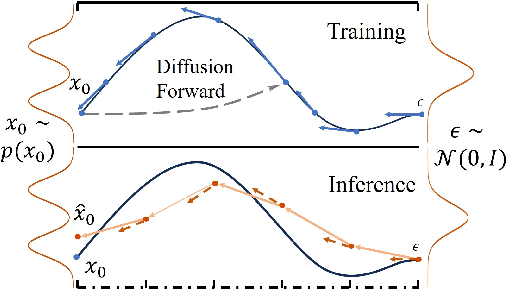
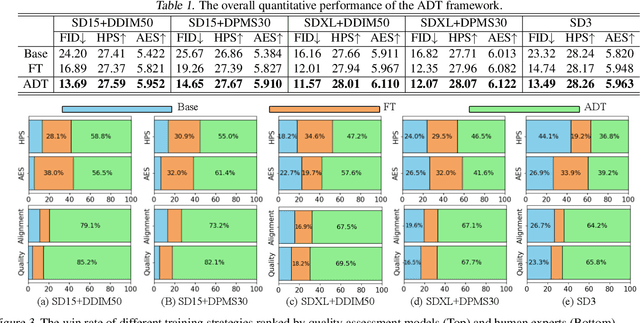
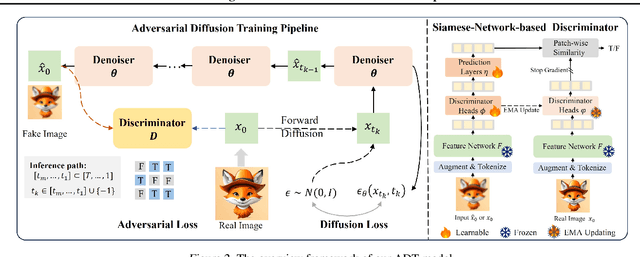
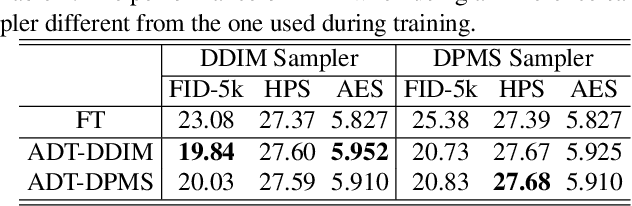
Diffusion models have achieved outstanding image generation by reversing a forward noising process to approximate true data distributions. During training, these models predict diffusion scores from noised versions of true samples in a single forward pass, while inference requires iterative denoising starting from white noise. This training-inference divergences hinder the alignment between inference and training data distributions, due to potential prediction biases and cumulative error accumulation. To address this problem, we propose an intuitive but effective fine-tuning framework, called Adversarial Diffusion Tuning (ADT), by stimulating the inference process during optimization and aligning the final outputs with training data by adversarial supervision. Specifically, to achieve robust adversarial training, ADT features a siamese-network discriminator with a fixed pre-trained backbone and lightweight trainable parameters, incorporates an image-to-image sampling strategy to smooth discriminative difficulties, and preserves the original diffusion loss to prevent discriminator hacking. In addition, we carefully constrain the backward-flowing path for back-propagating gradients along the inference path without incurring memory overload or gradient explosion. Finally, extensive experiments on Stable Diffusion models (v1.5, XL, and v3), demonstrate that ADT significantly improves both distribution alignment and image quality.
VividFace: A Diffusion-Based Hybrid Framework for High-Fidelity Video Face Swapping
Dec 15, 2024


Video face swapping is becoming increasingly popular across various applications, yet existing methods primarily focus on static images and struggle with video face swapping because of temporal consistency and complex scenarios. In this paper, we present the first diffusion-based framework specifically designed for video face swapping. Our approach introduces a novel image-video hybrid training framework that leverages both abundant static image data and temporal video sequences, addressing the inherent limitations of video-only training. The framework incorporates a specially designed diffusion model coupled with a VidFaceVAE that effectively processes both types of data to better maintain temporal coherence of the generated videos. To further disentangle identity and pose features, we construct the Attribute-Identity Disentanglement Triplet (AIDT) Dataset, where each triplet has three face images, with two images sharing the same pose and two sharing the same identity. Enhanced with a comprehensive occlusion augmentation, this dataset also improves robustness against occlusions. Additionally, we integrate 3D reconstruction techniques as input conditioning to our network for handling large pose variations. Extensive experiments demonstrate that our framework achieves superior performance in identity preservation, temporal consistency, and visual quality compared to existing methods, while requiring fewer inference steps. Our approach effectively mitigates key challenges in video face swapping, including temporal flickering, identity preservation, and robustness to occlusions and pose variations.
EasyRef: Omni-Generalized Group Image Reference for Diffusion Models via Multimodal LLM
Dec 12, 2024
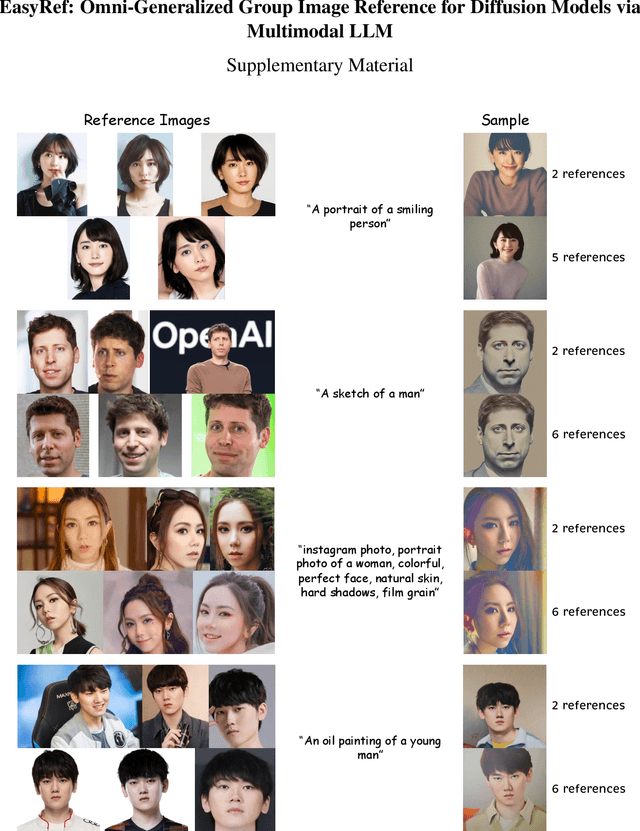


Significant achievements in personalization of diffusion models have been witnessed. Conventional tuning-free methods mostly encode multiple reference images by averaging their image embeddings as the injection condition, but such an image-independent operation cannot perform interaction among images to capture consistent visual elements within multiple references. Although the tuning-based Low-Rank Adaptation (LoRA) can effectively extract consistent elements within multiple images through the training process, it necessitates specific finetuning for each distinct image group. This paper introduces EasyRef, a novel plug-and-play adaptation method that enables diffusion models to be conditioned on multiple reference images and the text prompt. To effectively exploit consistent visual elements within multiple images, we leverage the multi-image comprehension and instruction-following capabilities of the multimodal large language model (MLLM), prompting it to capture consistent visual elements based on the instruction. Besides, injecting the MLLM's representations into the diffusion process through adapters can easily generalize to unseen domains, mining the consistent visual elements within unseen data. To mitigate computational costs and enhance fine-grained detail preservation, we introduce an efficient reference aggregation strategy and a progressive training scheme. Finally, we introduce MRBench, a new multi-reference image generation benchmark. Experimental results demonstrate EasyRef surpasses both tuning-free methods like IP-Adapter and tuning-based methods like LoRA, achieving superior aesthetic quality and robust zero-shot generalization across diverse domains.
Exploring the Role of Large Language Models in Prompt Encoding for Diffusion Models
Jun 17, 2024Large language models (LLMs) based on decoder-only transformers have demonstrated superior text understanding capabilities compared to CLIP and T5-series models. However, the paradigm for utilizing current advanced LLMs in text-to-image diffusion models remains to be explored. We observed an unusual phenomenon: directly using a large language model as the prompt encoder significantly degrades the prompt-following ability in image generation. We identified two main obstacles behind this issue. One is the misalignment between the next token prediction training in LLM and the requirement for discriminative prompt features in diffusion models. The other is the intrinsic positional bias introduced by the decoder-only architecture. To deal with this issue, we propose a novel framework to fully harness the capabilities of LLMs. Through the carefully designed usage guidance, we effectively enhance the text representation capability for prompt encoding and eliminate its inherent positional bias. This allows us to integrate state-of-the-art LLMs into the text-to-image generation model flexibly. Furthermore, we also provide an effective manner to fuse multiple LLMs into our framework. Considering the excellent performance and scaling capabilities demonstrated by the transformer architecture, we further design an LLM-Infused Diffusion Transformer (LI-DiT) based on the framework. We conduct extensive experiments to validate LI-DiT across model size and data size. Benefiting from the inherent ability of the LLMs and our innovative designs, the prompt understanding performance of LI-DiT easily surpasses state-of-the-art open-source models as well as mainstream closed-source commercial models including Stable Diffusion 3, DALL-E 3, and Midjourney V6. The powerful LI-DiT-10B will be available after further optimization and security checks.