 Add to Chrome
 Add to Firefox
 Add to Edge
ClaimDiff-RL: Fine-Grained Caption Reinforcement Learning through Visual Claim Comparison
May 19, 2026
Long-form image captioning exposes a reward granularity problem in RL: captions are judged as whole sequences, while the important errors occur at the level of individual visual claims. A good dense caption should be both faithful and informative, avoiding hallucination without omitting salient details. Yet pairwise preferences, reference-based metrics, and holistic scalar rewards compress these local errors into a single sequence-level signal, obscuring the tradeoff between factuality and coverage. We introduce ClaimDiff-RL, a framework that uses reference-conditioned atomic claim differences as the reward unit for caption RL. Given an image, an actor caption, and a reference caption, a multimodal judge enumerates visually grounded differences, verifies each difference against the image, assigns open-vocabulary error types and severity levels, and produces per-difference statistics for reward composition. This makes hallucinated claims and omitted salient facts separately measurable and tunable. Experiments show that holistic scalar rewards can reduce hallucination by increasing missing facts, while ClaimDiff-RL exposes this faithfulness and coverage tradeoff and enables more balanced operating points. On a 160-image human-labeled diagnostic benchmark, public captioning benchmarks, and VQA benchmarks, ClaimDiff-RL improves the hallucination--missing-fact balance, preserves general capability, and even surpasses Gemini-3-Pro-Preview on several fine-grained Capability dimensions such as object counting, spatial relations, and scene recognition. These results suggest that typed, verifiable claim differences are an effective reward unit for fine-grained and diagnosable caption RL.

VideoZeroBench: Probing the Limits of Video MLLMs with Spatio-Temporal Evidence Verification
Apr 02, 2026Recent video multimodal large language models achieve impressive results across various benchmarks. However, current evaluations suffer from two critical limitations: (1) inflated scores can mask deficiencies in fine-grained visual understanding and reasoning, and (2) answer correctness is often measured without verifying whether models identify the precise spatio-temporal evidence supporting their predictions. To address this, we present VideoZeroBench, a hierarchical benchmark designed for challenging long-video question answering that rigorously verifies spatio-temporal evidence. It comprises 500 manually annotated questions across 13 domains, paired with temporal intervals and spatial bounding boxes as evidence. To disentangle answering generation, temporal grounding, and spatial grounding, we introduce a five-level evaluation protocol that progressively tightens evidence requirements. Experiments show that even Gemini-3-Pro correctly answers fewer than 17% of questions under the standard end-to-end QA setting (Level-3). When grounding constraints are imposed, performance drops sharply: No model exceeds 1% accuracy when both correct answering and accurate spatio-temporal localization are required (Level-5), with most failing to achieve any correct grounded predictions. These results expose a significant gap between surface-level answer correctness and genuine evidence-based reasoning, revealing that grounded video understanding remains a bottleneck for long-video QA. We further analyze performance across minimal evidence spans, atomic abilities, and inference paradigms, providing insights for future research in grounded video reasoning. The benchmark and code will be made publicly available.
Self-Evolving Recommendation System: End-To-End Autonomous Model Optimization With LLM Agents
Feb 10, 2026Optimizing large-scale machine learning systems, such as recommendation models for global video platforms, requires navigating a massive hyperparameter search space and, more critically, designing sophisticated optimizers, architectures, and reward functions to capture nuanced user behaviors. Achieving substantial improvements in these areas is a non-trivial task, traditionally relying on extensive manual iterations to test new hypotheses. We propose a self-evolving system that leverages Large Language Models (LLMs), specifically those from Google's Gemini family, to autonomously generate, train, and deploy high-performing, complex model changes within an end-to-end automated workflow. The self-evolving system is comprised of an Offline Agent (Inner Loop) that performs high-throughput hypothesis generation using proxy metrics, and an Online Agent (Outer Loop) that validates candidates against delayed north star business metrics in live production. Our agents act as specialized Machine Learning Engineers (MLEs): they exhibit deep reasoning capabilities, discovering novel improvements in optimization algorithms and model architecture, and formulating innovative reward functions that target long-term user engagement. The effectiveness of this approach is demonstrated through several successful production launches at YouTube, confirming that autonomous, LLM-driven evolution can surpass traditional engineering workflows in both development velocity and model performance.
U-Net Based Image Enhancement for Short-time Muon Scattering Tomography
Feb 05, 2026Muon Scattering Tomography (MST) is a promising non-invasive inspection technique, yet the practical application of short-time MST is hindered by poor image quality due to limited muon flux. To address this limitation, we propose a U-Net-based framework trained on Point of Closest Approach (PoCA) images reconstructed with simulation MST data to enhance image quality. When applied to experimental MST data, the framework significantly improves image quality, increasing the Structural Similarity Index Measure (SSIM) from 0.7232 to 0.9699 and decreasing the Learned Perceptual Image Patch Similarity (LPIPS) from 0.3604 to 0.0270. These results demonstrate that our method can effectively enhance low-statistics MST images, thereby paving the way for the practical deployment of short-time MST.
SAMTok: Representing Any Mask with Two Words
Jan 22, 2026Pixel-wise capabilities are essential for building interactive intelligent systems. However, pixel-wise multi-modal LLMs (MLLMs) remain difficult to scale due to complex region-level encoders, specialized segmentation decoders, and incompatible training objectives. To address these challenges, we present SAMTok, a discrete mask tokenizer that converts any region mask into two special tokens and reconstructs the mask using these tokens with high fidelity. By treating masks as new language tokens, SAMTok enables base MLLMs (such as the QwenVL series) to learn pixel-wise capabilities through standard next-token prediction and simple reinforcement learning, without architectural modifications and specialized loss design. SAMTok builds on SAM2 and is trained on 209M diverse masks using a mask encoder and residual vector quantizer to produce discrete, compact, and information-rich tokens. With 5M SAMTok-formatted mask understanding and generation data samples, QwenVL-SAMTok attains state-of-the-art or comparable results on region captioning, region VQA, grounded conversation, referring segmentation, scene graph parsing, and multi-round interactive segmentation. We further introduce a textual answer-matching reward that enables efficient reinforcement learning for mask generation, delivering substantial improvements on GRES and GCG benchmarks. Our results demonstrate a scalable and straightforward paradigm for equipping MLLMs with strong pixel-wise capabilities. Our code and models are available.
MMFormalizer: Multimodal Autoformalization in the Wild
Jan 06, 2026Autoformalization, which translates natural language mathematics into formal statements to enable machine reasoning, faces fundamental challenges in the wild due to the multimodal nature of the physical world, where physics requires inferring hidden constraints (e.g., mass or energy) from visual elements. To address this, we propose MMFormalizer, which extends autoformalization beyond text by integrating adaptive grounding with entities from real-world mathematical and physical domains. MMFormalizer recursively constructs formal propositions from perceptually grounded primitives through recursive grounding and axiom composition, with adaptive recursive termination ensuring that every abstraction is supported by visual evidence and anchored in dimensional or axiomatic grounding. We evaluate MMFormalizer on a new benchmark, PhyX-AF, comprising 115 curated samples from MathVerse, PhyX, Synthetic Geometry, and Analytic Geometry, covering diverse multimodal autoformalization tasks. Results show that frontier models such as GPT-5 and Gemini-3-Pro achieve the highest compile and semantic accuracy, with GPT-5 excelling in physical reasoning, while geometry remains the most challenging domain. Overall, MMFormalizer provides a scalable framework for unified multimodal autoformalization, bridging perception and formal reasoning. To the best of our knowledge, this is the first multimodal autoformalization method capable of handling classical mechanics (derived from the Hamiltonian), as well as relativity, quantum mechanics, and thermodynamics. More details are available on our project page: MMFormalizer.github.io
MMaDA-Parallel: Multimodal Large Diffusion Language Models for Thinking-Aware Editing and Generation
Nov 18, 2025While thinking-aware generation aims to improve performance on complex tasks, we identify a critical failure mode where existing sequential, autoregressive approaches can paradoxically degrade performance due to error propagation. To systematically analyze this issue, we propose ParaBench, a new benchmark designed to evaluate both text and image output modalities. Our analysis using ParaBench reveals that this performance degradation is strongly correlated with poor alignment between the generated reasoning and the final image. To resolve this, we propose a parallel multimodal diffusion framework, MMaDA-Parallel, that enables continuous, bidirectional interaction between text and images throughout the entire denoising trajectory. MMaDA-Parallel is trained with supervised finetuning and then further optimized by Parallel Reinforcement Learning (ParaRL), a novel strategy that applies semantic rewards along the trajectory to enforce cross-modal consistency. Experiments validate that our model significantly improves cross-modal alignment and semantic consistency, achieving a 6.9\% improvement in Output Alignment on ParaBench compared to the state-of-the-art model, Bagel, establishing a more robust paradigm for thinking-aware image synthesis. Our code is open-sourced at https://github.com/tyfeld/MMaDA-Parallel
CrossVid: A Comprehensive Benchmark for Evaluating Cross-Video Reasoning in Multimodal Large Language Models
Nov 15, 2025Cross-Video Reasoning (CVR) presents a significant challenge in video understanding, which requires simultaneous understanding of multiple videos to aggregate and compare information across groups of videos. Most existing video understanding benchmarks focus on single-video analysis, failing to assess the ability of multimodal large language models (MLLMs) to simultaneously reason over various videos. Recent benchmarks evaluate MLLMs' capabilities on multi-view videos that capture different perspectives of the same scene. However, their limited tasks hinder a thorough assessment of MLLMs in diverse real-world CVR scenarios. To this end, we introduce CrossVid, the first benchmark designed to comprehensively evaluate MLLMs' spatial-temporal reasoning ability in cross-video contexts. Firstly, CrossVid encompasses a wide spectrum of hierarchical tasks, comprising four high-level dimensions and ten specific tasks, thereby closely reflecting the complex and varied nature of real-world video understanding. Secondly, CrossVid provides 5,331 videos, along with 9,015 challenging question-answering pairs, spanning single-choice, multiple-choice, and open-ended question formats. Through extensive experiments on various open-source and closed-source MLLMs, we observe that Gemini-2.5-Pro performs best on CrossVid, achieving an average accuracy of 50.4%. Notably, our in-depth case study demonstrates that most current MLLMs struggle with CVR tasks, primarily due to their inability to integrate or compare evidence distributed across multiple videos for reasoning. These insights highlight the potential of CrossVid to guide future advancements in enhancing MLLMs' CVR capabilities.
MVU-Eval: Towards Multi-Video Understanding Evaluation for Multimodal LLMs
Nov 13, 2025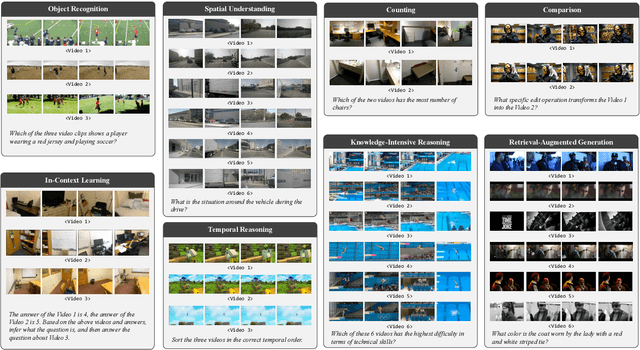
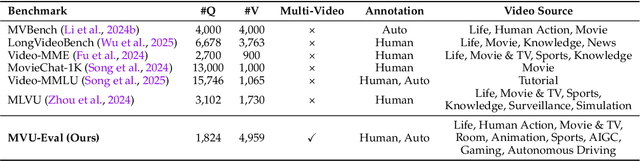
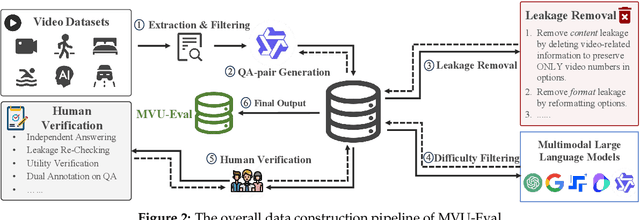
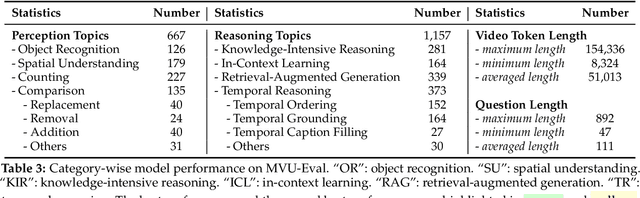
The advent of Multimodal Large Language Models (MLLMs) has expanded AI capabilities to visual modalities, yet existing evaluation benchmarks remain limited to single-video understanding, overlooking the critical need for multi-video understanding in real-world scenarios (e.g., sports analytics and autonomous driving). To address this significant gap, we introduce MVU-Eval, the first comprehensive benchmark for evaluating Multi-Video Understanding for MLLMs. Specifically, our MVU-Eval mainly assesses eight core competencies through 1,824 meticulously curated question-answer pairs spanning 4,959 videos from diverse domains, addressing both fundamental perception tasks and high-order reasoning tasks. These capabilities are rigorously aligned with real-world applications such as multi-sensor synthesis in autonomous systems and cross-angle sports analytics. Through extensive evaluation of state-of-the-art open-source and closed-source models, we reveal significant performance discrepancies and limitations in current MLLMs' ability to perform understanding across multiple videos. The benchmark will be made publicly available to foster future research.
Open-o3 Video: Grounded Video Reasoning with Explicit Spatio-Temporal Evidence
Oct 23, 2025Most video reasoning models only generate textual reasoning traces without indicating when and where key evidence appears. Recent models such as OpenAI-o3 have sparked wide interest in evidence-centered reasoning for images, yet extending this ability to videos is more challenging, as it requires joint temporal tracking and spatial localization across dynamic scenes. We introduce Open-o3 Video, a non-agent framework that integrates explicit spatio-temporal evidence into video reasoning, and carefully collect training data and design training strategies to address the aforementioned challenges. The model highlights key timestamps, objects, and bounding boxes alongside its answers, allowing reasoning to be grounded in concrete visual observations. To enable this functionality, we first curate and build two high-quality datasets, STGR-CoT-30k for SFT and STGR-RL-36k for RL, with carefully constructed temporal and spatial annotations, since most existing datasets offer either temporal spans for videos or spatial boxes on images, lacking unified spatio-temporal supervision and reasoning traces. Then, we adopt a cold-start reinforcement learning strategy with multiple specially designed rewards that jointly encourage answer accuracy, temporal alignment, and spatial precision. On V-STAR benchmark, Open-o3 Video achieves state-of-the-art performance, raising mAM by 14.4% and mLGM by 24.2% on the Qwen2.5-VL baseline. Consistent improvements are also observed on a broad range of video understanding benchmarks, including VideoMME, WorldSense, VideoMMMU, and TVGBench. Beyond accuracy, the reasoning traces produced by Open-o3 Video also provide valuable signals for test-time scaling, enabling confidence-aware verification and improving answer reliability.