 Add to Chrome
 Add to Firefox
 Add to Edge
Actor as Its Own Critic: Unifying Region Understanding and Localization via CycleGRPO
Jul 13, 2026
This paper introduces Actor as Its Own Critic, a unified reinforcement learning framework, Cycle Group Relative Policy Optimization (CycleGRPO), that jointly optimizes region understanding and localization for Multimodal Large Language Models (MLLMs). Unlike existing separate pipelines, we leverage the inherent duality between the two tasks to construct a self-evaluating reinforcement learning paradigm: "region $\to$ text $\to$ region''. Specifically, a single MLLM first acts as the actor to generate region captions, then immediately transitions to a critic to ground its generated text back in the spatial domain. Therefore, CycleGRPO requires only region inputs, e.g., masks or bounding boxes, entirely bypassing the need for textual ground truths. A quality-aware token-level cycle-consistency reward is employed to assess the semantic discriminability of text captions via their physical localization accuracy. Empirically, built upon SAMTok, our CycleGRPO framework successfully bootstraps both capabilities simultaneously. Without any task-specific fine-tuning, the framework yields consistent performance gains across a wide range of benchmarks, including region captioning, region VQA, grounded dialogue, and referring segmentation. Overall, CycleGRPO offers a straightforward and scalable way to advance pixel-level capabilities in MLLMs. Code and models are released at https://github.com/devinxzhang/CycleGRPO.

PixelEyes: Decoupling Perception and Reasoning for Pinpoint Visual Evidence Seeking
Jun 30, 2026This paper explores multi-turn visual reasoning and observes that MLLMs repeatedly fail to localize the target, leading to long, redundant trajectories. We attribute this failure to the entanglement of reasoning and perception within a single model, the MLLM reasons and localizes simultaneously, and inaccurate localization triggers additional reasoning turns that bloat the trajectory. To solve this problem, we propose PixelEyes, a multi-turn visual reasoning agent that explicitly decouples reasoning from perception, i.e., the reasoner decides what to look for, while a specialized perception tool answers where it is. Specifically, PixelEyes introduces 1) Mask-guided Visual Search. A referring segmentation model is invoked to provide mask-precise localization, freeing the reasoner from the need to compensate for imprecise grounding. 2) Semantic-region Breadth-first Search (BFS). To eliminate redundant loops caused by repeatedly cropping incorrect sub-regions, we organize exploration as a breadth-first search over semantic regions. To internalize these capabilities, we construct the PixelEyes-6K dataset by resynthesizing expert trajectories from existing data. This explicitly embeds our mask-guided search and BFS logic into the model. We further introduce Pinpoint-Bench, a zero-hint visual search benchmark, i.e., no location cues are provided in the question, with instance-level masks and bounding boxes that separate localization failures from reasoning failures, enabling fine-grained analysis of failure modes such as inattentional blindness. Recent state-of-the-art MLLMs and visual reasoning agents leave large headroom on Pinpoint-Bench, demonstrating its quality and difficulty. Code and models are open-sourced.
MotionAtlas: Detailed Region Captioning for Motion-Centric Videos
Jun 28, 2026We propose MotionAtlas, a system for detailed captioning of motion-centric videos, comprising (1) a dedicated human-annotated benchmark, (2) a scalable, high-quality pipeline to construct training samples, and (3) a family of powerful Video-MLLMs. Unlike conventional global motion captioning datasets, we focus on region-aware motion captioning: given a video and a spatiotemporal mask, the model generates precise descriptions of motion within the target region, thereby alleviating visual clutter and motion entanglement and enabling reliable, quantifiable evaluation. Concretely, we first build MotionAtlas-Bench, a comprehensive benchmark comprising 2,073 multiple-choice questions, meticulously annotated for a curated set of high-quality, motion-centric videos, to evaluate fine-grained motion understanding of the objects in question. Second, we design a rigorous and scalable data pipeline that leverages self-bootstrap refinement to suppress fine-grained hallucinations, yielding 159k high-quality motion captioning data. Third, we design a tailored training data composition strategy, which achieves consistent and substantial performance gains across diverse baseline Video-MLLMs, including Molmo2 and Qwen3-VL. For instance, MotionAtlas-4B surpasses Qwen3-VL-4B by an average of 5.2 percentage points across general motion benchmarks. The benchmark, dataset, and code have been released.
World Action Models: The Next Frontier in Embodied AI
May 12, 2026Vision-Language-Action (VLA) models have achieved strong semantic generalization for embodied policy learning, yet they learn reactive observation-to-action mappings without explicitly modeling how the physical world evolves under intervention. A growing body of work addresses this limitation by integrating world models, predictive models of environment dynamics, into the action generation pipeline. We term this emerging paradigm World Action Models (WAMs): embodied foundation models that unify predictive state modeling with action generation, targeting a joint distribution over future states and actions rather than actions alone. However, the literature remains fragmented across architectures, learning objectives, and application scenarios, lacking a unified conceptual framework. We formally define WAMs and disambiguate them from related concepts, and trace the foundations and early integration of VLA and world model research that gave rise to this paradigm. We organize existing methods into a structured taxonomy of Cascaded and Joint WAMs, with further subdivision by generation modality, conditioning mechanism, and action decoding strategy. We systematically analyze the data ecosystem fueling WAMs development, spanning robot teleoperation, portable human demonstrations, simulation, and internet-scale egocentric video, and synthesize emerging evaluation protocols organized around visual fidelity, physical commonsense, and action plausibility. Overall, this survey provides the first systematic account of the WAMs landscape, clarifies key architectural paradigms and their trade-offs, and identifies open challenges and future opportunities for this rapidly evolving field.
SaSaSaSa2VA: 2nd Place of the 5th PVUW MeViS-Text Track
Mar 28, 2026Referring video object segmentation (RVOS) commonly grounds targets in videos based on static textual cues. MeViS benchmark extends this by incorporating motion-centric expressions (referring & reasoning motion expressions) and introducing no-target queries. Extending SaSaSa2VA, where increased input frames and [SEG] tokens already strengthen the Sa2VA backbone, we adopt a simple yet effective target existence-aware verification mechanism, leading to Still Awesome SaSaSa2VA (SaSaSaSa2VA). Despite its simplicity, the method achieves a final score of 89.19 in the 5th PVUW Challenge (MeViS-Text Track), securing 2nd place. Both quantitative results and ablations suggest that this existence-aware verification strategy is sufficient to unlock strong performance on motion-centric referring tasks.
SAMTok: Representing Any Mask with Two Words
Jan 22, 2026Pixel-wise capabilities are essential for building interactive intelligent systems. However, pixel-wise multi-modal LLMs (MLLMs) remain difficult to scale due to complex region-level encoders, specialized segmentation decoders, and incompatible training objectives. To address these challenges, we present SAMTok, a discrete mask tokenizer that converts any region mask into two special tokens and reconstructs the mask using these tokens with high fidelity. By treating masks as new language tokens, SAMTok enables base MLLMs (such as the QwenVL series) to learn pixel-wise capabilities through standard next-token prediction and simple reinforcement learning, without architectural modifications and specialized loss design. SAMTok builds on SAM2 and is trained on 209M diverse masks using a mask encoder and residual vector quantizer to produce discrete, compact, and information-rich tokens. With 5M SAMTok-formatted mask understanding and generation data samples, QwenVL-SAMTok attains state-of-the-art or comparable results on region captioning, region VQA, grounded conversation, referring segmentation, scene graph parsing, and multi-round interactive segmentation. We further introduce a textual answer-matching reward that enables efficient reinforcement learning for mask generation, delivering substantial improvements on GRES and GCG benchmarks. Our results demonstrate a scalable and straightforward paradigm for equipping MLLMs with strong pixel-wise capabilities. Our code and models are available.
Grasp Any Region: Towards Precise, Contextual Pixel Understanding for Multimodal LLMs
Oct 22, 2025While Multimodal Large Language Models (MLLMs) excel at holistic understanding, they struggle in capturing the dense world with complex scenes, requiring fine-grained analysis of intricate details and object inter-relationships. Region-level MLLMs have been a promising step. However, previous attempts are generally optimized to understand given regions in isolation, neglecting crucial global contexts. To address this, we introduce Grasp Any Region (GAR) for comprehen- sive region-level visual understanding. Empowered by an effective RoI-aligned feature replay technique, GAR supports (1) precise perception by leveraging necessary global contexts, and (2) modeling interactions between multiple prompts. Together, it then naturally achieves (3) advanced compositional reasoning to answer specific free-form questions about any region, shifting the paradigm from passive description to active dialogue. Moreover, we construct GAR-Bench, which not only provides a more accurate evaluation of single-region comprehension, but also, more importantly, measures interactions and complex reasoning across multiple regions. Extensive experiments have demonstrated that GAR-1B not only maintains the state-of-the-art captioning capabilities, e.g., outperforming DAM-3B +4.5 on DLC-Bench, but also excels at modeling relationships between multiple prompts with advanced comprehension capabilities, even surpassing InternVL3-78B on GAR-Bench-VQA. More importantly, our zero-shot GAR-8B even outperforms in-domain VideoRefer-7B on VideoRefer-BenchQ, indicating its strong capabilities can be easily transferred to videos.
Dense360: Dense Understanding from Omnidirectional Panoramas
Jun 17, 2025Multimodal Large Language Models (MLLMs) require comprehensive visual inputs to achieve dense understanding of the physical world. While existing MLLMs demonstrate impressive world understanding capabilities through limited field-of-view (FOV) visual inputs (e.g., 70 degree), we take the first step toward dense understanding from omnidirectional panoramas. We first introduce an omnidirectional panoramas dataset featuring a comprehensive suite of reliability-scored annotations. Specifically, our dataset contains 160K panoramas with 5M dense entity-level captions, 1M unique referring expressions, and 100K entity-grounded panoramic scene descriptions. Compared to multi-view alternatives, panoramas can provide more complete, compact, and continuous scene representations through equirectangular projections (ERP). However, the use of ERP introduces two key challenges for MLLMs: i) spatial continuity along the circle of latitude, and ii) latitude-dependent variation in information density. We address these challenges through ERP-RoPE, a position encoding scheme specifically designed for panoramic ERP. In addition, we introduce Dense360-Bench, the first benchmark for evaluating MLLMs on omnidirectional captioning and grounding, establishing a comprehensive framework for advancing dense visual-language understanding in panoramic settings.
An Empirical Study of GPT-4o Image Generation Capabilities
Apr 08, 2025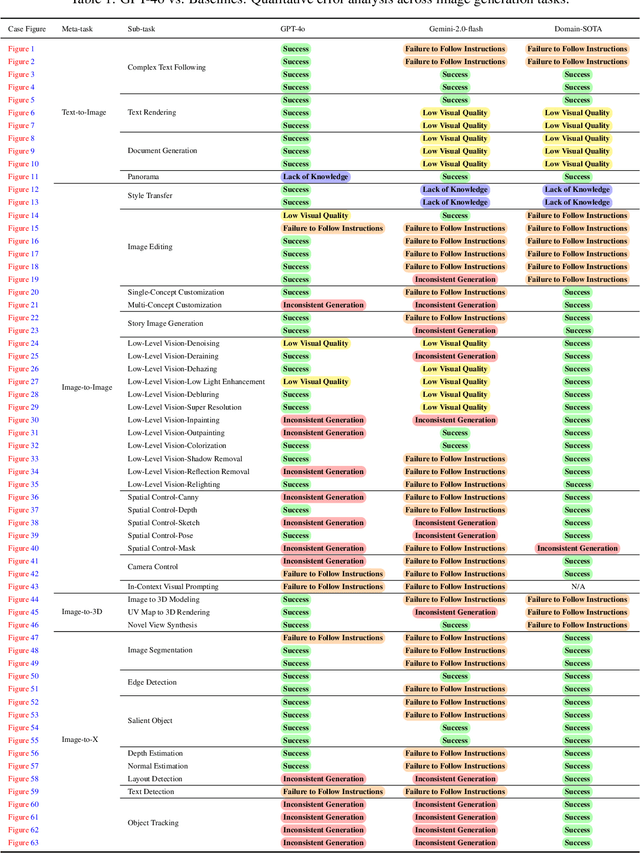
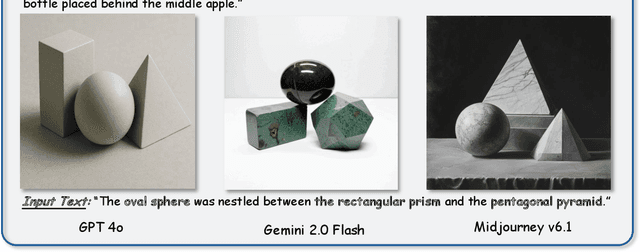

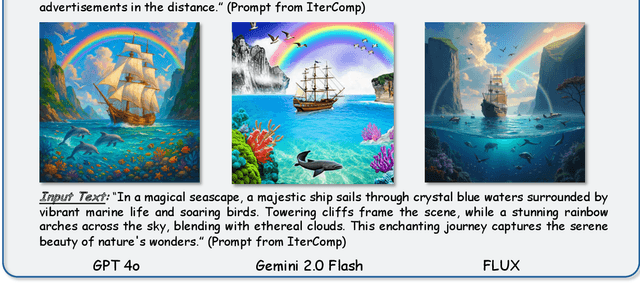
The landscape of image generation has rapidly evolved, from early GAN-based approaches to diffusion models and, most recently, to unified generative architectures that seek to bridge understanding and generation tasks. Recent advances, especially the GPT-4o, have demonstrated the feasibility of high-fidelity multimodal generation, their architectural design remains mysterious and unpublished. This prompts the question of whether image and text generation have already been successfully integrated into a unified framework for those methods. In this work, we conduct an empirical study of GPT-4o's image generation capabilities, benchmarking it against leading open-source and commercial models. Our evaluation covers four main categories, including text-to-image, image-to-image, image-to-3D, and image-to-X generation, with more than 20 tasks. Our analysis highlights the strengths and limitations of GPT-4o under various settings, and situates it within the broader evolution of generative modeling. Through this investigation, we identify promising directions for future unified generative models, emphasizing the role of architectural design and data scaling.
Are They the Same? Exploring Visual Correspondence Shortcomings of Multimodal LLMs
Jan 08, 2025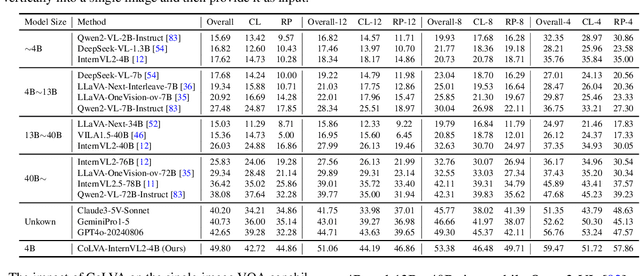
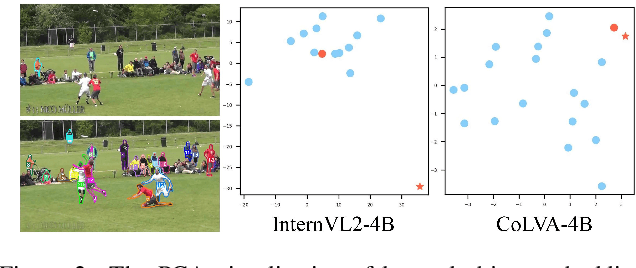

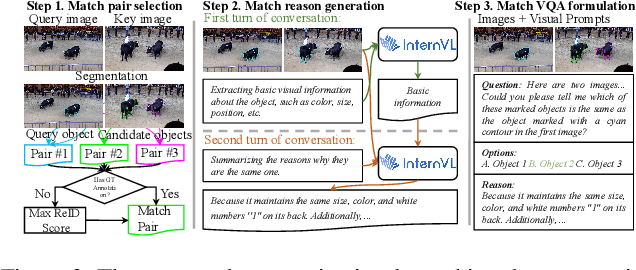
Recent advancements in multimodal models have shown a strong ability in visual perception, reasoning abilities, and vision-language understanding. However, studies on visual matching ability are missing, where finding the visual correspondence of objects is essential in vision research. Our research reveals that the matching capabilities in recent multimodal LLMs (MLLMs) still exhibit systematic shortcomings, even with current strong MLLMs models, GPT-4o. In particular, we construct a Multimodal Visual Matching (MMVM) benchmark to fairly benchmark over 30 different MLLMs. The MMVM benchmark is built from 15 open-source datasets and Internet videos with manual annotation. We categorize the data samples of MMVM benchmark into eight aspects based on the required cues and capabilities to more comprehensively evaluate and analyze current MLLMs. In addition, we have designed an automatic annotation pipeline to generate the MMVM SFT dataset, including 220K visual matching data with reasoning annotation. Finally, we present CoLVA, a novel contrastive MLLM with two novel technical designs: fine-grained vision expert with object-level contrastive learning and instruction augmentation strategy. CoLVA achieves 51.06\% overall accuracy (OA) on the MMVM benchmark, surpassing GPT-4o and baseline by 8.41\% and 23.58\% OA, respectively. The results show the effectiveness of our MMVM SFT dataset and our novel technical designs. Code, benchmark, dataset, and models are available at https://github.com/zhouyiks/CoLVA.