 Add to Chrome
 Add to Firefox
 Add to Edge
Bridging Physical Reasoning and Task Generalization via Visual Action Outcome Reasoning Alignment
Jul 07, 2026
Vision-language models (VLMs) struggle to generalize in interactive physical reasoning, particularly under unseen tasks and environments. Two key failure modes are prominent: hallucinated chain-of-thought (CoT) reasoning that contradicts physical reality, and misalignment between the model's reasoning and actions. We present VAORA (Visual Action Outcome Reasoning Alignment), a novel reward design that directly addresses both issues. VAORA introduces two complementary rewards: Visual Alignment Reward, which anchors VLM reasoning to the visual context independent of the agent action itself, and Visual-Action Alignment Reward, which grounds reasoning in the visual outcome induced by the model's action. Together, these rewards suppress hallucinated CoT and reduce the gap between reasoning and behavior. To improve training stability, we further employ smooth, dense rewards by estimating success probabilities using a pre-trained in-domain expert agent. Experiments on PHYRE and Virtual Tool support our performances across novel-task and unseen-environment settings, confirming that grounded and generalizable physical intelligence can be induced through VAORA.

PixelEyes: Decoupling Perception and Reasoning for Pinpoint Visual Evidence Seeking
Jun 30, 2026This paper explores multi-turn visual reasoning and observes that MLLMs repeatedly fail to localize the target, leading to long, redundant trajectories. We attribute this failure to the entanglement of reasoning and perception within a single model, the MLLM reasons and localizes simultaneously, and inaccurate localization triggers additional reasoning turns that bloat the trajectory. To solve this problem, we propose PixelEyes, a multi-turn visual reasoning agent that explicitly decouples reasoning from perception, i.e., the reasoner decides what to look for, while a specialized perception tool answers where it is. Specifically, PixelEyes introduces 1) Mask-guided Visual Search. A referring segmentation model is invoked to provide mask-precise localization, freeing the reasoner from the need to compensate for imprecise grounding. 2) Semantic-region Breadth-first Search (BFS). To eliminate redundant loops caused by repeatedly cropping incorrect sub-regions, we organize exploration as a breadth-first search over semantic regions. To internalize these capabilities, we construct the PixelEyes-6K dataset by resynthesizing expert trajectories from existing data. This explicitly embeds our mask-guided search and BFS logic into the model. We further introduce Pinpoint-Bench, a zero-hint visual search benchmark, i.e., no location cues are provided in the question, with instance-level masks and bounding boxes that separate localization failures from reasoning failures, enabling fine-grained analysis of failure modes such as inattentional blindness. Recent state-of-the-art MLLMs and visual reasoning agents leave large headroom on Pinpoint-Bench, demonstrating its quality and difficulty. Code and models are open-sourced.
SaSaSaSa2VA: 2nd Place of the 5th PVUW MeViS-Text Track
Mar 28, 2026Referring video object segmentation (RVOS) commonly grounds targets in videos based on static textual cues. MeViS benchmark extends this by incorporating motion-centric expressions (referring & reasoning motion expressions) and introducing no-target queries. Extending SaSaSa2VA, where increased input frames and [SEG] tokens already strengthen the Sa2VA backbone, we adopt a simple yet effective target existence-aware verification mechanism, leading to Still Awesome SaSaSa2VA (SaSaSaSa2VA). Despite its simplicity, the method achieves a final score of 89.19 in the 5th PVUW Challenge (MeViS-Text Track), securing 2nd place. Both quantitative results and ablations suggest that this existence-aware verification strategy is sufficient to unlock strong performance on motion-centric referring tasks.
SAMTok: Representing Any Mask with Two Words
Jan 22, 2026Pixel-wise capabilities are essential for building interactive intelligent systems. However, pixel-wise multi-modal LLMs (MLLMs) remain difficult to scale due to complex region-level encoders, specialized segmentation decoders, and incompatible training objectives. To address these challenges, we present SAMTok, a discrete mask tokenizer that converts any region mask into two special tokens and reconstructs the mask using these tokens with high fidelity. By treating masks as new language tokens, SAMTok enables base MLLMs (such as the QwenVL series) to learn pixel-wise capabilities through standard next-token prediction and simple reinforcement learning, without architectural modifications and specialized loss design. SAMTok builds on SAM2 and is trained on 209M diverse masks using a mask encoder and residual vector quantizer to produce discrete, compact, and information-rich tokens. With 5M SAMTok-formatted mask understanding and generation data samples, QwenVL-SAMTok attains state-of-the-art or comparable results on region captioning, region VQA, grounded conversation, referring segmentation, scene graph parsing, and multi-round interactive segmentation. We further introduce a textual answer-matching reward that enables efficient reinforcement learning for mask generation, delivering substantial improvements on GRES and GCG benchmarks. Our results demonstrate a scalable and straightforward paradigm for equipping MLLMs with strong pixel-wise capabilities. Our code and models are available.
On Path to Multimodal Generalist: General-Level and General-Bench
May 07, 2025The Multimodal Large Language Model (MLLM) is currently experiencing rapid growth, driven by the advanced capabilities of LLMs. Unlike earlier specialists, existing MLLMs are evolving towards a Multimodal Generalist paradigm. Initially limited to understanding multiple modalities, these models have advanced to not only comprehend but also generate across modalities. Their capabilities have expanded from coarse-grained to fine-grained multimodal understanding and from supporting limited modalities to arbitrary ones. While many benchmarks exist to assess MLLMs, a critical question arises: Can we simply assume that higher performance across tasks indicates a stronger MLLM capability, bringing us closer to human-level AI? We argue that the answer is not as straightforward as it seems. This project introduces General-Level, an evaluation framework that defines 5-scale levels of MLLM performance and generality, offering a methodology to compare MLLMs and gauge the progress of existing systems towards more robust multimodal generalists and, ultimately, towards AGI. At the core of the framework is the concept of Synergy, which measures whether models maintain consistent capabilities across comprehension and generation, and across multiple modalities. To support this evaluation, we present General-Bench, which encompasses a broader spectrum of skills, modalities, formats, and capabilities, including over 700 tasks and 325,800 instances. The evaluation results that involve over 100 existing state-of-the-art MLLMs uncover the capability rankings of generalists, highlighting the challenges in reaching genuine AI. We expect this project to pave the way for future research on next-generation multimodal foundation models, providing a robust infrastructure to accelerate the realization of AGI. Project page: https://generalist.top/
PVUW 2025 Challenge Report: Advances in Pixel-level Understanding of Complex Videos in the Wild
Apr 15, 2025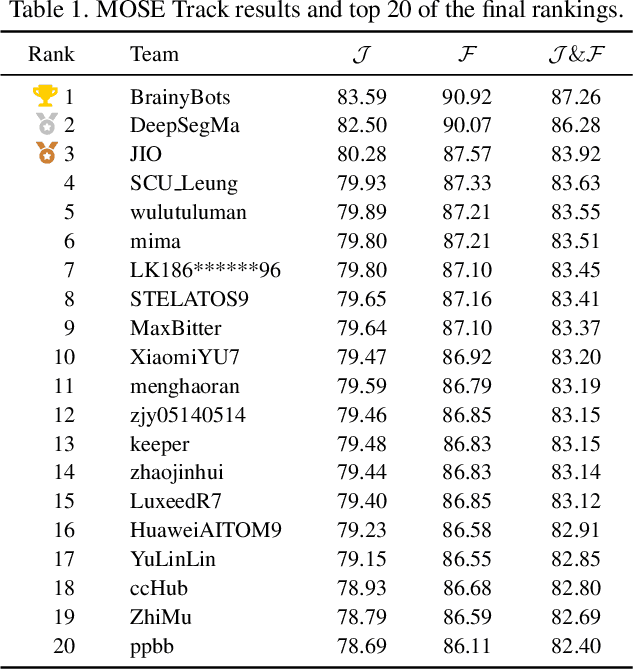
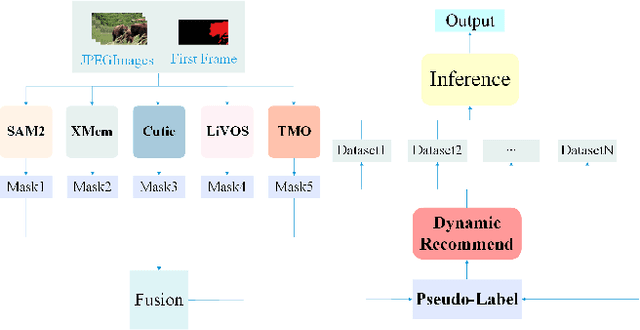
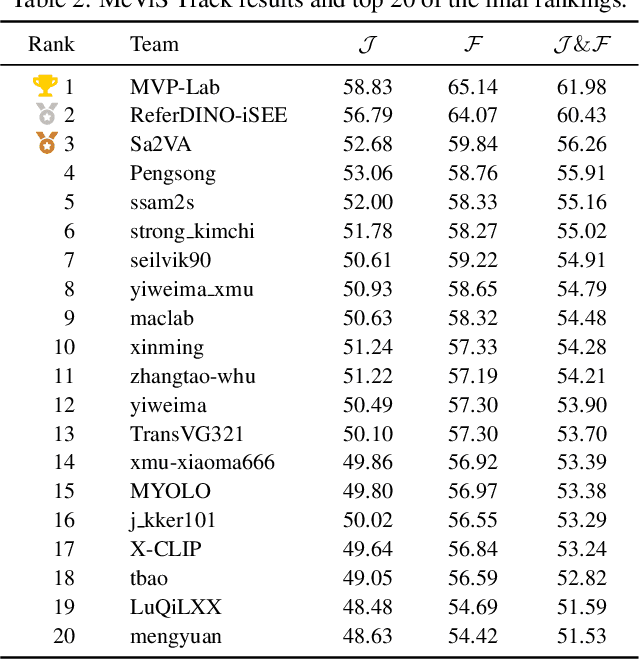
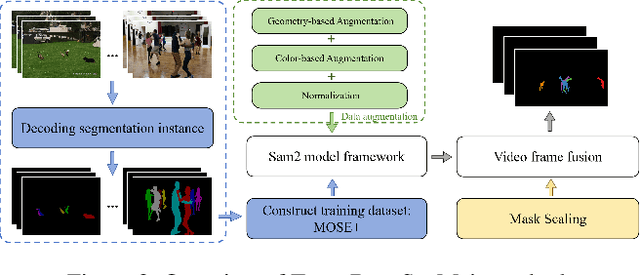
This report provides a comprehensive overview of the 4th Pixel-level Video Understanding in the Wild (PVUW) Challenge, held in conjunction with CVPR 2025. It summarizes the challenge outcomes, participating methodologies, and future research directions. The challenge features two tracks: MOSE, which focuses on complex scene video object segmentation, and MeViS, which targets motion-guided, language-based video segmentation. Both tracks introduce new, more challenging datasets designed to better reflect real-world scenarios. Through detailed evaluation and analysis, the challenge offers valuable insights into the current state-of-the-art and emerging trends in complex video segmentation. More information can be found on the workshop website: https://pvuw.github.io/.
An Empirical Study of GPT-4o Image Generation Capabilities
Apr 08, 2025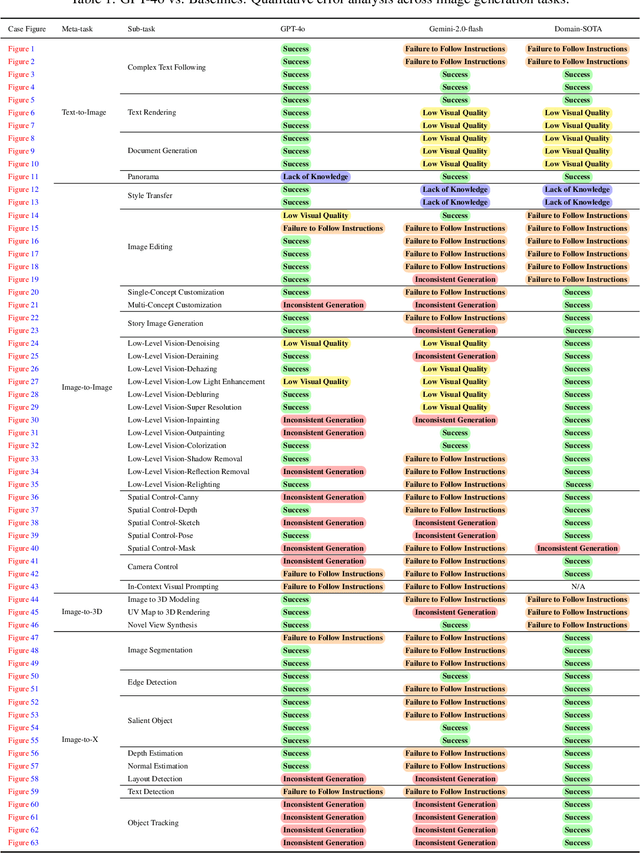
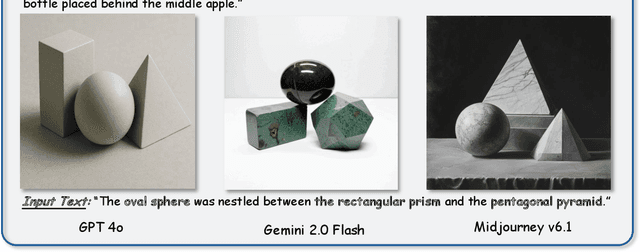

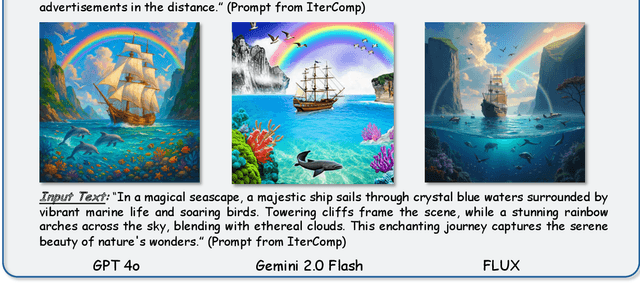
The landscape of image generation has rapidly evolved, from early GAN-based approaches to diffusion models and, most recently, to unified generative architectures that seek to bridge understanding and generation tasks. Recent advances, especially the GPT-4o, have demonstrated the feasibility of high-fidelity multimodal generation, their architectural design remains mysterious and unpublished. This prompts the question of whether image and text generation have already been successfully integrated into a unified framework for those methods. In this work, we conduct an empirical study of GPT-4o's image generation capabilities, benchmarking it against leading open-source and commercial models. Our evaluation covers four main categories, including text-to-image, image-to-image, image-to-3D, and image-to-X generation, with more than 20 tasks. Our analysis highlights the strengths and limitations of GPT-4o under various settings, and situates it within the broader evolution of generative modeling. Through this investigation, we identify promising directions for future unified generative models, emphasizing the role of architectural design and data scaling.
4th PVUW MeViS 3rd Place Report: Sa2VA
Apr 01, 2025Referring video object segmentation (RVOS) is a challenging task that requires the model to segment the object in a video given the language description. MeViS is a recently proposed dataset that contains motion expressions of the target objects, leading to a challenging benchmark, compared with existing RVOS benchmarks. On the other hand, for referring expression tasks, a new trend is to adopt multi-modal large language model (MLLM) to achieve better image and text alignment. In this report, we show that with a simple modification to the test time inference method on stronger MLLMs, we can lead to stronger results on MeVIS. In particular, we adopt the recent method Sa2VA, a unified model for dense grounded understanding of both images and videos. By enlarging the scope of key frames, without any further training, we can achieve the 3rd place in the 4th PVUW workshop.
Sa2VA: Marrying SAM2 with LLaVA for Dense Grounded Understanding of Images and Videos
Jan 07, 2025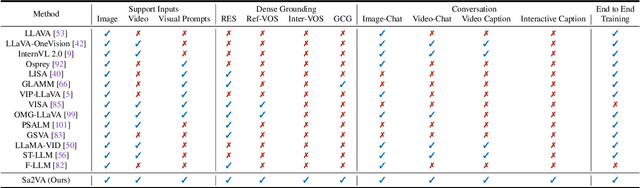
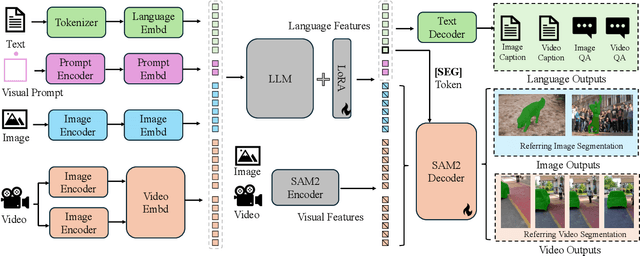
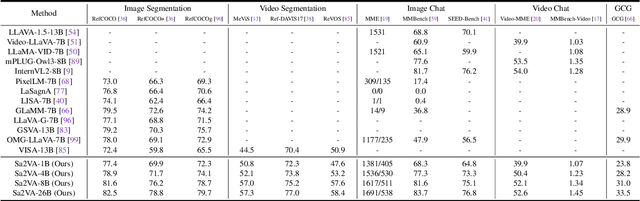

This work presents Sa2VA, the first unified model for dense grounded understanding of both images and videos. Unlike existing multi-modal large language models, which are often limited to specific modalities and tasks, Sa2VA supports a wide range of image and video tasks, including referring segmentation and conversation, with minimal one-shot instruction tuning. Sa2VA combines SAM-2, a foundation video segmentation model, with LLaVA, an advanced vision-language model, and unifies text, image, and video into a shared LLM token space. Using the LLM, Sa2VA generates instruction tokens that guide SAM-2 in producing precise masks, enabling a grounded, multi-modal understanding of both static and dynamic visual content. Additionally, we introduce Ref-SAV, an auto-labeled dataset containing over 72k object expressions in complex video scenes, designed to boost model performance. We also manually validate 2k video objects in the Ref-SAV datasets to benchmark referring video object segmentation in complex environments. Experiments show that Sa2VA achieves state-of-the-art across multiple tasks, particularly in referring video object segmentation, highlighting its potential for complex real-world applications.
LLAVADI: What Matters For Multimodal Large Language Models Distillation
Jul 28, 2024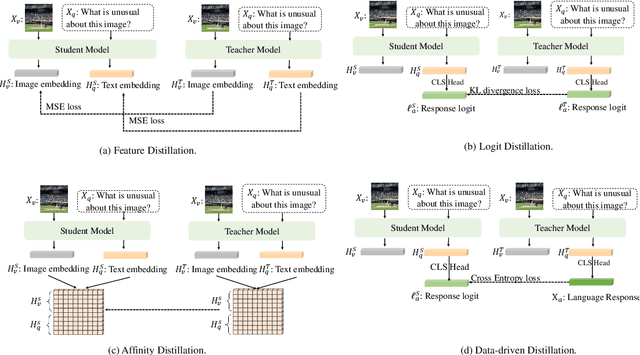
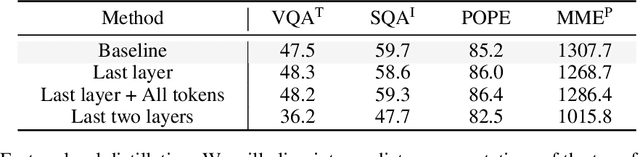
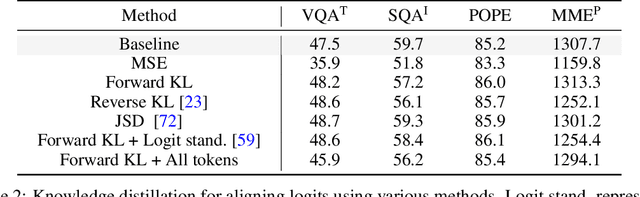
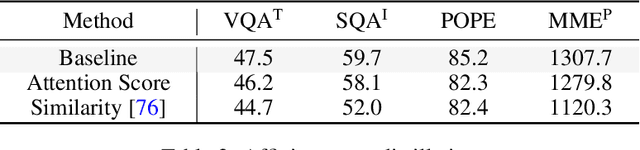
The recent surge in Multimodal Large Language Models (MLLMs) has showcased their remarkable potential for achieving generalized intelligence by integrating visual understanding into Large Language Models.Nevertheless, the sheer model size of MLLMs leads to substantial memory and computational demands that hinder their widespread deployment. In this work, we do not propose a new efficient model structure or train small-scale MLLMs from scratch. Instead, we focus on what matters for training small-scale MLLMs through knowledge distillation, which is the first step from the multimodal distillation perspective. Our extensive studies involve training strategies, model choices, and distillation algorithms in the knowledge distillation process. These results show that joint alignment for both tokens and logit alignment plays critical roles in teacher-student frameworks. In addition, we draw a series of intriguing observations from this study. By evaluating different benchmarks and proper strategy, even a 2.7B small-scale model can perform on par with larger models with 7B or 13B parameters. Our code and models will be publicly available for further research.