 Add to Chrome
 Add to Firefox
 Add to Edge
OmniCap-IF: Benchmarking and Improving Instruction Following Abilities for Omni-Video Captioning
Jun 07, 2026
While Omni-modal Large Language Models (OLLMs) have demonstrated impressive capabilities in jointly processing audio and visual streams, their ability to strictly adhere to complex, multi-faceted user instructions remains largely unexplored. Existing benchmarks primarily focus on holistic video understanding or text-only instruction following, failing to capture the intricate interplay between modalities and user constraints. To bridge this gap, we introduce OmniCap-IF, the first comprehensive benchmark specifically designed to evaluate instruction-following capabilities in omni-modal captioning. OmniCap-IF incorporates a systematic framework that assesses captions on two dimensions: format correctness and content correctness. Our benchmark encompasses 50 distinct constraint types across pure visual, pure audio, and audio-visual modalities, while integrating Temporal Grounding to assess spatio-temporal precision. Extensive evaluations of prominent models on 1,920 high-quality samples reveal significant performance disparities. Furthermore, our analysis uncovers a critical "format-content tradeoff", demonstrating that increasing formatting complexity directly degrades models' omni-modal reasoning abilities. Finally, to advance the field, we curate a 54K instruction-tuning dataset, OmniCap-IF-54K and present OmniCaptioner-IF, which achieves notable improvements in both complex instruction adherence and general omni-modal captioning performance.

DR$^{3}$-Eval: Towards Realistic and Reproducible Deep Research Evaluation
Apr 16, 2026Deep Research Agents (DRAs) aim to solve complex, long-horizon research tasks involving planning, retrieval, multimodal understanding, and report generation, yet their evaluation remains challenging due to dynamic web environments and ambiguous task definitions. We propose DR$^{3}$-Eval, a realistic and reproducible benchmark for evaluating deep research agents on multimodal, multi-file report generation. DR$^{3}$-Eval is constructed from authentic user-provided materials and paired with a per-task static research sandbox corpus that simulates open-web complexity while remaining fully verifiable, containing supportive documents, distractors, and noise. Moreover, we introduce a multi-dimensional evaluation framework measuring Information Recall, Factual Accuracy, Citation Coverage, Instruction Following, and Depth Quality, and validate its alignment with human judgments. Experiments with our developed multi-agent system DR$^{3}$-Agent based on multiple state-of-the-art language models demonstrate that DR$^{3}$-Eval is highly challenging and reveals critical failure modes in retrieval robustness and hallucination control. Our code and data are publicly available.
T2AV-Compass: Towards Unified Evaluation for Text-to-Audio-Video Generation
Dec 24, 2025Text-to-Audio-Video (T2AV) generation aims to synthesize temporally coherent video and semantically synchronized audio from natural language, yet its evaluation remains fragmented, often relying on unimodal metrics or narrowly scoped benchmarks that fail to capture cross-modal alignment, instruction following, and perceptual realism under complex prompts. To address this limitation, we present T2AV-Compass, a unified benchmark for comprehensive evaluation of T2AV systems, consisting of 500 diverse and complex prompts constructed via a taxonomy-driven pipeline to ensure semantic richness and physical plausibility. Besides, T2AV-Compass introduces a dual-level evaluation framework that integrates objective signal-level metrics for video quality, audio quality, and cross-modal alignment with a subjective MLLM-as-a-Judge protocol for instruction following and realism assessment. Extensive evaluation of 11 representative T2AVsystems reveals that even the strongest models fall substantially short of human-level realism and cross-modal consistency, with persistent failures in audio realism, fine-grained synchronization, instruction following, etc. These results indicate significant improvement room for future models and highlight the value of T2AV-Compass as a challenging and diagnostic testbed for advancing text-to-audio-video generation.
MVU-Eval: Towards Multi-Video Understanding Evaluation for Multimodal LLMs
Nov 13, 2025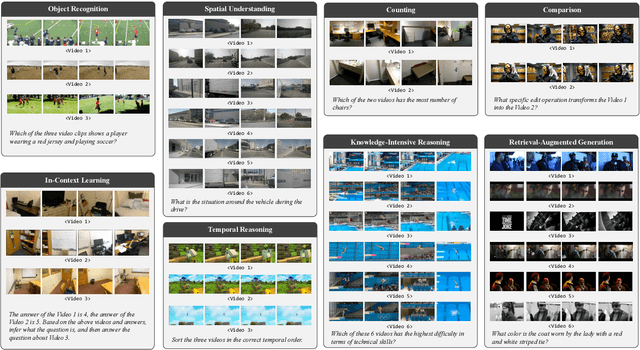
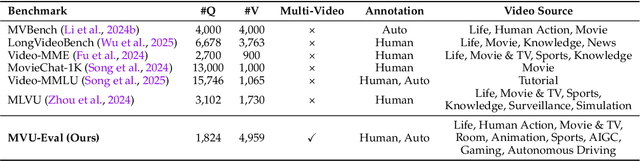
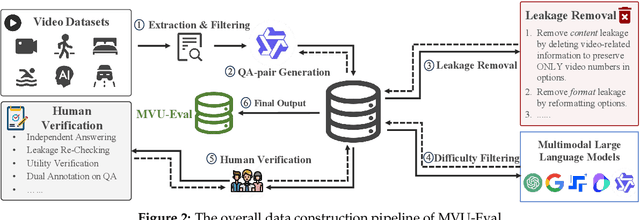
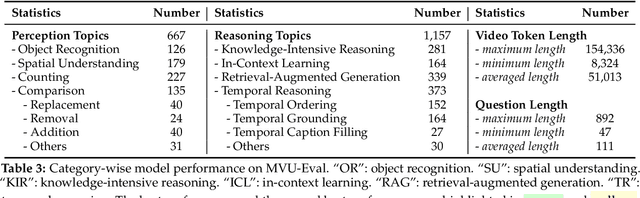
The advent of Multimodal Large Language Models (MLLMs) has expanded AI capabilities to visual modalities, yet existing evaluation benchmarks remain limited to single-video understanding, overlooking the critical need for multi-video understanding in real-world scenarios (e.g., sports analytics and autonomous driving). To address this significant gap, we introduce MVU-Eval, the first comprehensive benchmark for evaluating Multi-Video Understanding for MLLMs. Specifically, our MVU-Eval mainly assesses eight core competencies through 1,824 meticulously curated question-answer pairs spanning 4,959 videos from diverse domains, addressing both fundamental perception tasks and high-order reasoning tasks. These capabilities are rigorously aligned with real-world applications such as multi-sensor synthesis in autonomous systems and cross-angle sports analytics. Through extensive evaluation of state-of-the-art open-source and closed-source models, we reveal significant performance discrepancies and limitations in current MLLMs' ability to perform understanding across multiple videos. The benchmark will be made publicly available to foster future research.