 Add to Chrome
 Add to Firefox
 Add to Edge
BrainWAM: Action-Space Coordination of Semantic Priors and Predictive Dynamics for Autonomous Driving
Aug 13, 2026
Autonomous driving requires planning under both semantic constraints and predictive dynamics. Existing end-to-end driving approaches, however, typically emphasize only one side of this requirement: Vision-Language-Action (VLA) models exploit VLM priors for semantic reasoning, while World Action Models (WAMs) provide future-aware prediction through generative world modeling. This naturally motivates a unified planner that can leverage both semantic priors and predictive dynamics. However, we find that a naive combination through joint token-level attention suffers from an attention-allocation mismatch, where semantic shortcuts dominate the shared attention space and suppress predictive dynamics. Inspired by neuroscience evidence that complex behavior arises from coordination among functionally specialized systems, we propose BrainWAM, a structured action-space coordination framework that converts semantic reasoning and predictive world modeling into two specialized action-oriented pathways, and aligns them at the level of compact action representations. We further introduce an asynchronous rectified-flow inference strategy with decoupled video and action denoising, which shortens inference latency while preserving planning-relevant predictive context. BrainWAM reaches state-of-the-art performance on both NAVSIM v1 (89.5 PDMS) and NAVSIM v2 (89.6 EPDMS), consistently outperforming VLA-only or WAM-only methods, highlighting BrainWAM as a practical and promising direction for autonomous driving systems.

WorldExam: Benchmarking World Models from Apparent Appearance to Inherent Reactivity
Aug 03, 2026Controllable video generation models are increasingly being developed as world models. Accordingly, evaluating them in this role extends beyond the apparent appearance of generated videos to the inherent reactivity of the worlds they depict: the ability to infer from the scene state how the world should react and to generate plausible consequences not explicitly described in the input. Yet existing benchmarks mainly assess visual quality or explicit instruction fulfillment by checking whether requested actions and interaction outcomes are realized, leaving inherent reactivity underexamined. We introduce WorldExam, a hierarchical diagnostic benchmark spanning four levels: Visual Quality, Control Adherence, Spatial Consistency, and World Reactivity. It comprises 1,474 cases across eight dedicated tasks and supports unified evaluation of camera-, action-, and language-driven model paradigms. The World Reactivity level evaluates scene-conditioned reactions and goal-directed behaviors beyond what is explicitly specified in the input. Evaluation of 20 representative models reveals a clear capability split. Camera-driven models excel at camera control, but their interfaces do not support dynamic interaction; action-driven models control subjects more precisely but often leave the world unresponsive; and language-driven models perform better on interaction but follow complex controls less faithfully. No model combines broad task coverage with consistently strong performance, showing that high visual quality and explicit instruction fulfillment do not guarantee inherent reactivity.
PhiZero: A World Model Built Around Physical Language
Jul 30, 2026We introduce PhiZero, a physical world model built around physical language, a compact discrete representation of world-state transitions. Existing physical world models typically predict future videos directly in pixel space, leaving the underlying world dynamics implicit within high-dimensional visual predictors. Motivated by humans' ability to abstract predictive structure from visual experience and organize it in natural language for explicit reasoning, we learn physical language from in-the-wild videos through self-supervision and use it to explicitly reason about how the physical world evolves. Accordingly, PhiZero adopts a reason-then-render paradigm: it first infers future world evolution as a physical-language sequence and then renders the inferred transitions into videos. Extensive experiments across generation and understanding benchmarks validate the ability of PhiZero to model physically coherent world evolution. We further show its potential for realistic and interactive world modeling, fine-grained action-conditioned simulation, and zero-shot motion transfer.
DynVLA: Learning World Dynamics for Action Reasoning in Autonomous Driving
Mar 11, 2026We propose DynVLA, a driving VLA model that introduces a new CoT paradigm termed Dynamics CoT. DynVLA forecasts compact world dynamics before action generation, enabling more informed and physically grounded decision-making. To obtain compact dynamics representations, DynVLA introduces a Dynamics Tokenizer that compresses future evolution into a small set of dynamics tokens. Considering the rich environment dynamics in interaction-intensive driving scenarios, DynVLA decouples ego-centric and environment-centric dynamics, yielding more accurate world dynamics modeling. We then train DynVLA to generate dynamics tokens before actions through SFT and RFT, improving decision quality while maintaining latency-efficient inference. Compared to Textual CoT, which lacks fine-grained spatiotemporal understanding, and Visual CoT, which introduces substantial redundancy due to dense image prediction, Dynamics CoT captures the evolution of the world in a compact, interpretable, and efficient form. Extensive experiments on NAVSIM, Bench2Drive, and a large-scale in-house dataset demonstrate that DynVLA consistently outperforms Textual CoT and Visual CoT methods, validating the effectiveness and practical value of Dynamics CoT.
DriveVLA-W0: World Models Amplify Data Scaling Law in Autonomous Driving
Oct 14, 2025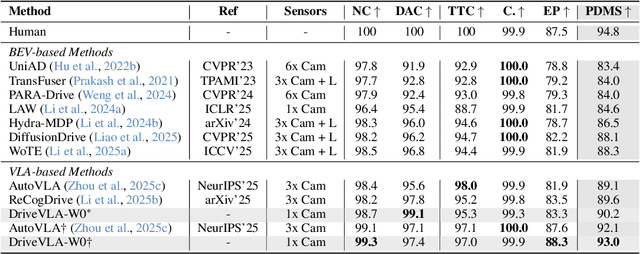
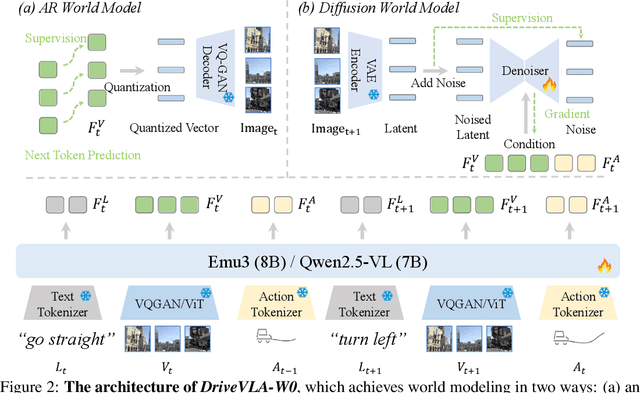

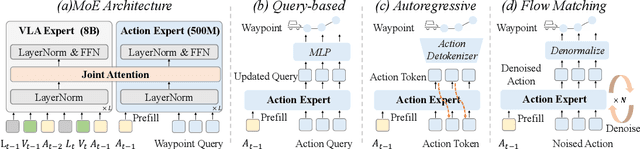
Scaling Vision-Language-Action (VLA) models on large-scale data offers a promising path to achieving a more generalized driving intelligence. However, VLA models are limited by a ``supervision deficit'': the vast model capacity is supervised by sparse, low-dimensional actions, leaving much of their representational power underutilized. To remedy this, we propose \textbf{DriveVLA-W0}, a training paradigm that employs world modeling to predict future images. This task generates a dense, self-supervised signal that compels the model to learn the underlying dynamics of the driving environment. We showcase the paradigm's versatility by instantiating it for two dominant VLA archetypes: an autoregressive world model for VLAs that use discrete visual tokens, and a diffusion world model for those operating on continuous visual features. Building on the rich representations learned from world modeling, we introduce a lightweight action expert to address the inference latency for real-time deployment. Extensive experiments on the NAVSIM v1/v2 benchmark and a 680x larger in-house dataset demonstrate that DriveVLA-W0 significantly outperforms BEV and VLA baselines. Crucially, it amplifies the data scaling law, showing that performance gains accelerate as the training dataset size increases.
ResDiff: Combining CNN and Diffusion Model for Image Super-Resolution
Mar 16, 2023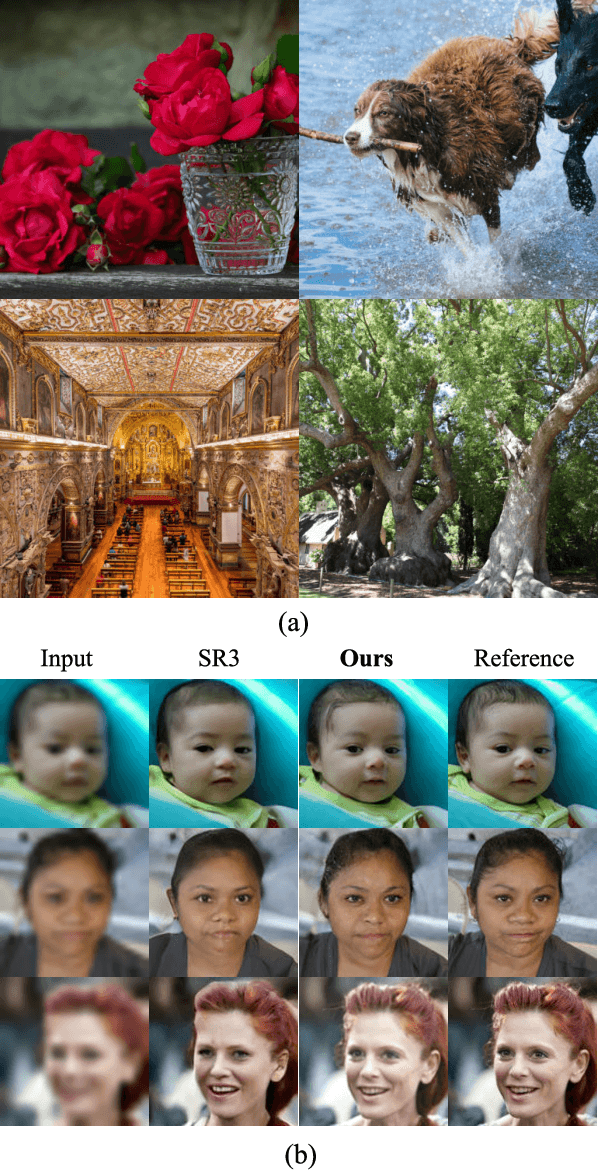

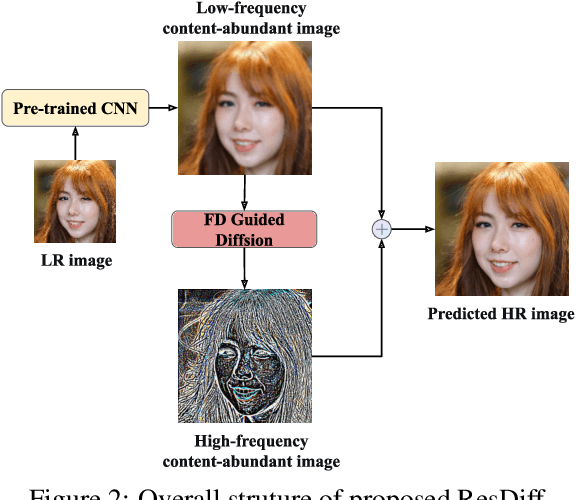
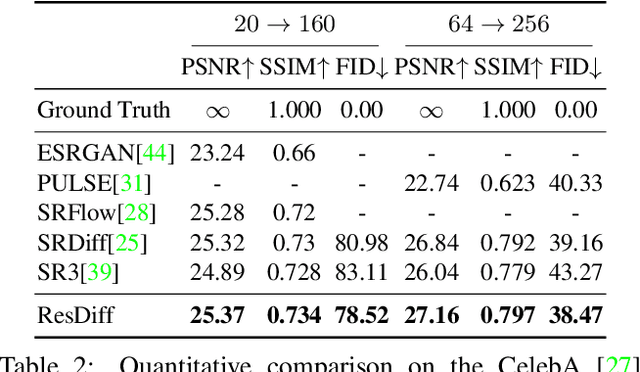
Adapting the Diffusion Probabilistic Model (DPM) for direct image super-resolution is wasteful, given that a simple Convolutional Neural Network (CNN) can recover the main low-frequency content. Therefore, we present ResDiff, a novel Diffusion Probabilistic Model based on Residual structure for Single Image Super-Resolution (SISR). ResDiff utilizes a combination of a CNN, which restores primary low-frequency components, and a DPM, which predicts the residual between the ground-truth image and the CNN-predicted image. In contrast to the common diffusion-based methods that directly use LR images to guide the noise towards HR space, ResDiff utilizes the CNN's initial prediction to direct the noise towards the residual space between HR space and CNN-predicted space, which not only accelerates the generation process but also acquires superior sample quality. Additionally, a frequency-domain-based loss function for CNN is introduced to facilitate its restoration, and a frequency-domain guided diffusion is designed for DPM on behalf of predicting high-frequency details. The extensive experiments on multiple benchmark datasets demonstrate that ResDiff outperforms previous diffusion-based methods in terms of shorter model convergence time, superior generation quality, and more diverse samples.