 Add to Chrome
 Add to Firefox
 Add to Edge
Prefilling-dLLM: Predictive Prefilling for Long-Context Inference in Diffusion Language Models
Jun 09, 2026
Diffusion large language models (dLLMs) re-encode the entire prefix at every denoising step, causing recomputation that scales quadratically with context length and becomes prohibitive for long-context scenarios. We propose Prefilling-dLLM, a training-free prefill-decode disaggregation framework for dLLMs that partitions the prefix into N chunks, caches their KV representations once, and selects the top-K most relevant chunks with intra-chunk token sparsity for decoding, showing that sparse prefilling can outperform dense attention while reducing per-step complexity from quadratic in the full sequence length to quadratic only in the decode length. On LongBench and InfiniteBench, Prefilling-dLLM achieves state-of-the-art quality among dLLM acceleration methods, and an attention kernel that parallelizes decoding over the non-contiguously cached chunk KV yields 9.1--28.0x speedup at 8K--32K contexts. We further show that beginning-of-sequence tokens prepended to each chunk act as periodic attention anchors that eliminate the lost-in-the-middle phenomenon. Code is available at https://github.com/menik1126/Prefilling-dLLM.

SkillEvolBench: Benchmarking the Evolution from Episodic Experience to Procedural Skills
May 22, 2026Large language model (LLM) agents accumulate rich episodic trajectories while solving real-world tasks, but it remains unclear whether such experience can be distilled into reusable procedural skills. We introduce SkillEvolBench, a diagnostic benchmark for evaluating this step from experience reuse to skill formation. It contains 180 tasks across six real-world agent environments, organized into role-conditioned task families with shared latent procedures. Agents learn from acquisition tasks, update an external skill library using compacted trajectories and verifier feedback, and then face frozen deployment tasks testing context shift, adversarial shortcuts, and composition. By comparing self-generated and curated-start skill evolution against no-skill and raw-trajectory controls, SkillEvolBench separates procedural abstraction from base capability, curated prior knowledge, and direct reuse of episodic traces. Across ten model configurations and three agent harnesses, we find that current agents often adapt locally but rarely form robust reusable skills. Skill-based conditions can improve acquisition or replay, and individual models sometimes gain on specific deployment axes, but these gains are unstable under frozen deployment. Raw-trajectory reuse frequently outperforms distilled skills, suggesting that current abstraction procedures discard contextual and procedural cues that remain useful for future tasks. Capacity and cost analyses further show that writing more skills or larger Tier-3 resource libraries is not sufficient: additional updates can improve coverage while introducing episode-specific drift and procedural clutter. These findings position SkillEvolBench as a testbed for measuring when one-off experience becomes durable procedural knowledge rather than task-local memory.
MathGen: Revealing the Illusion of Mathematical Competence through Text-to-Image Generation
Mar 31, 2026Modern generative models have demonstrated the ability to solve challenging mathematical problems. In many real-world settings, however, mathematical solutions must be expressed visually through diagrams, plots, geometric constructions, and structured symbolic layouts, where correctness depends on precise visual composition. This naturally raises the question of whether generative models can still do so when the answer must be rendered visually rather than written in text? To study this problem, we introduce MathGen, a rigorous benchmark of 900 problems spanning seven core domains, each paired with an executable verifier under a Script-as-a-Judge protocol for deterministic and objective evaluation. Experiments on representative open-source and proprietary text-to-image models show that mathematical fidelity remains a major bottleneck: even the best closed-source model reaches only 42.0% overall accuracy, while open-source models achieve just ~ 1-11%, often near 0% on structured tasks. Overall, current T2I models remain far from competent at even elementary mathematical visual generation.
MMSpec: Benchmarking Speculative Decoding for Vision-Language Models
Mar 16, 2026Vision-language models (VLMs) achieve strong performance on multimodal tasks but suffer from high inference latency due to large model sizes and long multimodal contexts. Speculative decoding has recently emerged as an effective acceleration technique, yet its behavior in VLMs remains insufficiently understood. We introduce MMSpec, the first benchmark for evaluating speculative decoding in vision-language models. MMSpec contains 600 multimodal samples across six task categories and integrates ten representative speculative decoding algorithms under a unified evaluation framework. Our study reveals three key findings: (1) methods designed for text-only LLMs degrade in multimodal scenarios, (2) vision awareness becomes increasingly important at larger batch sizes, and (3) throughput speedup alone does not reliably reflect latency performance. Motivated by these findings, we propose ViSkip, a plug-and-play speculative decoding method that dynamically adapts speculation to vision tokens and achieves state-of-the-art performance.
QuantVLA: Scale-Calibrated Post-Training Quantization for Vision-Language-Action Models
Feb 25, 2026Vision-language-action (VLA) models unify perception, language, and control for embodied agents but face significant challenges in practical deployment due to rapidly increasing compute and memory demands, especially as models scale to longer horizons and larger backbones. To address these bottlenecks, we introduce QuantVLA, a training-free post-training quantization (PTQ) framework that, to our knowledge, is the first PTQ approach for VLA systems and the first to successfully quantize a diffusion transformer (DiT) action head. QuantVLA incorporates three scale-calibrated components: (1) a selective quantization layout that integerizes all linear layers in both the language backbone and the DiT while keeping attention projections in floating point to preserve the original operator schedule; (2) attention temperature matching, a lightweight per-head scaling mechanism that stabilizes attention logits and is folded into the dequantization scales at inference; and (3) output head balancing, a per-layer residual interface calibration that mitigates post-projection energy drift. The framework requires no additional training, uses only a small unlabeled calibration buffer, and supports integer kernels for low-bit weights and activations while leaving the architecture unchanged. Across representative VLA models on LIBERO, QuantVLA exceeds the task success rates of full-precision baselines, achieves about 70% relative memory savings on the quantized components, and delivers a 1.22x speedup in end-to-end inference latency, providing a practical pathway toward scalable low-bit embodied intelligence under strict compute, memory, and power constraints.
MMFormalizer: Multimodal Autoformalization in the Wild
Jan 06, 2026Autoformalization, which translates natural language mathematics into formal statements to enable machine reasoning, faces fundamental challenges in the wild due to the multimodal nature of the physical world, where physics requires inferring hidden constraints (e.g., mass or energy) from visual elements. To address this, we propose MMFormalizer, which extends autoformalization beyond text by integrating adaptive grounding with entities from real-world mathematical and physical domains. MMFormalizer recursively constructs formal propositions from perceptually grounded primitives through recursive grounding and axiom composition, with adaptive recursive termination ensuring that every abstraction is supported by visual evidence and anchored in dimensional or axiomatic grounding. We evaluate MMFormalizer on a new benchmark, PhyX-AF, comprising 115 curated samples from MathVerse, PhyX, Synthetic Geometry, and Analytic Geometry, covering diverse multimodal autoformalization tasks. Results show that frontier models such as GPT-5 and Gemini-3-Pro achieve the highest compile and semantic accuracy, with GPT-5 excelling in physical reasoning, while geometry remains the most challenging domain. Overall, MMFormalizer provides a scalable framework for unified multimodal autoformalization, bridging perception and formal reasoning. To the best of our knowledge, this is the first multimodal autoformalization method capable of handling classical mechanics (derived from the Hamiltonian), as well as relativity, quantum mechanics, and thermodynamics. More details are available on our project page: MMFormalizer.github.io
PhyX: Does Your Model Have the "Wits" for Physical Reasoning?
May 21, 2025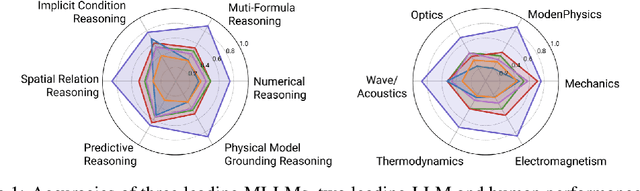
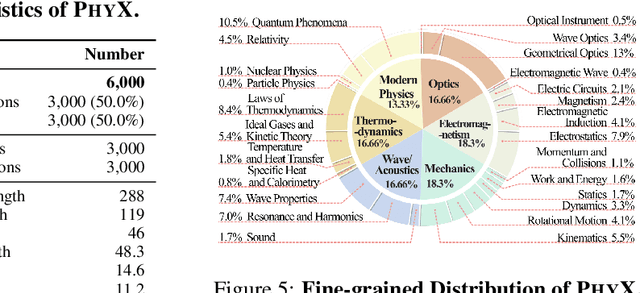
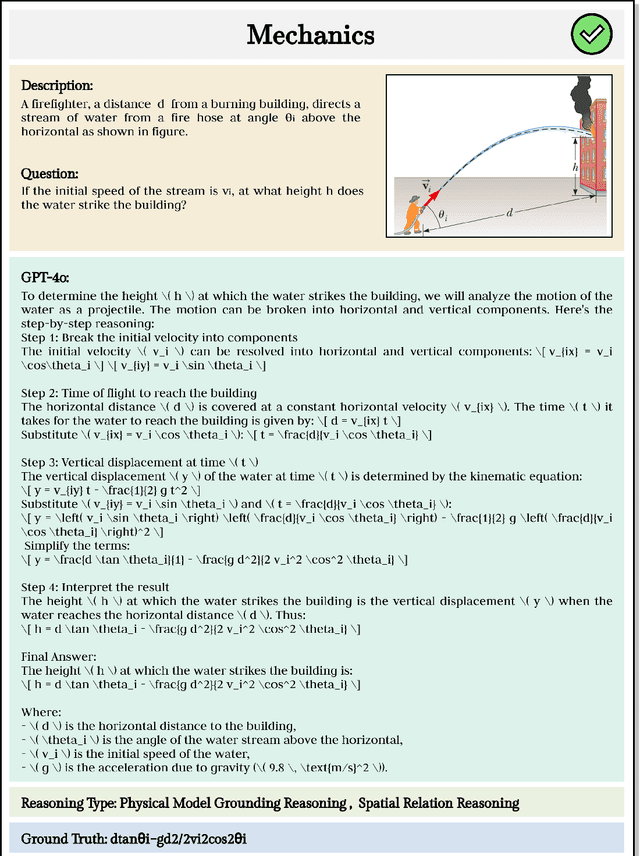
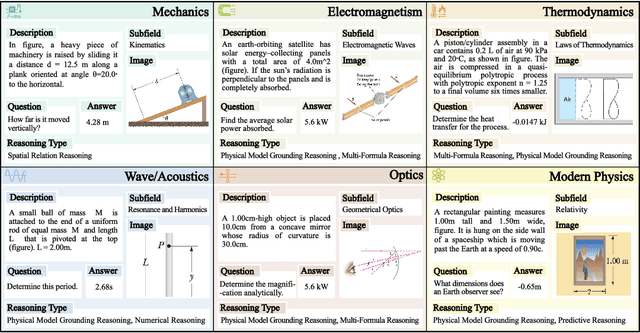
Existing benchmarks fail to capture a crucial aspect of intelligence: physical reasoning, the integrated ability to combine domain knowledge, symbolic reasoning, and understanding of real-world constraints. To address this gap, we introduce PhyX: the first large-scale benchmark designed to assess models capacity for physics-grounded reasoning in visual scenarios. PhyX includes 3K meticulously curated multimodal questions spanning 6 reasoning types across 25 sub-domains and 6 core physics domains: thermodynamics, electromagnetism, mechanics, modern physics, optics, and wave\&acoustics. In our comprehensive evaluation, even state-of-the-art models struggle significantly with physical reasoning. GPT-4o, Claude3.7-Sonnet, and GPT-o4-mini achieve only 32.5\%, 42.2\%, and 45.8\% accuracy respectively-performance gaps exceeding 29\% compared to human experts. Our analysis exposes critical limitations in current models: over-reliance on memorized disciplinary knowledge, excessive dependence on mathematical formulations, and surface-level visual pattern matching rather than genuine physical understanding. We provide in-depth analysis through fine-grained statistics, detailed case studies, and multiple evaluation paradigms to thoroughly examine physical reasoning capabilities. To ensure reproducibility, we implement a compatible evaluation protocol based on widely-used toolkits such as VLMEvalKit, enabling one-click evaluation.