 Add to Chrome
 Add to Firefox
 Add to Edge
Fast Explicit-Input Assistance for Teleoperation in Clutter
Feb 04, 2024
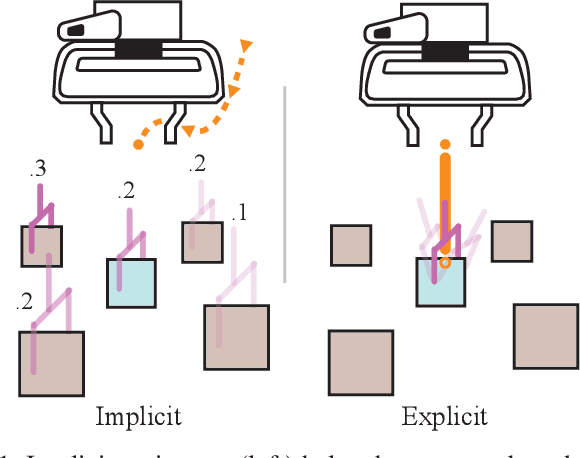


The performance of prediction-based assistance for robot teleoperation degrades in unseen or goal-rich environments due to incorrect or quickly-changing intent inferences. Poor predictions can confuse operators or cause them to change their control input to implicitly signal their goal, resulting in unnatural movement. We present a new assistance algorithm and interface for robotic manipulation where an operator can explicitly communicate a manipulation goal by pointing the end-effector. Rapid optimization and parallel collision checking in a local region around the pointing target enable direct, interactive control over grasp and place pose candidates. We compare the explicit pointing interface to an implicit inference-based assistance scheme in a within-subjects user study (N=20) where participants teleoperate a simulated robot to complete a multi-step singulation and stacking task in cluttered environments. We find that operators prefer the explicit interface, which improved completion time, pick and place success rates, and NASA TLX scores. Our code is available at https://github.com/NVlabs/fast-explicit-teleop

STOW: Discrete-Frame Segmentation and Tracking of Unseen Objects for Warehouse Picking Robots
Nov 04, 2023


Segmentation and tracking of unseen object instances in discrete frames pose a significant challenge in dynamic industrial robotic contexts, such as distribution warehouses. Here, robots must handle object rearrangement, including shifting, removal, and partial occlusion by new items, and track these items after substantial temporal gaps. The task is further complicated when robots encounter objects not learned in their training sets, which requires the ability to segment and track previously unseen items. Considering that continuous observation is often inaccessible in such settings, our task involves working with a discrete set of frames separated by indefinite periods during which substantial changes to the scene may occur. This task also translates to domestic robotic applications, such as rearrangement of objects on a table. To address these demanding challenges, we introduce new synthetic and real-world datasets that replicate these industrial and household scenarios. We also propose a novel paradigm for joint segmentation and tracking in discrete frames along with a transformer module that facilitates efficient inter-frame communication. The experiments we conduct show that our approach significantly outperforms recent methods. For additional results and videos, please visit \href{https://sites.google.com/view/stow-corl23}{website}. Code and dataset will be released.
cuRobo: Parallelized Collision-Free Minimum-Jerk Robot Motion Generation
Nov 03, 2023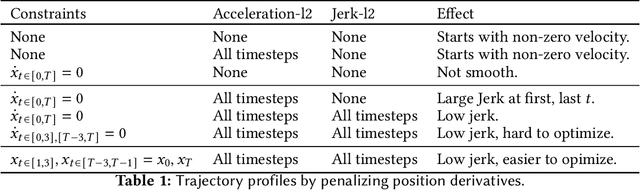


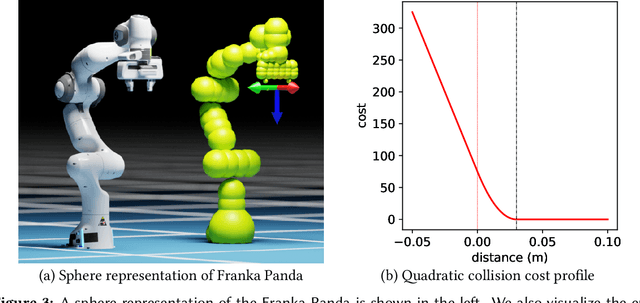
This paper explores the problem of collision-free motion generation for manipulators by formulating it as a global motion optimization problem. We develop a parallel optimization technique to solve this problem and demonstrate its effectiveness on massively parallel GPUs. We show that combining simple optimization techniques with many parallel seeds leads to solving difficult motion generation problems within 50ms on average, 60x faster than state-of-the-art (SOTA) trajectory optimization methods. We achieve SOTA performance by combining L-BFGS step direction estimation with a novel parallel noisy line search scheme and a particle-based optimization solver. To further aid trajectory optimization, we develop a parallel geometric planner that plans within 20ms and also introduce a collision-free IK solver that can solve over 7000 queries/s. We package our contributions into a state of the art GPU accelerated motion generation library, cuRobo and release it to enrich the robotics community. Additional details are available at https://curobo.org
M2T2: Multi-Task Masked Transformer for Object-centric Pick and Place
Nov 02, 2023With the advent of large language models and large-scale robotic datasets, there has been tremendous progress in high-level decision-making for object manipulation. These generic models are able to interpret complex tasks using language commands, but they often have difficulties generalizing to out-of-distribution objects due to the inability of low-level action primitives. In contrast, existing task-specific models excel in low-level manipulation of unknown objects, but only work for a single type of action. To bridge this gap, we present M2T2, a single model that supplies different types of low-level actions that work robustly on arbitrary objects in cluttered scenes. M2T2 is a transformer model which reasons about contact points and predicts valid gripper poses for different action modes given a raw point cloud of the scene. Trained on a large-scale synthetic dataset with 128K scenes, M2T2 achieves zero-shot sim2real transfer on the real robot, outperforming the baseline system with state-of-the-art task-specific models by about 19% in overall performance and 37.5% in challenging scenes where the object needs to be re-oriented for collision-free placement. M2T2 also achieves state-of-the-art results on a subset of language conditioned tasks in RLBench. Videos of robot experiments on unseen objects in both real world and simulation are available on our project website https://m2-t2.github.io.
MimicGen: A Data Generation System for Scalable Robot Learning using Human Demonstrations
Oct 26, 2023


Imitation learning from a large set of human demonstrations has proved to be an effective paradigm for building capable robot agents. However, the demonstrations can be extremely costly and time-consuming to collect. We introduce MimicGen, a system for automatically synthesizing large-scale, rich datasets from only a small number of human demonstrations by adapting them to new contexts. We use MimicGen to generate over 50K demonstrations across 18 tasks with diverse scene configurations, object instances, and robot arms from just ~200 human demonstrations. We show that robot agents can be effectively trained on this generated dataset by imitation learning to achieve strong performance in long-horizon and high-precision tasks, such as multi-part assembly and coffee preparation, across broad initial state distributions. We further demonstrate that the effectiveness and utility of MimicGen data compare favorably to collecting additional human demonstrations, making it a powerful and economical approach towards scaling up robot learning. Datasets, simulation environments, videos, and more at https://mimicgen.github.io .
Human-in-the-Loop Task and Motion Planning for Imitation Learning
Oct 24, 2023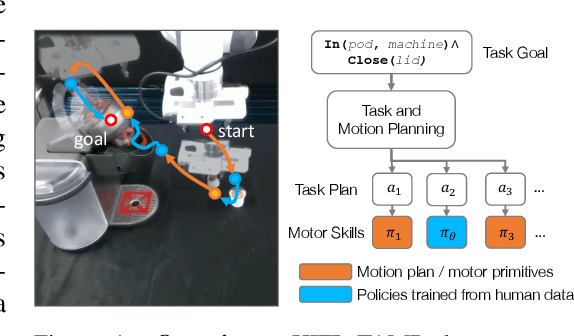
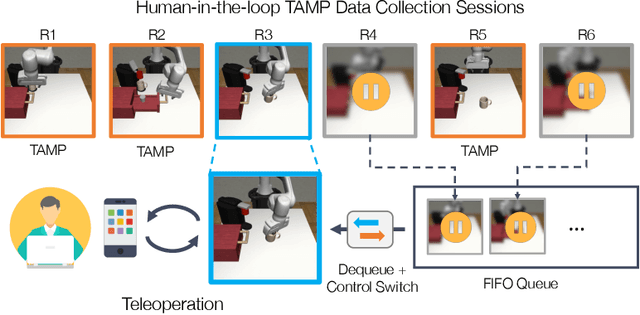
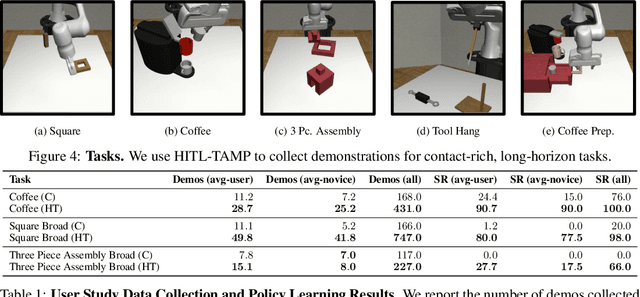
Imitation learning from human demonstrations can teach robots complex manipulation skills, but is time-consuming and labor intensive. In contrast, Task and Motion Planning (TAMP) systems are automated and excel at solving long-horizon tasks, but they are difficult to apply to contact-rich tasks. In this paper, we present Human-in-the-Loop Task and Motion Planning (HITL-TAMP), a novel system that leverages the benefits of both approaches. The system employs a TAMP-gated control mechanism, which selectively gives and takes control to and from a human teleoperator. This enables the human teleoperator to manage a fleet of robots, maximizing data collection efficiency. The collected human data is then combined with an imitation learning framework to train a TAMP-gated policy, leading to superior performance compared to training on full task demonstrations. We compared HITL-TAMP to a conventional teleoperation system -- users gathered more than 3x the number of demos given the same time budget. Furthermore, proficient agents (75\%+ success) could be trained from just 10 minutes of non-expert teleoperation data. Finally, we collected 2.1K demos with HITL-TAMP across 12 contact-rich, long-horizon tasks and show that the system often produces near-perfect agents. Videos and additional results at https://hitltamp.github.io .
NEWTON: Are Large Language Models Capable of Physical Reasoning?
Oct 10, 2023


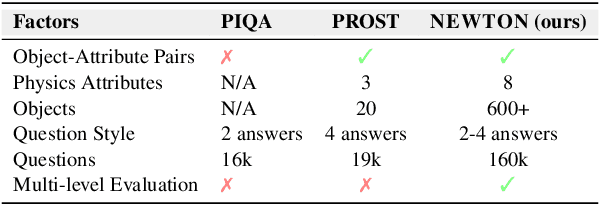
Large Language Models (LLMs), through their contextualized representations, have been empirically proven to encapsulate syntactic, semantic, word sense, and common-sense knowledge. However, there has been limited exploration of their physical reasoning abilities, specifically concerning the crucial attributes for comprehending everyday objects. To address this gap, we introduce NEWTON, a repository and benchmark for evaluating the physics reasoning skills of LLMs. Further, to enable domain-specific adaptation of this benchmark, we present a pipeline to enable researchers to generate a variant of this benchmark that has been customized to the objects and attributes relevant for their application. The NEWTON repository comprises a collection of 2800 object-attribute pairs, providing the foundation for generating infinite-scale assessment templates. The NEWTON benchmark consists of 160K QA questions, curated using the NEWTON repository to investigate the physical reasoning capabilities of several mainstream language models across foundational, explicit, and implicit reasoning tasks. Through extensive empirical analysis, our results highlight the capabilities of LLMs for physical reasoning. We find that LLMs like GPT-4 demonstrate strong reasoning capabilities in scenario-based tasks but exhibit less consistency in object-attribute reasoning compared to humans (50% vs. 84%). Furthermore, the NEWTON platform demonstrates its potential for evaluating and enhancing language models, paving the way for their integration into physically grounded settings, such as robotic manipulation. Project site: https://newtonreasoning.github.io
AnyTeleop: A General Vision-Based Dexterous Robot Arm-Hand Teleoperation System
Aug 02, 2023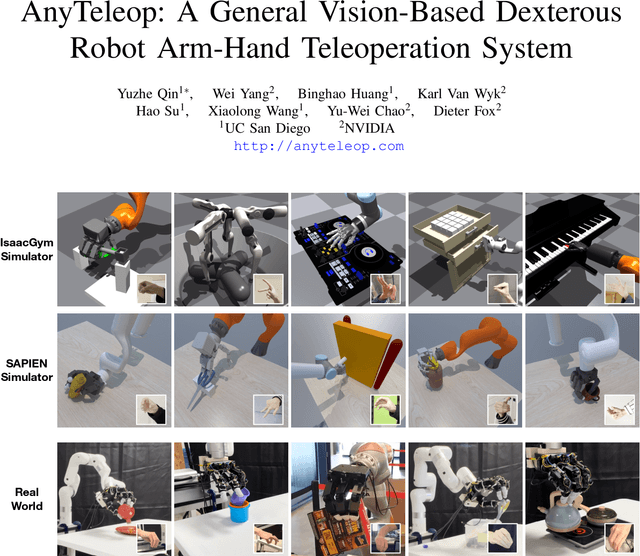
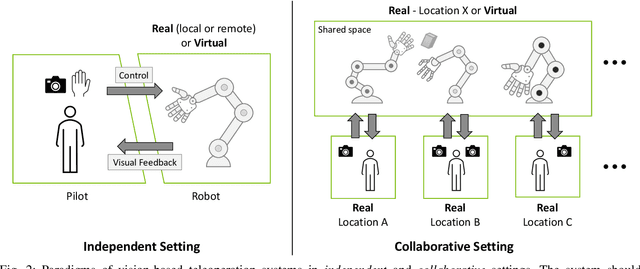
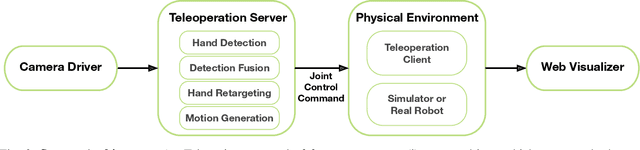
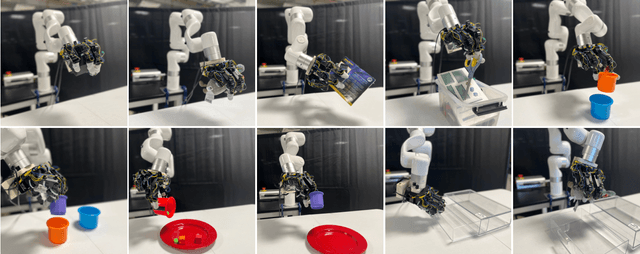
Vision-based teleoperation offers the possibility to endow robots with human-level intelligence to physically interact with the environment, while only requiring low-cost camera sensors. However, current vision-based teleoperation systems are designed and engineered towards a particular robot model and deploy environment, which scales poorly as the pool of the robot models expands and the variety of the operating environment increases. In this paper, we propose AnyTeleop, a unified and general teleoperation system to support multiple different arms, hands, realities, and camera configurations within a single system. Although being designed to provide great flexibility to the choice of simulators and real hardware, our system can still achieve great performance. For real-world experiments, AnyTeleop can outperform a previous system that was designed for a specific robot hardware with a higher success rate, using the same robot. For teleoperation in simulation, AnyTeleop leads to better imitation learning performance, compared with a previous system that is particularly designed for that simulator. Project page: http://anyteleop.com/.
Shelving, Stacking, Hanging: Relational Pose Diffusion for Multi-modal Rearrangement
Jul 10, 2023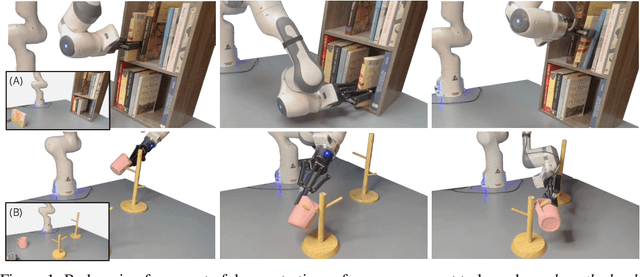
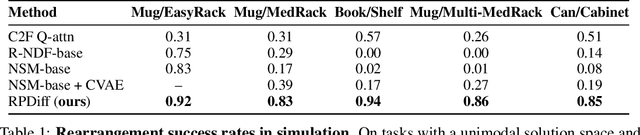
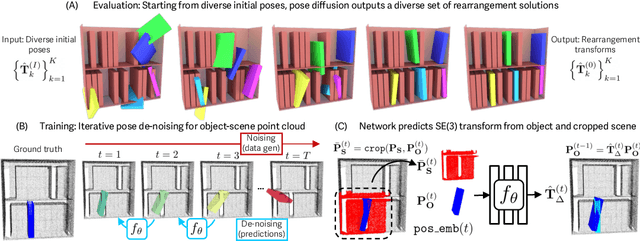
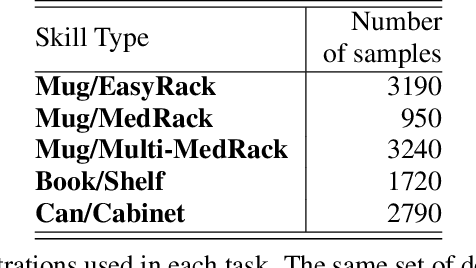
We propose a system for rearranging objects in a scene to achieve a desired object-scene placing relationship, such as a book inserted in an open slot of a bookshelf. The pipeline generalizes to novel geometries, poses, and layouts of both scenes and objects, and is trained from demonstrations to operate directly on 3D point clouds. Our system overcomes challenges associated with the existence of many geometrically-similar rearrangement solutions for a given scene. By leveraging an iterative pose de-noising training procedure, we can fit multi-modal demonstration data and produce multi-modal outputs while remaining precise and accurate. We also show the advantages of conditioning on relevant local geometric features while ignoring irrelevant global structure that harms both generalization and precision. We demonstrate our approach on three distinct rearrangement tasks that require handling multi-modality and generalization over object shape and pose in both simulation and the real world. Project website, code, and videos: https://anthonysimeonov.github.io/rpdiff-multi-modal/
Meta-Policy Learning over Plan Ensembles for Robust Articulated Object Manipulation
Jul 08, 2023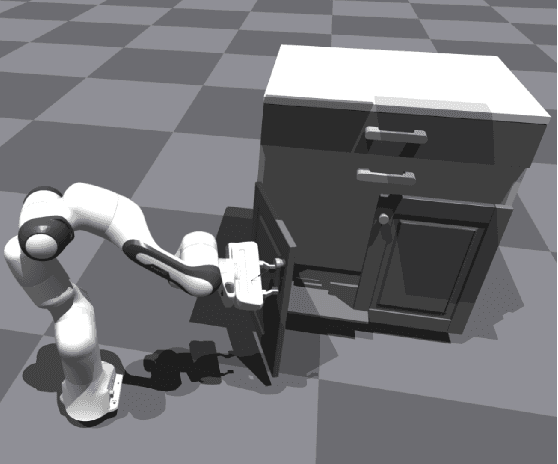
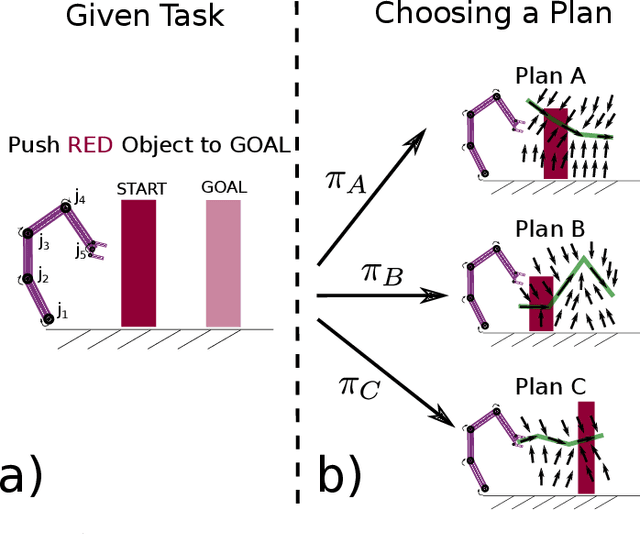
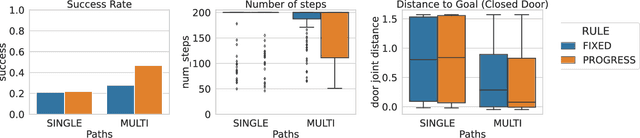
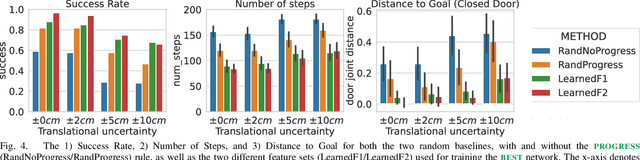
Recent work has shown that complex manipulation skills, such as pushing or pouring, can be learned through state-of-the-art learning based techniques, such as Reinforcement Learning (RL). However, these methods often have high sample-complexity, are susceptible to domain changes, and produce unsafe motions that a robot should not perform. On the other hand, purely geometric model-based planning can produce complex behaviors that satisfy all the geometric constraints of the robot but might not be dynamically feasible for a given environment. In this work, we leverage a geometric model-based planner to build a mixture of path-policies on which a task-specific meta-policy can be learned to complete the task. In our results, we demonstrate that a successful meta-policy can be learned to push a door, while requiring little data and being robust to model uncertainty of the environment. We tested our method on a 7-DOF Franka-Emika Robot pushing a cabinet door in simulation.