 Add to Chrome
 Add to Firefox
 Add to Edge
Chain of Modality: From Static Fusion to Dynamic Orchestration in Omni-MLLMs
Apr 16, 2026
Omni-modal Large Language Models (Omni-MLLMs) promise a unified integration of diverse sensory streams. However, recent evaluations reveal a critical performance paradox: unimodal baselines frequently outperform joint multimodal inference. We trace this perceptual fragility to the static fusion topologies universally employed by current models, identifying two structural pathologies: positional bias in sequential inputs and alignment traps in interleaved formats, which systematically distort attention regardless of task semantics. To resolve this functional rigidity, we propose Chain of Modality (CoM), an agentic framework that transitions multimodal fusion from passive concatenation to dynamic orchestration. CoM adaptively orchestrates input topologies, switching among parallel, sequential, and interleaved pathways to neutralize structural biases. Furthermore, CoM bifurcates cognitive execution into two task-aligned pathways: a streamlined ``Direct-Decide'' path for direct perception and a structured ``Reason-Decide'' path for analytical auditing. Operating in either a training-free or a data-efficient SFT setting, CoM achieves robust and consistent generalization across diverse benchmarks.

GPA: Learning GUI Process Automation from Demonstrations
Apr 02, 2026GUI Process Automation (GPA) is a lightweight but general vision-based Robotic Process Automation (RPA), which enables fast and stable process replay with only a single demo. Addressing the fragility of traditional RPA and the non-deterministic risks of current vision language model-based GUI agents, GPA introduces three core benefits: (1) Robustness via Sequential Monte Carlo-based localization to handle rescaling and detection uncertainty; (2) Deterministic and Reliability safeguarded by readiness calibration; and (3) Privacy through fast, fully local execution. This approach delivers the adaptability, robustness, and security required for enterprise workflows. It can also be used as an MCP/CLI tool by other agents with coding capabilities so that the agent only reasons and orchestrates while GPA handles the GUI execution. We conducted a pilot experiment to compare GPA with Gemini 3 Pro (with CUA tools) and found that GPA achieves higher success rate with 10 times faster execution speed in finishing long-horizon GUI tasks.
Probabilistic Concept Graph Reasoning for Multimodal Misinformation Detection
Mar 26, 2026Multimodal misinformation poses an escalating challenge that often evades traditional detectors, which are opaque black boxes and fragile against new manipulation tactics. We present Probabilistic Concept Graph Reasoning (PCGR), an interpretable and evolvable framework that reframes multimodal misinformation detection (MMD) as structured and concept-based reasoning. PCGR follows a build-then-infer paradigm, which first constructs a graph of human-understandable concept nodes, including novel high-level concepts automatically discovered and validated by multimodal large language models (MLLMs), and then applies hierarchical attention over this concept graph to infer claim veracity. This design produces interpretable reasoning chains linking evidence to conclusions. Experiments demonstrate that PCGR achieves state-of-the-art MMD accuracy and robustness to emerging manipulation types, outperforming prior methods in both coarse detection and fine-grained manipulation recognition.
DiffCoT: Diffusion-styled Chain-of-Thought Reasoning in LLMs
Jan 07, 2026Chain-of-Thought (CoT) reasoning improves multi-step mathematical problem solving in large language models but remains vulnerable to exposure bias and error accumulation, as early mistakes propagate irreversibly through autoregressive decoding. In this work, we propose DiffCoT, a diffusion-styled CoT framework that reformulates CoT reasoning as an iterative denoising process. DiffCoT integrates diffusion principles at the reasoning-step level via a sliding-window mechanism, enabling unified generation and retrospective correction of intermediate steps while preserving token-level autoregression. To maintain causal consistency, we further introduce a causal diffusion noise schedule that respects the temporal structure of reasoning chains. Extensive experiments on three multi-step CoT reasoning benchmarks across diverse model backbones demonstrate that DiffCoT consistently outperforms existing CoT preference optimization methods, yielding improved robustness and error-correction capability in CoT reasoning.
Towards Comprehensive Stage-wise Benchmarking of Large Language Models in Fact-Checking
Jan 06, 2026Large Language Models (LLMs) are increasingly deployed in real-world fact-checking systems, yet existing evaluations focus predominantly on claim verification and overlook the broader fact-checking workflow, including claim extraction and evidence retrieval. This narrow focus prevents current benchmarks from revealing systematic reasoning failures, factual blind spots, and robustness limitations of modern LLMs. To bridge this gap, we present FactArena, a fully automated arena-style evaluation framework that conducts comprehensive, stage-wise benchmarking of LLMs across the complete fact-checking pipeline. FactArena integrates three key components: (i) an LLM-driven fact-checking process that standardizes claim decomposition, evidence retrieval via tool-augmented interactions, and justification-based verdict prediction; (ii) an arena-styled judgment mechanism guided by consolidated reference guidelines to ensure unbiased and consistent pairwise comparisons across heterogeneous judge agents; and (iii) an arena-driven claim-evolution module that adaptively generates more challenging and semantically controlled claims to probe LLMs' factual robustness beyond fixed seed data. Across 16 state-of-the-art LLMs spanning seven model families, FactArena produces stable and interpretable rankings. Our analyses further reveal significant discrepancies between static claim-verification accuracy and end-to-end fact-checking competence, highlighting the necessity of holistic evaluation. The proposed framework offers a scalable and trustworthy paradigm for diagnosing LLMs' factual reasoning, guiding future model development, and advancing the reliable deployment of LLMs in safety-critical fact-checking applications.
MM-CRITIC: A Holistic Evaluation of Large Multimodal Models as Multimodal Critique
Nov 12, 2025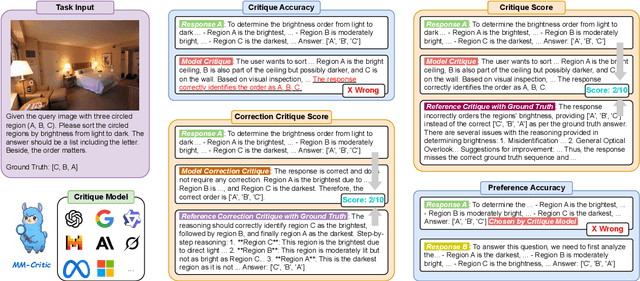

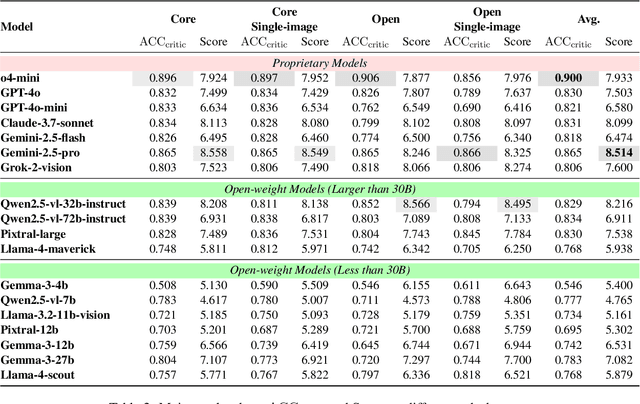
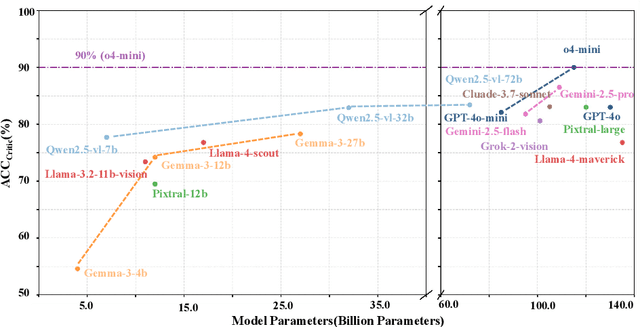
The ability of critique is vital for models to self-improve and serve as reliable AI assistants. While extensively studied in language-only settings, multimodal critique of Large Multimodal Models (LMMs) remains underexplored despite their growing capabilities in tasks like captioning and visual reasoning. In this work, we introduce MM-CRITIC, a holistic benchmark for evaluating the critique ability of LMMs across multiple dimensions: basic, correction, and comparison. Covering 8 main task types and over 500 tasks, MM-CRITIC collects responses from various LMMs with different model sizes and is composed of 4471 samples. To enhance the evaluation reliability, we integrate expert-informed ground answers into scoring rubrics that guide GPT-4o in annotating responses and generating reference critiques, which serve as anchors for trustworthy judgments. Extensive experiments validate the effectiveness of MM-CRITIC and provide a comprehensive assessment of leading LMMs' critique capabilities under multiple dimensions. Further analysis reveals some key insights, including the correlation between response quality and critique, and varying critique difficulty across evaluation dimensions. Our code is available at https://github.com/MichealZeng0420/MM-Critic.
MemeArena: Automating Context-Aware Unbiased Evaluation of Harmfulness Understanding for Multimodal Large Language Models
Oct 31, 2025The proliferation of memes on social media necessitates the capabilities of multimodal Large Language Models (mLLMs) to effectively understand multimodal harmfulness. Existing evaluation approaches predominantly focus on mLLMs' detection accuracy for binary classification tasks, which often fail to reflect the in-depth interpretive nuance of harmfulness across diverse contexts. In this paper, we propose MemeArena, an agent-based arena-style evaluation framework that provides a context-aware and unbiased assessment for mLLMs' understanding of multimodal harmfulness. Specifically, MemeArena simulates diverse interpretive contexts to formulate evaluation tasks that elicit perspective-specific analyses from mLLMs. By integrating varied viewpoints and reaching consensus among evaluators, it enables fair and unbiased comparisons of mLLMs' abilities to interpret multimodal harmfulness. Extensive experiments demonstrate that our framework effectively reduces the evaluation biases of judge agents, with judgment results closely aligning with human preferences, offering valuable insights into reliable and comprehensive mLLM evaluations in multimodal harmfulness understanding. Our code and data are publicly available at https://github.com/Lbotirx/MemeArena.
EvolProver: Advancing Automated Theorem Proving by Evolving Formalized Problems via Symmetry and Difficulty
Oct 01, 2025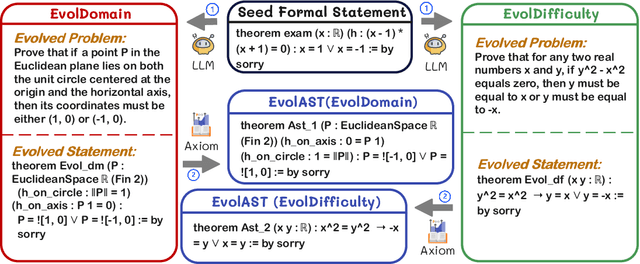
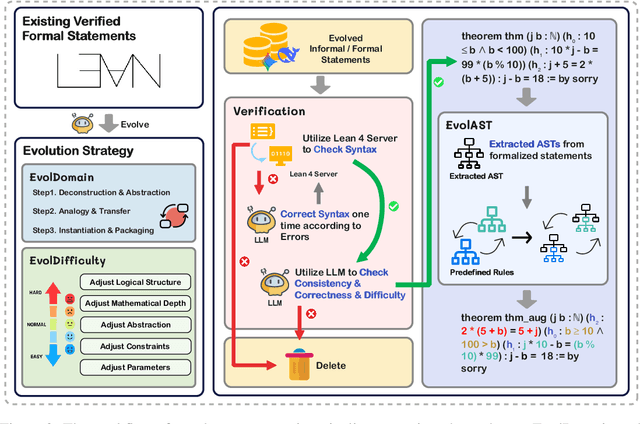
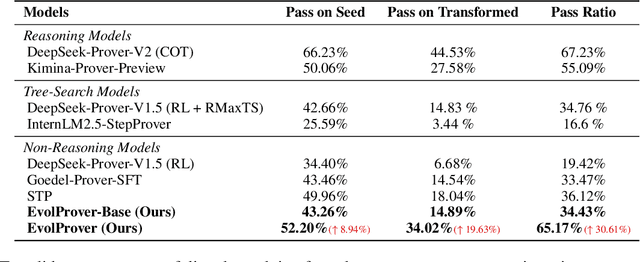
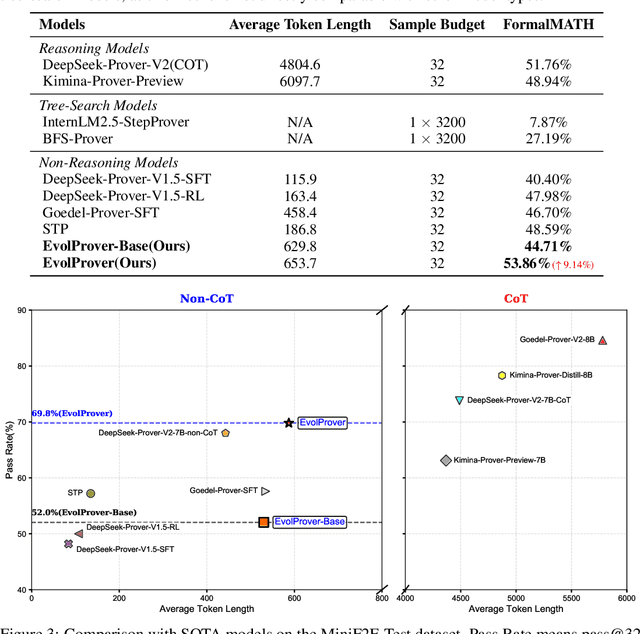
Large Language Models (LLMs) for formal theorem proving have shown significant promise, yet they often lack generalizability and are fragile to even minor transformations of problem statements. To address this limitation, we introduce a novel data augmentation pipeline designed to enhance model robustness from two perspectives: symmetry and difficulty. From the symmetry perspective, we propose two complementary methods: EvolAST, an Abstract Syntax Tree (AST) based approach that targets syntactic symmetry to generate semantically equivalent problem variants, and EvolDomain, which leverages LLMs to address semantic symmetry by translating theorems across mathematical domains. From the difficulty perspective, we propose EvolDifficulty, which uses carefully designed evolutionary instructions to guide LLMs in generating new theorems with a wider range of difficulty. We then use the evolved data to train EvolProver, a 7B-parameter non-reasoning theorem prover. EvolProver establishes a new state-of-the-art (SOTA) on FormalMATH-Lite with a 53.8% pass@32 rate, surpassing all models of comparable size, including reasoning-based models. It also sets new SOTA records for non-reasoning models on MiniF2F-Test (69.8% pass@32), Ineq-Comp-Seed (52.2% pass@32), and Ineq-Comp-Transformed (34.0% pass@32). Ablation studies further confirm our data augmentation pipeline's effectiveness across multiple benchmarks.
MCP-Universe: Benchmarking Large Language Models with Real-World Model Context Protocol Servers
Aug 20, 2025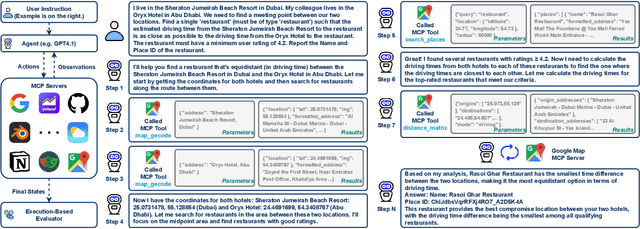
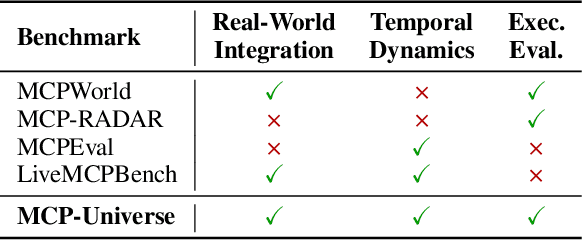
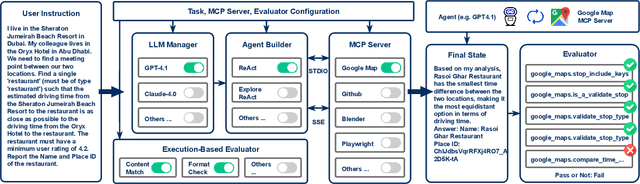
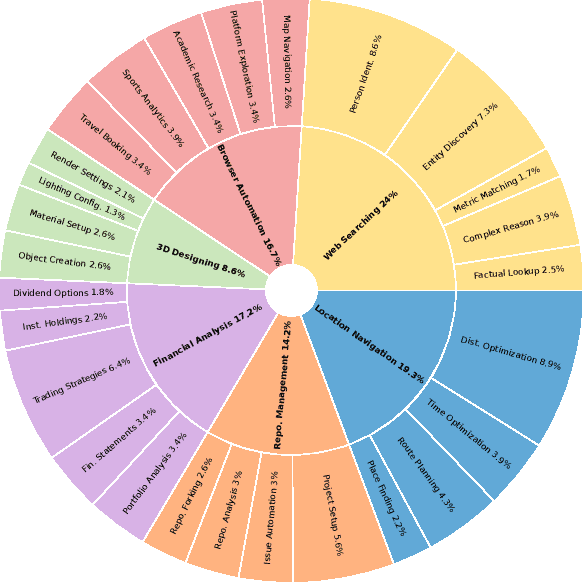
The Model Context Protocol has emerged as a transformative standard for connecting large language models to external data sources and tools, rapidly gaining adoption across major AI providers and development platforms. However, existing benchmarks are overly simplistic and fail to capture real application challenges such as long-horizon reasoning and large, unfamiliar tool spaces. To address this critical gap, we introduce MCP-Universe, the first comprehensive benchmark specifically designed to evaluate LLMs in realistic and hard tasks through interaction with real-world MCP servers. Our benchmark encompasses 6 core domains spanning 11 different MCP servers: Location Navigation, Repository Management, Financial Analysis, 3D Design, Browser Automation, and Web Searching. To ensure rigorous evaluation, we implement execution-based evaluators, including format evaluators for agent format compliance, static evaluators for time-invariant content matching, and dynamic evaluators that automatically retrieve real-time ground truth for temporally sensitive tasks. Through extensive evaluation of leading LLMs, we find that even SOTA models such as GPT-5 (43.72%), Grok-4 (33.33%) and Claude-4.0-Sonnet (29.44%) exhibit significant performance limitations. In addition, our benchmark poses a significant long-context challenge for LLM agents, as the number of input tokens increases rapidly with the number of interaction steps. Moreover, it introduces an unknown-tools challenge, as LLM agents often lack familiarity with the precise usage of the MCP servers. Notably, enterprise-level agents like Cursor cannot achieve better performance than standard ReAct frameworks. Beyond evaluation, we open-source our extensible evaluation framework with UI support, enabling researchers and practitioners to seamlessly integrate new agents and MCP servers while fostering innovation in the rapidly evolving MCP ecosystem.
RepreGuard: Detecting LLM-Generated Text by Revealing Hidden Representation Patterns
Aug 18, 2025


Detecting content generated by large language models (LLMs) is crucial for preventing misuse and building trustworthy AI systems. Although existing detection methods perform well, their robustness in out-of-distribution (OOD) scenarios is still lacking. In this paper, we hypothesize that, compared to features used by existing detection methods, the internal representations of LLMs contain more comprehensive and raw features that can more effectively capture and distinguish the statistical pattern differences between LLM-generated texts (LGT) and human-written texts (HWT). We validated this hypothesis across different LLMs and observed significant differences in neural activation patterns when processing these two types of texts. Based on this, we propose RepreGuard, an efficient statistics-based detection method. Specifically, we first employ a surrogate model to collect representation of LGT and HWT, and extract the distinct activation feature that can better identify LGT. We can classify the text by calculating the projection score of the text representations along this feature direction and comparing with a precomputed threshold. Experimental results show that RepreGuard outperforms all baselines with average 94.92% AUROC on both in-distribution (ID) and OOD scenarios, while also demonstrating robust resilience to various text sizes and mainstream attacks. Data and code are publicly available at: https://github.com/NLP2CT/RepreGuard