 Add to Chrome
 Add to Firefox
 Add to Edge
SimpleOPD: Simple Tokenizer-Agnostic On-Policy Distillation for Long-Context Reasoning
Aug 14, 2026
On-policy distillation (OPD) offers a promising way to transfer reasoning capabilities from stronger teacher models, but applying it to long-context reasoning teachers and short-context students introduces practical challenges, including tokenizer mismatch, teacher-student distribution mismatch, response length explosion, and training instability. In this work, we study this setting by transferring proof-reasoning capabilities from the long-context reasoning model SU-01 to short-context student models. To handle tokenizer differences, we perform OPD in a shared text space and align only tokens that occupy identical text spans under the student and teacher tokenizers. To mitigate the problem of excessive generation length and frequent truncation, we introduce a student reference KL loss and mask the advantages of special termination tokens such as </think> and <|im_end|>. This strategy constrains the student from drifting excessively from its initial policy, thereby mitigating the teacher-student distribution mismatch problem and fostering steady length growth. Experiments on both same-family and different-family student models, including Qwen3, Qwen3.5, Intern-S2, GLM-4.7, Gemma-4, show consistent gains in mathematical reasoning, especially natural-language math proving. Notably, Intern-S2-Preview improves by 21.2 points on ProofBench, reaching 55.2 and surpassing Gemini-2.5-Pro. It also improves on science benchmarks such as HLE and HiPhO, suggesting that OPD transfers reasoning capabilities that generalize beyond the mathematical training domain.

EvoPolicyGym: Evaluating Autonomous Policy Evolution in Interactive Environments
Jul 02, 2026Autonomous agents are increasingly expected to improve executable policies through feedback, yet existing evaluations often collapse this process into a final score or confound it with open-ended software-engineering progress. We introduce Autonomous Policy Evolution, a controlled evaluation setting in which a harness-model agent repeatedly edits an executable policy system under a fixed interaction budget. We instantiate this setting in EvoPolicyGym, a benchmark built from compact interactive RL environments that evaluates how agents iteratively improve explored policies. On the EvoPolicyGym suite, GPT-5.5 achieves the strongest aggregate rank score and top-two performance on all 16 environments. Beyond leaderboard results, EvoPolicyGym also provides trajectory-level diagnostics that distinguish how agents allocate budget, convert feedback into parametric tuning. These analyses show that strong autonomous policy evolution depends not only on isolated task wins, but on discovering task-appropriate mechanisms and refining policies under bounded feedback.
G-IdiomAlign: A Gloss-Pivoted Benchmark for Cross-Lingual Idiom Alignment
Jun 17, 2026Idioms are difficult to transfer across languages due to their non-compositionality and weak surface-form grounding, making literal mappings unreliable. We present G-IdiomAlign, a gloss-pivoted benchmark where each idiom is anchored by an English gloss from Wiktionary. We further construct a high-confidence reference alignment set for reproducible evaluation. G-IdiomAlign supports two protocols: (1) a controlled Multiple-Choice Idiom Equivalence with typed distractors for error attribution; and (2) a Gloss-Contrastive Generation contrasting No-gloss and With-gloss inputs to isolate the effect of an explicit semantic pivot. Across diverse LLMs, a bias to literal translation is a dominant failure mode, especially when the target is a low-resource language. Glosses consistently improve Gloss-Contrastive Generation under an embedding-based semantic proxy, but performance remains modest, indicating substantial headroom in the open output space. Subsequent analysis on Qwen3-8B further suggests that cross-condition differences are concentrated more in attention heads than in layers, while better With-gloss generations coincide with stronger gloss anchoring.
ComBench: A Benchmark for Rigorous Proof Reasoning and Constructive Realization in Olympiad-Level Combinatorics
Jun 09, 2026Combinatorics is central to Olympiad-level mathematical problem solving, requiring deep discrete reasoning, creative constructions, and rigorous structural insight. Recent evidence suggests that even today's strongest frontier models remain uneven on Olympiad combinatorics, revealing a gap in creative mathematical reasoning. We introduce ComBench, an Olympiad-level combinatorics benchmark for evaluating and diagnosing the combinatorial reasoning capabilities of large language models. ComBench contains 100 human-annotated competition-level problems organized around two complementary settings: analysis-centric problems, which primarily require rigorous mathematical arguments, and construction-centric problems, which require explicit constructions in addition to correctness justifications. The evaluation protocol combines rubric-guided proof grading with deterministic construction verification, exposing cases where proof quality and construction validity diverge. Experiments on frontier open- and closed-source models show that ComBench is far from saturated: the strongest model reaches 65.4% overall Avg. and 75.3% overall Best@4. We further find that Rigorous Proof Reasoning and Constructive Realization are distinct capabilities: Kimi-K2.6 trails GPT-5.5 on analysis-centric proof grading but surpasses it on construction-centric Best@4, while Existence and Construction problems remain consistently hardest across representative frontier models.
Achieving Gold-Medal-Level Olympiad Reasoning via Simple and Unified Scaling
May 13, 2026Recent progress in reasoning models has substantially advanced long-horizon mathematical and scientific problem solving, with several systems now reaching gold-medal-level performance on International Mathematical Olympiad (IMO) and International Physics Olympiad (IPhO) problems. In this paper, we introduce a simple and unified recipe for converting a post-trained reasoning backbone into a rigorous olympiad-level solver. The recipe first uses a reverse-perplexity curriculum for SFT to instill rigorous proof-search and self-checking behaviors, then scales these behaviors through a two-stage RL pipeline that progresses from RL with verifiable rewards to more delicate proof-level RL, and finally boosts solving performance with test-time scaling. Applying this recipe, we train a 30B-A3B backbone with SFT on around 340K sub-8K-token trajectories followed by 200 RL steps. The resulting model, SU-01, supports stable reasoning on difficult problems with trajectories exceeding 100K tokens, while achieving gold-medal-level performance on mathematical and physical olympiad competitions, including IMO 2025/USAMO 2026 and IPhO 2024/2025. It also demonstrates strong generalization of scientific reasoning to domains beyond mathematics and physics.
Neuron-Aware Data Selection In Instruction Tuning For Large Language Models
Mar 13, 2026Instruction Tuning (IT) has been proven to be an effective approach to unlock the powerful capabilities of large language models (LLMs). Recent studies indicate that excessive IT data can degrade LLMs performance, while carefully selecting a small subset of high-quality IT data can significantly enhance their capabilities. Therefore, identifying the most efficient subset data from the IT dataset to effectively develop either specific or general abilities in LLMs has become a critical challenge. To address this, we propose a novel and efficient framework called NAIT. NAIT evaluates the impact of IT data on LLMs performance by analyzing the similarity of neuron activation patterns between the IT dataset and the target domain capability. Specifically, NAIT captures neuron activation patterns from in-domain datasets of target domain capabilities to construct reusable and transferable neuron activation features. It then evaluates and selects optimal samples based on the similarity between candidate samples and the expected activation features of the target capabilities. Experimental results show that training on the 10\% Alpaca-GPT4 IT data subset selected by NAIT consistently outperforms methods that rely on external advanced models or uncertainty-based features across various tasks. Our findings also reveal the transferability of neuron activation features across different capabilities of LLMs. In particular, IT data with more logical reasoning and programmatic features possesses strong general transferability, enabling models to develop stronger capabilities across multiple tasks, while a stable core subset of data is sufficient to consistently activate fundamental model capabilities and universally improve performance across diverse tasks.
Are Large Reasoning Models Good Translation Evaluators? Analysis and Performance Boost
Oct 23, 2025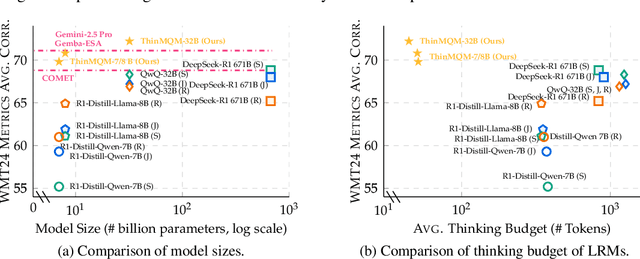
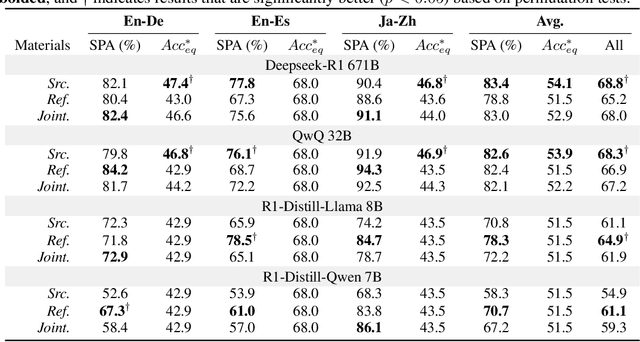
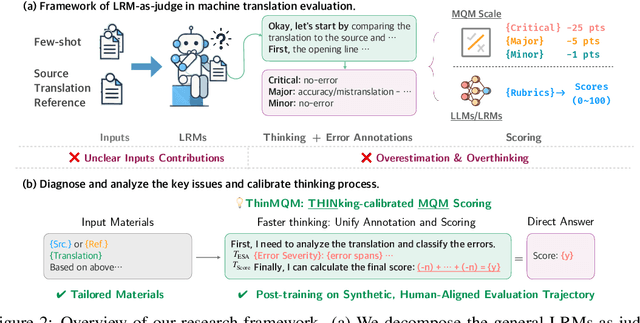
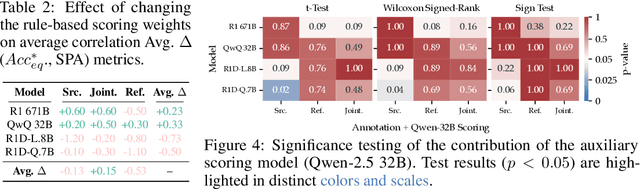
Recent advancements in large reasoning models (LRMs) have introduced an intermediate "thinking" process prior to generating final answers, improving their reasoning capabilities on complex downstream tasks. However, the potential of LRMs as evaluators for machine translation (MT) quality remains underexplored. We provides the first systematic analysis of LRM-as-a-judge in MT evaluation. We identify key challenges, revealing LRMs require tailored evaluation materials, tend to "overthink" simpler instances and have issues with scoring mechanisms leading to overestimation. To address these, we propose to calibrate LRM thinking by training them on synthetic, human-like thinking trajectories. Our experiments on WMT24 Metrics benchmarks demonstrate that this approach largely reduces thinking budgets by ~35x while concurrently improving evaluation performance across different LRM scales from 7B to 32B (e.g., R1-Distill-Qwen-7B achieves a +8.7 correlation point improvement). These findings highlight the potential of efficiently calibrated LRMs to advance fine-grained automatic MT evaluation.
ExGRPO: Learning to Reason from Experience
Oct 02, 2025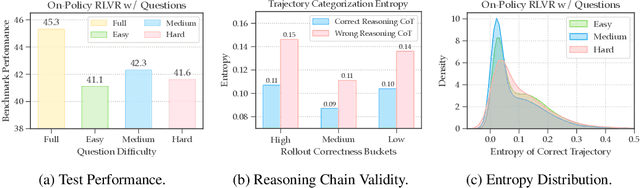
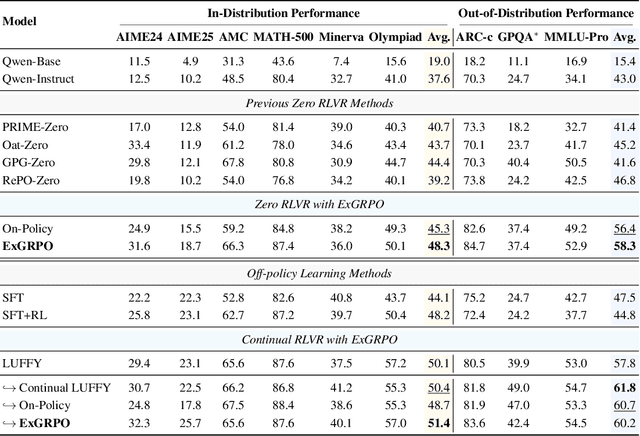
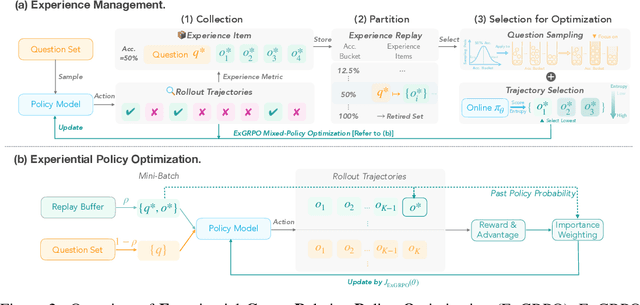
Reinforcement learning from verifiable rewards (RLVR) is an emerging paradigm for improving the reasoning ability of large language models. However, standard on-policy training discards rollout experiences after a single update, leading to computational inefficiency and instability. While prior work on RL has highlighted the benefits of reusing past experience, the role of experience characteristics in shaping learning dynamics of large reasoning models remains underexplored. In this paper, we are the first to investigate what makes a reasoning experience valuable and identify rollout correctness and entropy as effective indicators of experience value. Based on these insights, we propose ExGRPO (Experiential Group Relative Policy Optimization), a framework that organizes and prioritizes valuable experiences, and employs a mixed-policy objective to balance exploration with experience exploitation. Experiments on five backbone models (1.5B-8B parameters) show that ExGRPO consistently improves reasoning performance on mathematical/general benchmarks, with an average gain of +3.5/7.6 points over on-policy RLVR. Moreover, ExGRPO stabilizes training on both stronger and weaker models where on-policy methods fail. These results highlight principled experience management as a key ingredient for efficient and scalable RLVR.
Exposing the Cracks: Vulnerabilities of Retrieval-Augmented LLM-based Machine Translation
Oct 01, 2025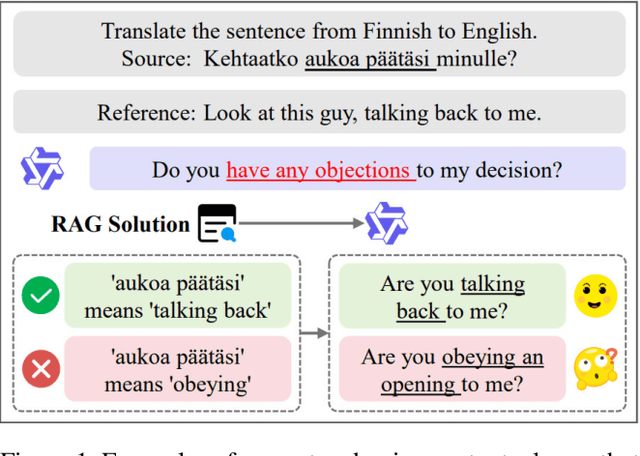
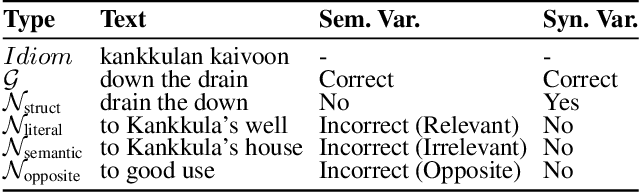
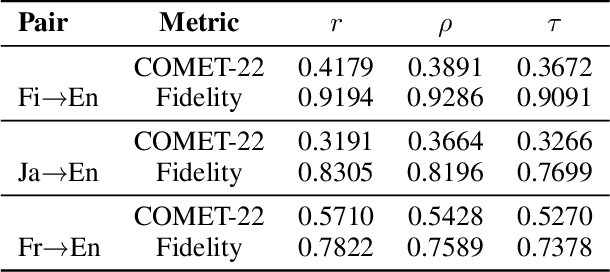
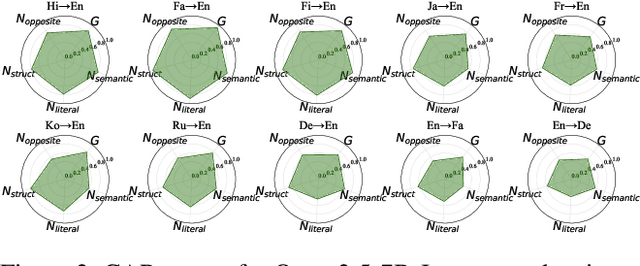
\textbf{RE}trieval-\textbf{A}ugmented \textbf{L}LM-based \textbf{M}achine \textbf{T}ranslation (REAL-MT) shows promise for knowledge-intensive tasks like idiomatic translation, but its reliability under noisy retrieval contexts remains poorly understood despite this being a common challenge in real-world deployment. To address this gap, we propose a noise synthesis framework and new metrics to evaluate the robustness of REAL-MT systematically. Using this framework, we instantiate REAL-MT with Qwen-series models, including standard LLMs and large reasoning models (LRMs) with enhanced reasoning, and evaluate their performance on idiomatic translation across high-, medium-, and low-resource language pairs under synthesized noise. Our results show that low-resource language pairs, which rely more heavily on retrieved context, degrade more severely under noise than high-resource ones and often produce nonsensical translations. Although LRMs possess enhanced reasoning capabilities, they show no improvement in error correction and are even more susceptible to noise, tending to rationalize incorrect contexts. We find that this stems from an attention shift away from the source idiom to noisy content, while confidence increases despite declining accuracy, indicating poor calibration. To mitigate these issues, we investigate training-free and fine-tuning strategies, which improve robustness at the cost of performance in clean contexts, revealing a fundamental trade-off. Our findings highlight the limitations of current approaches, underscoring the need for self-verifying integration mechanisms.
Synthesizing Sheet Music Problems for Evaluation and Reinforcement Learning
Sep 04, 2025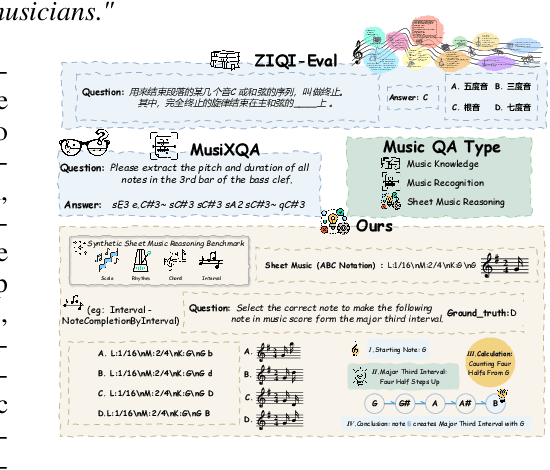
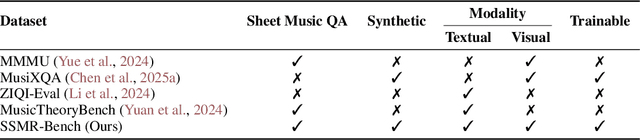
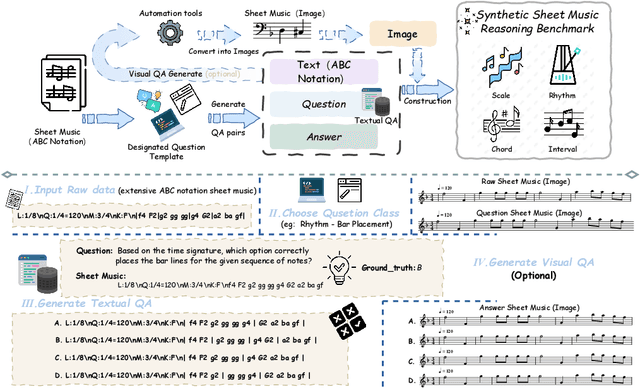
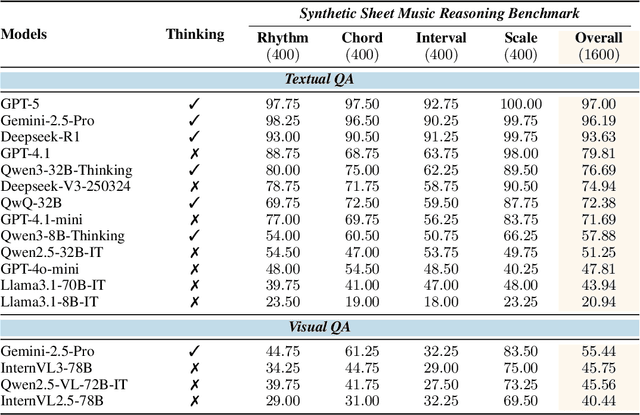
Enhancing the ability of Large Language Models (LLMs) and Multimodal Large Language Models (MLLMs) to interpret sheet music is a crucial step toward building AI musicians. However, current research lacks both evaluation benchmarks and training data for sheet music reasoning. To address this, we propose the idea of synthesizing sheet music problems grounded in music theory, which can serve both as evaluation benchmarks and as training data for reinforcement learning with verifiable rewards (RLVR). We introduce a data synthesis framework that generates verifiable sheet music questions in both textual and visual modalities, leading to the Synthetic Sheet Music Reasoning Benchmark (SSMR-Bench) and a complementary training set. Evaluation results on SSMR-Bench show the importance of models' reasoning abilities in interpreting sheet music. At the same time, the poor performance of Gemini 2.5-Pro highlights the challenges that MLLMs still face in interpreting sheet music in a visual format. By leveraging synthetic data for RLVR, Qwen3-8B-Base and Qwen2.5-VL-Instruct achieve improvements on the SSMR-Bench. Besides, the trained Qwen3-8B-Base surpasses GPT-4 in overall performance on MusicTheoryBench and achieves reasoning performance comparable to GPT-4 with the strategies of Role play and Chain-of-Thought. Notably, its performance on math problems also improves relative to the original Qwen3-8B-Base. Furthermore, our results show that the enhanced reasoning ability can also facilitate music composition. In conclusion, we are the first to propose the idea of synthesizing sheet music problems based on music theory rules, and demonstrate its effectiveness not only in advancing model reasoning for sheet music understanding but also in unlocking new possibilities for AI-assisted music creation.